Tags: GEICO / Warren Buffett / History
This fanpage is not officially affiliated with Berkshire Hathaway: Disclaimer
Fifty years ago this spring, a 43-year-old actuary named John J. "Jack" Byrne walked into a District of Columbia insurance company three weeks from the graveyard. GEICO was carrying a $126 million net loss for 1975 — its first losing year in 36 years1 — its stock had collapsed from a 1972 peak of $61 to roughly $21, and a stubborn DC Insurance Superintendent named Max Wallach had given the board until late June 1976 to produce a rescue plan or face liquidation1. One spring evening at Katharine Graham's Georgetown house, Byrne met a 45-year-old investor from Omaha. The next morning, that investor placed a block order for about $4 million of GEICO common stock at roughly $2 a share1. He would later call that $47 million eventual half-stake worth "about what you might pay today for a trophy apartment in New York."6 This is the story of how the Byrne rescue became the single most important deal Berkshire ever did without really doing one.
The Company Graham Kept
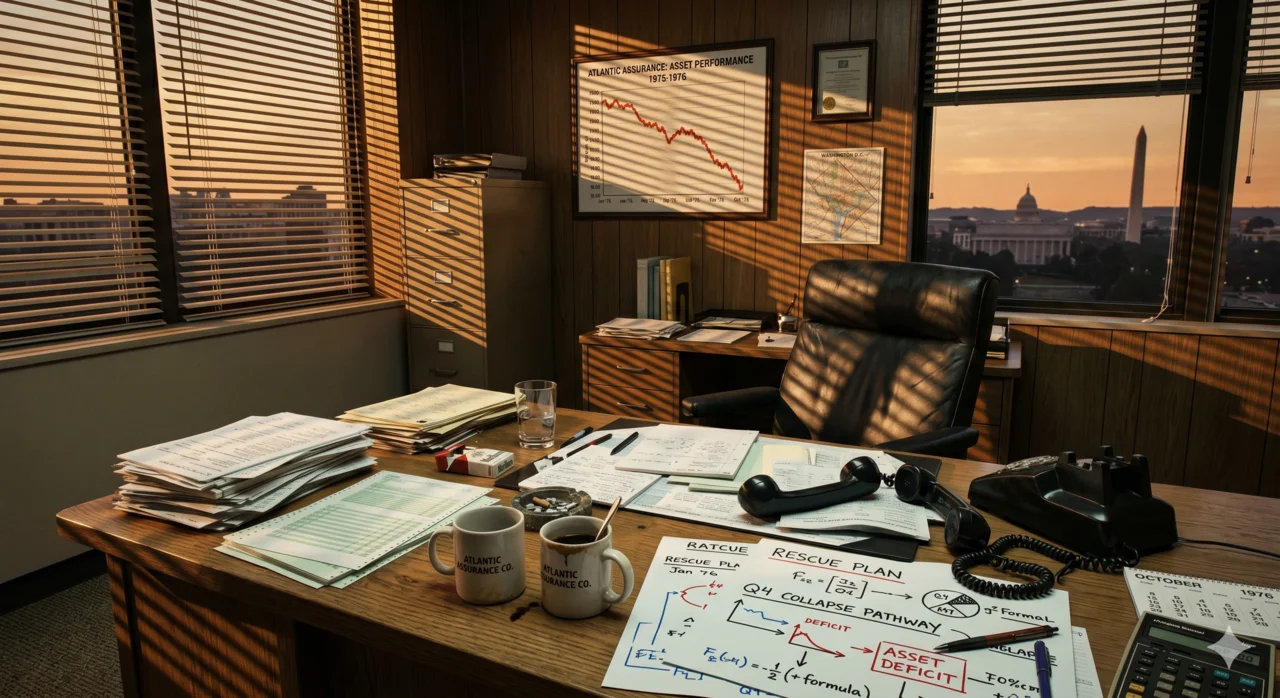
GEICO — the Government Employees Insurance Company — was founded in 1936 by Leo Goodwin Sr. with $25,000 of his own money and $75,000 from a Fort Worth banker named Cleaves Rhea. Its original niche was federal employees and top-ranked enlisted officers: a preselected low-risk pool sold direct-to-consumer by mail. By 1948, the Rhea family wanted out. Benjamin Graham's fund, Graham-Newman, bought roughly half the company for $712,000, and Graham himself took the chairman's seat — a position the SEC would shortly force him to relinquish personally, though Graham-Newman retained the stake.
The significance of that detail was not lost on a 20-year-old Columbia Business School student named Warren Buffett. On a cold Saturday in January 1951, Buffett took the train to Washington, knocked on GEICO's locked door, and was let in by a janitor. The only person in the building was a vice president named Lorimer Davidson, who gave the young Buffett a four-hour tutorial on the economics of direct-written auto insurance. Buffett later put three-quarters of his net worth into GEICO stock, sold it too early for a $15,259 gain, and spent the next two decades watching Davidson, as CEO from 1958 to 1970, grow premiums from about $40 million to $250 million at a roughly 16% compound rate. Readers of ↗ will recognize these beats; they are the same backstory seen from the other end of the telescope.
Then Davidson retired. That is when the trouble started.
The Expansion That Broke It
The post-Davidson management — chairman David Lloyd Kreeger, president Ralph Peck, and (eventually) CEO Norman Gidden — made two fatal bets.
First, they threw open the eligibility gates. In 1973 GEICO began writing non-standard drivers: younger, blue-collar, higher-risk pools the company had spent 35 years avoiding. The theory was that computerized motor-vehicle records let GEICO screen more precisely than the old occupational filter. The practice was that GEICO did not actually have the computer systems to aggregate or analyze that data13. It was, in effect, writing worse risks with worse information.
Second, they underpriced the whole book. US inflation ran at 11.1% in 1974 and 9.1% in 1975; auto-repair costs and medical costs ran faster. Many states had just adopted no-fault rules that fundamentally changed claim mechanics. GEICO's management failed to keep rate filings in step with any of it13. The company wrote a thin $26 million profit in 1974 with reserves already inadequate. In 1975 the bill came due: a net loss of $126 million — with a pre-tax underwriting loss pegged by Alice Schroeder at roughly $190 million1. The dividend was cut1. The stock chart looked like a ski slope.
| Metric | Peak (1972–73) | Nadir (spring 1976) |
|---|---|---|
| GEICO share price | ~$611 | ~$21 |
| Net income / (loss) | +$26M (1974)13 | ($126M) (1975)1 |
| Capital surplus | ~healthy | ~$25M1 |
| Loss-generating policies on book | — | 2.3 million6 |
| Employees | ~7,0007 | ~7,000 (pre-cuts) |
Buffett himself had flagged the reserves the year before. In 1975, on one of his Washington Post board trips, he stopped by Gidden's office. "It was clear in a sixty-second examination that the company was far underreserved and the situation was getting worse," Buffett told Schroeder. Gidden "sort of hustled me out of the office and would not respond on the subject."1 Deep denial ran all the way down.
April 1976: The Statler Hilton
The annual meeting that April, at Washington's Statler Hilton, turned into something between a court-martial and a riot. About four hundred shareholders turned up armed with questions, accusations, and, in at least some accounts, raised voices1. Shortly afterward the insurance commissioners arrived "in a squadron" at GEICO's offices1. Gidden's frantic search for fresh capital was going nowhere.
Enter Max Wallach, District of Columbia Superintendent of Insurance. An old-school German immigrant whose thick accent Byrne would later recall with affection, Wallach was — in Byrne's own words — "stubborn as hell, and he had this enormous interest in serving the public."1 He had refused to engage with Gidden's management. But he held the card that mattered: the power to liquidate GEICO. He gave the board a deadline of late June 1976 to assemble (a) a reinsurance consortium that would absorb a chunk of GEICO's book and (b) a fresh capital raise. Without both, he would shut GEICO down1.
With no sitting CEO, a Cravath, Swaine & Moore partner on the board named Sam Butler effectively ran the company as interim chief while the search for a real one began1. It is instructive to pause here: Berkshire's whole subsequent half-century rested on the next hire.
Byrne's Five-Hour Pitch
Butler knew that Jack Byrne had recently quit Travelers after being passed over for CEO — and that Byrne had, two years earlier, rescued Travelers' home and auto lines from a similar mess1. Byrne was 43, Rutgers-and-Michigan mathematics, Air Force veteran, a Fellow of the American Academy of Actuaries10, the kind of insurance operator who had become a millionaire in his twenties by starting a company of his own1.
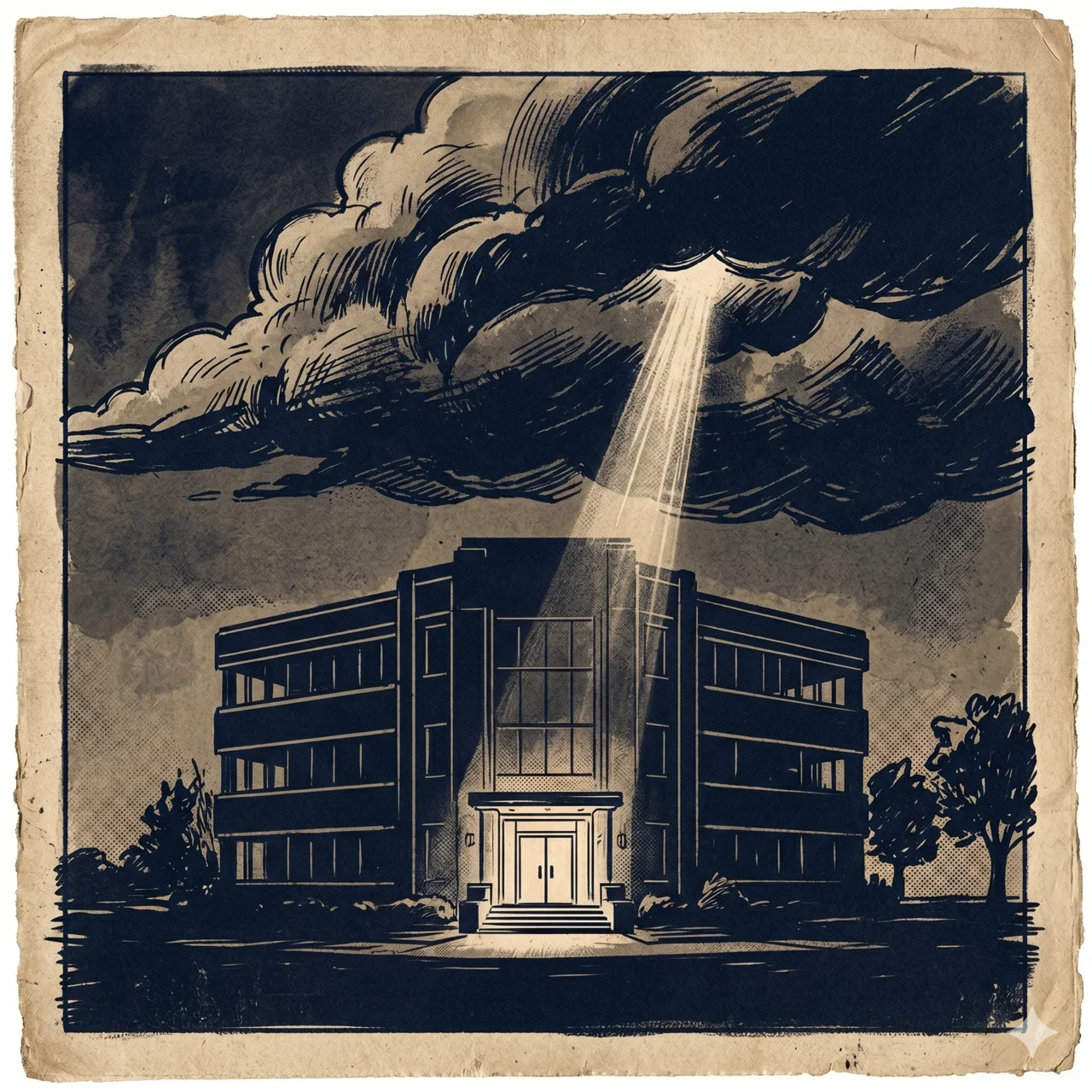
Early in May 1976 Byrne flew to Washington and, by his own telling, "pogo-sticked back and forth before the board, tearing through white flip-chart pages… I came in and gave a sort of off-the-cuff five-hour blah, blah, blah, here's five points, here's what we have to do, boom boom boom speech."1 The board hired him. Three weeks in, he was sure he had made the biggest mistake of his life. His wife Dorothy, he told Schroeder, was up in Hartford "crying and crying and crying. We had just moved for the nineteenth time."1
Operation Bootstrap
What Byrne rolled out that summer was not one plan but three stacked on top of each other — Operation Bootstrap (internal repair), the reinsurance consortium (external risk transfer), and a capital raise. The Bootstrap component looks, in retrospect, like a masterclass in insurance underwriting discipline dressed up as corporate triage.
The quick-action summary:
- Rate increases across the remaining book, including a 35% jump in New York alone, granted fast1. Elsewhere, rates went up to roughly 40%9.
- Roughly 40% of customers not renewed — out of a 2.3 million-policy book, nearly a million policies cut loose1.
- Withdrawal from all but seven states plus DC1. New Jersey's exit was the theatrical set piece: after a meeting with the state insurance commissioner went badly, Byrne drove back to the office with tires screeching, sent telegrams to 30,000 New Jersey policyholders canceling their insurance, and fired 2,000 New Jersey employees in a single afternoon1.
- Half of GEICO's profitable life-insurance affiliate sold to raise cash1.
- Workforce cut from about 7,000 to roughly 4,000, and roughly 100 offices closed79.
- Expense discipline right down to the mundane: the executive dining room closed, bill paper reduced in size to cut postage8.
Byrne's famous chef-hat story belongs somewhere in here — if staff hit their sales targets, he pledged to cook them Irish dinners, colcannon included, and if they failed, they would have to carry his 240-pound frame through the office in a sedan chair1. A young underwriter named Tony Nicely, then in his twenties, later described Byrne as "unmerciful on me… But he taught me to think of the business as a whole, not separate functions like underwriting or investing. I learned the importance of a disciplined balance sheet."1 Nicely would run GEICO from 1993 to 2018.
The Consortium and the Salomon Lifeline
Wallach did his part by personally phoning insurance executives across the country for weeks, persuading 27 reinsurers to absorb a quarter of GEICO's book in return for sliding commissions112. Two refusals became part of the folklore. State Farm's Ed Rust Sr. told Byrne he would pay $100 million to cover GEICO's claims if that put the upstart out of business, because "they have a better mousetrap, and killing GEICO will save us money in the long run."1 Travelers, Byrne's old employer, simply declined — "wussy about it," in his words1. USAA's General Robert McDermott wrote the opposite kind of letter, the one that saved the deal. "In the military we never leave people behind; we have a fallen eagle here," ran the spirit of it1. The consortium held.
The capital raise was the other leg. No investment bank would touch it except John Gutfreund's Salomon Brothers, which agreed to underwrite a $76 million convertible preferred stock offering alone, with no syndicate partners1. The offering came with an SEC consent decree in which GEICO neither admitted nor denied that it had failed to disclose its losses to shareholders1. Gutfreund's condition, delivered pointedly to Sam Butler in front of Byrne: "I will do this underwriting. I feel you've got the right guy, but you've got to keep him quiet."1 Buffett took a quarter of the offering — roughly $19 million in convertible preferred1.
Within weeks the common stock quadrupled from $2 to around $81. The reinsurance pact itself — having done its job — would be wound down by June 30, 197812.

Buffett's $4M Morning Order
Step backward to the decisive scene. One evening in June 1976, after a Washington Post board dinner, Katharine Graham arranged for Buffett to meet Byrne at her Georgetown house. They sat by the fireplace in her high-ceilinged library. Byrne was, in Schroeder's phrase, "red-faced, effervescent, forty-three years old, like a firecracker exploding."1 He babbled. Buffett asked how he planned to stay out of insolvency and what came after that1. On the way out, Buffett told Don Graham: "It could go completely out of business. But in insurance it's very hard to get an edge, and they have an edge. If they got the right person in to run it, I think he could turn it around."1
The next morning Buffett called Berkshire's trader Bill Scott and placed an order for half a million shares. Scott assembled a large block trade — roughly $4 million of GEICO common at around $2 a share1. Buffett told the lawyer George Gillespie that day: "it's pretty uncharacteristic of me, but today I bought some stock that really might be worthless tomorrow."1
It was not, of course. And the math of what happened next is the most instructive part of the whole episode.
The Silent Compounding: 33% to 50%
Buffett kept buying in 1976 — common through the block trade, preferred through the Salomon offering, more common through 1980 — and stopped there. The 1995 Chairman's Letter states the numbers plainly: "By yearend 1980, Berkshire had invested $45.7 million and owned 33.3% of GEICO's shares. During the next 15 years, Berkshire made no additional purchases."4 The stake nevertheless climbed to roughly 50% because GEICO spent those 15 years repurchasing its own stock.
That is the lesson. When a well-run business returns capital to shareholders via buybacks, a patient fixed-share holder's percentage ownership rises automatically. No brokerage tickets. No tax friction. No press releases. By yearend 1995 Berkshire's $45.7 million (Buffett would round it to $47 million in his 2018 letter6) was worth approximately $2.4 billion14 — a roughly 50-fold mark. The 1996 ↗ $2.3 billion buyout of the remaining 49% merely cashed out the public shareholders; Berkshire's half had been earned, quietly, over two decades.
Byrne himself left GEICO in mid-1985 to run Fireman's Fund3, leaving Bill Snyder as chairman and Lou Simpson as vice-chairman. In that year's letter Buffett wrote the one sentence that still stands: "Jack's performance in reviving GEICO from near-bankruptcy was truly extraordinary, and his work resulted in enormous gains for Berkshire… We are equally indebted to Jack for an achievement that eludes most outstanding leaders: he found managers to succeed him who have talents as valuable as his own."3
By 1983 GEICO's combined ratio stood at 96 versus an industry average of 111 — roughly 15 points of operational advantage, compounding every year13. Byrne went on to turn around Fireman's Fund, take it public in the largest US IPO of 1985, spin it into what became White Mountains Insurance Group, and operate for another 22 years before retiring in 200710. He died in 2013 at 808.
2026: The Byrne Playbook Returns
Fifty years is long enough for a rhyme. Beginning in 2021 GEICO once again lost pricing discipline — this time against Progressive's telematics lead during the COVID-era cost spike — and in 2022 ran a $1.9 billion underwriting loss15. The response, executed by then-CEO Todd Combs, looked eerily familiar: cumulative premium increases in the 40% range, roughly 14,000 of 47,000 employees let go, 600 legacy applications shuttered, policies-in-force allowed to shrink by about 20%, market share sacrificed for rate adequacy. By 2024, GEICO was back to $7.8 billion in pre-tax underwriting profit16. The full version of that story is set out in ↗ and ↗, but the playbook is straight out of May 1976.
| Dimension | Byrne (1976–80) | Combs (2022–24) |
|---|---|---|
| Crisis trigger | Underreserved, underpriced, non-standard book13 | Telematics lag, COVID claim shock |
| Peak loss | $126M net loss, 19751 | $1.9B underwriting loss, 202215 |
| Workforce cut | ~3,000 of 7,000 (~43%)7 | ~14,000 of 47,000 (~30%) |
| Cumulative rate action | Up to 40%9 | ~40% 2021–24 |
| Market-share sacrifice | ~40% of policies dropped1 | ~20% policies-in-force decline |
| Return to profit | Q1 1977 underwriting profit | $7.8B underwriting profit, 202416 |
Conclusion
It is tempting, on a round-number anniversary, to package 1976 as a single heroic hire. The real lesson is narrower and more useful. GEICO in 1975 did not fail because of bad luck; it failed because a management that had inherited a direct-distribution cost moat decided that moat was now wide enough to let underwriting discipline slip. The rescue worked because Byrne understood the cost moat was the only thing that made GEICO worth saving — the 1976 Buffett memo on GEICO put it in three lines: "(i) an extremely large business, (ii) a more or less homogenous product, and (iii) a very large gap in operating costs."2 Everything Byrne did — the rate hikes, the policy cancellations, the New Jersey exit, the expense eradication down to the bill-paper size — was in service of protecting line (iii).
Buffett's $47 million half-stake reached $2.4 billion not because GEICO grew fast, but because a fixed-share holder compounded alongside two decades of buybacks from a company that had rebuilt its cost discipline under threat of liquidation. The ↗ Rickershauser piece captures the Berkshire half of 1975; this one is the GEICO half. Together they suggest how much of Berkshire's eventual insurance franchise was assembled in a 12-month window most of the rest of Wall Street was spending trying to forget.
And the playbook, as the 2022–24 episode showed, does not expire. Cost moats in commodity insurance last precisely as long as the discipline behind them — which is to say, until the next management persuades itself that the moat is doing the work. Somewhere in that recurring mistake is the reason GEICO was worth rescuing in 1976, and the reason it keeps being worth rebuilding.
References
-
Schroeder, Alice. The Snowball: Warren Buffett and the Business of Life (2008), chapter on GEICO 1975–76 - amazon.com ↩↩↩↩↩↩↩↩↩↩↩↩↩↩↩↩↩↩↩↩↩↩↩↩↩↩↩↩↩↩↩↩↩↩↩↩↩
-
1976 Buffett letter on GEICO, excerpt - futureblind.com ↩
-
Berkshire Hathaway 1985 Chairman's Letter - berkshirehathaway.com ↩↩
-
Berkshire Hathaway 1995 Chairman's Letter - berkshirehathaway.com ↩
-
Berkshire Hathaway 1996 Chairman's Letter - berkshirehathaway.com ↩
-
Berkshire Hathaway 2018 Annual Letter (Buffett on GEICO) - berkshirehathaway.com ↩↩
-
Jack Byrne biography - insurancehalloffame.org ↩
-
Jack Byrne obituary, March 2013 - bostonglobe.com ↩↩
-
Jack Byrne obituary - sltrib.com ↩↩
-
Jack Byrne, insurance turnaround specialist, dies at 80 - carriermanagement.com ↩↩
-
Insurance industry mourns Jack Byrne - insurancejournal.com ↩
-
"A Miracle on Wall Street" December 4, 1977 - washingtonpost.com ↩↩
-
Cunningham, Lawrence. Berkshire Beyond Buffett (2014) - amazon.com ↩↩↩
-
Daily, Daniel & Johnson, Corey. University of Berkshire Hathaway (2018) - amazon.com ↩
-
Berkshire Hathaway 2022 Annual Report, p. K-34 (GEICO pre-tax underwriting loss $1,880M) - berkshirehathaway.com ↩
-
Berkshire Hathaway 2024 Annual Report (GEICO pre-tax underwriting earnings $7,813M) - berkshirehathaway.com ↩