Tags: Warren Buffett / Greg Abel / History
This fanpage is not officially affiliated with Berkshire Hathaway: Disclaimer
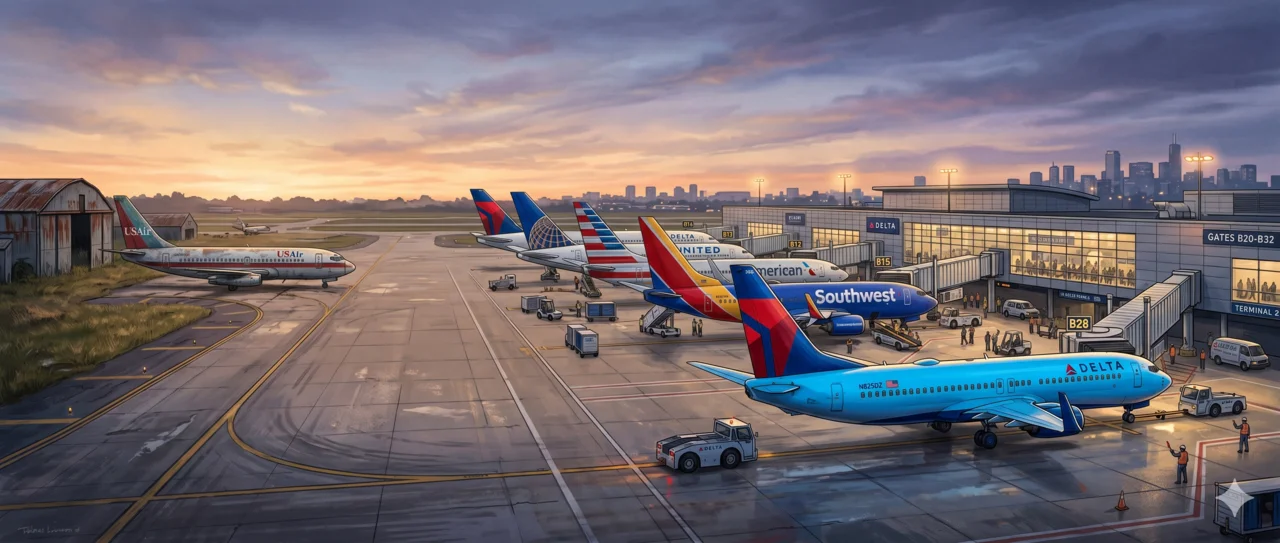
When Berkshire Hathaway filed its first-quarter 2026 13F on May 15, sell-side airline analysts read it as a vindication. Six years after Warren Buffett liquidated the entire four-airline portfolio in the early panic days of COVID and told the 2020 annual meeting "I made a mistake in that business," his successors are back — with 39,809,456 shares of Delta Air Lines, a $2.65 billion position carrying 6.1% of the carrier's outstanding shares.1 Read carefully, though, this is not the same trade Berkshire made in 2016, and the company is not buying what it bought then. It is buying a loyalty franchise that happens to fly planes — and the three airline acts Berkshire has now staged over thirty-seven years trace an evolution in what "investing in airlines" even means.
Introduction
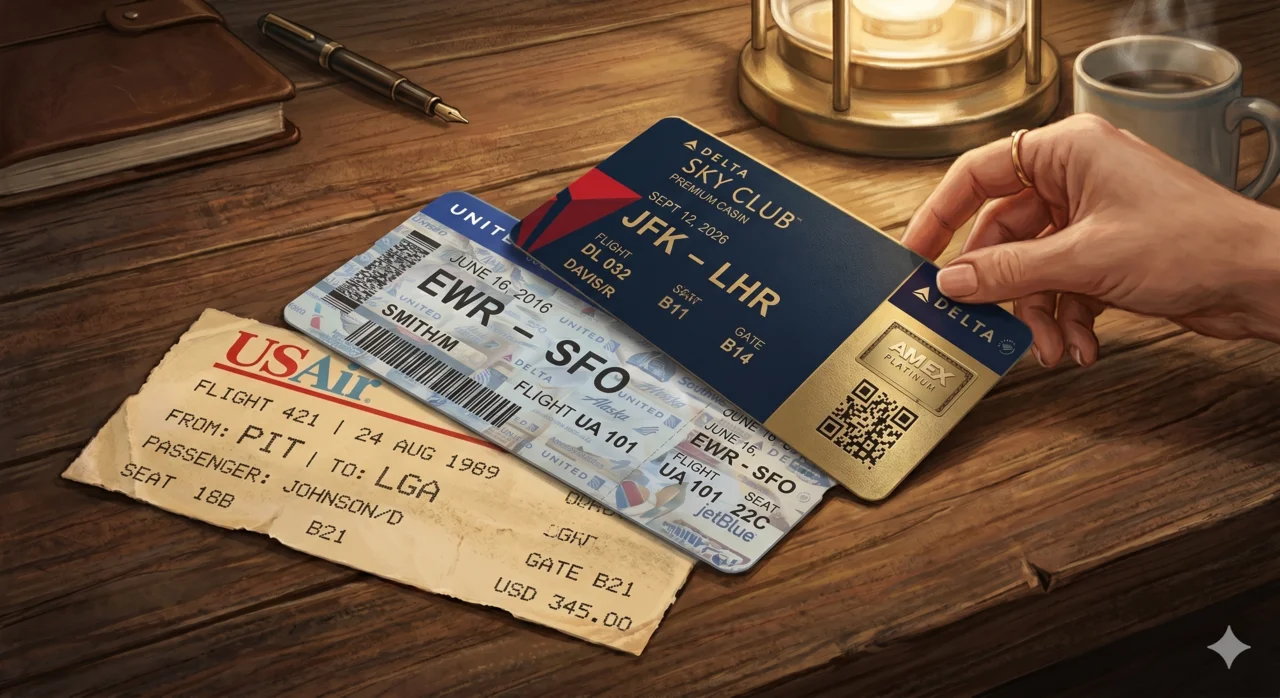
Three times since 1989, Berkshire has put real money into the U.S. domestic airline industry. The first was a $358 million convertible-preferred stake in USAir at 9.25% — an "unforced error," as Buffett would label it in the 1990 letter, on a carrier whose costs were both high and impossible to lower fast enough.2 The second was the 2016 build of a four-airline common-stock basket (Delta, United, American, Southwest), accumulated through 2019 to a peak aggregate market value of roughly $8.6 billion.3 The third — and the subject of this piece — is the May 2026 reappearance of a single name, Delta, at a position size that says less about what Berkshire thinks of airlines than about how it now thinks about consumer loyalty.
The three encounters look, on the surface, like Berkshire making the same mistake with diminishing self-awareness. The 2016 basket cost roughly $7-8 billion to build. Berkshire exited it in April 2020 at average prices in the $24-25 range against an average cost closer to $45 — a multi-billion-dollar realized loss at almost exactly the worst possible moment of the cycle.9 Six years later, here we are again, with the stock at $70 and Berkshire holding.
Yet the three acts are not the same act. The instrument is different (preferred, then a basket of common, then a single concentrated common). The decision-maker is different (Buffett alone, Buffett plus Combs/Weschler, now Weschler-or-Abel — the CIO structure changed in 2025 when Todd Combs moved to GEICO as CEO). And, most importantly, the asset Berkshire is buying when it buys Delta in 2026 is structurally not the asset it bought when it bought four airlines in 2016. That is what this piece is about.
For the 1989 USAir story in full, see our earlier piece ↗. The shape of the 1989 disaster — preferred suspended in 1994, written to twenty-five cents on the dollar, salvaged only at the 1998 redemption — is the baseline against which both subsequent acts should be read.
Three Acts at the Same Well
The cleanest way to see the evolution is in a side-by-side. Each act has a different instrument, a different size, a different actor, and — Buffett's stated rationale shifting across all three — a different lesson.
| 1989 USAir | 2016-2020 Big Four basket | 2026 Q1 Delta | |
|---|---|---|---|
| Instrument | Convertible preferred, 9.25% | Common stock, four carriers | Common stock, one carrier |
| Entry size | $358M2 | ~$7.5B aggregate cost basis3 | $2.65B1 |
| % of equity book at peak | n/a (preferred, not common) | ~3.5% (12/31/2019)7 | 1.01% (3/31/2026)1 |
| Decision-maker | Buffett alone | Buffett + Combs/Weschler input | Weschler-or-Abel (Combs at GEICO)8 |
| Outcome | Dividend suspended Sept 1994; written to 25¢; redeemed at par March 1998; $240M dividends collected over life4 | April 2020 exit at ~$24-25 avg vs ~$45 cost; multi-billion realized loss9 | Open position; 6.1% Delta stake disclosed on Schedule 13G18 |
| Stated lesson | "Unforced error" (1990); "Orville should have failed at Kitty Hawk" (1992)2,3 | "I made a mistake in that business" (May 2020 annual meeting) | None — no 8-K, no annual meeting reference, no letter |
A few things jump off the table. The size of the bet has actually shrunk as a percentage of Berkshire's then-equity-portfolio in every successive act. The 1989 USAir preferred was a meaningful single position. By 2019 the entire four-airline common-stock basket had grown to about 3.5% of the equity book. The 2026 Delta-only position is just over 1% of a $263 billion 13F portfolio. That is not a high-conviction return to a well; that is a probe.
The instrument arc is also telling. In 1989 Buffett took preferred — the Buffett of that era was already suspicious enough of the airline business to insist on a coupon and a redemption right. The 2016 basket was common stock, the entire structure of the bet implying that the cyclical-ruinous-economics view had been replaced by an industry-consolidation thesis: buy the top four after the post-2008/2010/2011/2013 mergers had finally created a domestic oligopoly. The 2026 position is again common, but it is one name, not four — meaning whatever the current thesis is, it is no longer "the industry consolidated, the cycle is tamer." It is, specifically, "Delta."
The "stated lesson" column is where the 37-year vocabulary shift is loudest. In 1990 Buffett wrote that the USAir mistake was "an unforced error" — borrowing tennis parlance to describe a position no one had pushed him into.2 In 1992 he produced the most-quoted single sentence on airlines in his entire body of work: "For these investors, it would have been far better if Orville had failed to get off the ground at Kitty Hawk: the more the industry has grown, the worse the disaster for owners."3 In 1994 he doubled down on the self-indictment after the dividend was suspended: "I was neither pushed into the investment nor misled by anyone. Before this purchase, I simply failed to focus on the problems that would inevitably beset a carrier whose costs were both high and extremely difficult to lower."4 In 2020 he told the May annual meeting "I made a mistake in that business" and walked away from $8 billion of common stock at the bottom of the cycle. In 2026 the company has said nothing at all. The Q1 13F is the only disclosure. No annual letter postmortem (the 2025 letter predated the buy), no annual-meeting reference (the May 2 meeting predated the 13F filing), no 8-K. The language has gone from indictment to apology to silence — which usually means the bet has been delegated to hands whose names don't go on the cover of the letter.
The Survivor Test: Why Delta Specifically
If 2020 was a thesis change, it was the right thesis change. The Big Four did not cure airlines. The 2025 financial divergence between the four carriers Berkshire held in the 2016 build tells that story in one table.
| Metric (2019 → 2025) | Delta | United | American | Southwest |
|---|---|---|---|---|
| Revenue ($B) | 47.0 → 63.410 | 43.2 → 59.116 | 45.8 → 54.615 | 22.4 → 28.117 |
| Operating margin | 14.1% → 9.2% | 9.1% → 8.0% | 4.9% → 2.7% | 13.2% → 1.5% |
| Free cash flow ($B) | 4.2 → 4.6 | n/d → 2.6 | n/d → (0.7) | 2.9 → (0.8) |
| Loyalty / co-brand revenue ($B) | 4.1 → 8.213 | 2.0 → 3.2 | n/d → 5.6 | n/d → ~3.2 |
The 2019 column shows what Berkshire was actually buying when it built the 2016 basket: four companies that all carried double-digit or high-single-digit operating margins, all generated positive free cash flow, and all had manageable balance sheets. The 2025 column shows what survived the 2020-2024 stress test. Delta did. The other three did not.
American Airlines is carrying $30.7 billion of net debt as of year-end 2025 and produced negative free cash flow that year15 — a worse balance sheet than the post-bankruptcy carrier of 2014. Southwest, the once-pristine balance sheet of the industry, also burned cash in 2025 and its operating margin fell from 13.2% in 2019 to 1.5%.17 United sits in the middle — positive cash flow, single-digit margin, but no operating-margin progress against 2019. Only Delta has come through the cycle structurally better than it went in: operating margin still respectable, free cash flow at $4.6 billion (higher than 2019's $4.2 billion), net debt down from $17 billion to $14.3 billion.10 The headline 2025 operating margin (9.2% GAAP) is below 2019's 14.1%, but the revenue base is half again as large, so absolute earnings power has roughly doubled.
Delta in 2026 generates more free cash flow alone than the other three Big Four carriers combined. This is the survivor that Berkshire bought. It is not buying the cyclical recovery of the industry — the industry has not recovered. It is buying the one carrier that has demonstrated something the other three have not.
SkyMiles: A Loyalty Business That Flies Planes
The "something" is the part that fails the obvious-coverage test. Most of the financial-press write-ups of the Berkshire-buys-Delta 13F treated the position as a thesis change on airlines. Read Delta's own disclosures and that framing falls apart. Delta in 2026 is structurally not an airline in the Buffett-1992 sense any longer; the marginal dollar of profit is increasingly generated not by selling main-cabin seats but by selling premium-cabin upsells and, especially, by the SkyMiles loyalty franchise and its American Express co-brand.
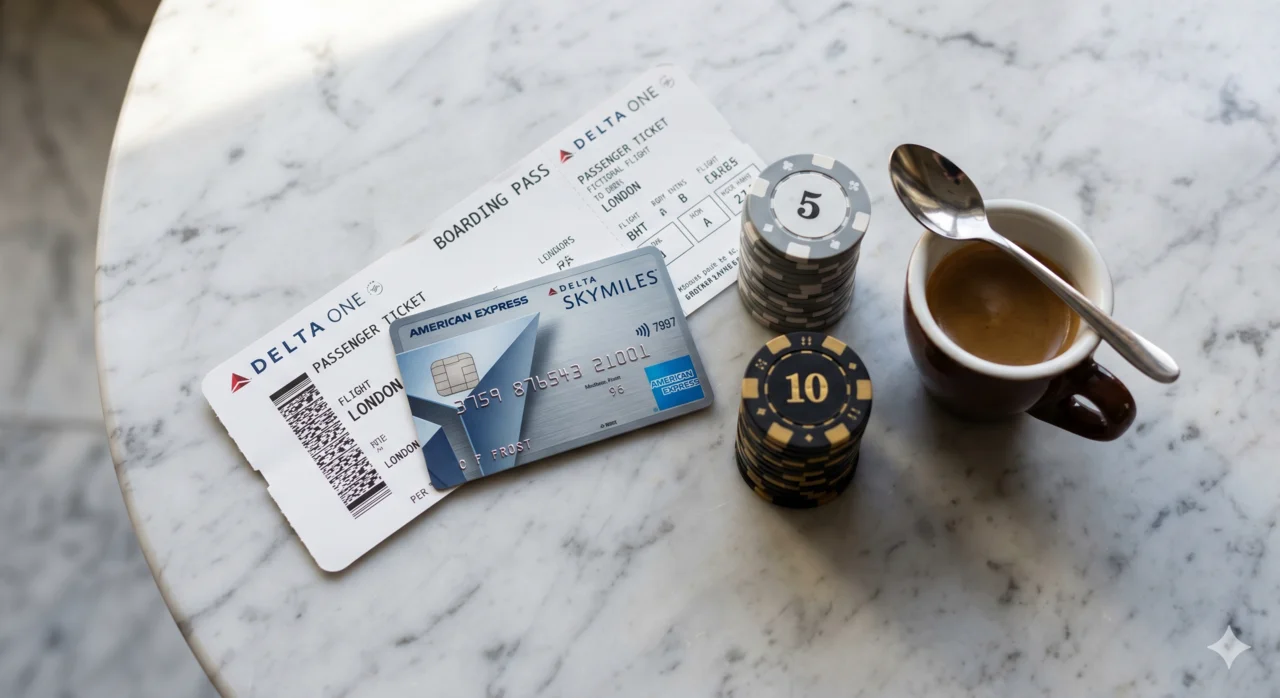
Three numbers tell that story.
First, the annual cash Amex pays Delta under the co-brand partnership. In 2019 that figure was $4.1 billion. In 2022 it was $5.5 billion, in 2023 $6.8 billion, in 2024 $7.4 billion, in 2025 $8.2 billion. The growth was nearly linear through COVID. Q1 2026 alone ran above $2 billion — annualizing comfortably north of $8 billion.1113 This is not airline revenue. It is a cut of every dollar Delta-branded cardholders spend at Amazon, the supermarket, and the gas station. Ed Bastian, in an April 2026 Fortune profile, was direct about what it bought Delta: "As Delta's brand started to move and people started to see it as a premium brand, as a differentiated experience, Amex was critical to that because we see Amex as the premium credit card in the business."13
Second, the standalone valuation of SkyMiles itself. On Point Loyalty's 2026 ranking of the world's most valuable airline loyalty programs put SkyMiles at $31.78 billion — the largest in the world, ahead of American's AAdvantage at $26.7 billion and United's MileagePlus at $25.3 billion.12 With Delta's enterprise value around $46 billion in mid-May 2026 (roughly 660 million shares at $70), SkyMiles alone now accounts for roughly seventy percent of the company's enterprise value. In October 2020, at the bottom of the COVID panic, Delta raised $9 billion of debt collateralized purely on SkyMiles intellectual property — when the company's entire equity market capitalization was $12-15 billion. The loyalty business has been worth more than the flying business for some time; the 13F simply put Berkshire's money on the structural fact.
Third, the mix shift inside Delta's own revenue line. In 2019 premium-cabin revenue was about 35-40% of Delta's passenger revenue. In Q4 2025, premium overtook main cabin for the first time in the company's history.14 In Q1 2026 the two were essentially tied at $5.36 billion (premium) versus $5.44 billion (main cabin) — within $80 million of each other.11 Bastian, again in the Fortune piece: "If you ask people why they choose Delta, eighty percent would say, 'Because it's Delta, because the experience, the brand, the confidence I have in that company — that's my airline.'" That is the language of consumer-staples branding, not transport-commodity pricing.
Now look at Berkshire's existing portfolio — Apple, American Express, Coca-Cola, Moody's, the four names Greg Abel highlighted as the durable core in his 2025 letter8 — and the common thread is precisely this: businesses whose pricing power comes from brand and loyalty rather than from a position on a commodity cost-curve. Delta in 2026 looks a great deal more like American Express, in whose ecosystem it is partially nested, than it does like USAir in 1989.
Buffett's Airline Vocabulary, 1989-2026

The most evergreen piece of the 2026 Delta entry is what it implies about how Berkshire has changed its operating definition of "airline" over thirty-seven years.
In the 1990 letter, when Buffett accounted for the USAir preferred, he was framing the bet as a cost-structure problem: a commodity-type product sold by carriers whose costs were impossible to lower fast enough. "In a business selling a commodity-type product," he wrote, "it's impossible to be a lot smarter than your dumbest competitor."2 The 1992 letter generalized this into the Orville-at-Kitty-Hawk indictment. In neither letter does Buffett's airline vocabulary include the words "loyalty," "co-brand," "premium cabin," or "frequent flyer." He was thinking about jet fuel, labor cost, route economics, and the basic Marx-of-capitalism problem of perfect competition driving margins toward zero. The Snowball preserves the joking version of the same view: "As soon as the check cleared, the company went into the red and never came out. I have an 800 number I call and say, 'My name is Warren Buffett and I'm an Air-aholic.'"5 Charlie Munger's reaction to the deal at the time: "Warren didn't call me on that one."5
In the 2016-2019 era the vocabulary shifted, but the operative concept was still industry structure: how many competitors, how much capacity discipline, how stable the consolidation. It was a bet on the cyclical pattern improving, not on any particular carrier's brand. The 2020 letter, written after the exit, did not actually post-mortem the airline portfolio at all — Buffett used the May annual meeting to address the sale verbally, then moved on. The 2020 vocabulary was just panic: the world had changed for the airlines, and Berkshire did not know when people would fly again.
In 2026 the vocabulary is absent. Nothing in the Q1 10-Q, nothing in the 2025 letter, no commentary at the May 2 annual meeting. The silence is, in its own way, a statement: the position is small enough (1% of the 13F portfolio) and the decision-making structure has changed enough that the Delta entry is not the kind of thing a CEO of Abel's stated reluctance writes about in a letter. The asset being bought is not the asset Buffett swore off in 1990. It is being analyzed under a different framework, by different hands, with a different vocabulary that has not yet been disclosed to shareholders.
Who Bought It, And Why That Matters
Which brings us to the central tactical question of the Delta position: who pulled the trigger?
In his 2025 letter — the first written under his name — Abel was explicit about the equity-management arrangement: "At Berkshire, equity investments are fundamental to our capital allocation activities; responsibility ultimately resides with me as CEO. Ted Weschler manages about 6% of our investments, including a portion of the portfolio formerly overseen by Todd Combs."8 Todd Combs had moved to lead GEICO; for the structural context see our coverage of the GEICO turnaround in ↗. So the equity-management arrangement at Berkshire HQ as of 2026 looks like this: Ted Weschler runs roughly $15.8 billion (6% of the $263 billion 13F book), Abel retains residual authority over the rest, and there is no third named manager.
The Delta position at $2.65 billion would fit comfortably inside Ted Weschler's mandate. It is exactly the kind of size and shape — a single high-conviction name with an unusual analytical angle, in this case the SkyMiles-as-loyalty-business framing — that the Combs-Weschler hands have historically chosen. The 2016 four-airline basket itself was widely understood at the time to be a Combs/Weschler initiative on which Buffett, after some hesitation, gave the green light.
But it is equally possible that Delta is Abel's first material concentrated equity move. The position size sits exactly on the fault line between a Weschler-magnitude position and what would be Abel's first standalone bet. Abel's 2025 letter also said: "A large portion of our portfolio is concentrated in a small number of American companies such as Apple, American Express, Coca-Cola, and Moody's... This concentrated approach will continue, with limited activity in these holdings, though we may significantly adjust a holding if we see fundamental changes in its long-term economic prospects."8 The Delta entry is neither additive to that concentrated core nor a "significant adjustment" to it — it is something new, at exactly the size where attribution is genuinely ambiguous.
If the Delta position stays around $2.65 billion through the year-end 13F, it is overwhelmingly likely a Weschler position and the structural airline thesis is unchanged from 2020. If it doubles or more by Q4 2026, Abel made the call himself, and the "we don't do airlines" rule from 2020 is structurally over.
That is the watch-list item for the next twelve months. Read against the broader Abel-era backdrop — the $397 billion cash pile, the March 2026 buyback restart at 1.44× book documented in our piece on Berkshire and the high-CAPE market ↗, and the broader question raised in our coverage of ↗ about how the new CEO is actually moving equity money — the Delta position is a small, readable signal in an unusually quiet capital-allocation environment. Four 13Fs from now we will know which kind of signal it was.
Conclusion
Berkshire did not return to airlines on May 15, 2026. That is the headline that doesn't survive the data. Berkshire returned to one airline — specifically the one whose business has become structurally less airline-like over thirty-seven years and more like a branded loyalty franchise that derives roughly seventy percent of its enterprise value from a credit-card-and-premium-cabin engine. The 1989 USAir bet was a cost-structure bet that went wrong by exactly the mechanism Buffett later named. The 2016 four-airline bet was an industry-consolidation bet whose thesis was not vindicated by the 2020-2024 stress test on three of the four carriers. The 2026 Delta bet, whoever pulled the trigger, is a bet on something that did not exist as an analytical category in either of the previous two acts: a loyalty-and-premium franchise embedded inside an airline holding company.
It is, properly understood, the kind of bet Berkshire has been making for sixty years on consumer-staples names. The fact that the wrapper is an airline is incidental — or, as Bastian put it, the eighty percent of Delta passengers who fly Delta "because it's Delta" don't care about the wrapper either.
That is the small, quiet, $2.65 billion observation buried in the Q1 13F. It is not vindication of 2016 — three of the four carriers have proved the 2020 thesis correct, and probably will for years yet. It is not a reversal of 2020 — Berkshire has not reversed anything, only added one position. It is something else: an evolution in what Berkshire's airline vocabulary means, with thirty-seven years of evidence behind it. Whether the position grows depends on who pulled the trigger, and on whether the post-Buffett era's first concentrated equity move really is the airline that stopped being one.
References
-
Berkshire Hathaway 13F-HR filing, Q1 2026 - sec.gov ↩
-
Berkshire Hathaway Chairman's Letter 1990 - berkshirehathaway.com ↩↩↩
-
Berkshire Hathaway Chairman's Letter 1992 - berkshirehathaway.com ↩↩
-
Berkshire Hathaway Chairman's Letter 1994 - berkshirehathaway.com ↩
-
Alice Schroeder, The Snowball: Warren Buffett and the Business of Life - simonandschuster.com ↩↩
-
Berkshire Hathaway Chairman's Letter 1996 - berkshirehathaway.com ↩
-
Berkshire Hathaway 2019 Annual Report - berkshirehathaway.com ↩
-
Berkshire Hathaway 2025 Annual Report — Greg Abel's first chairman's letter - berkshirehathaway.com ↩↩↩
-
Berkshire Hathaway DAL transaction history - stockcircle.com ↩
-
Delta Air Lines Full-Year 2025 Results - prnewswire.com ↩
-
Delta Air Lines Q1 2026 Results - ir.delta.com ↩↩
-
SkyMiles ranked world's most valuable airline loyalty program at $31 billion - prnewswire.com ↩
-
Ed Bastian on the Amex-Delta partnership - fortune.com ↩↩
-
Delta premium-cabin revenue overtakes main cabin for first time - aviationa2z.com ↩
-
American Airlines Full-Year 2025 Results - news.aa.com ↩
-
United Airlines financial statements - stockanalysis.com ↩
-
Southwest Airlines financial statements - stockanalysis.com ↩
-
Berkshire Hathaway Schedule 13G — Delta Air Lines - stocktitan.net ↩