Tags: FlightSafety / GEICO / History
This fanpage is not officially affiliated with Berkshire Hathaway: Disclaimer
In one calendar year, Berkshire Hathaway completed two major deals that together changed what kind of company it was. The full GEICO acquisition closed on January 2, 1996 — $2.3 billion for the remaining 49% of the car insurer Buffett had been courting since he was twenty years old. Then, announced in October and closed the following February, came FlightSafety International: $1.5 billion for the world's premier pilot training school, founded by a 79-year-old former Pan Am pilot who had never sold because he had never found the right buyer. Together, the two deals mark the line between Berkshire as an insurance holding company that dabbled in operating businesses and Berkshire as an operating-business conglomerate that happened to own the most productive insurance float machine in American history.
Introduction
On a Saturday morning in January 1951, a twenty-year-old Columbia graduate student named Warren Buffett took a train from New York to Washington, found the offices of Government Employees Insurance Company locked, and knocked until a man named Lorimer Davidson let him in. Davidson, GEICO's vice president of investments, had no reason to give an unknown student four hours of his time. He did it as a courtesy to Ben Graham, whose name Buffett had dropped. In the course of that conversation, Davidson explained how auto insurance for government employees — a self-selected group of cautious, risk-averse drivers — could be written at a structural cost advantage over every competitor in the market.7
Buffett put more than half his net worth into GEICO stock at $29.375 per share and sold it a year later for $15,259, booking a modest profit and believing he had closed the chapter. Over the next twenty years, the shares he sold appreciated to roughly $1.3 million — a decision Buffett would later call one of the costliest of his life.2 He hadn't closed the chapter at all. Over the next 45 years, GEICO would occupy a permanent corner of his thinking — through its near-bankruptcy in 1975, its rescue in 1976, and two decades of partial ownership. The full buyout in 1996 was not an acquisition in the normal sense. It was the closing of a 45-year loop that began with a Saturday knock on a locked door.
GEICO at the Brink
By 1975, GEICO had wandered far from Davidson's original logic. New management had pursued policyholders outside the low-risk government-employee niche, pricing policies aggressively to capture market share and then discovering the math didn't work. The company announced a $190 million underwriting loss for 1975, and the stock fell from $61 to $2.7 Washington regulators were deciding whether to let it fail.
Jack Byrne was brought in as CEO to attempt a rescue. Buffett met him at a dinner party at Kay Graham's Georgetown house and within an evening concluded that Byrne understood insurance deeply and had the operational instincts to turn the ship. Berkshire purchased $4 million in GEICO stock near the lows; Salomon Brothers, against most expectations, underwrote a $76 million convertible preferred offering that gave the company its capital base.2 By year-end 1980, Berkshire had built its stake to 33.3% for a total cost of $45.7 million.1
The less-told part of the GEICO story is what happened over the next fifteen years. GEICO's management, focused on shareholder value, bought back enormous quantities of its own stock. Berkshire did not sell a single share. The arithmetic did the work: as GEICO's share count shrank, Berkshire's percentage rose — steadily, without spending another dollar — until by the early 1990s Berkshire owned roughly half the company for the same $45.7 million it had invested in the late 1970s.1 This is how patient capital compounds: not through activity but through the absence of it.
Closing the Book on Partnership
The negotiations for the remaining half were not easy. Buffett dispatched Charlie Munger as what he called the "Appointed Bad Guy" — the hardliner who would make Buffett seem reasonable by comparison. GEICO's lead board member, Sam Butler of Cravath Swaine & Moore, proved resistant to both the strategy and the pressure. The famous "Circular Saw" tactic — Buffett's aggressive lowball opener designed to anchor negotiations — was neutralized. Butler held firm, and Buffett, who wanted GEICO badly enough to capitulate, did.2
The deal announced in August 1995 and closed January 2, 1996: $2.3 billion in Berkshire stock for GEICO's remaining 49%.3 After spending $45.7 million for the first 51%, Berkshire paid fifty times more for roughly the same economic ownership. Buffett called the price "steep" but justified: the business Tony Nicely was running in 1996 was not the business Jack Byrne had rescued in 1976. GEICO had grown into a cost-disciplined growth machine.
The 1996 results confirmed it. Voluntary auto policies grew 10%, smashing the prior twenty-year record of 8%.1 Pre-tax underwriting profit reached $180 million.4 Profit-sharing ran at a record 16.9%, costing Berkshire $40 million, worth every cent as a retention mechanism.1 GEICO's full consolidation added roughly $2.6 billion to Berkshire's float, pushing the total to $6.702 billion by year-end.1 And the float was free: Berkshire had earned an underwriting profit on its insurance operations for four consecutive years. Borrowing at negative cost and investing in operating businesses and equities is not a secret. It is just very difficult to sustain, and GEICO at full scale was the engine that made it possible.
The Class B Subplot
While the GEICO paperwork was clearing in January, a separate problem was brewing. Boutique financial promoters had noticed that Berkshire's Class A shares — trading above $30,000 by early 1996 — were inaccessible to small investors, and were planning to market unit trusts packaged as Berkshire look-alikes. They intended to use Berkshire's track record as a sales tool while charging management fees that would guarantee worse-than-Berkshire performance for the retail investors they attracted.
Buffett, who regarded this as predatory, did something he genuinely disliked: he issued new equity. In May 1996, Berkshire created Class B shares — each worth 1/30th of a Class A and carrying 1/200th the voting power — and sold 517,500 of them at $1,000 each.9 His framing in the 1996 Chairman's Letter was blunt: "we made this sale in response to the threatened creation of unit trusts that would have marketed themselves as Berkshire look-alikes. In the process, they would have used our past, and definitely nonrepeatable, record to entice naive small investors and would have charged these innocents high fees and commissions."1
The B shares mattered more than Buffett let on at the time. When FlightSafety International shareholders were given the choice of cash or Berkshire stock in October 1996, some chose the newly liquid Class B. The instrument created to defend against copycats became partial currency for one of Berkshire's most consequential acquisitions.
Al Ueltschi and the Hamburger Deal
Albert Lee Ueltschi was born in 1917 in Kentucky, opened a hamburger stand at sixteen to fund flying lessons, joined Pan Am in 1942, and spent two decades as personal pilot to Juan Trippe, the airline's founder.6 In 1951 — the same year Buffett was in Davidson's office in Washington — Ueltschi founded FlightSafety International out of the Marine Air Terminal at LaGuardia Airport, using customer prepayments from Alcoa, Coca-Cola, and Eastman Kodak to finance his first simulators. He mortgaged his house. He kept his Pan Am salary for living expenses and plowed every dollar of profit back into the business.5
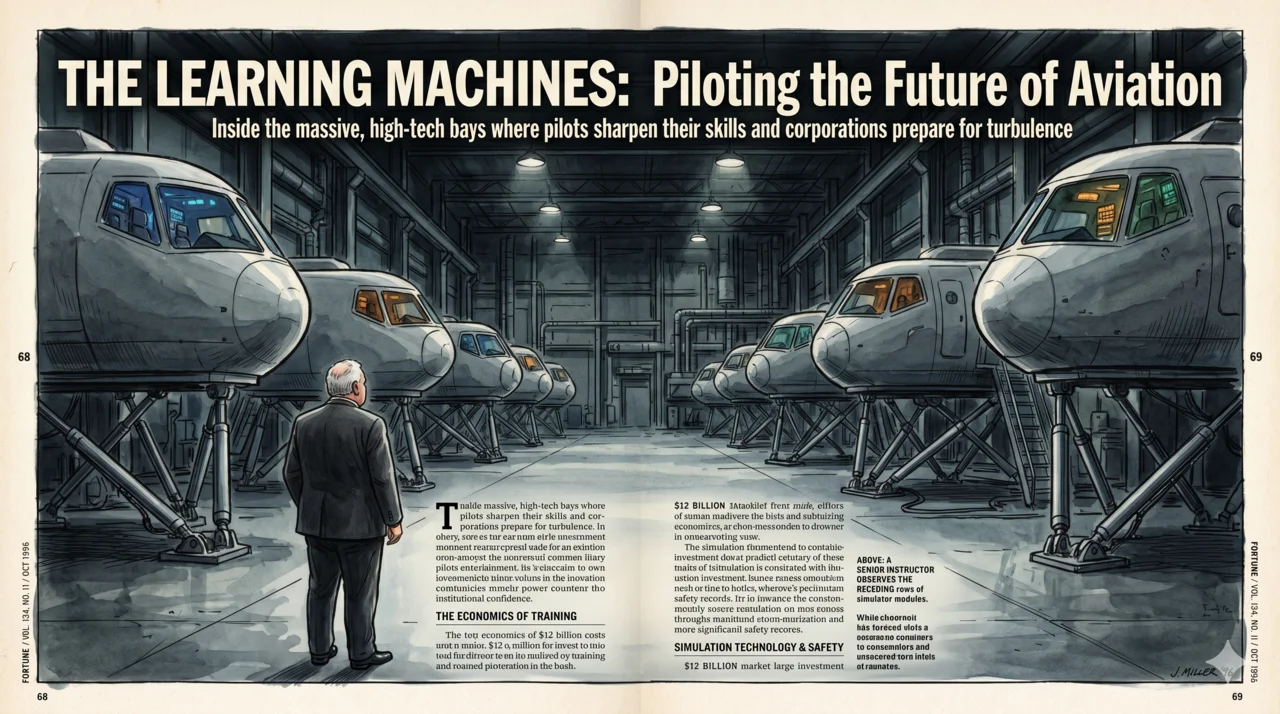
By the mid-1990s, FlightSafety had grown to 175 simulators across 41 locations, training 50,000 pilots and technicians annually for every major business aircraft manufacturer — Beechcraft, Bombardier, Cessna, Dassault, Gulfstream, Learjet.1 Each simulator cost up to $19 million.8 The business was unusually capital-hungry: roughly $3.50 of investment produced every $1 of revenue — a ratio most acquirers would find punishing, but one Berkshire could absorb on an insurance-float balance sheet without flinching.11 The structure Buffett found irresistible: a genuine moat, a long record of profitability, and a founder who had never sold because he could never find a buyer who would leave it alone. By the mid-1990s Ueltschi was approaching eighty and had a different problem — a succession vacuum that would leave FlightSafety exposed to a leveraged raider who might load it with debt, replace its managers, and carve it apart. Finding a permanent home before that happened had become his defining concern.2
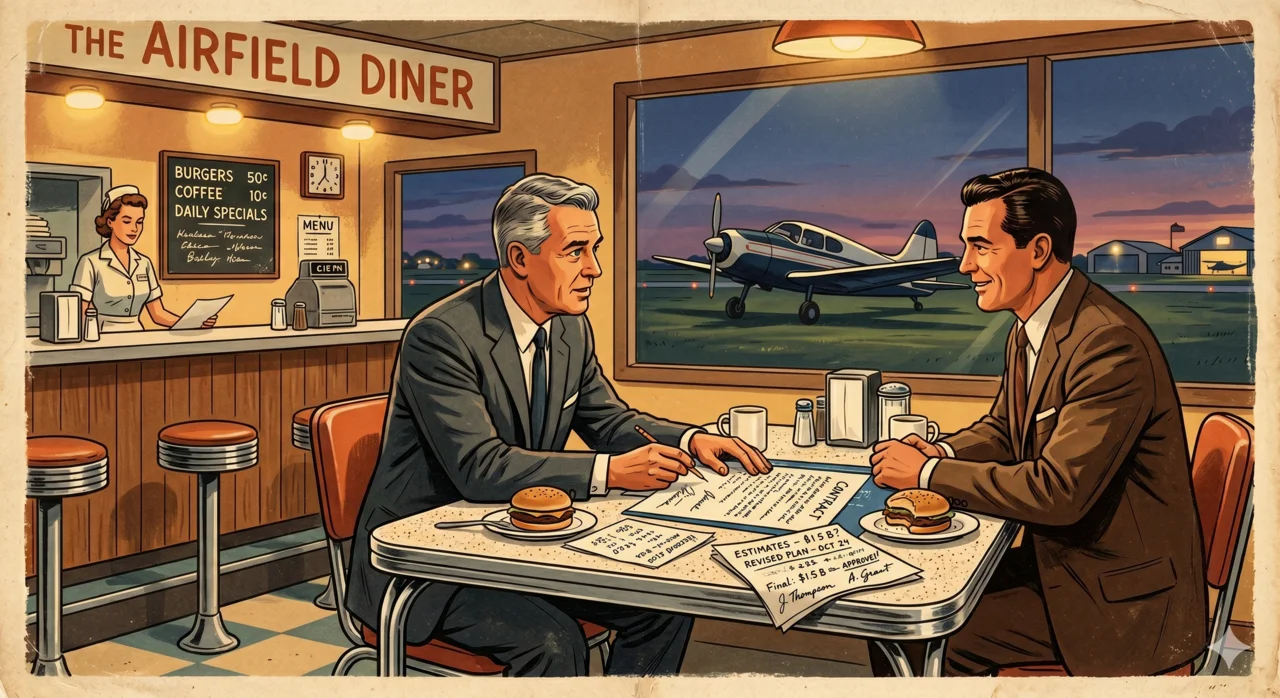
The catalyst was Richard Sercer, a Tucson aviation consultant who happened to own stock in both companies — a coincidence engineered partly by his wife, who had persuaded him to buy Berkshire in 1990.1 Sercer spotted the fit and in July 1996 pitched the idea to FlightSafety's VP of Marketing, who passed it up the chain. On September 18, 1996, Buffett met Ueltschi for lunch — hamburgers and Cherry Cokes. His assessment was immediate: "in about 60 seconds I knew that Al was exactly our kind of manager."1
The deal was signed within a month, announced in mid-October 1996 at approximately $1.5 billion, with shareholders able to take cash or Berkshire stock.10 Ueltschi, who had spent forty-five years building the company, explained his reasoning in terms that echo every founder-owner who has chosen Berkshire: "I've seen big companies when they buy little companies; they'll try to change everything."8 Buffett captured his own enthusiasm in the 1996 Chairman's Letter: "Al may be 79, but he looks and acts about 55. He will run operations just as he has in the past: We never fool with success." He added, with the ceremonial half-seriousness the letters are famous for, that "we will split his age 2-for-1 when he hits 100."1
The legal close came in early 1997, which meant FlightSafety's revenues did not appear in Berkshire's 1996 consolidated results. The company that had just pivoted toward operating businesses had books that still looked, on the surface, like an insurance conglomerate.
What the Numbers Said
A look at Berkshire's 1996 after-tax earnings captures both where the company was and where it was going. The operating businesses that had been accumulating since the late 1970s — the shoe group, Scott Fetzer ↗, See's Candies — collectively earned well under $300 million after tax. Insurance investment income alone hit $593 million.
| Business Segment | After-Tax Earnings (Berkshire's share) |
|---|---|
| Insurance: net investment income | $593.1M 4 |
| Insurance: underwriting | $142.8M 4 |
| Shoe Group | $41.0M 4 |
| Kirby | $39.9M 4 |
| Scott Fetzer Manufacturing | $32.2M 4 |
| See's Candies | $30.8M 4 |
| Buffalo News | $29.5M 4 |
| Home Furnishings (NFM + R.C. Willey) | $24.8M 4 |
| Jewelry | $16.1M 4 |
| Finance businesses | $14.9M 4 |
| World Book | $9.5M 4 |
| Fechheimer | $9.3M 4 |
| FlightSafety International | not consolidated (legal close Feb 1997) |
The ratio was roughly 4:1, insurance earnings to operating business earnings. That ratio was already set to compress. FlightSafety's earnings would begin landing in 1997's books, and Ueltschi and his deputy Bruce Whitman would go on to commit roughly $3 billion in fresh simulator capital over the next eight years — an investment pace the old public-company structure could not have supported.11 But the float underneath it all — $6.7 billion, at negative cost — was what made the expansion possible.
Berkshire's per-share book value grew 31.8% in 1996 against the S&P 500's 23.0%, extending a 32-year record that had compounded at 23.8% annually since 1965.1 The two big deals that defined the year are shown below:
| Deal | Announced | Closed | Price | BRK Prior Stake |
|---|---|---|---|---|
| GEICO (remaining 49%) | August 1995 | January 2, 1996 | $2.3B (BRK stock) 3 | ~51% since 1980 |
| FlightSafety International | October 1996 | February 1997 | ~$1.5B (cash + stock) 1 | None |
The $3.8 billion combined outlay, measured against a total market cap of roughly $41 billion, represented about 9% of Berkshire's value deployed in a single year into two businesses at opposite ends of Buffett's portfolio logic: one he had been building since 1976, one he committed to over a single lunch. The scale was made digestible by timing. Disney's February 1996 acquisition of Capital Cities/ABC had just delivered roughly $2 billion in after-tax cash and Disney shares to Berkshire — proceeds that funded the cash portion of FlightSafety while the GEICO deal was settled in Berkshire equity.2 Rarely have Berkshire's inflows and outflows aligned so neatly in a single calendar year.
Conclusion
The two deals of 1996 were not a grand strategy articulated in advance. They were the product of accumulated judgment — Buffett knowing since 1951 that he would eventually own all of GEICO, and knowing in sixty seconds in September 1996 that he wanted all of FlightSafety. What changed in 1996 is that both conclusions arrived in the same year, and the company that emerged was structurally different from the one that entered it.
GEICO at full scale gave Berkshire the float engine at its most powerful. The $6.7 billion in float, earned at negative cost, funded every subsequent operating-business acquisition for years. FlightSafety established the template for what those acquisitions would look like: founder-operated, moat-protected, allowed to run without interference. Within two years, NetJets arrived on the same terms ↗ — and FlightSafety, it turned out, was NetJets' single largest training customer.
Thirty years on, the result of that pivot is visible in Berkshire's 2025 operating earnings of $44.5 billion.12 GEICO hit a $7.8 billion pre-tax underwriting peak in 2024 before the post-restructuring cycle turned ↗.12 The operating businesses that were a footnote in 1996 became the majority of Berkshire's earnings within a decade. Ueltschi lived to see it. He died in October 2012 at age 95,6 having worked through his eighties, never once forced to change the playbook that had built the company.
References
-
1996 Berkshire Hathaway Chairman's Letter - berkshirehathaway.com ↩↩↩↩↩↩↩↩↩↩↩
-
The Snowball: Warren Buffett and the Business of Life — Schroeder, Alice - amazon.com ↩↩↩↩↩
-
1995 Berkshire Hathaway Chairman's Letter - berkshirehathaway.com ↩
-
1996 Berkshire Hathaway Annual Report — Consolidated Financial Statements - berkshirehathaway.com ↩
-
FlightSafety International Inc. History - fundinguniverse.com ↩
-
Albert Lee Ueltschi - wikipedia.org ↩↩
-
Warren Buffett's GEICO Investment - theweekendinvestor.substack.com ↩↩
-
A.L. Ueltschi: The Father of Modern Flight Training - intelligentfanatics.com ↩↩
-
A Very Strange Public Offering - rationalwalk.com ↩
-
Berkshire Hathaway acquires FlightSafety International - crunchbase.com ↩
-
Berkshire Beyond Buffett: The Enduring Value of Values — Cunningham, Lawrence - amazon.com ↩↩
-
Berkshire Hathaway Chairman's Letters Index (2025 Annual Report) - berkshirehathaway.com ↩↩