Tags: Lubrizol / OxyChem / Warren Buffett
This fanpage is not officially affiliated with Berkshire Hathaway: Disclaimer
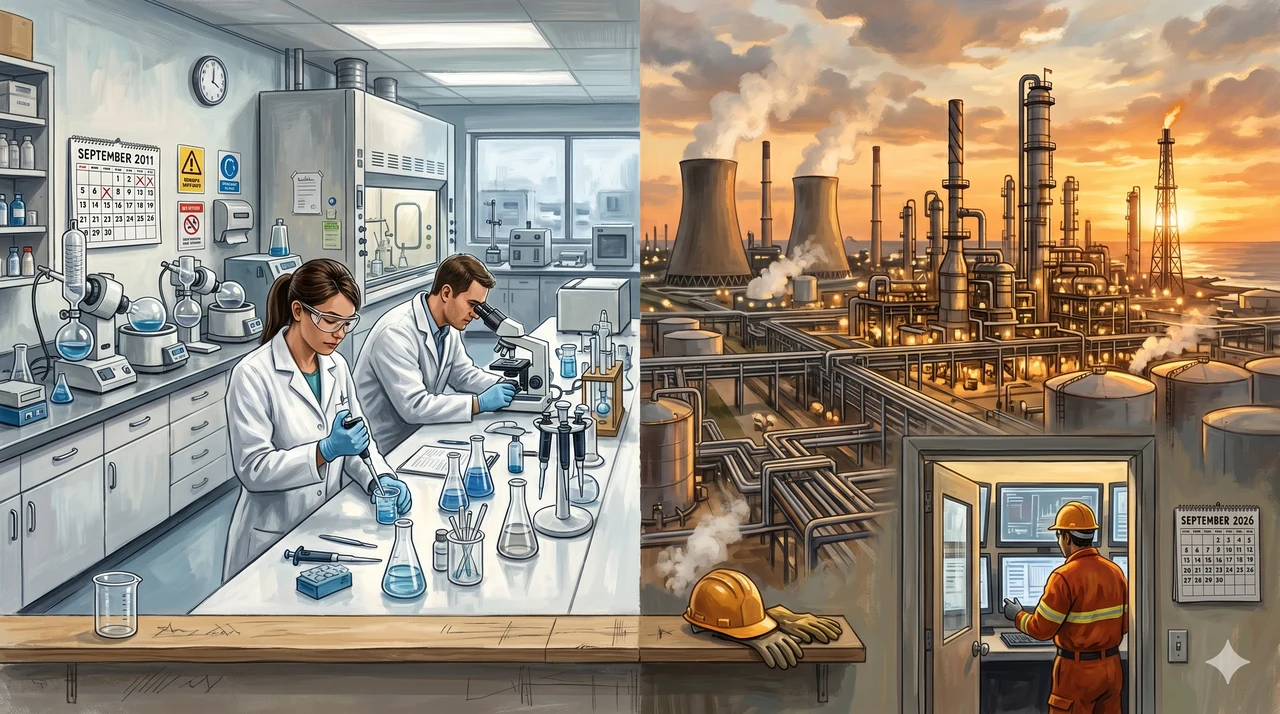
In September 2011, Berkshire Hathaway paid $9.7 billion in enterprise value — about $8.7 billion in cash for the equity1 — to take The Lubrizol Corporation private. Fifteen years later, almost to the calendar quarter, it paid the same headline number for OxyChem2, a basic-chemicals business Occidental Petroleum had spent thirty-eight years assembling. One was sold as a specialty premium. The other was sold as commodity cyclicality at a cycle trough. Fourteen years of Lubrizol-under-Berkshire data, the long arc of OxyChem inside Occidental, and the Citi-and-Evercore fairness opinion that Lubrizol shareholders received in May 2011 are now all on the table. They tell a story that doesn't sit easily with the specialty narrative.
Introduction
Berkshire's ↗ piece this April leaned into the obvious symmetry: two $9.7 billion checks, one Cleveland specialty business and one Houston commodity business, with Lubrizol's Rebecca Liebert now running both3. The framing then was that Lubrizol-into-OxyChem was a "doubling-down on a category Buffett spent his last working year revisiting." The framing was correct as far as it went. The question this piece asks — now that we have fifteen years of post-acquisition Lubrizol financials, a complete OxyChem segment record under Occidental, and the actual valuation arithmetic Berkshire walked into the boardroom with — is whether the specialty premium that justified the 2011 Lubrizol price was ever earned, and what that means for the OxyChem bet sitting on Greg Abel's desk in 2026.
The short version: every component of the specialty premium that the 2011 deal paid for — higher margins, R&D-driven moat, faster compounding, lower cyclicality — turns out to be either smaller than advertised or absent altogether when measured against the parallel basic-chemicals business sitting one shelf over. The "commodity" business outearned the "specialty" business in pre-tax dollars over the same 14-year window. The "specialty" business compressed its operating margin by roughly 750 basis points over the period Berkshire held it. And the deal multiple Buffett paid in 2011 was not the "cheapest specialty chemicals deal in 12 years" that Bloomberg announced4 — at least not against contemporary peers, who were trading meaningfully cheaper than the price Berkshire walked away with.
The 2011 Pitch — and Why It Was Credible
Lubrizol's last full year as a public company was a strong one. In 2010 the business generated $5.42 billion in revenue, net income of $732 million on diluted EPS of $10.64, and operating income of approximately $1.09 billion — a 20.1% operating margin5. EBITDA margins ran around 24% per the deal-announcement materials. The two segments told the specialty story precisely: Lubrizol Additives ran a 25.0% operating margin, and Lubrizol Advanced Materials — the consumer-and-coatings business assembled around the $1.84 billion 2004 Noveon acquisition6 — ran 14.8%5. R&D spend was $225.8 million in 2010, 4.2% of revenue5 — the conventional specialty-chemicals signature. Capital expenditure was $176 million, 3.2% of revenue — significantly lighter than a petrochemical plant builder.
Management's pitch in early February 2011, six weeks before the Berkshire announcement, was 2011 EPS guidance of $11.05 to $11.55, and a "longer-term goal" of $13.50 EPS by 20137. The Advanced Materials segment was supposed to compound at 15-17% operating margins by 2013. CEO James Hambrick stayed on after the merger; Buffett called Lubrizol "exactly the sort of company with which we love to partner — the global leader in several market applications run by a talented CEO"8. Every element of the brief was on-narrative for a Berkshire purchase: durable competitive position, capital-light footprint, an R&D moat, and a management team that knew the technology.
What Berkshire Actually Paid
The Lubrizol DEFM14A filed in May 20119 reveals what was actually on the table. Berkshire's $135 per share offer represented a 28% premium to the March 11, 2011 closing price, and a 7.6× multiple on Lubrizol's last-twelve-months 2010 EBITDA. Bloomberg's data put that at "the cheapest for a specialty chemicals company in 12 years"4. The framing was technically accurate — and slightly misleading.
Inside the proxy, Evercore's fairness analysis showed the peer group's actual contemporary trading multiples. The nine specialty-chemicals peers Evercore selected — Albemarle, Cytec, Dow, DuPont, Eastman, NewMarket, PPG, Rockwood, and Valspar — were trading at a 2011-forward TEV/EBITDA range of 5.9× to 8.8×9. Lubrizol itself was trading at 5.6× forward EBITDA pre-deal — toward the bottom of its peer group. NewMarket, the only other publicly traded lubricant-additives company and Evercore's closest comp, was at 5.9× forward. When Evercore had to pick an applied multiple range for its comp-companies analysis, it chose 5.5× to 7.0×. The Berkshire deal at 7.6× sat above the top of Evercore's applied comp range.
| 2011 valuation reference point | EV/EBITDA |
|---|---|
| Lubrizol pre-deal trading (2011E forward)9 | 5.6× |
| Closest peer NewMarket (2011E forward)9 | 5.9× |
| Evercore peer range (2011E forward)9 | 5.9× – 8.8× |
| Evercore applied comp range9 | 5.5× – 7.0× |
| Evercore applied precedent range9 | 7.0× – 8.0× |
| Berkshire deal (LTM 2010 EBITDA)9 | 7.6× |
| Historic precedent range 2000–20119 | 6.7× – 16.0× |
The "cheapest in 12 years" framing was relative to 2007 cycle peaks — Dow / Rohm & Haas closed at the top of that range. On contemporary peers, Berkshire paid a roughly 35% premium to where Lubrizol itself was trading the month before the deal. The specialty premium was not just a story about the underlying business mix; it was embedded directly in the price.
Fourteen Years of Operating Reality
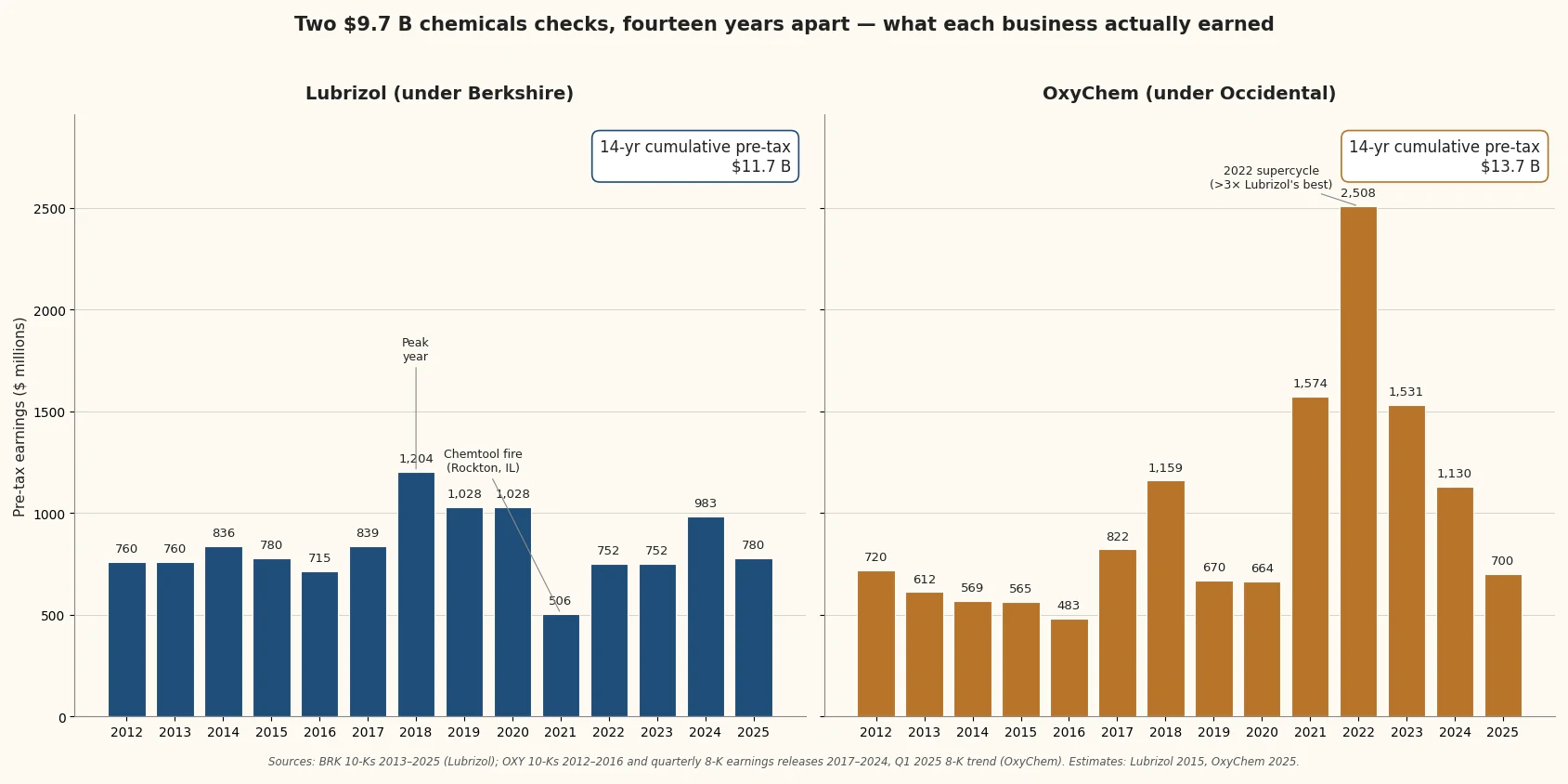
Lubrizol's first full year inside Berkshire was 2012. Revenue ran approximately $6.0 billion, and pre-tax earnings approximately $760 million — derivable from the 2013 annual report's industrial-group disclosure10. The 2014 annual report explicitly reported Lubrizol revenue at $6.9 billion (+9% versus 2013) and pre-tax earnings up 10%11, implying roughly $836 million for 2014. From there forward, the trajectory broke from the pitch.
| Year | Revenue ($B) | Pre-tax ($M) | Source |
|---|---|---|---|
| 2012 (first full year) | ~6.0 | ~760 | BRK 2013 AR10 |
| 2013 | 6.4 | ~760 | BRK 2014 AR ("relatively unchanged")11 |
| 2014 | 6.9 | ~836 | BRK 2014 AR (+10%)11 |
| 201512 | ~6.5 | ~780 | Triangulated; Lubrizol-specific not isolated |
| 2016 | ~6.2 | ~715 (reported); ~1,080 ex-charges | Derived from BRK 2017 AR13 |
| 2017 | 6.42 | ~839 (reported); ~1,029 ex-charges | Derived from BRK 2018 AR14 |
| 2018 | 6.80 | ~1,204 (peak) | BRK 2018 AR (+43.5%)14 |
| 2019 | 6.50 | ~1,028 | BRK 2019 AR (−14.6%)15 |
| 2020 | 5.95 | ~1,028 | BRK 2020 AR ("essentially unchanged")16 |
| 2021 | 6.50 | ~506 (Chemtool fire) | BRK 2021 AR (−50.8%)17 |
| 2022 | 6.70 | ~752 | BRK 2022 AR (+48.6%)18 |
| 2023 | 6.40 | ~752 | BRK 2023 AR ("relatively unchanged")19 |
| 2024 | 6.40 | ~983 | BRK 2024 AR (+30.7%)20 |
| 2025 | 6.20 | ~780 | BRK 2025 AR (−20.6%)21 |
| 14-yr cumulative pre-tax | ~11,700 | Sum of reported series |
Lubrizol's 2025 revenue ($6.2 billion) is essentially identical to its 2012 revenue ($6.0 billion) — a fourteen-year top-line move of roughly three percent in nominal dollars21. Pre-tax earnings of approximately $780 million in 2025 match the $760 million of 2012 within rounding2110. Headcount: 7,589 employees in 2013, 7,690 in 2025 — basically static22. ↗ covered the 2024 recovery in detail; the 2025 retreat undid most of it.
The operating-margin compression is the larger finding. Lubrizol's 2010 operating margin of 20.1% has fallen to an implied pre-tax margin of approximately 12.5% in 2025 ($780M divided by $6.2B)21. The Advanced Materials segment that was supposed to reach 15-17% margins by 2013 never delivered, and two manufacturing-plant fires — Rouen, France in September 201915 and the Chemtool facility in Rockton, Illinois in June 202117 — took bites out of two separate years' earnings.
The OxyChem Counterfactual
The same fourteen-year window, run on OxyChem inside Occidental, looks structurally different. Revenue cycled from $4.0 billion in 2010 to a 2014 peak of $4.82 billion, collapsed to $3.75 billion in 2016 as the oil-and-gas-cycle downturn rolled into petrochemicals23, recovered through the late 2010s, and ran the 2022 supercycle to roughly $6.76 billion24. Pre-tax earnings followed the cycle on much higher amplitude.
| Year | Revenue ($B) | Pre-tax ($M) | Source |
|---|---|---|---|
| 2012 | 4.58 | 720 | OXY 2012 10-K23 |
| 2014 | 4.82 | 569 | OXY 2014 10-K23 |
| 2016 | 3.76 | 483 | OXY 2016 10-K (trough)23 |
| 2018 | ~4.8 | 1,159 | OXY Q4 2018 8-K25 |
| 2020 | ~3.8 | 664 | OXY Q4 2020 8-K25 |
| 2021 | ~5.5 | 1,574 | OXY Q4 2021 8-K25 |
| 2022 | ~6.76 | 2,508 | OXY Q4 2022 8-K (peak)24 |
| 2023 | ~5.32 | 1,531 | OXY Q4 2023 8-K25 |
| 2024 | ~4.92 | 1,130 | OXY Q4 2024 8-K26 |
| 2025e | ~4.5 | ~700 | OXY Q1 2025 8-K trend27 |
| 14-yr cumulative pre-tax | ~13,700 | Sum 2012–2025 |
OxyChem's 2022 single-year pre-tax of $2.51 billion24 is more than three times Lubrizol's best year under Berkshire. Its peak pre-tax margin (37.1%, 2022) is double Lubrizol's best (around 18% in 2018). And the fourteen-year cumulative pre-tax under Occidental — approximately $13.7 billion — runs about $2.0 billion ahead of Lubrizol's $11.7 billion under Berkshire over the identical window, for an asset Berkshire later bought for the same $9.7 billion price. The specialty premium did not manifest in pre-tax dollars.
The R&D contrast does hold on the input side. OxyChem reports essentially zero R&D as a segment line28; Lubrizol ran 4.2% of revenue at acquisition5. The capex profile is comparable ex-Project-Redstone (the $1.1 billion Battleground modernization peaking in 202529). What didn't hold is the proposition that the input difference translates to a durable output advantage. Specialty-as-input was real; specialty-as-compounding was not.
The Sokol Footnote, Recast
The 2011 Lubrizol deal almost did not get done in the form Berkshire wanted. David Sokol, then Berkshire's heir-presumptive operating executive, purchased 96,060 shares of Lubrizol in January 2011 for roughly $10 million after he had identified Lubrizol as a Berkshire target and arranged a meeting with its CEO30. He pitched the deal to Buffett days later. When Berkshire announced the acquisition on March 14 at $135 per share, Sokol had an immediate paper gain of approximately $3 million. He resigned at the end of the month. Berkshire's audit committee concluded the trades violated company ethics policy31; Buffett called them "inexcusable and inexplicable"32; Munger, asked for a one-word diagnosis, offered "hubris."
The Sokol section is well-trodden ground — already laid out in ↗. What the operating data fifteen years on adds is a less obvious second indictment. The most controversial Berkshire deal of the prior decade was also, on the numbers, its operational disappointment. Munger's "hubris" diagnosis was about the sourcing. The price discipline was a separate failure — Berkshire walked into the contemporary peer comp range at the top of it, paid an extra turn for the specialty narrative, and watched the underlying business produce a flat earnings stream for fourteen years.
What This Says About the OxyChem Bet
OxyChem closed on January 2, 2026 at $9.7 billion cash. Against 2024 EBITDA of approximately $1.48 billion28, that is roughly 6.6× LTM EBITDA — a full turn below the 7.6× multiple Berkshire paid for Lubrizol in 2011, and against the bottom of the 2010-2024 cycle rather than its top226. Occidental retained the legacy environmental liabilities through Glenn Springs Holdings33; there is no embedded debt; the management team is unchanged. ↗ framed the OxyChem closing as the first major item on Greg Abel's capital-allocation ledger. The Lubrizol comparison sharpens what kind of bet that ledger entry actually is.
The case for OxyChem is not that commodity is permanently better than specialty. It is that the specialty premium turned out to be a story Buffett paid for in cash in 2011 and got back in flat compounding through 2025, while OxyChem was bought at a lower multiple, on lower-multiple inputs (R&D-light, capex-similar), with the cyclical earnings band Berkshire just observed across one shelf over. The 2022 OxyChem peak of $2.51 billion in single-year pre-tax — recall, more than three years of Lubrizol-at-its-best stacked into a single year — is what cyclicality looks like when properly sized. The 2024 OxyChem print of $1.13 billion26 is what the cycle's middle looks like. ↗ documents the recovery Buffett's expensive industrial deal of the prior decade has put together; OxyChem is positioned not at PCC's entry point but well below it on the cycle clock.
Conclusion
Berkshire's two $9.7 billion chemicals checks make a clean controlled experiment. Same purchase price, same broad industry, same fifteen-year compound window when measured forward from each deal's vintage. One was bought as specialty and paid a specialty multiple; the other was bought as commodity and paid a commodity multiple. The 2011 fairness opinion's contemporary peer trading at 5.9× to 8.8× sits beside the 2026 OxyChem multiple of 6.6× — and the cumulative pre-tax earnings of the basic-chemicals business beat the cumulative pre-tax of the specialty business by roughly $2.0 billion over the same fourteen years. Buffett's last big chemicals deal validates his pricing discipline more than his deal that bore the Sokol footnote did. The most counterintuitive thing about the parallel $9.7 billion checks is which one the data thinks was the better one.
References
-
Berkshire Hathaway 2013 10-K (Lubrizol purchase consideration disclosure) - sec.gov ↩
-
Berkshire Hathaway Inc. Completes Acquisition of OxyChem - businesswire.com ↩↩
-
Greg Abel's 2025 letter to shareholders - berkshirehathaway.com ↩
-
How Buffett got Lubrizol at Lehman-bust valuation - business-standard.com ↩↩
-
Lubrizol Corporation 10-K FY2010 - sec.gov ↩↩↩↩
-
Lubrizol to Acquire Noveon - cen.acs.org ↩
-
Lubrizol Corp. Reports Higher Q4 Earnings; Forecasts 2011 and 2013 - crainscleveland.com ↩
-
Berkshire Hathaway to Purchase Lubrizol for $9 Billion - cnbc.com ↩
-
Lubrizol Corporation DEFM14A (Fairness Opinions, Citi and Evercore) - sec.gov ↩↩
-
Berkshire Hathaway 2013 Annual Report - berkshirehathaway.com ↩↩
-
Berkshire Hathaway 2014 Annual Report - berkshirehathaway.com ↩
-
Lubrizol-specific pre-tax earnings were not separately disclosed in the BRK 2015 annual report; the industrial-products group's pre-tax fell $165M (5%) to $2,994M with an unchanged 17.9% pre-tax margin (2015 AR). The ~$780M figure is an estimate consistent with that group-level narrative and is the only number in this table not anchored to a direct disclosure. ↩
-
Berkshire Hathaway 2017 Annual Report (Lubrizol +17% from 2016; 5-company aggregate $5.5B / $5.4B) - berkshirehathaway.com ↩
-
Berkshire Hathaway 2018 Annual Report (Lubrizol +43.5%, $190M one-time charges, +17% ex-charges) - berkshirehathaway.com ↩
-
Berkshire Hathaway 2019 Annual Report (Lubrizol −14.6%, Rouen fire impact) - berkshirehathaway.com ↩
-
Berkshire Hathaway 2020 Annual Report - berkshirehathaway.com ↩
-
Berkshire Hathaway 2021 Annual Report (Lubrizol −50.8%, Chemtool Rockton fire) - berkshirehathaway.com ↩
-
Berkshire Hathaway 2022 Annual Report (Lubrizol +48.6%) - berkshirehathaway.com ↩
-
Berkshire Hathaway 2023 Annual Report - berkshirehathaway.com ↩
-
Berkshire Hathaway 2024 Annual Report (Lubrizol +30.7%) - berkshirehathaway.com ↩
-
Berkshire Hathaway 2025 Annual Report (Lubrizol −20.6%, $6.2B revenue) - berkshirehathaway.com ↩↩↩
-
Lubrizol headcount per BRK 2013 AR Exhibit 21 (7,589) and BRK 2025 AR Exhibit 21 (7,690). ↩
-
OXY Chemical segment net sales: 2010 $4,016M / 2011 $4,815M / 2012 $4,580M / 2013 $4,673M / 2014 $4,817M / 2015 $3,945M / 2016 $3,756M, from Occidental Petroleum 10-K filings 2012-2017 - sec.gov. ↩
-
Occidental Announces 4th Quarter 2022 Results — OxyChem record $2.5B pre-tax - oxy.com ↩↩
-
Occidental Petroleum quarterly 8-K earnings releases archive - oxy.com ↩
-
Occidental Q1 2025 8-K earnings release - sec.gov ↩
-
The Oracle and OxyChem — segment R&D, D&A, capex analysis - kingswell.io ↩↩
-
OxyChem Battleground $1.1B Modernization (Project Redstone) - downstreamcalendar.com ↩
-
David L. Sokol — Lubrizol trades and resignation - en.wikipedia.org ↩
-
Berkshire Hathaway Audit Committee Report on Sokol's Lubrizol Trading - scribd.com ↩
-
Buffett: I Made a Big Mistake by Not Questioning Sokol's "Inexplicable and Inexcusable" Trades - cnbc.com ↩
-
Berkshire Hathaway Completes $9.7B OxyChem Acquisition — Glenn Springs Holdings retention - icis.com ↩