Tags: Comments / Greg Abel / Float
This fanpage is not officially affiliated with Berkshire Hathaway: Disclaimer
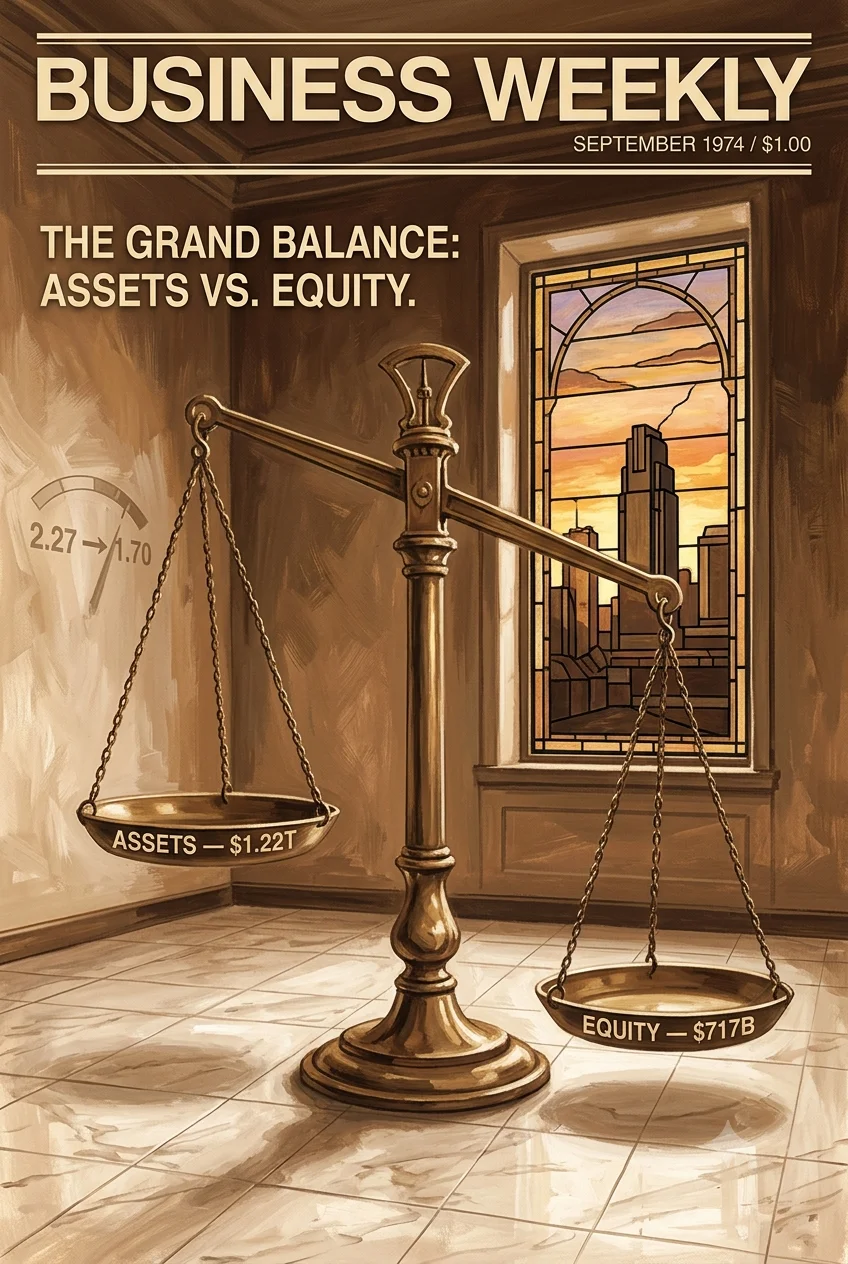
Four days ago this site documented that Berkshire Hathaway has lagged the S&P 500 Total Return index by 2.8 percentage points per year since 2010 ↗. The reflexive explanations — Buffett aged out, the company got too big, value lost to growth — are all true in some measure, but each is descriptive rather than mechanical. The mechanical explanation has been sitting in the back of the 10-K all along, and almost no one has pointed at it: Berkshire's balance-sheet leverage has been quietly shrinking for sixteen years. Assets-to-equity fell from 2.27× at year-end 2009 to 1.70× at year-end 2025 — a quarter of the multiplier, gone. The same compounding machine, operating with three-quarters of the structural amplification it used to have, was always going to lag a passive index in a bull market. The float-side moat, meanwhile, is at record wides. This is the structural decomposition.

Introduction
Berkshire's Owner Manual has carried the same paragraph on leverage for more than two decades. The wording in the 2013 annual report is verbatim what appears in 2025: "We use debt sparingly and, when we do borrow, we attempt to structure our loans on a long-term fixed-rate basis. We will reject interesting opportunities rather than over-leverage our balance sheet. This conservatism has penalized our results but it is the only behavior that leaves us comfortable, considering our fiduciary obligations to policyholders, lenders and the many equity holders who have committed unusually large portions of their net worth to our care."1 The next paragraph is the philosophical hinge: "The financial calculus that Charlie and I employ would never permit our trading a good night's sleep for a shot at a few extra percentage points of return."1
A reader could be forgiven for treating that as boilerplate. The Owner Manual is, after all, where Buffett buries his more aspirational claims about how the company behaves. But unlike the lines about "owner-oriented management" or "intrinsic value," the leverage paragraph is measurable — and the measurements show that the trade has been happening, slowly and steadily, for the entire post-financial-crisis period. Equity has grown faster than assets. The float pile has grown but not as fast. Debt has stayed essentially flat. The result is a balance sheet that today carries about 25% less amplification per dollar of book value than it did when Buffett was still adding Goldman Sachs preferred at the bottom of the crisis.
This piece is the structural companion to the May 15 comparison piece. That piece told you Berkshire lagged. This piece tells you how the laggard arithmetic was generated — and what is not broken alongside what is.
The Disappearing Multiplier
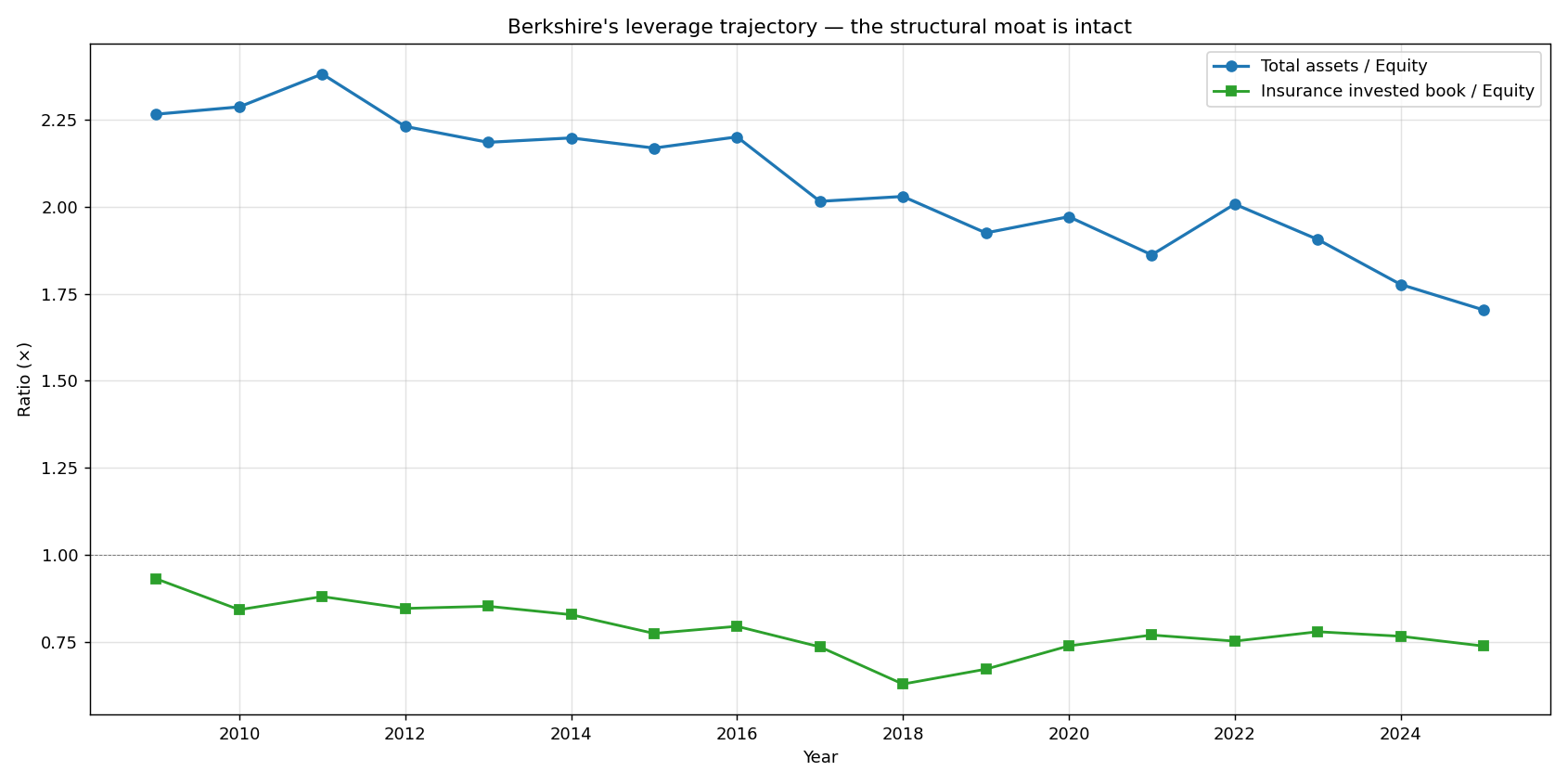
The chart above carries the whole structural argument in one frame. Berkshire's total-assets-to-equity ratio peaked at 2.38× in 2011, drifted down through the 2010s, took a step-function leg lower around 2017–2018 as the equity portfolio appreciated faster than the rest of the balance sheet, and has continued to slide through 2025. The terminal reading is 1.70×2. The peak was 2.27×2. Mechanically, that means a 10% move in the underlying invested book translated into roughly a 23% move in shareholder equity in 2009, and into roughly a 17% move in 2025. Same equities. Same float. Less amplification per dollar.
Why? The mechanical answer is straightforward. Berkshire's equity has roughly quintupled since 2009, from $131 billion to $717 billion2. Its total assets have roughly quadrupled, from $297 billion to $1,222 billion2. Equity grew faster — chiefly because the operating businesses retained essentially all of their earnings (no dividend), the equity portfolio appreciated through the post-2017 bull market, and Buffett resisted the temptation to lever up into the cash pile that built behind it. Debt issuance has been deliberately modest. Float has compounded at roughly 7% per year3, slower than equity's roughly 11%. The combined effect is that the structural leverage gradient pointed downward for the entire period.
This was not an accident. The 2024 annual letter is unusually direct about the philosophy: "Our combined insurance operations generated pre-tax underwriting gains in 2024 and 2023, and the average cost of float was negative in each year"4 — celebrated as a feature, not because Berkshire is maximizing leverage but because it is generating negative-cost leverage. The 2025 letter, Abel's first as CEO, hardens the language: "We maintain a fortress-like balance sheet, ensuring Berkshire's foundation is never compromised... Our balance sheet is a strategic asset to be deployed at the right time."5 The reference frame is now explicitly defensive. Abel has also made the framing institutional, writing: "Risk management is central to Berkshire. The CEO is responsible for serving as Chief Risk Officer – there is no more important duty."5 You do not see that sentence in Jack Welch's GE letters or Jamie Dimon's chairman letters. It is a tell.
Where the Levered Dollars Went
If the multiplier has shrunk, the composition of what is being multiplied has also shifted. Berkshire's insurance invested book — cash, Treasury bills, equity securities, fixed-maturity securities, and other — grew from roughly $122 billion in 2009 to $529 billion at year-end 20254. Inside that pile, the cash-and-T-bill share went from roughly 25% in 2017 to roughly 40% in 20254. Equity securities are essentially flat as a percentage; fixed-maturity bonds have shrunk from roughly $35 billion to $17 billion4. The mix has rotated toward short-duration, dollar-safe, rate-sensitive securities.
The income statement registers this rotation immediately. The "Interest, dividend and other investment income" line from the Insurance and Other segment ran $5.5 billion in 2009. By 2019 it was $9.2 billion. By 2025 it was $23.3 billion4 — close to a tripling in six years. Most of that growth is not equity-dividend growth; Apple's dividend has crept up but is not the explanation. The explanation is the cash pile multiplied by a 4% short rate. A $200 billion T-bill ladder yielding 4% generates $8 billion of investment income that did not exist when the same balance was earning 0.04% in 2021. That is the math that has quietly inverted Berkshire's income statement.
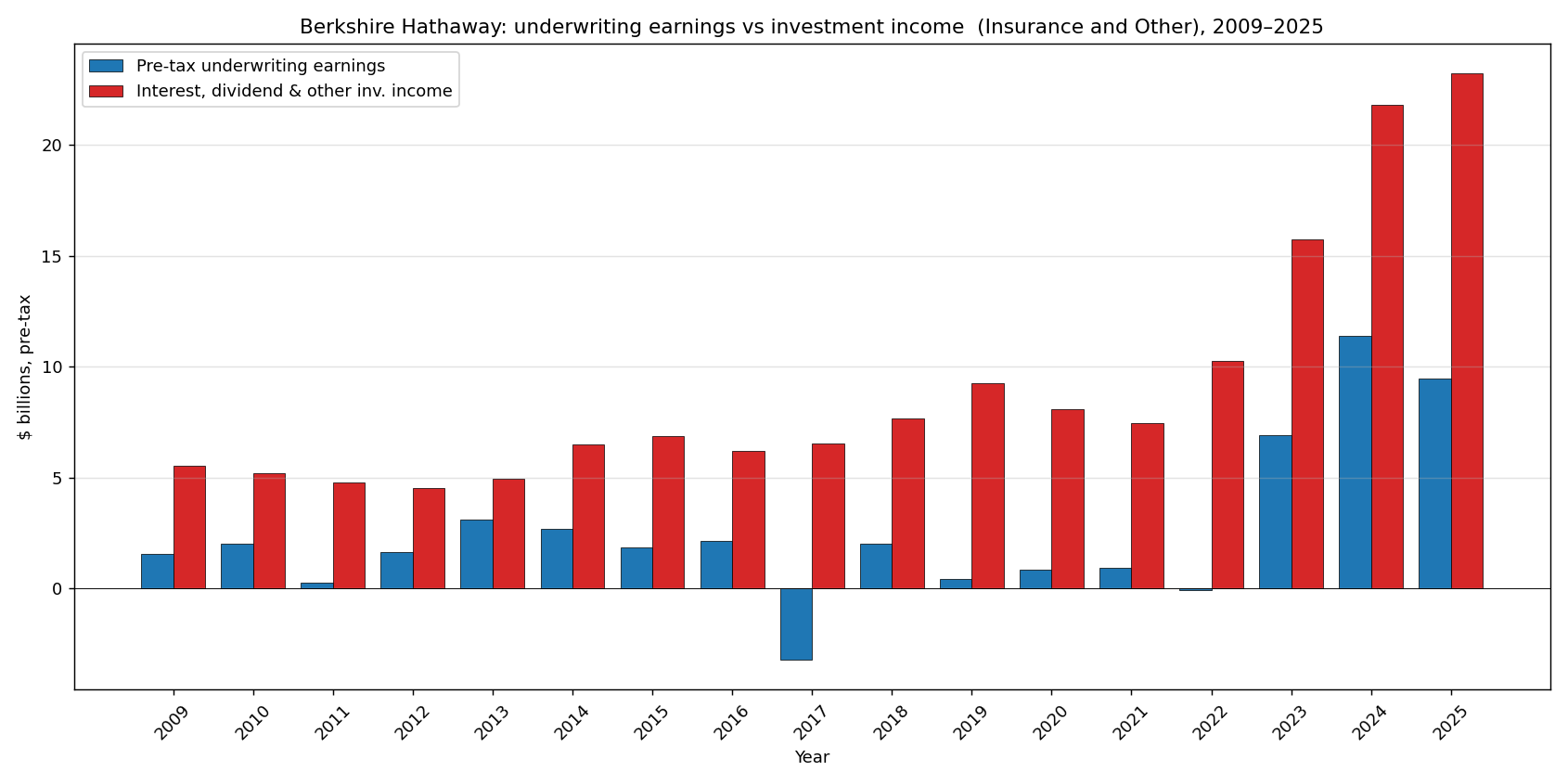
The strategic question for shareholders is whether this composition shift is permanent or transitional. The Fed cuts that the market is pricing for late 2026 would not be benign here. A return to the 1.55% short rates that prevailed in 2019 would remove approximately $11 billion of run-rate investment income from a $397 billion cash position2. A return to zero-interest-rate-policy levels — improbable but not impossible — would remove closer to $15 billion. Investment income is now a meaningfully rate-sensitive line on a balance sheet that used to depend on it less.
The Float Moat at Record Wides
There is a counter-story embedded in the same data set, and it is the genuinely encouraging part. The cost of float — defined as the negative of pre-tax underwriting earnings divided by the average float balance — has been negative in 14 of the last 16 years4. The 2024 reading, computed from a pre-tax underwriting gain of roughly $11.4 billion against an average float of $170 billion, was approximately −6.7%4. That is not a Buffett-published number; it is the implied annualized rate, computed straightforwardly from the disclosed inputs. By the same calculation, 2023 ran roughly −4.2% and 2025 roughly −5.5%4. The three-year run is the deepest in the historic series Berkshire has published, which begins in 1970 with $39 million of float6.
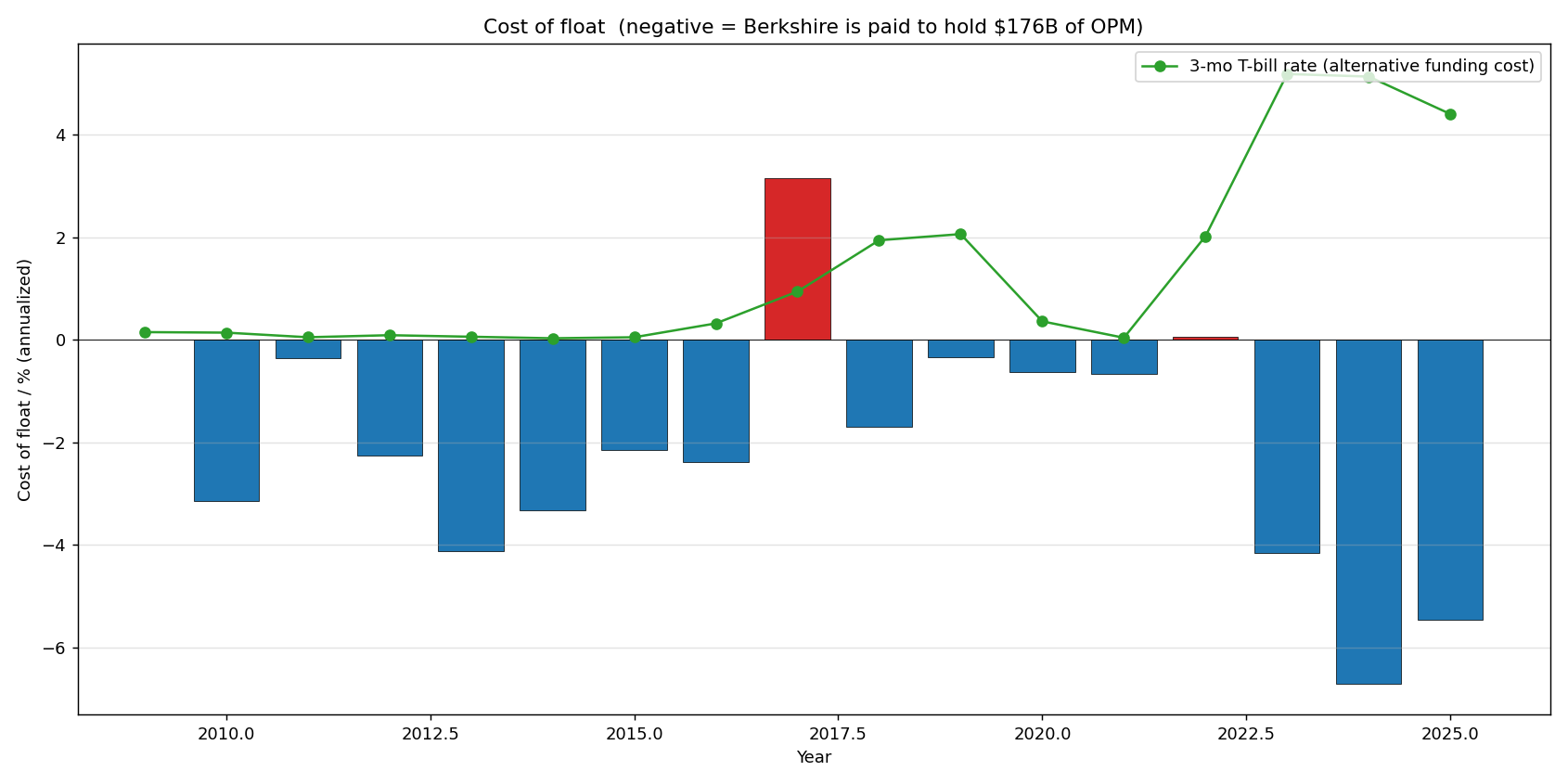
What this means in plain English: in 2024, every dollar of float that Berkshire's policyholders effectively lent to the holding company generated a 6.7% pre-tax profit for shareholders before any investment income was added on top. The traditional Buffett framing — that Berkshire's float is the equivalent of borrowing at an interest rate set by underwriting discipline — has rarely been more flattering. The 2018 letter put it in three words: "free money — and, better yet, get paid for holding it."7
The cost-of-float series is the only one of the three structural pieces in this analysis that is at its all-time best. Leverage is shrinking, the equity-selection moat has mean-reverted, but the underwriting machinery — driven principally by GEICO, BHRG's exit from low-rate property cat, and three years of light catastrophe activity — is running at a level of profitability that has no historical analogue inside Berkshire. The float pile itself, at $176 billion4, is at an all-time high. The Tokio Marine 10-year whole-account quota-share that began April 1, 2026 will add more ↗.
What the De-Levering Costs Shareholders
It is fair to ask, then, what shareholders have given up for this fortress posture. The arithmetic is not trivial. From year-end 2009 through May 2026, Berkshire's stock compounded at 12.0% per year. The S&P 500 Total Return compounded at 14.7%8. A dollar invested in BRK is worth roughly $7.30 today; the same dollar in the index is worth roughly $9.108. The 2.7-percentage-point annual gap, compounded over 16 years, is a substantial dispersion in terminal value. If Berkshire had held its 2009 leverage ratio of 2.27× for the entire period, a simple mechanical adjustment would put its return at roughly 14-16% per year — squarely in the index's neighborhood. The conservatism is not free.
Buffett would have a response to that arithmetic, and it would not be a defensive one. He has been explicit, for decades, that the company has access to two non-perilous sources of leverage and is not interested in a third: "Berkshire has access to two low-cost, non-perilous sources of leverage that allow us to safely own far more assets than our equity capital alone would permit: deferred taxes and 'float'... In effect, they give us the benefit of debt — an ability to have more assets working for us — but saddle us with none of its drawbacks."1 The 2009 reading of 2.27× included a sizeable chunk of conventional debt issuance from the BNSF acquisition financing ↗. The 2025 reading of 1.70× is almost entirely "leverage" in the Buffett-acceptable sense — float plus deferred taxes plus minimal long-dated debt. The de-levering, in other words, is also a re-composition: the same amount of float is doing more of the levering, and conventional debt is doing less. The total multiplier is smaller, but it is cleaner.
Echoes of 1976
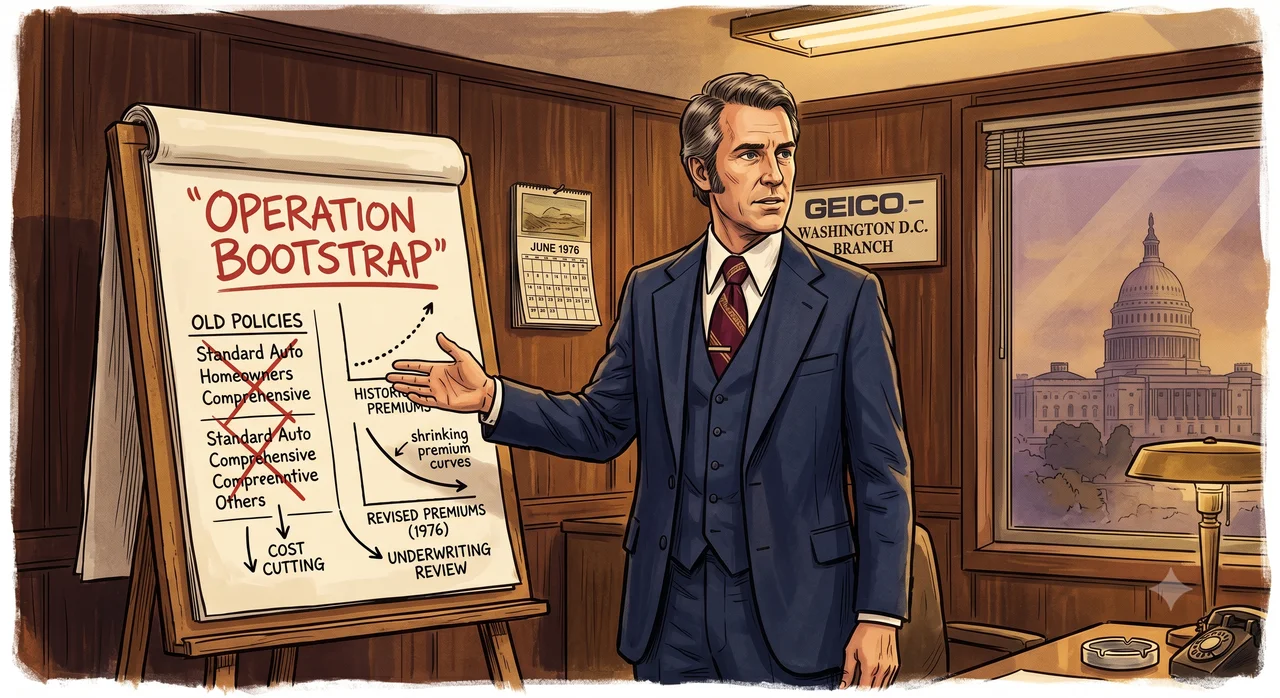
There is a historical mirror worth holding up. In June 1976, Jack Byrne walked into a near-bankrupt GEICO with a flip chart and a deliberate, almost violent program to shrink the company — Operation Bootstrap — that cut policies, exited states, and ran assets off the balance sheet faster than premium volume ↗. The result was a violent reduction in assets-to-equity over six quarters. The asset side fell faster than the liability side, and the equity recovered through retained earnings and the Salomon convertible. Buffett bought 33% of the recapitalized company at roughly $2 a share. The de-levering at GEICO in 1976 was deliberate, was forced by solvency math, and was — in retrospect — the precondition for fifty years of compounding.
What Berkshire has done from 2009 to 2025 is structurally similar but tactically the opposite. The 1976 de-levering at GEICO was rapid, defensive, and forced. The 2009-to-2025 de-levering at Berkshire has been gradual, voluntary, and surplus-financed. The 1976 version took six quarters and cost the workforce. The 2026 version has taken sixteen years and cost shareholders 2.7 percentage points per year of relative return against a passive index. Different motivations, similar mechanic: let the equity base grow faster than the asset base, and the company comes out the other side carrying less risk per dollar of book value. The 2.27× → 1.70× walk is a continuation of the same conservative-balance-sheet doctrine that Buffett brought to GEICO in 1976 and to Berkshire from the start.
Abel's Inheritance
The leverage chart in this piece is, in one important sense, not a Greg Abel chart. The de-levering started in 2011 under Buffett and was largely complete by the time Abel formally took over in January 2026. The 2017 step-function leg lower is the Apple-led equity rally widening the denominator; the 2018–2025 gradual decline is float and operating earnings not keeping pace with equity's appreciation. By the time the new CEO inherited the role, the company was already running at the lowest leverage ratio in its modern era. Abel's contribution has been linguistic: codifying what the chart had already done, with the "fortress-like balance sheet" line in the 2025 letter and the explicit "Chief Risk Officer" framing ↗.
That is significant in its own right. The act of naming a structural posture changes its political economy. Buffett's leverage paragraph in the Owner Manual was always somewhat philosophical — a statement of preference. Abel's "Chief Risk Officer" framing is operational — a statement of duty. The downstream consequence is that even moderate re-leveraging (a big M&A deal, a buyback program that draws cash down meaningfully, or a sustained equity drawdown that compresses the denominator) will now run against an explicit stated posture. The $234 million March 2026 buyback at 1.44× book is, by that lens, the new visible boundary of the willingness threshold rather than the start of a deployment cycle9.
| Era | Avg assets / equity | Avg cost of float | Investment income / yr |
|---|---|---|---|
| 2009 - 2015 (post-GFC build) | 2.25×2 | −2.6%4 | $5.5B4 |
| 2016 - 2021 (mid-cycle drift) | 2.03×2 | −0.8%4 | $7.5B4 |
| 2022 - 2025 (rate-pivot era) | 1.85×2 | −4.1%4 | $17.6B4 |
The three-row table above summarizes the structural shift in one frame: each of the last three roughly-equal periods has carried less leverage, deeper-negative cost of float, and more investment income than the one before it. The same company, but a measurably different one, generating a measurably different shareholder experience.
Three Moats, Three Trajectories
Where does this leave the shareholder who reads this piece and the 260515 piece in sequence? The composite picture is structurally clearer than either piece alone:
-
The equity-selection moat has mean-reverted. Berkshire's equity portfolio is no longer beating the S&P 500. The 2010-2026 record is below-index by 2.8pp per year and the trailing 10-year CAGR has Berkshire behind for the first time in a generation.8 This is not unique to Berkshire — most active managers have lagged the index in this stretch — but it does retire the "Buffett picks better stocks" framing as a present-tense claim.
-
The structural leverage moat has shrunk by about a quarter. Assets/equity went from 2.27× to 1.70×.2 The conservatism is deliberate and is publicly defended in the Owner Manual, but it does mechanically explain a meaningful share of the index gap. A levered Berkshire at the 2009 multiplier would have been roughly index-rate over the same period.
-
The float-side moat is at the widest in the company's history. Cost of float has run roughly −5% across 2023–2025, the deepest negative reading on Buffett's published series back to 1970.4 Float itself is at an all-time high of $176 billion4 and is contracted to grow further via the Tokio Marine quota-share. The Buffett-Abel insurance machine is functioning better than it ever has, and is the one piece of the structure that is unambiguously a buy signal for the shareholder.
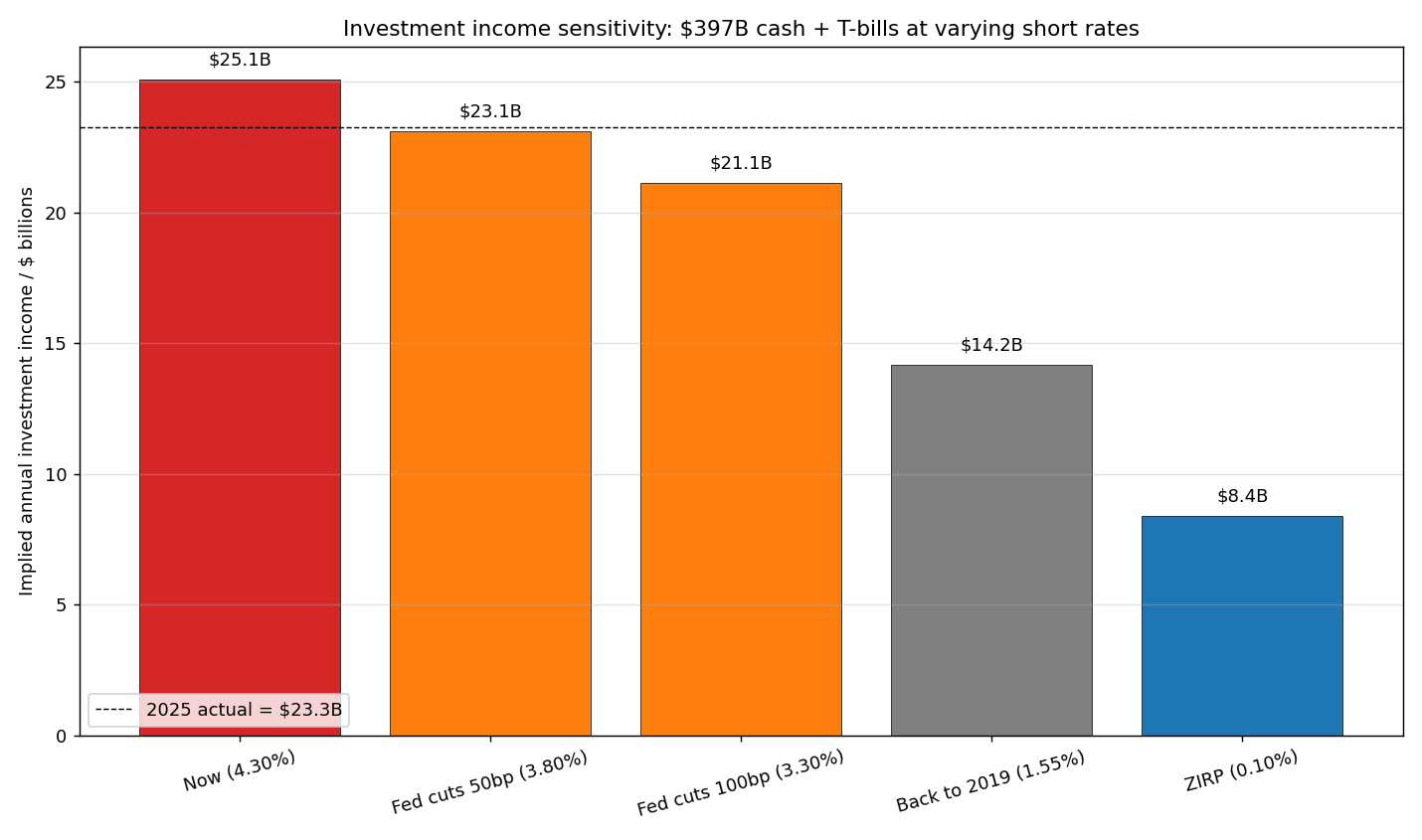
The forward question is whether the third moat can carry the other two. A $176 billion float at −5% cost generates roughly $9 billion of pure-margin underwriting profit per year that flows directly to retained earnings and compounds. If rates stay near 4%, the investment-income side adds another $20+ billion per year. Together these two sources of pre-tax profit are running roughly twice the level they did pre-pandemic. They could plausibly do so for another decade. What they will not do — and this is the math — is reproduce the leverage-amplified equity returns of the 1988-2005 era. That run depended on a 2.5×+ leverage multiplier and a portfolio of equities (Coca-Cola, Geico, the early Washington Post position, the See's Candies cash-pump) that was structurally cheaper than the S&P average. Berkshire today has neither. It has, instead, an unprecedentedly profitable insurance operation and a balance sheet that lets it deploy $397 billion at the moment of someone else's misjudged risk.
Conclusion
The Owner Manual paragraph on leverage has been in the annual report since 1996. For most of those thirty years, shareholders treated it as a philosophical preference — a Buffett-style aspiration about not trading good sleep for return. The arithmetic in this piece suggests it has been an operational program. The 2.27× to 1.70× walk is not a marketing claim. It is the most consequential structural change at Berkshire Hathaway in this generation, and it is the mechanical explanation for the 2010-2026 underperformance that the May 15 piece left unexplained.
The good news for shareholders is that the de-levering appears to be approaching a floor. The 1.70× reading at year-end 2025 is the lowest in the post-crisis era; further compression would require either a substantial equity-portfolio rally without a corresponding asset-side investment, or a sustained shrinkage of the float book — neither of which is in the cards. The 2026-2030 setup is for the leverage line to stabilize, the cost-of-float line to remain deeply negative, and the investment-income line to fall as the Fed cuts. The arithmetic gets less rate-dependent, more underwriting-dependent, and — finally — slightly more comparable across cycles.
What Buffett and now Abel have built is a structurally lower-volatility compounding engine that no longer materially beats the index but no longer materially loses to it either. The 2025 letter's "Chief Risk Officer" framing is the public statement that this is the destination, not the journey. The Owner Manual was always pointing here. Shareholders who came for the equity-selection genius are unlikely to find it again; shareholders who came for an unleveraged-by-conventional-debt, float-financed, fortress balance sheet that compounds book value at mid-teens with materially less drawdown risk than the index are, on the available evidence, exactly where they signed up to be.
References
-
Berkshire Hathaway 2013 Annual Report — Owner Manual - berkshirehathaway.com ↩↩↩
-
Berkshire Hathaway (BRK-A) — Balance Sheet History - finance.yahoo.com ↩↩↩↩↩↩
-
Berkshire Hathaway 2018 Annual Report — Float Disclosure Table - berkshirehathaway.com ↩
-
Berkshire Hathaway 2025 Annual Report — Income Statement and Insurance Segment - berkshirehathaway.com ↩↩↩↩↩↩↩↩↩↩↩
-
Greg Abel, Berkshire Hathaway 2025 Chairman's Letter - berkshirehathaway.com ↩↩
-
Berkshire Hathaway 2018 Annual Report — Historic Float Table (1970-2018) - berkshirehathaway.com ↩
-
Warren Buffett, Berkshire Hathaway 2018 Chairman's Letter - berkshirehathaway.com ↩
-
Gold, Berkshire, and the S&P 500: 1988-2026 - brk-b.com ↩↩↩
-
Berkshire Hathaway Q1 2026 10-Q — Share Repurchase Activity - sec.gov ↩