Tags: Kraft Heinz / History / Risk
This fanpage is not officially affiliated with Berkshire Hathaway: Disclaimer
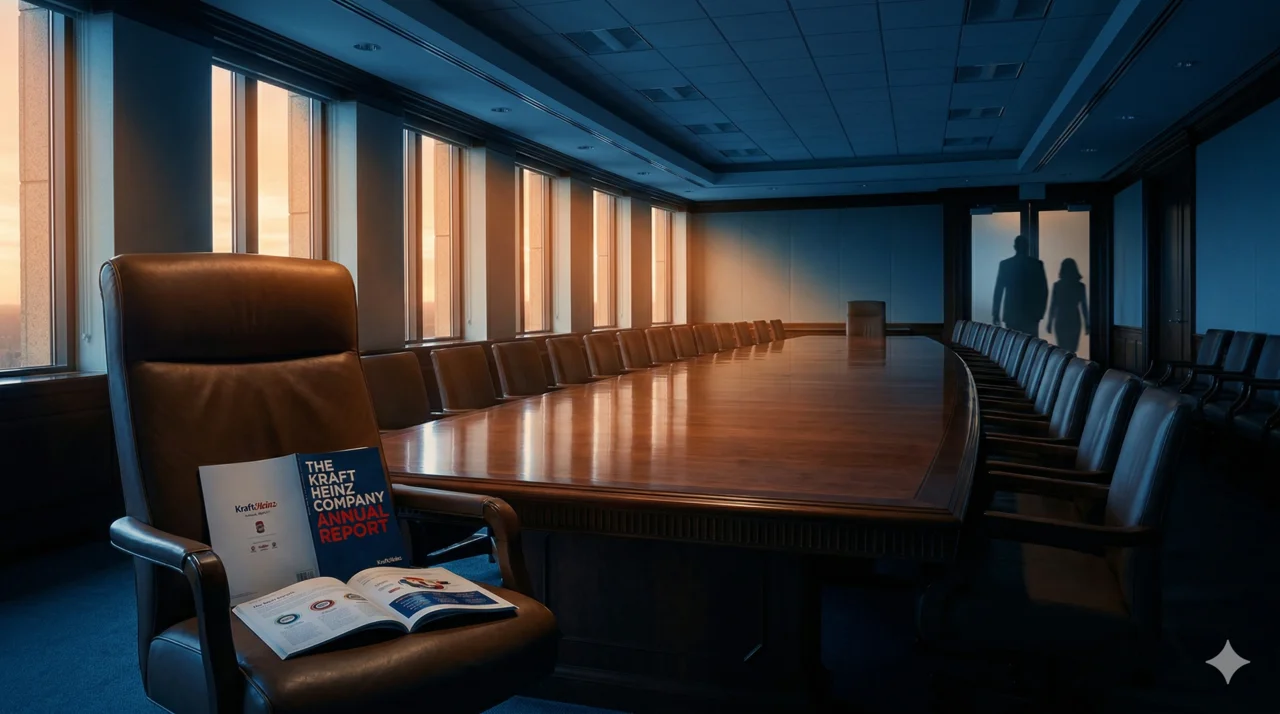
In Berkshire Hathaway's 2013 annual letter, Warren Buffett wrote that the firm "never intends to sell a share" of its newly acquired stake in H.J. Heinz.1 Twelve years, one $46 billion merger, more than $25 billion of company-level impairments, and one CEO succession later, that pledge has been quietly retired. On January 20, 2026, Greg Abel's Berkshire registered all 325,442,152 Kraft Heinz shares for potential resale6 — the most consequential reversal of a Buffett conviction in decades.
Introduction
This piece traces the full arc — from the 2013 Heinz LBO with Jorge Paulo Lemann's 3G Capital to Abel's January 2026 paperwork — and asks the question every Berkshire shareholder should be turning over: what does it mean when the Oracle's permanent holdings stop being permanent? Strip away the headline drama and you find one of the most instructive case studies in modern value investing: a deal that looked like vintage Buffett, executed with a partner he admired, in a category he had championed for decades, that nevertheless became — in his own words — proof that "we overpaid for Kraft."5 The story matters not because Berkshire is going to take a fatal hit (the position is now down to roughly four-tenths of one percent of the company's market cap), but because the divestment will reverberate through Kraft Heinz's stock, set a precedent for other dormant holdings, and reveal a great deal about how Abel intends to run the portfolio Buffett spent six decades assembling. This is the story of how a $12.25 billion gamble1 became Berkshire's textbook lesson in the difference between a good business and a good price.
The 3G Playbook and the Ketchup Titan
When Berkshire and 3G Capital agreed in February 2013 to take H.J. Heinz private at an enterprise value of roughly $23 billion, Buffett did not pretend it was an ordinary acquisition. He called it a "partnership template that may be used by Berkshire in future acquisitions of size,"1 and structured the deal to give Berkshire three different bites at the apple: $8 billion of preferred stock carrying a 9% coupon (with features designed to push the effective return north of 12%), $4.25 billion of common equity for a 50% interest, and warrants that sweetened the package.1 Total Berkshire outlay: $12.25 billion. Lemann's 3G brought the operational doctrine — zero-based budgeting, ruthless cost discipline, the management style that had turned InBev into AB InBev. Buffett supplied the balance sheet and the brand. The two shook hands on what looked, at the time, like the best of both worlds: a Buffett moat run with 3G knives.
The first three years validated the bet. The Heinz preferred was redeemed in June 2016, returning Berkshire's $8 billion at par plus the dividends collected along the way. By then, though, the preferred had become an afterthought. In July 2015, Heinz had merged with Kraft Foods Group in a $46 billion combination that produced The Kraft Heinz Company — a portfolio of brands that walked the aisle of nearly every grocery store in North America.11 Berkshire and 3G held just over half the new entity. On paper, it was the moat-and-knives playbook scaled up to industrial size.
A Merger Built on Cost Cuts
The math of the 2015 merger is where the trouble began, though it took years to surface. Kraft was valued in the combination at a steep premium to its tangible asset base, and the resulting consolidated balance sheet was loaded with goodwill and indefinite-lived intangibles. Buffett described the problem with characteristic clarity in his 2019 admission: "It's still a wonderful business in that it uses about $7 billion of tangible assets and earns $6 billion pretax on that. We paid $100 billion in tangible assets. So for us, it has to earn $107 billion."5 The underlying ketchup-and-cheese operation was a fine business; the price tag was the disaster.
For three years, the 3G machinery masked the issue. Zero-based budgeting squeezed working capital, slashed headcount, and pushed margins to industry-leading levels. Then the playbook ran out. You cannot perpetually reduce marketing spend on consumer brands without erosion; you cannot indefinitely defer R&D in a category where private label is taking shelf space; and you cannot keep raising prices on processed cheese and lunch meat without consumers walking. All three forces hit at once.
The Reckoning of February 2019
On February 21, 2019, Kraft Heinz dropped a bomb on the market: a $15.4 billion non-cash impairment of the Kraft and Oscar Mayer brand values, a dividend cut from $0.625 to $0.40 per quarter, and disclosure of an SEC investigation into procurement accounting.12 The stock fell 27% the next morning. Berkshire's share of the carnage flowed through equity-method accounting: a $3.0 billion non-cash impairment loss in 2018, contributing to a year in which Berkshire reported just $4.0 billion of GAAP earnings.2 Buffett, who had preached patience through worse drawdowns, found himself in the rare position of publicly admitting an error. Asked four days later on Squawk Box whether Berkshire had paid too much, he answered plainly: "We overpaid for Kraft."5 He took pains to specify the target: not Heinz — Kraft. The 2013 deal was not the mistake. The 2015 merger was.
The SEC eventually documented the rot in greater detail. Kraft Heinz had, between Q4 2015 and the end of 2018, manufactured supplier contracts to claim unearned discounts and improperly capitalize procurement costs. A $208 million revenue restatement followed.12 In September 2021, the company paid $62.3 million to settle the agency's charges; a securities class action settled separately for an additional $450 million in cash, gaining final court approval in September 2023.12 Buffett did not own up to those particulars publicly, but he did not need to. The price action had already.
A Steady Drip of Dividends
What is easy to miss in the wreckage is that Berkshire never stopped collecting. Even after the 2019 cut, Kraft Heinz paid $0.40 per quarter on Berkshire's roughly 325 million shares, generating $521 million in annual cash dividends3 from 2019 through 2024 — a stream Berkshire happily booked while the carrying value stayed frozen on the balance sheet. Add in the larger 2018 figure ($814 million)2 and the Heinz preferred coupons collected before redemption, and Berkshire has pulled roughly $3.6 billion in cash out of the position over the holding period — against a $9.8 billion adjusted cost basis.2 That is not nothing. It is, in fact, a low-single-digit annualized cash yield on a position that was supposed to also compound capital.
The carrying-value-versus-market-value chronology tells the rest of the story:
| Year-end | Berkshire carrying value | Market value of stake | Cash dividends to Berkshire | Source |
|---|---|---|---|---|
| 2018 | $13.8B | $14.0B | $0.81B | 2 |
| 2019 | $13.8B | $10.5B | $0.52B | 2 |
| 2020 | $13.3B | $11.3B | $0.52B | 2 |
| 2021 | $13.1B | $11.7B | $0.52B | 2 |
| 2022 | $12.9B | $13.2B | $0.52B | 2 |
| 2023 | $13.2B | $12.0B | $0.52B | 2 |
| 2024 | $13.4B | $10.0B | $0.52B | 4 |
| 2025 | $8.6B | $7.9B | $0.52B | 3 |
For five consecutive years, Berkshire's carrying value exceeded its market value by $1-3 billion, and Buffett each year evaluated the position for impairment and concluded none was required.4 That kind of patience is unusual even for him. It only gave way in 2025 — and then it gave way decisively.
The Final Reckoning of 2025
The summer of 2025 was when the dam broke. On May 19, 2025, Berkshire's representatives on the Kraft Heinz board of directors resigned3 — a quiet but unmistakable signal that the relationship had cooled. Berkshire had held continuous board seats since the original 2013 Heinz transaction; walking away ended a twelve-year direct involvement. Six weeks later, in its second-quarter results, Berkshire took a pre-tax impairment of approximately $5.0 billion on its Kraft Heinz stake, finally writing the carrying value down toward market.3 The Q2 charge — combined with Berkshire's share of the company's own impairment activity in 2025 — produced a full-year equity-method loss of roughly $4.4 billion on the position.3 Greg Abel's first annual letter, released in early 2026, broke decades of internal-letter discipline by naming the failure directly: "Our investment in Kraft Heinz has been disappointing. Even after considering the preferred equity component in our original Heinz investment, our return has been well short of adequate."3 No single sentence in the Abel-era letters has carried more weight.
In September 2025, Buffett added his own postscript when Kraft Heinz announced plans to split itself into two separate companies. Asked for his view, the 95-year-old Buffett delivered the line that should be carved into every value investor's office wall: "It certainly didn't turn out to be a brilliant idea to put them together, but I don't think taking them apart will fix it."10 The market had already wiped out roughly $57 billion of Kraft Heinz's value since the 2015 merger — a 60% decline from the post-merger peak — and the planned breakup was greeted with the skepticism it deserved.10 It was, in its own way, the most Buffett-like sentence Buffett had uttered all year: refusing the easy story, refusing the cheap optimism, naming the structural problem in plain English.

Abel Pulls the Trigger
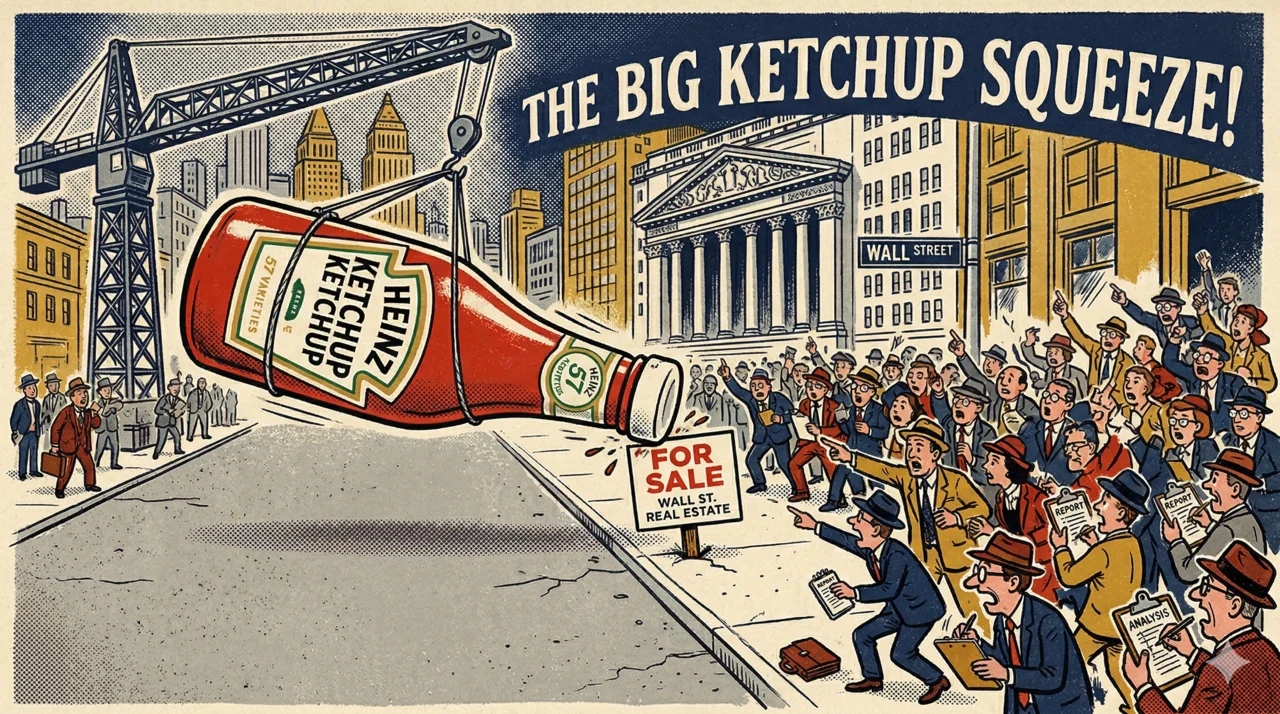
On January 20, 2026 — within weeks of Buffett's formal handoff — Berkshire and Kraft Heinz jointly filed a prospectus supplement registering up to 325,442,152 shares for potential resale by Berkshire, exercising rights under the Registration Rights Agreement that had been in place since the 2015 merger.6 The mechanism does not commit Berkshire to sell anything, but it puts the legal machinery in place to do so without further filings. Kraft Heinz stock dropped as much as 7.5% the same day; analysts at JP Morgan, Morgan Stanley, and UBS cut price targets within 48 hours, framing the registration as "a massive vote of no confidence from the company's largest and most famous shareholder."14 The position the market began the year valuing near $7.6 billion was suddenly worth closer to $7.0 billion at the lower price.7
Then two unexpected things happened. First, on February 11, 2026, Kraft Heinz's incoming CEO Steve Cahillane halted the planned split, announcing instead a $600 million reinvestment program in marketing, R&D, and selective price reductions to rebuild consumer trust.13 Second, in a CNBC interview on March 7, 2026, Greg Abel said publicly that Berkshire had "no immediate plans" to alter its stake — that he agreed with Cahillane's pause and supported the recovery strategy.8 The registration, in other words, sits ready but unused. As of early April 2026, Berkshire still owns the entire 325 million share block. Kraft Heinz stock fell to a six-year low of $21.13 on March 23, 2026, valuing the Berkshire stake at roughly $6.9 billion.13
This is, by some distance, the most significant capital allocation tea-leaf reading exercise of the Abel era — far more revealing than any buyback, the Tokio Marine sale, or any single position adjustment to date. Abel has shown his hand: he is willing to put a 27% block of a Buffett-era investment up for sale within his first month in the corner office. He is also, equally importantly, willing to reverse course publicly when management responds. That is a different temperament from Buffett's, who very rarely commented on portfolio holdings between annual letters.
What a Berkshire Exit Would Mean
If Abel does eventually pull the trigger, the implications run in four directions, each worth thinking through carefully.
Market overhang and price impact. A 325 million share block represents roughly 27% of Kraft Heinz's outstanding common stock. Even in a friendly underwritten secondary, distributing that volume into a market with average daily trading of perhaps 8-12 million shares would require either a deeply discounted block trade, a prolonged dribble-out program, or — most likely — a structured combination of both. Analysts estimate the overhang alone has been suppressing Kraft Heinz's share price by 5-10% since the registration filing.14 An actual sale could push shares meaningfully lower in the short run, ironically realizing more of the loss Berkshire has been trying to defer for years.
Tax mechanics. This is the surprising twist. With Kraft Heinz trading near $22 against Berkshire's roughly $9.8 billion adjusted cost basis, Berkshire is sitting on what looks for tax purposes like an embedded loss rather than an embedded gain. Years of equity-method earnings recognition and dividend distributions complicate the precise basis, but in broad strokes a sale at current prices would produce a capital loss available to offset gains elsewhere in Berkshire's portfolio — of which there are many. The 2025 GAAP impairment did not affect tax basis. In other words, an exit today is closer to a tax shelter than a tax bill — an unusual feature for a Berkshire divestment, and one that materially lowers the friction of pulling the trigger.
Capital redeployment. A $7 billion exit would generate, after-tax, perhaps $7.5 billion of cash that joins Berkshire's already enormous war chest. For Abel — who has been criticized in some corners for a perceived passivity in the early months of his tenure (see ↗) — it would not move the needle on aggregate firepower, but it would free management bandwidth and clean up the portfolio's most-questioned position. The bigger redeployment story is whether Abel uses the proceeds to seed a new long-term position or simply lets the cash rest in T-bills like the rest of the dry powder.
Precedent for the dormant holdings. This is, arguably, the most important implication. Berkshire still carries several long-held positions of debatable conviction: the Coca-Cola stake (held since 1988, untouched since 1994), the American Express stake (since 1991), even legacy slugs of Bank of America and Occidental that have moved sideways for years. None of those is in trouble the way Kraft Heinz was, but each has been described publicly by Buffett as essentially permanent. If Abel demonstrates a willingness to reverse a "never sell" pledge on Kraft Heinz, every other "permanent" holding gets quietly reclassified in the market's eyes. The implication is not bearish — Abel could reasonably trim to fund better opportunities — but it is real, and it is new. Compare with Berkshire's earlier quiet exit from Markel ↗, which set the template: when conviction fades, the position goes, regardless of how good the original logic looked.
There is also a fifth, softer implication worth naming: the mythology of Buffett's permanence has lost its load-bearing wall. The line "Berkshire never intends to sell" was never literally true (see USAir, Markel, the airlines in 2020, the Petrobras stake in the early 2010s), but it carried real signaling weight. The Kraft Heinz registration tells the market that Abel will run the portfolio on conviction, not on legacy — and that, more than any single trade, is the news.
For a granular view of how the economics actually worked over the holding period, the table below summarizes Berkshire's full position P&L:
| Item | Amount | Source |
|---|---|---|
| Initial outlay (2013): preferred + common | $12.25B | 1 |
| Heinz preferred redeemed (June 2016, principal) | $8.0B returned | 1 |
| Adjusted equity cost basis (post-merger) | ~$9.8B | 2 |
| Cumulative cash dividends 2018-2024 | ~$3.6B | 2, 3 |
| Q2 2025 pre-tax impairment | $(5.0)B | 3 |
| Carrying value, December 31, 2025 | $8.6B | 3 |
| Market value, December 31, 2025 | $7.9B | 3 |
| Market value at $22/share, April 2026 | ~$7.2B | 14 |
It is worth pausing on one number in that table that is easy to overlook: the cumulative dividends. Roughly $3.6 billion of cash, collected steadily across some of the most public turbulence in Berkshire's portfolio, did real work in offsetting the capital loss. The position's true total return is meaningfully better than the headline price chart suggests. It is still bad — but it is the difference between "Berkshire's worst public-equity mistake of the modern era" and "a capital allocation lesson that Buffett himself wrote down at twenty cents on the dollar." Reasonable people will land in different places on that distinction.
Conclusion
The Kraft Heinz arc is, in the end, a discipline lesson rather than a disaster. Berkshire is not going to be financially impaired by what happens here — the position is small relative to the company, the cash dividends provided a real cushion, and the embedded tax loss may even help. What Kraft Heinz offers is something rarer than an earnings hit: a clean window into how Greg Abel intends to run the portfolio, and how the next generation of Berkshire management plans to handle the legacy positions Buffett built. The earlier brk-b.com analysis from 2023 ↗ documented the warning signs already flashing two years before the impairment cycle accelerated; the comparison with Buffett's other public mistake in ↗ shows the same pattern of admit-then-exit playing out on a longer time horizon. The difference this time is that the man holding the pen is not Warren Buffett. Heinz sight, as the title says, is twenty-twenty — and the next move belongs to Greg Abel.
References
-
Berkshire Hathaway 2013 Annual Report - berkshirehathaway.com ↩↩↩↩
-
Berkshire Hathaway 2018 Annual Report - berkshirehathaway.com ↩↩↩
-
Berkshire Hathaway 2025 Annual Report - berkshirehathaway.com ↩↩↩↩↩
-
Berkshire Hathaway 2024 Annual Report - berkshirehathaway.com ↩
-
Buffett, after last week's stock plunge, says Berkshire Hathaway 'overpaid' for Kraft - cnbc.com ↩↩↩
-
Berkshire prepares to exit 28% stake in Kraft Heinz as new CEO aims to move on from rare Buffett gaffe - cnbc.com ↩↩
-
New Berkshire CEO Abel quickly signals troubled Kraft Heinz stake could be toast - cnbc.com ↩
-
Berkshire CEO Greg Abel on working with Buffett, Kraft Heinz and using all his salary to buy the stock - cnbc.com ↩
-
Berkshire Has No Plans for Kraft Heinz Stake With Split Halted - bloomberg.com ↩
-
Warren Buffett's $57 billion face-plant: Kraft Heinz breaks up a decade after his megamerger soured - fortune.com ↩↩
-
3G Capital quietly exited its Kraft Heinz investment last year - cnbc.com ↩
-
SEC Charges The Kraft Heinz Company and Two Former Executives for Engaging in Years-Long Accounting Scheme - sec.gov ↩↩↩
-
Kraft Heinz shares drop as investor concern over recovery deepens - foodnavigator.com ↩↩
-
Kraft Heinz slid 6% on Berkshire exit. Is the stock undervalued in 2026? - tikr.com ↩↩