Tags: NetJets / Earnings / History
This fanpage is not officially affiliated with Berkshire Hathaway: Disclaimer
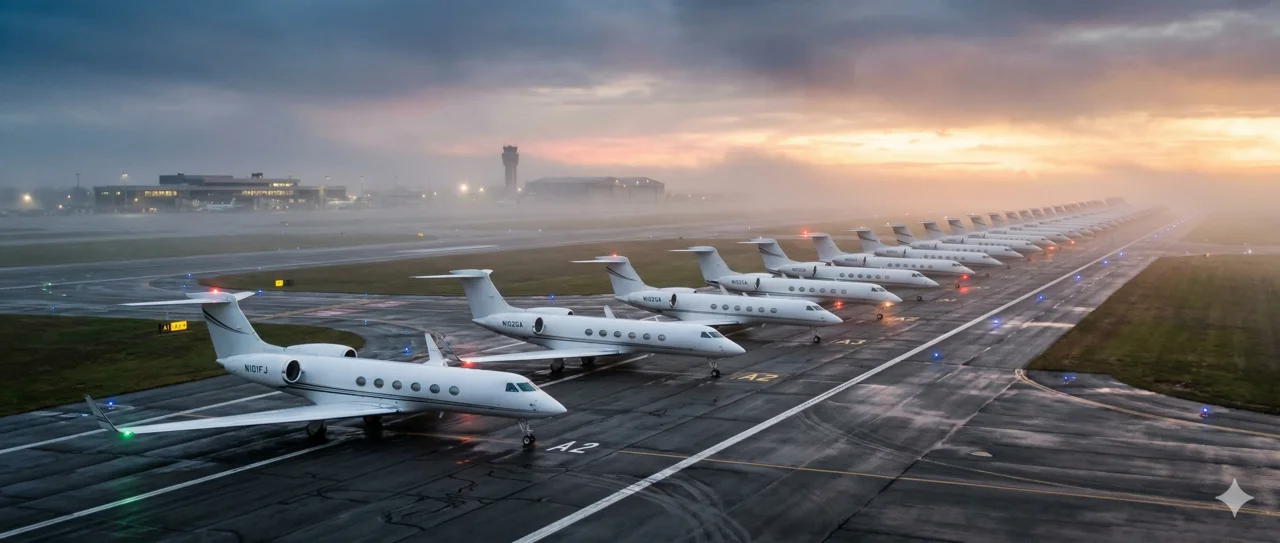
Warren Buffett spent decades railing against corporate jets as monuments to executive vanity. Then he bought one, named it "The Indefensible," and eventually acquired the world's largest private jet company for $725 million 1. Today, NetJets operates nearly 1,100 aircraft across more than 150 countries 2, anchors Berkshire's fastest-growing service segment, and has quietly become one of the most dominant franchise operations in aviation history. It is, by any measure, the most ironic jewel in Berkshire Hathaway's crown.
Introduction — From "Indefensible" to "Indispensable"
The story of Warren Buffett and private aviation reads like a parable about the gap between principle and practice. For years, the Oracle of Omaha preached frugality. "I argued passionately against corporate jets," he wrote in his 1992 shareholder letter 3. Then, in 1986, he quietly spent $850,000 on a used jet. Acknowledging the contradiction, he christened it "The Indefensible" 3.
Three years later, he traded up to a $6.7 million replacement and — without a trace of shame — renamed it "The Indispensable" 3. By 1995, Buffett had become a NetJets customer, buying fractional shares instead of whole aircraft 4. Three years after that, he bought the entire company. The man who once compared corporate jets to Egyptian pyramids now owned the world's largest fleet of them.
This conversion from skeptic to owner is more than a billionaire's punchline. It reveals something essential about Buffett's investment philosophy: when a business model is so compelling that it changes the mind of its loudest critic, it might just be worth $725 million. In the case of NetJets, it turned out to be worth considerably more — though not without a near-death experience along the way. ↗

From Generals to Jet Shares — A Cold War Origin Story
NetJets' origin is far stranger than anything Buffett could have dreamed up. Executive Jet Airways was founded on May 21, 1964, by a group of retired military officers including General Curtis LeMay — the architect of the U.S. strategic bombing campaign in World War II and later a controversial figure in Cold War politics — and General Paul Tibbets, the pilot who dropped the atomic bomb on Hiroshima 4. The founding board also reportedly included the actor James Stewart, himself a decorated WWII bomber pilot 4.
The company muddled along as a charter and management firm for two decades until a Goldman Sachs-trained mathematician named Richard Santulli purchased it in 1984 4. Santulli had an idea that would reinvent private aviation: what if wealthy individuals could buy a fraction of a jet — a 1/16th or 1/8th share — gaining guaranteed access without the headache of full ownership? In 1986, he launched the concept with eight Cessna Citation IIs 4. It was, in essence, a timeshare for the sky.
The fractional model was elegant in its simplicity. Buy a share, pay a monthly management fee, and a jet appears at your chosen airport within four hours. No maintenance bills, no hangar fees, no pilot payroll. Santulli's insight was that most private jet owners fly only 200–400 hours per year, leaving their aircraft idle roughly 90% of the time. Fractional ownership turned that idle capacity into revenue 5.
By the mid-1990s, the "NetJets" brand had caught on with Fortune 500 executives, professional athletes, and high-net-worth families. When Buffett became a customer in 1995, the company was already five times larger than its nearest competitor 1. It was also, crucially, not yet profitable — a detail that would haunt Berkshire for the next decade.
The $725 Million Handshake
In 1998, Berkshire Hathaway acquired Executive Jet Aviation — the parent of NetJets — for $725 million, paid half in cash and half in Berkshire stock 1. At the time of acquisition, the fleet comprised roughly 95 aircraft serving over 700 customers 1. Buffett saw "huge potential" in the fractional ownership concept and kept Santulli on as chairman and CEO 1.
The deal was classic Buffett: buy a dominant operator in a growing niche, trust the founder to keep running it, and let Berkshire's capital provide the runway for expansion. What he didn't anticipate was that Santulli's aggressive fleet expansion — ordering new planes faster than customer demand warranted — would create a financial sinkhole that lasted more than a decade.
Between 1998 and 2009, NetJets accumulated $157 million in aggregate pre-tax losses 1. In the good years, it earned modest profits. In the bad years — particularly during recessions when wealthy clients sold back their shares — it hemorrhaged cash. The global financial crisis of 2008–2009 delivered the knockout blow: a single-year loss of $711 million in 2009 1 6.
"I failed you in letting NetJets descend into this condition," Buffett confessed in his 2009 shareholder letter 1. It was one of the more candid admissions of the Buffett era. Without Berkshire's deep pockets, NetJets would have filed for bankruptcy — a fate that had already befallen several smaller competitors.
The Sokol Rescue and Johnson Era
Berkshire dispatched David Sokol, a hard-nosed operator who ran the company's utility operations, to stabilize NetJets in August 2009. Sokol diagnosed two problems immediately: too many aircraft had been purchased on speculation, and the management structure was too informal for an operation of NetJets' scale 6. He laid off roughly 1,000 employees, renegotiated supplier contracts, and imposed rigorous financial discipline 6.
The turnaround was swift. NetJets returned to profitability in the first quarter of 2010, swinging from a $711 million loss to a $207 million pre-tax profit for the full year 1 6. By 2011, earnings reached $227 million 1. Sokol had proven that the business model worked — it just needed a manager who could say "no" to shiny new aircraft. Ironically, Sokol himself departed Berkshire in 2011 amid a stock-trading controversy related to the Lubrizol acquisition, but his rescue of NetJets remains one of the more impressive turnarounds in Berkshire's subsidiary history.
After a transitional period under Jordan Hansell — marked by contentious negotiations with the pilot union, including a 2015 picket of the Berkshire annual meeting by some 400 pilots 7 — Adam Johnson was named chairman and CEO in June 2015. Johnson was 44, a licensed pilot, and a NetJets lifer who had joined the company in 1996, just a year after Buffett first became a customer 7.
Johnson inherited a company that was profitable but still punching below its weight. Over the next decade, he transformed it. Employee headcount grew from 6,540 to over 9,400 2. Flight hours climbed relentlessly. And Greg Abel, in his first annual letter as Berkshire CEO in early 2026, singled out Johnson by name: "Adam and his team at NetJets think like owners and earned their reputation for operational excellence over the past decade" 2. Abel added that Johnson's team had "transformed NetJets from a challenged business model into a successful enterprise that delivers value for Berkshire shareholders" 2. ↗
The Numbers at Altitude
Berkshire does not report NetJets as a standalone line item. Instead, it is bundled with FlightSafety International under "aviation services" within the broader Service Group segment. But the trajectory is unmistakable. ↗
| Year | Service Group Revenue | Service Group Pre-Tax Earnings | Aviation Services Revenue Growth |
|---|---|---|---|
| 2022 | $19.0B8 | ~$3.0B8 | — |
| 2023 | $20.6B8 | $3.0B8 | — |
| 2024 | $20.7B9 | $2.3B9 | +9.1%9 |
| 2025 | $23.0B2 | $2.7B2 | +9.9%2 |
The 2024 earnings dip — a 23% decline to $2.3 billion — reflected rising costs across flight crew compensation, maintenance, fuel, and depreciation rather than any softening in demand 9. By 2025, margin recovery was underway, with pre-tax earnings rebounding 17.2% to $2.7 billion 2. Flight hours surged 11.3% in 2025, with NetJets adding 53,737 flight hours — an increase so large it would rank as the eighth-biggest private jet operator in the country all by itself 2. ↗
King of the Skies — Market Dominance
NetJets' competitive position is not merely strong — it is overwhelming. In 2024, NetJets logged 665,349 flight hours, capturing 12.7% of all industry flight hours and ranking as the world's largest private jet operator by a wide margin 10. Its nearest competitor, Flexjet, managed 237,819 hours 10. Together, NetJets and Flexjet control more than 80% of the fractional ownership segment 10.
| Operator | 2024 Flight Hours | Market Share (All Private Aviation) |
|---|---|---|
| NetJets | 665,34910 | 12.7%10 |
| Flexjet | 237,81910 | 4.5%10 |
| Vista Global (VistaJet) | ~118,00010 | ~2.2%10 |
| Wheels Up | ~108,00010 | ~2.1%10 |
The customer base tells a similar story. As of late 2024, NetJets served approximately 12,500 fractional, lease, and jet card customers — over 10,200 in North America and 2,200 in Europe 11. More than 40 Fortune 100 companies are NetJets clients 11. The company operates roughly 1,400 flights per day across its global network 11.
What makes this dominance particularly interesting from an investment perspective is the sheer size of the untapped market. A McKinsey study from 2020 found that 93% of individuals who could afford private aviation were not using it 11. Fractional ownership — with its lower entry cost and reduced hassle compared to whole aircraft ownership — is the industry's best tool for converting that latent demand. And fractional is growing: the segment expanded 11% internationally in 2023–2024, while the overall private jet industry grew just 0.2% 11.
As NetJets President Patrick Gallagher put it: "I would argue that for most people who own their own airplane, it really doesn't make financial sense for them" 11. The pitch is simple — why own a $60 million jet that sits idle 90% of the time when you can buy a 1/16th share for under $1 million?
A Fleet for the Future
NetJets is not resting on its dominance. The company has committed to an aircraft procurement pipeline that dwarfs anything in private aviation history. In 2023, NetJets and Textron Aviation signed a record-breaking agreement for up to 1,500 Cessna Citation jets over 15 years — a deal estimated at roughly $32 billion at list prices 12. The order includes the Citation Ascend, a new model for which NetJets is the fleet launch customer, with deliveries beginning in 2025 12.
This follows the 2012 order — then the largest in private aviation history — for 425 firm aircraft worth $17.6 billion from Bombardier and Cessna 13. NetJets has also ordered 24 Bombardier Global 8000 ultra-long-range jets, with the first delivery arriving in March 2026 14. Across all manufacturers, the total order pipeline approaches 2,000 aircraft in firm orders and options 12 14.
The fleet today stands at over 800 owned aircraft 15, with Abel's 2026 annual report citing "nearly 1,100" when including managed and partner aircraft across the global network 2. In just the first months of 2026, NetJets added a net 19 aircraft, with roughly 80 more deliveries expected through the year 15. Well over half of 2026 deliveries were pre-sold to existing owners before the year began 16.
On the sustainability front, NetJets purchased 19.4 million gallons of Sustainable Aviation Fuel in 2024 — roughly doubling the prior year and more than any other player in private aviation 17. The company claims SAF reduces lifecycle CO2 emissions by up to 80% 17, a critical talking point as private aviation faces increasing scrutiny over its carbon footprint.
What It Costs to Fly Like Buffett
For the curious shareholder, here's what NetJets membership actually looks like. The entry-level fractional share — a 1/16th interest in a light jet like a Phenom 300 — runs approximately $750,000 to $850,000 upfront 5. On top of that, owners pay a monthly management fee of roughly $12,000 to $35,000 depending on aircraft type, plus an occupied hourly rate of $8,500 to $18,500 per flight hour 5. All in, the first year for an entry-level share costs north of $830,000 5.
For those who prefer not to commit to ownership, NetJets also offers jet card programs starting at approximately $215,000 annually for 25 hours of flight time 11. It is not, in other words, a product for the merely affluent. It is a product for the genuinely wealthy — which is precisely why the economics work. NetJets customers are not price-sensitive; they are time-sensitive. And time, as Buffett has spent a career demonstrating, compounds.
Conclusion
The NetJets story is, at its core, a vindication of Berkshire's model. Buy a dominant business. Survive the inevitable crisis — in this case, a $711 million loss that would have killed any standalone company. Install the right manager. And let compound growth do its work over decades.
From its improbable founding by atomic-bomb pilots and Hollywood actors in 1964, through Santulli's visionary fractional model in the 1980s, near-bankruptcy in 2009, and Adam Johnson's patient decade of operational excellence, NetJets has emerged as something rare in Berkshire's portfolio: a business that is simultaneously the undisputed market leader, the fastest-growing segment of its industry, and still staring at a total addressable market that is 93% untapped.
Buffett renamed his jet "The Indispensable" as a joke. Four decades later, NetJets has made the name a statement of fact.
References
-
Buffett on 25 years+ of owning NetJets - corporatejetinvestor.com ↩↩↩↩↩↩↩↩↩↩
-
NetJets receives wide praise by Abel in first Berkshire annual report - privatejetcardcomparisons.com ↩↩↩↩↩↩↩
-
Warren Buffett nicknamed his jet 'The Indefensible' - sentinel-aviation.com ↩↩↩
-
How much does NetJets cost in 2026 - privatejetcardcomparisons.com ↩↩↩↩
-
Sokol Restores NetJets to Profitability - rationalwalk.com ↩↩↩↩
-
Buffett's NetJets Lures Its Former Leaders Back - bloomberg.com ↩↩
-
Rate, fleet gain power NetJets; Berkshire Hathaway profits up 34% - privatejetcardcomparisons.com ↩
-
NetJets' parent Berkshire Hathaway earnings surge to $47.4 billion - privatejetcardcomparisons.com ↩
-
2024's 30 Biggest Charter/Fractional Private Jet Companies Ranked - privatejetcardcomparisons.com ↩↩↩
-
Why corporate travelers are turning to partially-owned private jets - fortune.com ↩↩↩↩↩↩↩
-
Textron Aviation and NetJets sign record-breaking fleet agreement - media.txtav.com ↩↩↩
-
NetJets Announces Largest Private Aviation Order in History - businesswire.com ↩
-
NetJets Becomes Fleet Launch Customer for Bombardier's Global 8000 - bombardier.com ↩↩
-
NetJets has increased fleet size by net 19 private jets so far in 2026 - privatejetcardcomparisons.com ↩↩
-
NetJets has pre-sold 'well over half' of expected 2026 deliveries - privatejetcardcomparisons.com ↩
-
NetJets 'roughly doubles' Sustainable Aviation Fuel in 2024 - privatejetcardcomparisons.com ↩↩