Tags: Comments / Gold / Cash
This fanpage is not officially affiliated with Berkshire Hathaway: Disclaimer
In January 2024 we asked which asset class won the 2002-2024 race — gold, Berkshire Hathaway, or the S&P 500 — and found a remarkably tidy three-way tie at roughly 9% per year. Twenty-eight months later the standings have lurched in directions no one was predicting, and stretching the lens back to 1988 changes the picture again. The composite finding: Berkshire has reverted to its 38-year mean against the S&P 500. The S&P 500 hasn't reverted to anything. And a record cash pile is sitting on the sidelines for a reason that becomes more obvious each quarter.
Introduction
The original 2024 piece ↗ argued that the 22-year stretch from 2002 to early 2024 had been kinder to gold than the Buffett-Kiyosaki spat would suggest. From January 2002 to January 2024, Berkshire's Class B compounded at 9.0% per year, gold at 9.1% per year, and the S&P 500 total return at 8.3% per year 1. A defensive yellow metal had nearly matched the world's most celebrated compounding machine. That finding deserved an update.
The update deserves a longer ruler. We now have monthly data running from January 1988 — using BRK-A divided by 1,500 to synthesize a pre-1996 Class B price, then BRK-B itself from May 1996 onward 1. The 1988 anchor matters in the same way 2002 mattered to the original piece. The Berlin Wall was still standing. Reagan was wrapping up his second term. The S&P 500 finished 1987 at 247 after the October crash. Buffett was 57, with the Coca-Cola purchase that would define a generation of his investing about to begin in earnest.
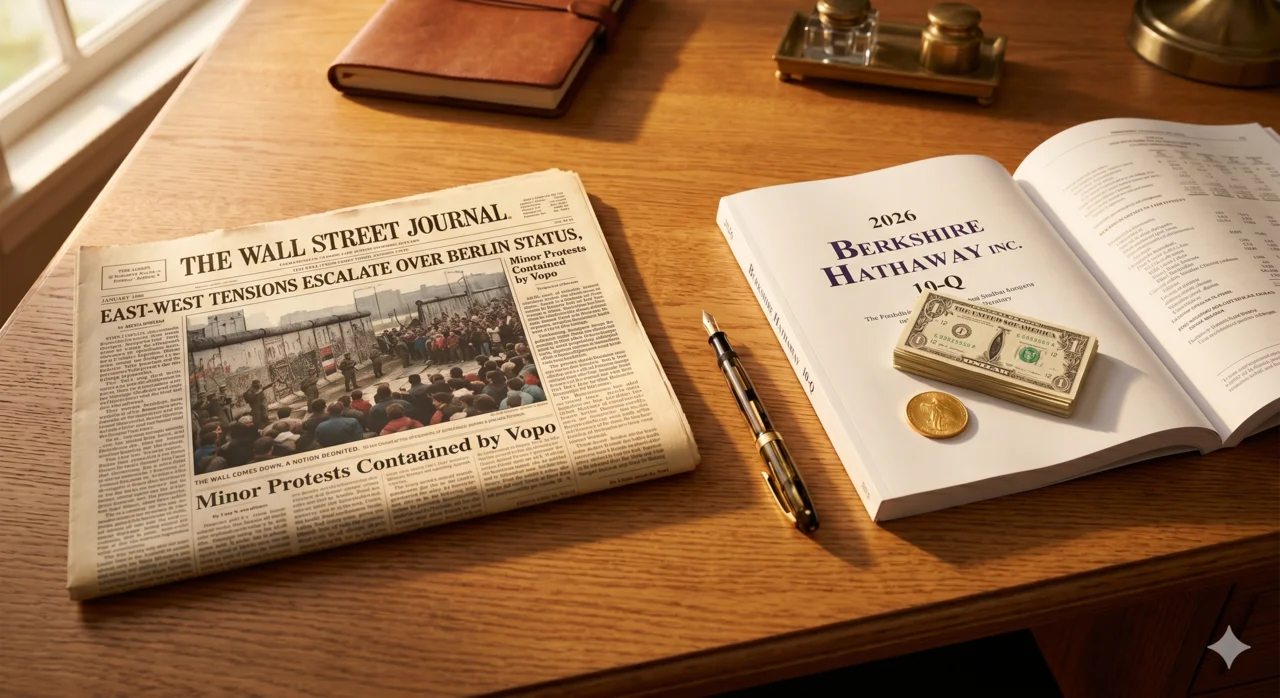
Stretching the comparison this far back is not just cosmetic. It changes the structural facts. So does what has happened in the past 28 months: Buffett stepped back, Greg Abel took the wheel, Berkshire's cash pile cleared the $397 billion mark 2, and the S&P 500 finished its boldest concentration episode in modern history with AI capex spending that beggars analogy.
Let's walk through it.
The 38-Year Race
The cleanest way to see Berkshire's long arc against the index is on a log scale.
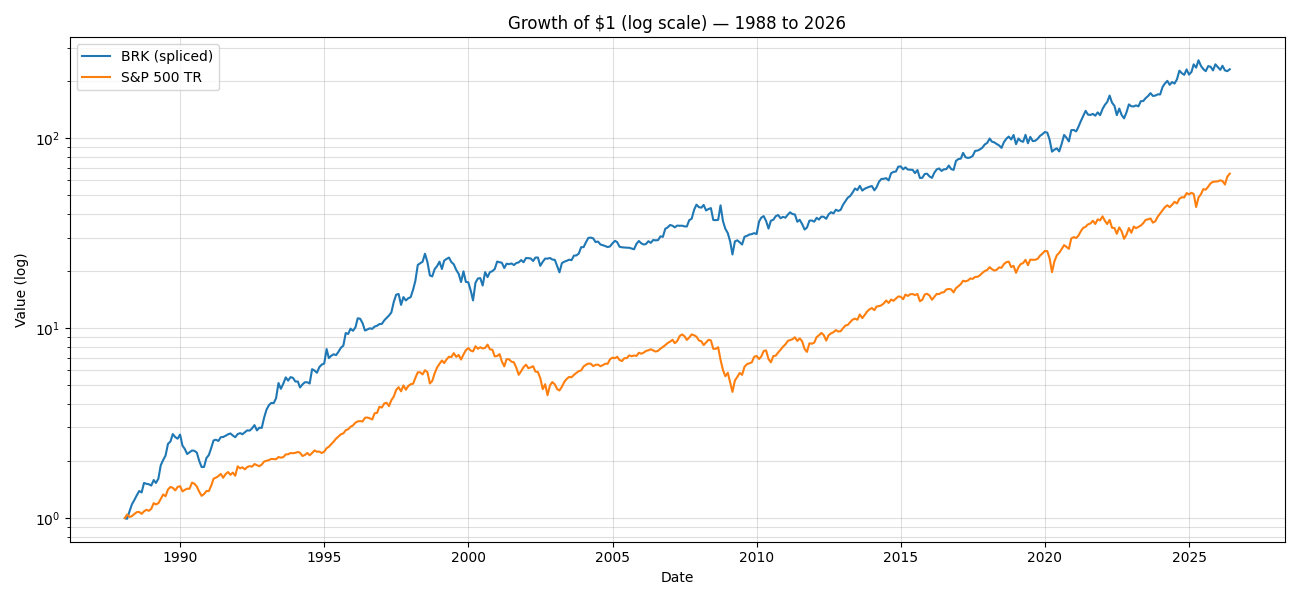
A dollar placed in Berkshire on the first business day of 1988 was worth roughly $240 at the end of April 2026. The same dollar in the S&P 500 total return index — dividends reinvested — was worth about $65 1. Berkshire compounded at 15.37% per year over 38 years. The S&P 500 total return delivered 11.51% per year. The 3.86-percentage-point gap was real, durable, and earned.
But the average is misleading without the slices.
| Window | BRK CAGR | S&P 500 TR CAGR | BRK − SPX |
|---|---|---|---|
| 1988-1998 (Buffett-Munger prime) | 33.4% | 18.7% | +14.7 pp |
| 1999-2008 (the great unwind) | 4.0% | 0.5% | +3.5 pp |
| 2010-2026 (post-split era) | 12.0% | 14.8% | −2.8 pp |
| Full 38 years (1988-2026) | 15.4% | 11.5% | +3.9 pp |
The pattern is hardly subtle. Berkshire's entire outperformance was front-loaded into the Buffett-Munger prime. Between 1988 and 1998 the company tripled the S&P's rate of return. By the late 1990s it was already a behemoth and started lagging; the dot-com bust handed it another decade of relative outperformance because the S&P went nowhere. Then post-2010, with the company past $200 billion in equity and unable to redeploy in size, the index has actually been ahead by 2.8 percentage points per year 1.
It is the kind of pattern that should make a value-investor humble. The "Buffett can't beat the index anymore" trope is wrong on the long sweep, but accurate on the recent sweep. Both can be true. Most patriotic shareholder narratives gloss over that.
Today: Berkshire Has Reverted
What does the price of Berkshire look like relative to the index it is so often compared to? Take the ratio BRK / S&P 500 total return, monthly, since 1988.
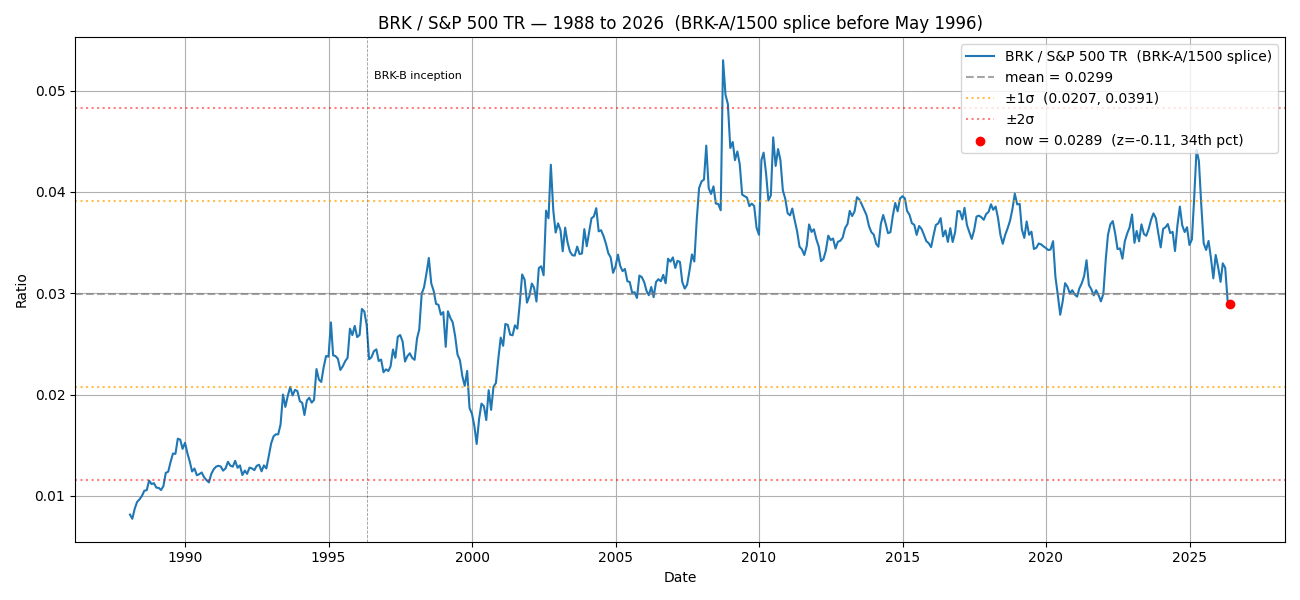
The ratio's 38-year mean is 0.0299, with the one-sigma band running from 0.0207 to 0.0391 1. The May 2026 reading is 0.0289 — fractionally below the mean. The 34th percentile of all months on record. There is nothing alarming, nothing climactic, nothing screaming buy-or-sell about Berkshire's standing against the index when you measure it over the full Cold-War-to-now stretch.
Two things sharpen that read. Against the post-2010 regime alone, the same 0.0289 sits at the 0.9th percentile — essentially the floor of the modern era, equalled but not breached without an actual crisis. This is the basis on which one could fairly say Berkshire is at a 16-year low against the index. And against the 1999 floor of 0.0142 — the deepest the ratio ever went, mid-dot-com — today's reading is only halfway down. We are not at that extreme. Yet.
Now overlay the rolling 10-year CAGR for each:
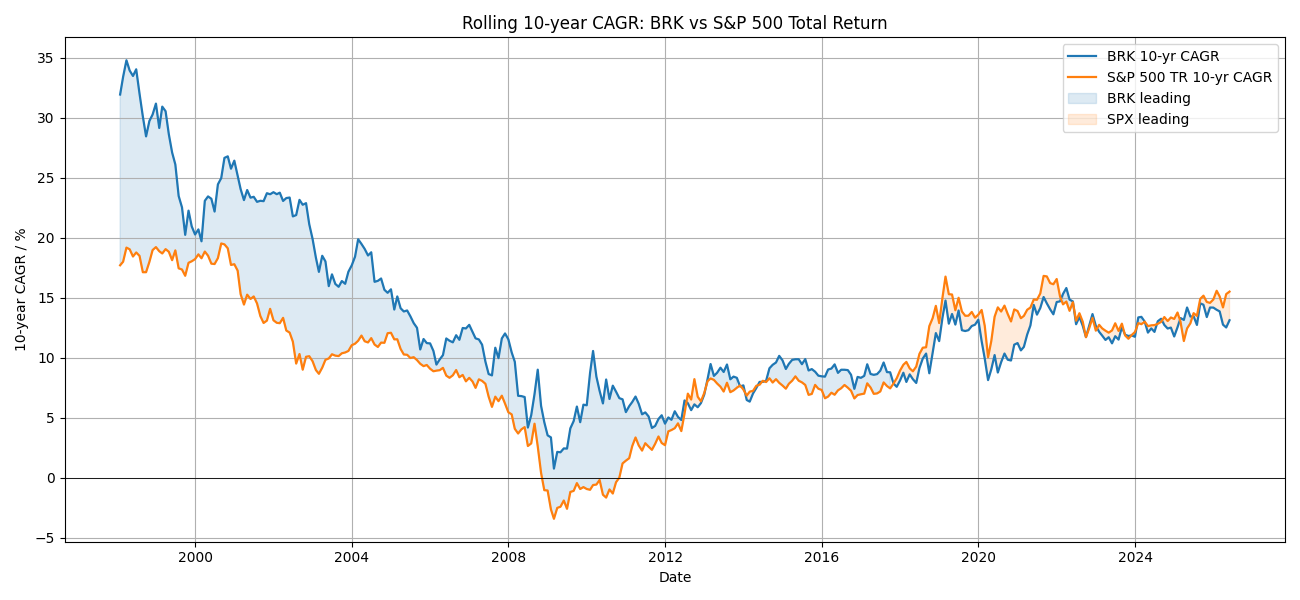
Across 38 years, Berkshire's trailing 10-year return has been ahead of the S&P 500's in 71% of all months 1. The index has led for only 29% — pretty much all of it concentrated in the late 1990s and the post-2018 stretch we are in now. Today's spread of −2.4 percentage points (BRK 13.1% vs SPX 15.5% on the trailing decade) is not a freak outlier, but it is unusual against the long record.
The honest summary of where Berkshire stands in May 2026: not cheap, not expensive, but in the rare lower quartile of its own modern relationship with the S&P 500, and lagging on the 10-year scoreboard for the first sustained stretch since the dot-com peak. After fifteen years of trading at a premium to its long-term mean against the index, mean-reversion has done its work. The premium is gone.
A Cash Pile and a Restart Button
If Berkshire's market price has reverted to its long-term mean, what is the company doing about it from the inside?
The numbers from the Q1 2026 10-Q 3:
| Metric | March 31, 2026 | Comparison |
|---|---|---|
| Cash & T-bills (gross) | $397.4 B | All-time record; up from $381.6 B at Sept 30, 20252 |
| Cash & T-bills (net of unsettled) | $373.5 B | As stated in the 10-Q MD&A3 |
| Insurance float | $176.9 B | Up ~$0.5 B from year-end 20253 |
| Q1 2026 operating earnings | $10.1 B | Vs $4.6 B in Q1 20253 |
| Q1 2026 stock repurchases | $235 M | First buyback since Q2 2024; zero in all of 20253 |
| Equity portfolio fair value | $288.0 B | Down from $297.8 B at year-end 20253 |
Two items in that table matter more than the others.
The $235 million Q1 buyback is the strongest valuation signal in the report. Buffett's stated repurchase rule, in force since 2018, has been to buy shares only at prices clearly below his estimate of intrinsic value. Berkshire bought back nothing — not a share — for 21 straight months between Q2 2024 and March 2026. Then, in the final two weeks of March 2026, 33 Class A shares at an average $729,701 and 431,462 Class B shares at $486.92 3. Modest as it is, that purchase says management thinks the stock has finally crossed into discount territory. Compare it to the silence of all of 2025. ↗
The Apple position is now $62 billion, down from $174 billion at peak in 2023 4. A 64% reduction in dollar value over roughly two and a half years, by trimming the share count from a peak of about 905 million to 228 million at year-end 2025. Buffett and Abel sold three out of every four Apple shares they owned. The cleanest expression of "we like productive assets, but we don't like that productive asset at this price."
A new and small position in Alphabet — about $4.3 billion initiated in Q3 2025 5 — represents Berkshire's only sustained AI-cloud equity bet. Less than 2% of a $288 billion portfolio. In Abel's first letter to shareholders as CEO, dated February 2026, he wrote: "Many times in Berkshire's history, some observers have suggested that our substantial cash position signals a retreat from investing. It does not." 6 His framing for the cash pile is intentional and deliberate, with a stated preference for ownership of productive businesses over U.S. Treasuries. The buyback restart is the first concrete capital deployment beyond bolt-on M&A since the handoff.
He also put one Buffett-era axiom in writing more starkly than usual: "The CEO is responsible for serving as Chief Risk Officer — there is no more important duty." 6 If you wanted a one-line summary of the Abel investment style, that is it.
The Shovelmaker's Cut
Berkshire's equity book has not gone all-in on AI. Apple is down, Alphabet is small. Where the company is deploying capital into the AI buildout — quietly and at meaningful scale — is on the regulated side, through Berkshire Hathaway Energy.

The BHE 2025 10-K, filed February 27, 2026, breaks out three-year capital expenditure plans by type 7. The shift between the 2023-2025 actuals and the 2026-2028 forecast is the cleanest statement of strategy in the entire Berkshire complex:
| Capex category | 2023-2025 actual | 2026-2028 plan | Change |
|---|---|---|---|
| Electric transmission & distribution | $12.2 B | $15.8 B | +29% |
| Solar generation | $1.6 B | $2.8 B | +82% |
| Electric battery storage | $907 M | $197 M | −78% |
The battery storage line is the eyebrow-raiser. BHE plans to spend $192 million on battery storage in 2026, $5 million in 2027, and zero dollars in 2028 7. A company with $397 billion in cash sees so little business case for novel grid-scale storage that it is winding the line item down to nothing.
The transmission and distribution buckets, conversely, are accelerating. BHE is pouring nearly $16 billion over three years into copper wire, transformers, and substations — the physical machinery that delivers electricity from generation to consumption. In Abel's words from his February letter: "Infrastructure built for hyperscalers and data centers must be paid for by those customers and reflect the risks tied to step-changes in long-term demand. BHE will pursue this incremental growth and invest our shareholders' capital only when those risks and rewards are appropriately balanced." 6
This is the Berkshire playbook in its purest form. ↗ Transmission and distribution earn a regulated return, usually 9-10% on the asset base, paid for by ratepayers and approved by state commissions. The risk sits with the regulator and the customer. Battery storage, by contrast, requires forecasting future energy-arbitrage spreads, lithium prices, technology curves, fire-suppression liabilities, and load patterns no one fully understands yet. The return is uncertain. The risk lands on the balance sheet.
Berkshire is letting Google, Microsoft, Tesla, and a fleet of mid-cap utilities take the technology risk of figuring out which battery chemistry wins. When the technology is boring, predictable, and standardized — when, as the Buffett-Munger formulation went, the swings are mostly behavior, not surprise — Berkshire can deploy $50 billion overnight to buy the leader or build a hundred plants. They are paying for the privilege of waiting.
In Greg Abel's annual-meeting reply on May 3, 2026, the framing was even sharper. "We're going to be a builder of technology, rather than just a buyer of technology," he told shareholders, before adding: "We're not going to do AI for the sake of AI." 8 BHE is the shovelmaker. The hyperscalers are the prospectors. The transcontinental analog from 1850s California — Levi Strauss and Sam Brannan getting rich selling pickaxes and denim while most prospectors went broke — is too on-the-nose to ignore.
Add the context: BHE's subsidiary PacifiCorp faces approximately $50 billion in outstanding wildfire claims as of year-end 2025, has paid $738 million in jury verdicts to date, settled federal claims for $575 million in February 2026, and carries $2.85 billion in cumulative reserves 9. No CEO who took over BHE in the middle of that existential fight is going to take on speculative technology risk on top.
The S&P 500 at a Generational Extreme
Berkshire's relative valuation only matters if the comparison stock is itself reasonably valued. So is the S&P 500.
By every traditional measure the index is somewhere between expensive and the most expensive it has ever been:
| Metric (May 2026) | Current | Historical context |
|---|---|---|
| Shiller CAPE | 42.18 | 99.2nd percentile since 1871; only exceeded during Jan 1999 - Sept 200010 |
| Buffett indicator (mkt cap / GDP) | ~233% | All-time high; 2000 peak ~150%, 2021 peak ~200%11 |
| Top-10 S&P weight | 35.6% | March 2000 peak ~27%; most concentrated index in modern history12 |
| "Magnificent 7" weight alone | 30.4% | Effectively 54 stocks doing the work of 50312 |
CAPE — Robert Shiller's cyclically-adjusted price-to-earnings ratio, which divides price by the 10-year inflation-adjusted average of earnings — is the cleanest metric for "are we paying too much?" The current 42.18 reading has been matched in precisely one prior period since 1871: the dot-com bubble between January 1999 and September 2000 10. Shiller's own current forecast for the next decade of S&P 500 returns, published in late 2025, is 1.3 to 1.5 percent per year nominal. "Another lost decade," in his phrasing 13. He is not predicting a crash. He is predicting that today's prices already capture a decade of future profit growth.
The chart that brings this home is the scatter of every monthly observation since 1988, with the BRK / S&P TR ratio on the y-axis and Shiller CAPE on the x-axis:
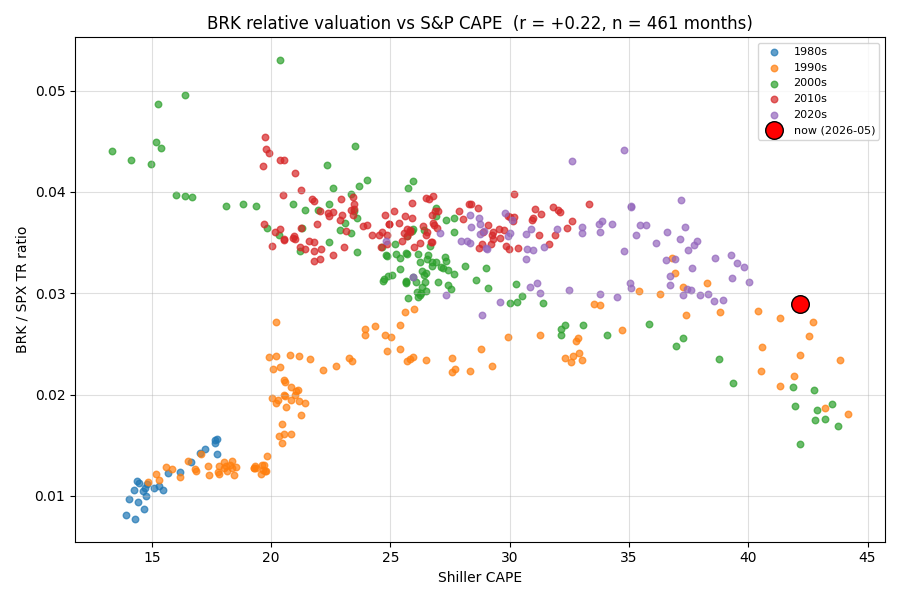
The 2020s cohort (purple) and the late-1990s cohort (orange) occupy the same region of the chart: CAPE above 35, BRK/SPX ratio below 0.030. Berkshire trades at a relative discount when the index is at a relative premium. Today's red marker sits in the 1999-2000 cluster. That is not a prediction. It is a portrait.
Now the AI engine driving the concentration extreme. The four hyperscalers — Microsoft, Alphabet, Amazon, Meta — spent roughly $240 billion on capex in 2024. The 2025 actual came in at $400-410 billion. The four guided capex for 2026 totals $700-725 billion 14. Combined hyperscaler capex tripled in two years. Goldman Sachs forecasts $1.15 trillion cumulative across 2025-2027. Morgan Stanley estimates 2026 hyperscaler capex alone will exceed the entire non-tech S&P 500's capex from 2025 14.
Nvidia, the shovelmaker of the AI boom in the literal silicon-and-rack sense, posted $130.5 billion in data-center segment revenue in fiscal 2025 — up 114% year-over-year — and reported $68.1 billion of total revenue in Q4 fiscal 2026 alone 15. The capex these hyperscalers are putting in the ground will require enormous electricity. Hence transmission and distribution. Hence BHE's $15.8 billion three-year plan. The shovelmaker buys from another shovelmaker.
Whether AI capex will ever earn returns on capital remotely comparable to what the hyperscalers project is the open question of this decade. Berkshire is silent on that question by design. The company owns enough Apple to participate in any consumer-AI tailwind, a small Alphabet stake for cloud exposure, and zero pure-play AI infrastructure equity. It is choosing instead to underwrite the enabling infrastructure — substations, transformers, the wires themselves — at regulated 9-10% returns, while the prospectors gamble on what the gold will be worth when they dig it out.
Macro adds context. The U.S. effective tariff rate sits at approximately 11.8%, the highest level since the 1930s 16. The Fed funds rate has been held at 3.50-3.75% for three consecutive meetings as core CPI continues to print above 2.7% 17. The CBO projects fiscal 2026 deficits at $1.9-2.0 trillion, around 5.8% of GDP, with federal debt held by the public crossing 101% of GDP this year 18. Inflation has not been beaten. Deficits have not been narrowed. The two-decade tailwind of disinflation and falling rates has reversed.
Through all of which the index is at CAPE 42 and the Buffett indicator is at 233%. The market is paying record multiples for record-concentrated earnings, against record fiscal slippage, in a regime where the Federal Reserve is on hold and the central banker who got us here just stepped down. Pick your metaphor. The patient is on every painkiller in the cabinet.
Gold, Again
In our 2024 article we asked whether productive assets could outrun "god's money" — a phrase gold bugs use without irony to describe what they consider monetary truth in metal. The answer at the time was: roughly yes, by a hair. From 2002 to early 2024, Berkshire compounded at 9.0% per year and gold spot at 9.1% per year. A statistical tie.
The 1988 anchor changes the verdict. Stretching back another 14 years catches the entire gold bear market of the 1980s and 1990s, before the metal began its 2000s reawakening. From 1988 to today, gold returned approximately 6.2% per year — a fraction of either Berkshire or the S&P 500. The "tie" of the 2002-2024 window was a story of two early-2000s starting points happening to land in convenient places.
The chart of equities-priced-in-gold-ounces tells a more interesting story:
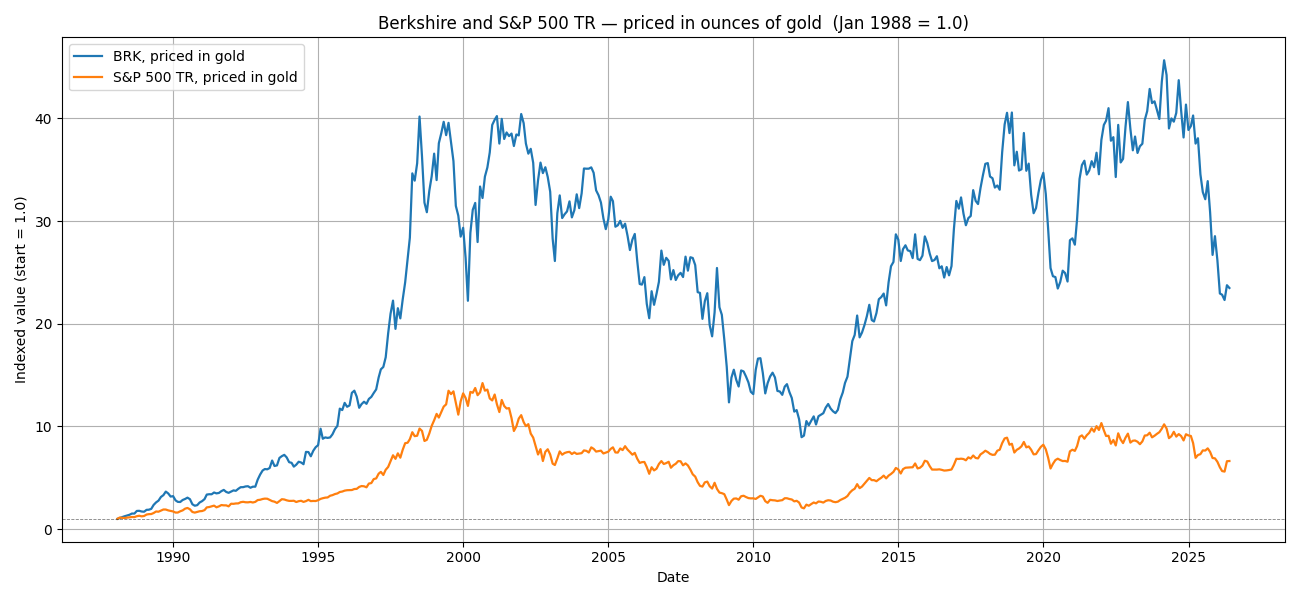
Three regimes, sharply defined:
| Window | BRK in gold ounces | SPX TR in gold ounces |
|---|---|---|
| 1988 → 2026 | 23.5× | 6.6× |
| 2002 → 2026 | 0.59× | 0.64× |
| 2010 → 2026 | 1.51× | 2.26× |
From the perspective of 1988, equities crushed gold. From the perspective of 2002 — catching the bottom of gold's bear and the climb of the dot-com bubble — both Berkshire and the S&P 500 have lost about 40% of their purchasing power in gold ounces. From the perspective of 2010, equities won again. Start-date determines verdict.
What is true regardless of start date: the past 28 months have been the kind of gold rally that gets central bankers nervous. The metal traded above $4,500 per ounce in May 2026, with a peak above $5,500 earlier in the year. Net central bank gold purchases ran above 1,000 tonnes annually in 2022, 2023, and 2024 19 — the three highest readings since the 1970s. In 2024, gold became the world's second-largest reserve asset by market value, behind only the U.S. dollar 19. The dollar's share of global FX reserves fell to 56.8% by late 2025, the lowest since 1994 — a quiet, twelve-year drip that no Treasury Secretary has publicly addressed.
Gold's signal is not that the dollar is dying. It is that the world's central banks have decided to hold a fraction less of it. That is a behavioral fact about institutional skepticism. It happens to coincide with CAPE at 42 and equities priced in gold worth 40% less than they were a quarter-century ago. The reader may draw conclusions.
Conclusion
The 2024 article ended on a recommendation to diversify. Twenty-eight months later, the structural picture is sharper and a little more uncomfortable.
Berkshire Hathaway has reverted to its long-term mean against the S&P 500 — a 38-year-old relationship that has done what mean-reverting relationships do. After fifteen years of trading at a 15-30% premium to its 1988-2026 average, the relative-valuation gap has closed. On 10-year rolling CAGR, the S&P now leads by 2.4 percentage points for the first sustained stretch since the late 1990s. Berkshire's intrinsic value engine is unchanged. The relative price has compressed.
The S&P 500, meanwhile, has compressed nothing. By every reasonable valuation measure — Shiller CAPE, Buffett indicator, index concentration, hyperscaler capex absurdity — it is at a level matched only by 1929 and 1999-2000. Shiller's own model puts the next decade of S&P returns at 1.3 to 1.5 percent nominal. The mathematical case for owning the index at these prices is rougher than it has been at any point since the dot-com peak.
Greg Abel has responded the way one would expect a Buffett protégé to respond. With patience. With $397 billion of dry powder. With a small Alphabet stake, a 64% trim of Apple, and $16 billion in regulated infrastructure capex aimed squarely at AI's electricity bill. ↗ The buyback signal turned back on in March, modest but real. The shovelmaker is buying shovels.
Whether Berkshire's relative discount is the early innings of a 1999-style reversal — when BRK delivered roughly +24% versus the S&P's −38% over the three years after the CAPE peak — or just a normal middle-of-band reading is impossible to know in advance. What is knowable: when CAPE has been here before, the next decade rewarded patience and punished extrapolation. The 2024 article ended on diversification. This one ends on a quieter observation. Berkshire has reverted. The S&P has not. Whether you find that reassuring or worrying is your investing philosophy talking. Either way, it is a fact.
References
-
Yahoo Finance API - finance.yahoo.com, using tickers BRK-A, BRK-B, ^SP500TR, ^IXIC, GC=F. Pre-1996 BRK-B prices synthesized as BRK-A / 1,500 (the modern post-2010 conversion ratio). All return calculations use monthly close, 1988-01-31 through 2026-05-12. ↩↩↩↩↩↩
-
Berkshire Hathaway annual meeting coverage, May 3, 2026 - cnbc.com ↩
-
Berkshire Hathaway Inc., Form 10-Q for the quarter ended March 31, 2026 - berkshirehathaway.com. Repurchase detail on p. 46; cash & T-bills on p. 43; float on p. 34. ↩↩
-
Berkshire Hathaway Inc., 2025 Annual Report — equity holdings table - berkshirehathaway.com ↩
-
Berkshire Hathaway 13F filings, Q3 2025 - sec.gov ↩
-
Greg Abel, 2025 Berkshire Hathaway annual letter to shareholders - berkshirehathaway.com. Cash quote on p. 5-6; "Chief Risk Officer" on p. 7; BHE-hyperscaler quote on p. 12. ↩↩↩
-
Berkshire Hathaway Energy Company, Form 10-K for fiscal year ended December 31, 2025 - sec.gov. Capex projections in MD&A — Liquidity and Capital Resources, Capital Expenditures, p. 114. ↩↩
-
Greg Abel on AI strategy at Berkshire annual meeting - cnbc.com, May 3, 2026 ↩
-
Berkshire Hathaway 2025 Annual Report, Note 27 — Pacificorp Wildfire-Related Litigation - berkshirehathaway.com. See also ↗ on this site. ↩
-
Shiller PE Ratio by Month - multpl.com (current values); historical 1871-1987 series computed from the datahub S&P 500 dataset as Real Price divided by 10-year trailing real earnings. ↩
-
Buffett Indicator — US Total Market Capitalization / GDP - gurufocus.com, May 14, 2026 ↩
-
S&P 500 Concentration Risk Dashboard - ahasignals.com, May 12, 2026; "Dot-Com Bubble Flashbacks Triggered by Lack of S&P 500 Breadth" - bloomberg.com, May 5, 2026 ↩
-
"Nobel Laureate Robert Shiller Just Issued a Warning" - fool.com, November 5, 2025 ↩
-
Big Tech hyperscalers will spend $700+ billion on AI infrastructure in 2026 - fortune.com, April 30, 2026; Why AI companies may invest more than $500 billion in 2026 - goldmansachs.com ↩↩
-
NVIDIA Q4 and Fiscal 2026 Financial Results - nvidianews.nvidia.com ↩
-
Tariff Tracker — Effective Average Tariff Rate - taxfoundation.org, May 2026 ↩
-
FOMC Minutes, March 17-18, 2026 - federalreserve.gov ↩
-
CBO Budget and Economic Outlook, 2026-2036 - cbo.gov ↩
-
Gold Demand Trends, Full Year 2024 - gold.org; Gold Demand Trends, Full Year 2025 - gold.org ↩↩