Tags: Dairy Queen / Earnings / History
This fanpage is not officially affiliated with Berkshire Hathaway: Disclaimer
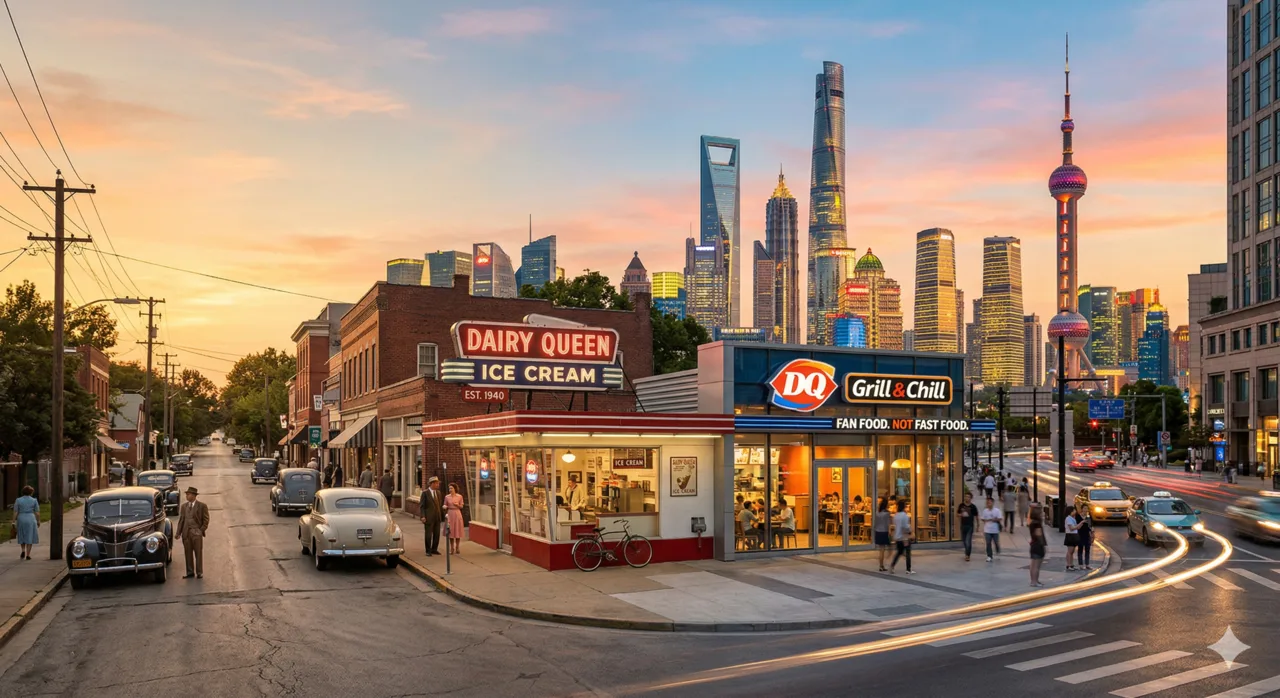
In June 1940, a man named Sherb Noble opened a small store at 501 North Chicago Street in Joliet, Illinois, and sold 1,600 servings of a new soft-serve ice cream formula in two hours 1. He had no seating, no brand, and no business plan beyond the obvious fact that people really, really wanted this stuff. Eighty-five years later, that impulse purchase has become International Dairy Queen Inc. — a 7,800-restaurant franchise empire spanning 27 countries, generating $6.4 billion in system-wide sales 2, and quietly depositing nearly $100 million a year in profit to its parent company, Berkshire Hathaway 3. Yet if you read Berkshire's 2025 annual report, you will find exactly one paragraph about Dairy Queen — 47 words, wedged between a description of IPS-Integrated Project Services and Business Wire 4. For a business that Warren Buffett personally patronized for decades and that Charlie Munger loyally supported at lakeside locations in northern Minnesota, this is the corporate equivalent of forgetting to mention dessert.
Introduction
Dairy Queen's story begins not in a boardroom but in a cow pasture — or more precisely, in the imagination of John Fremont McCullough, a man who always referred to the cow as "the queen of the dairy business" 1. In 1938, J.F. McCullough and his son Alex developed a soft-serve formula and persuaded their friend Sherb Noble to test it at his ice cream shop in Kankakee, Illinois. The product was an instant sensation. By 1941 there were 10 Dairy Queen stores. By 1947, a hundred. By 1950, an astonishing 1,446 1. The franchise concept — radical at the time — predated McDonald's first franchise by over a decade.
But rapid expansion brought chaos. For thirty years, Dairy Queen was a franchise in name only: thousands of independent operators running wildly inconsistent stores with no centralized quality control. As Buffett later noted, IDQ had "a bumpy history" 5. The turnaround began in 1970 when the Mooty and Luther families took control and rationalized the operation, extending food service to many more locations and building something resembling a modern franchise system 5. By 1987, IDQ had acquired Orange Julius — founded in 1926 in Los Angeles, making it even older than Dairy Queen — and by the mid-1990s, the company was a disciplined franchisor with nearly 6,000 locations 6. ↗
It was at this point that a certain Omaha billionaire, who had been quietly eating Dilly Bars for years, decided to write a check.
The $585 Million Handshake
On October 21, 1997, Berkshire Hathaway announced the acquisition of International Dairy Queen for $585 million — $27 per share in cash or $26 in Berkshire stock 7. The Mooty family, which controlled 35% of the voting shares, committed to vote in favor and take Berkshire stock rather than cash 7. Only 45% of shareholders ultimately elected cash — a vote of confidence in Buffett that would prove spectacularly justified. ↗
Why did Buffett want a soft-serve chain? The answer lies in what IDQ actually is — and what it is not. It is not a restaurant company. It does not, in any meaningful sense, cook food or serve customers. What IDQ does is collect royalties: 4% of gross sales from every franchised location, plus 5-6% in advertising fees 8. When Buffett bought IDQ, the system had approximately 5,792 Dairy Queen stores and 410 Orange Julius locations across 23 countries — "all but a handful run by franchisees" 5. The franchisees put up the capital. The franchisees hired the staff. The franchisees bore the risk of weather, recessions, and bad locations. IDQ collected a toll on every Blizzard sold.
This was, in essence, the See's Candies model on steroids: a brand so strong it could charge premium royalties on a product people bought not because they needed it but because they wanted it. Buffett had learned this lesson twenty-five years earlier when he paid $25 million for See's in 1972 — a business that has since generated over $2 billion in cumulative pre-tax earnings with minimal reinvestment 5. Dairy Queen was the franchise version of the same insight. ↗
Buffett and Munger brought, as Buffett put it with characteristic understatement, "a modicum of product expertise" to the evaluation. Munger had been patronizing DQ locations at Cass Lake and Bemidji, Minnesota, for decades. Buffett was a regular at the 114th and Dodge Omaha location — run by third-generation owners whose grandfather had built the building in 1962 5. That store became the site of the now-legendary "Shareholder Sunday" tradition: each year after the Berkshire annual meeting, it opens for shareholders, serving Dilly Bars for a dollar 9. It is a 27-year ritual that has made Dairy Queen the most personally embedded subsidiary in the Berkshire family.
The Blizzard That Changed Everything
If the franchise model explains why Buffett bought DQ, the Blizzard explains why DQ was worth buying.
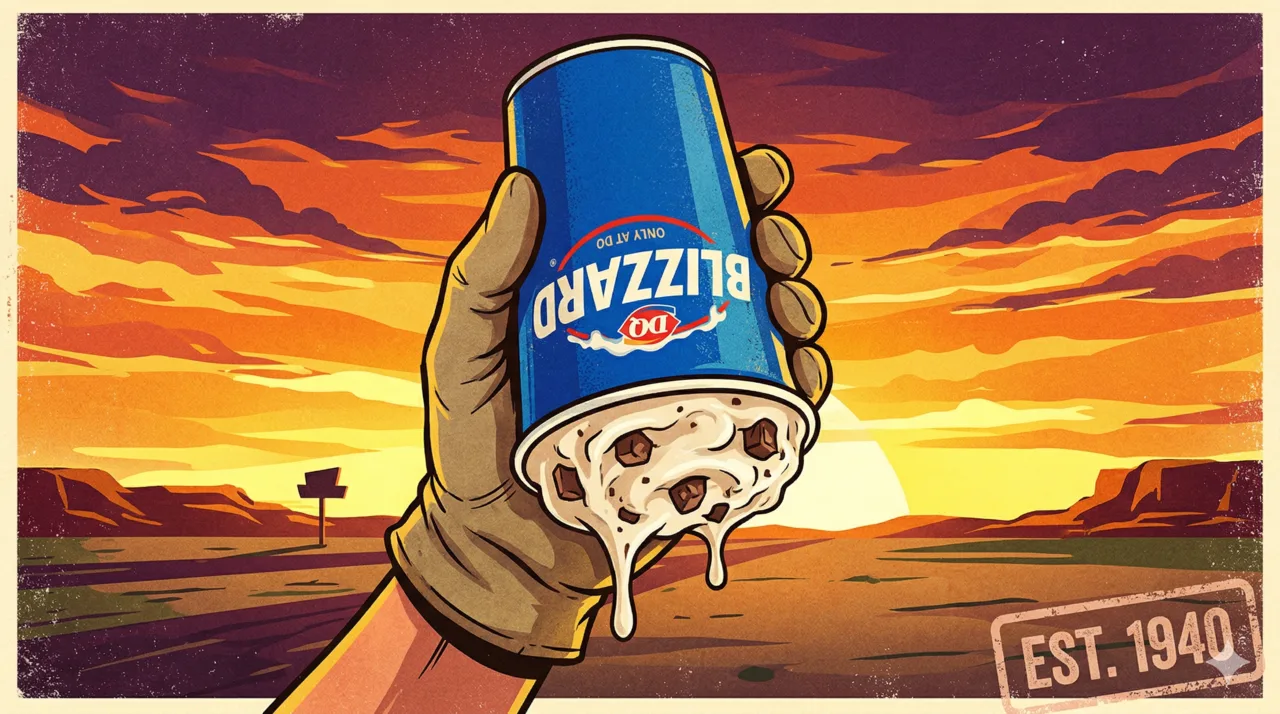
In 1985, a Missouri franchisee named Samuel Temperato, inspired by the frozen custard at Ted Drewes in St. Louis, developed a thick, mix-in-laden soft-serve treat and pitched it to corporate 10. DQ launched the Blizzard nationwide that year with four original flavors — Oreo, M&Ms, Heath Bars, and Snickers — and the results were extraordinary: over 175 million Blizzards sold in year one 10. DQ's net income jumped from $9.6 million to roughly $13 million, and the stock surged from $40 to $72.50 in six months 10. The DQ president at the time called it "the biggest thing that has happened to Dairy Queen in the last 25 years" 10.
The Blizzard also gave birth to one of the most effective zero-cost marketing stunts in fast food history: the upside-down guarantee. Borrowed from Ted Drewes' practice of flipping cups to demonstrate thickness, DQ policy dictates that every Blizzard must be served inverted — or it's free 10. The stunt costs nothing, generates endless word-of-mouth, and elegantly communicates a quality promise in a single visual gesture.
There is a technical footnote that food scientists enjoy: a Blizzard is not, strictly speaking, ice cream. It contains approximately 5% butterfat, half the FDA's 10% minimum threshold for the "ice cream" designation 10. DQ prefers the term "soft serve." Shareholders may prefer the term "profit driver" — the Blizzard and its descendants remain the franchise's signature draw four decades later, and the margins on soft-serve are the envy of the QSR industry.
A Royalty Machine in Disguise
Understanding Dairy Queen's economics requires understanding that IDQ — the entity Berkshire actually owns — is one of the most capital-light businesses in the Berkshire portfolio.
| Metric | 2024 | Notes |
|---|---|---|
| System-wide sales (global) | $6.4 billion | Up from $6.1B in 20232 |
| IDQ corporate revenue | $257 million | Royalties, fees, services3 |
| IDQ net profit | $97.8 million | 38.1% profit margin3 |
| Global restaurant count | ~7,800 | Per 2025 Berkshire annual report4 |
| New units opened (2024) | 419 | Majority in China2 |
| Royalty rate | 4% of gross sales | Plus 5-6% advertising fee8 |
| Average unit volume | $1.165 million | Essentially flat vs. 20232 |
| Franchisee cost to open (Grill & Chill) | $1.1M – $1.86M | All borne by franchisee8 |
The math is beautiful in its simplicity. Collect 4% of $6.4 billion in system-wide sales and you get roughly $256 million. Add advertising fees, licensing, and services, and you arrive at IDQ's $257 million in revenue — of which $97.8 million flows to the bottom line at a 38% margin 3. The franchisees invest the capital. The franchisees take the operating risk. IDQ harvests the royalties.
For context, IDQ's $97.8 million in 2024 net profit compares to roughly $84 million in 2021 11 — growth of approximately 16% over three years. This is not a business that generates headlines. It is a business that generates cash, quietly, year after year, with almost no capital requirements from Berkshire. Buffett paid $585 million for it in 1998. At current earnings, Berkshire has earned back the entire purchase price multiple times over — and IDQ is worth substantially more today than when he bought it.
The franchise economics for operators are equally compelling. A Grill & Chill franchisee investing $1.1-1.86 million can expect average annual gross sales of $1.43 million, with estimated EBITDA margins around 41% and a payback period of roughly 19 months 8. These are numbers that attract franchisees — which is why DQ has been able to expand from 5,792 locations at acquisition to 7,800 today without Berkshire spending a dime on store construction.
The Dragon and the Blizzard
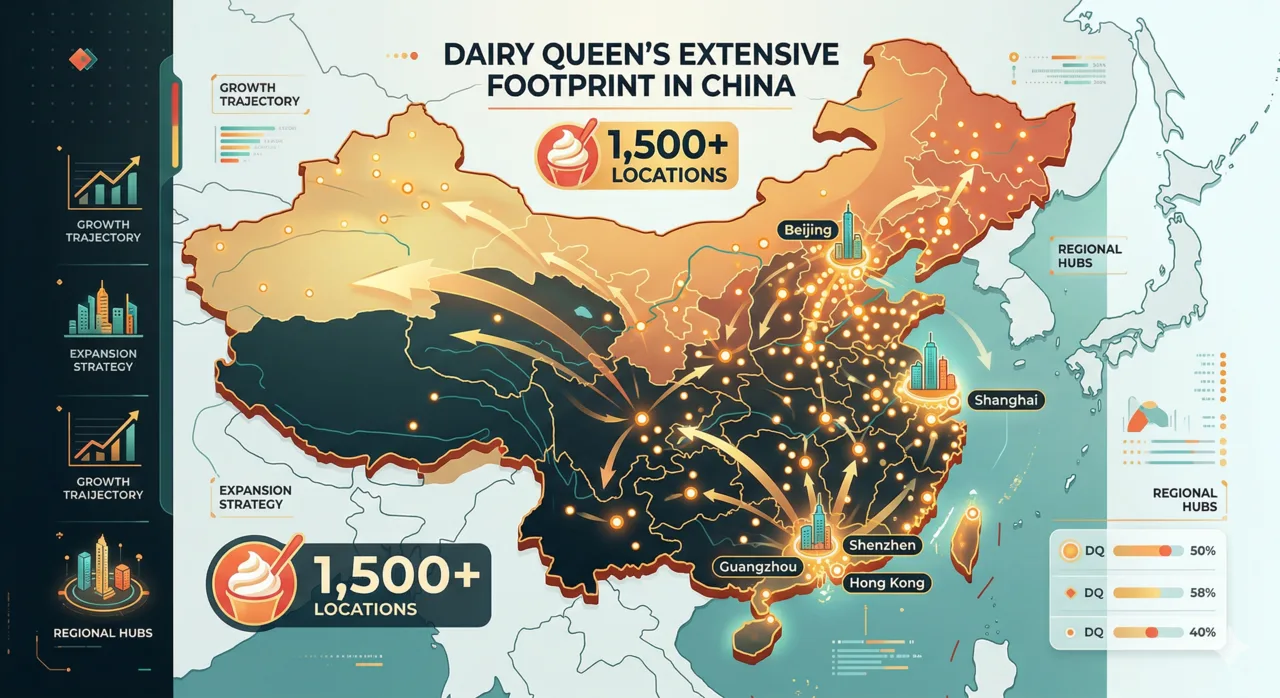
If the United States is Dairy Queen's heartland, China has become its growth frontier. The numbers tell a story of explosive expansion: from the first Beijing location in 1991 to approximately 1,500-1,600 stores in mainland China today 12. China is now DQ's second-largest market by store count, and its fastest-growing by far — nearly two-thirds of the 419 new restaurants opened globally in 2024 were in China 2.
The engine of this growth is CFB Group, backed by private equity firm FountainVest Partners. In March 2022, FountainVest announced plans to open 600 DQ restaurants in China by 2030, building on CFB Group's existing base of 900+ locations 12. By late 2024, CFB Group operated over 1,200 DQ restaurants in mainland China 13. In 2023, the ambitions expanded further: IDQ and CFB Group announced a plan for 180 food-centric DQ restaurants — the "Blizzard & Burgers" format offering hot food alongside treats — to open in China by 2034 13. The first of these opened in July 2024, marking the first time DQ's full American-style menu was available in China 14.
Jean Champagne, IDQ's COO for international operations, captured the strategic logic: "China remains an important growth market to us, and this expansion with FountainVest provides the opportunity to widen our footprint in one of the fastest-growing countries for QSR" 12. Alan Hsu, CFB Group's CEO, was more direct: "We've seen immense success from DQ restaurants in China, and with our strength in digitalized operations, social media management and sub-franchisee expansion, we see endless growth opportunities" 12.
The Chinese market has unique characteristics that favor DQ's model. Chinese consumers treat frozen treats as aspirational rather than routine — closer to a Starbucks visit than a McDonald's run. DQ's positioning as a premium soft-serve brand, rather than a discount fast-food chain, aligns naturally with urban Chinese consumer preferences. The brand's Instagram-friendly presentation (flipped Blizzards, elaborate toppings, photogenic stores) plays exceptionally well on Chinese social media platforms.
"10 by 30": The Road to $10 Billion
At the 2025 Berkshire annual meeting, Troy Bader — who became DQ's CEO in fall 2017 after a memorable job interview where Buffett spent the first fifteen minutes asking about an unrelated deal 15 — unveiled DQ's most ambitious growth target: $10 billion in system-wide sales by 2030 16. From a 2024 base of $6.4 billion, this requires roughly 56% growth in six years — aggressive for any mature franchise, extraordinary for an 85-year-old brand.
The plan has three pillars.
First, international expansion beyond China. In June 2025, IDQ announced its entry into India through a partnership with Devyani International, the operator of KFC and Pizza Hut in the country 17. First restaurants are expected to open in 2026, targeting major metropolitan areas. India's 1.4 billion population and booming fast-food market make it a natural target — but the logistics of cold chain distribution for soft-serve in a tropical country are formidable. IDQ is also expanding aggressively in the Middle East, where the largest DQ Grill & Chill in the world recently opened in Saudi Arabia 18. The demographic fit is compelling: 85% of fast food visits in Saudi Arabia come from consumers under 45 18.
Second, filling domestic gaps. Despite 4,200+ US locations, DQ has historically been a Midwest and Sun Belt brand. Major metropolitan markets — New York City, Los Angeles, downtown Chicago — remain largely untapped 16. Bader has signaled intent to push into these urban markets, though the economics of downtown real estate present a different challenge than suburban strip malls.
Third, menu evolution. The Stackburger platform, launched in 2021, represents DQ's most significant food innovation since the Blizzard. By building out the "Grill & Chill" format — which does roughly $1.43 million in average annual sales versus lower volumes for treats-only stores 8 — DQ is attempting to capture a larger share of the meal occasion rather than competing solely in the snack and dessert categories. Digital investment is accelerating this: the DQ rewards program has added over two million members and seen a 46% increase in purchase conversion 19.
| Market | Estimated Locations (2025) | Growth Plan |
|---|---|---|
| United States | ~4,200 | Urban market penetration (NYC, LA, Chicago)16 |
| China | ~1,500-1,600 | 600 new stores by 2030 + 180 food-centric by 20341213 |
| Thailand | ~500 | Ongoing franchise expansion2 |
| Mexico | ~300+ | Continued growth2 |
| India | 0 (entering 2026) | Partnership with Devyani International17 |
| Middle East | Expanding | Saudi Arabia, UAE — youth-driven QSR market18 |
The Invisible Subsidiary
Dairy Queen occupies a peculiar position in the Berkshire Hathaway empire. It is simultaneously one of Buffett's most personally beloved businesses and one of the least discussed in corporate filings. The 2025 annual report dedicates exactly 47 words to IDQ — fewer than it gives to XTRA Corporation, a trailer leasing company 4. IDQ's financial results are bundled into the "Service" segment alongside NetJets, FlightSafety, TTI, and a half-dozen other businesses, making it impossible to track DQ's performance through Berkshire's public filings alone 4. ↗
The Service segment as a whole reported $22.98 billion in revenue and $2.7 billion in pre-tax earnings in 2025, up 11.0% and 17.2% respectively from 2024 4. But the growth was driven primarily by aviation services (NetJets, +9.9%), IPS (+24.2%), and TTI (+12.3%) 4. DQ, with its estimated $257 million in revenue, accounts for roughly 1.1% of the Service segment's top line — a rounding error in a conglomerate that generated $214 billion in combined manufacturing, service, and retailing revenue 4.
This invisibility is, paradoxically, a feature rather than a bug. Buffett's entire operating philosophy for subsidiaries was to buy businesses run by capable managers and then leave them alone. Troy Bader runs DQ from Bloomington, Minnesota, with minimal interference from Omaha. There are no quarterly earnings calls, no analyst days, no guidance updates. DQ executes its expansion plan, mails the profits to Berkshire, and gets on with the work. For a franchise business whose value depends on consistent, predictable execution across 7,800 locations in 27 countries, this is exactly the right organizational structure.
The question under Greg Abel's leadership is whether this hands-off approach will continue — or whether Abel, who has been unusually direct about closing performance gaps at BNSF and pushing for operational improvements across the portfolio, might take a more active interest in optimizing Berkshire's smaller subsidiaries 4. At nearly $100 million in annual net profit, DQ is not immaterial. And at a 38% margin, there may be limited room to squeeze further efficiency — but the "10 by 30" growth plan suggests that the real opportunity is revenue expansion, not margin improvement.
Conclusion
On June 22, 2025, Dairy Queen will turn 85. It has survived the Great Depression (barely — it was founded a decade into it), World War II rationing, the franchise chaos of the 1950s-60s, the health food movement of the 1980s, and multiple recessions. It has thrived through a single product innovation — the Blizzard — that remains its signature draw four decades later. And it has grown from a single Illinois storefront to a $6.4 billion global system without ever requiring significant capital from its parent company.
Warren Buffett paid $585 million for this business in 1998. In the 27 years since, IDQ has returned far more than that in cumulative profits while simultaneously growing from 5,792 to 7,800 locations. The franchise model — capital-light, royalty-driven, risk-shifted to operators — is the See's Candies formula applied at global scale. It is, in Buffett's taxonomy, the very definition of a wonderful business: one that generates growing returns on no incremental invested capital.
The tariff headwinds of 2025-2026 present tactical challenges — cooking equipment, uniforms, and key ingredients like vanilla and bananas face import cost pressures 20 — but DQ's positioning as a treat brand rather than a meal destination may provide partial insulation. Consumers cut back on dining out before they stop buying Blizzards for their children. The "10 by 30" target of $10 billion in system-wide sales is ambitious, and India and the Middle East are unproven markets. But China's trajectory — from zero to 1,500+ stores in three decades — suggests that the DQ brand travels better than skeptics expect.
The next time you read a Berkshire annual report and notice that Dairy Queen gets fewer words than a trailer leasing company, remember this: some businesses are so good they don't need to be talked about. They just need to keep flipping Blizzards upside down.
References
-
This Week in Illinois History: World's First Dairy Queen (June 22, 1940) - northernpublicradio.org ↩↩↩
-
Dairy Queen — Top 500 Chains 2024 - restaurantbusinessonline.com ↩↩
-
Dairy Queen aims for $10 billion in sales by 2030 - startribune.com ↩↩
-
Berkshire Hathaway 2025 Annual Report - berkshirehathaway.com ↩↩↩↩↩↩↩
-
Berkshire Hathaway 1997 Chairman's Letter - berkshirehathaway.com ↩↩↩↩↩
-
Orange Julius — Wikipedia - wikipedia.org ↩
-
Berkshire Hathaway to Acquire International Dairy Queen - berkshirehathaway.com ↩↩
-
Dairy Queen Franchise Costs, Profit and Requirements — 2025 Guide - bizfranhub.com ↩↩↩
-
Grilling and Chilling with Warren Buffett - gatesnotes.com ↩
-
The History of Dairy Queen Blizzards - backthenhistory.com ↩↩↩↩↩↩
-
After hitting record sales in pandemic, Dairy Queen updates its burger lineup - startribune.com ↩
-
IDQ and FountainVest Partners Announce Plans to Open 600 DQ Restaurants in China - businesswire.com ↩↩↩↩
-
IDQ and CFB Group Announce 180 Food-Centric DQ Restaurants in China by 2034 - news.dairyqueen.com ↩↩
-
First DQ Restaurant in China Offering Hot Food and Treats - news.dairyqueen.com ↩
-
Dairy Queen CEO on Warren Buffett's advice from his job interview - fortune.com ↩
-
Dairy Queen Targets $10 Billion by 2030 as Global Growth Continues - qsrmagazine.com ↩↩
-
IDQ Grows International Business in New and Existing Markets - news.dairyqueen.com ↩
-
Dairy Queen Targets Middle East Expansion - ffcc.global ↩↩
-
DQ App and DairyQueen.com Win Top Industry Awards - news.dairyqueen.com ↩
-
2025 Tariffs Impact on Foodservice Industry Costs - honorfoods.com ↩