Tags: OxyChem / Oxy / Warren Buffett
This fanpage is not officially affiliated with Berkshire Hathaway: Disclaimer
Berkshire Hathaway closed 2026's first business day with an unusually elegant piece of corporate symmetry. On January 2, Greg Abel — in his first hours as Berkshire's CEO — completed the $9.7 billion all-cash acquisition of OxyChem, the chemicals business Occidental Petroleum had carved off after thirty-eight years2. Fifteen years earlier, almost to the calendar quarter, Warren Buffett had paid $9.7 billion to take Lubrizol private14. Same price tag. Same broad industry. And, as it turns out, the same CEO.
Introduction
OxyChem is officially Berkshire's first chemicals subsidiary, a designation that overstates the novelty by half. Berkshire has owned a major specialty-chemicals operation since 2011, when it bought Lubrizol for $9.7 billion in enterprise value (or roughly $8.7 billion in cash for the equity, depending on how you count assumed debt13). What OxyChem actually represents is something more interesting: a doubling-down on a category Buffett spent his last working year revisiting, executed at a price tag that — almost certainly by accident — lines up with the previous bet down to the last hundred million dollars.
The deal is also a study in CEO transitions handled the way Berkshire handles them: invisibly. Buffett announced OxyChem on October 2, 20251; the deal was structured to close on January 2, 2026, the second day of Greg Abel's tenure as Berkshire CEO2. Abel's role at the announcement was minimal — a one-line welcoming statement1 — but the operational integration is now his. The Berkshire press release announcing the close runs a single page3. CNBC characterized it as "his last big deal as CEO before Abel takes over"4.
Three threads run through the rest of this piece. First: the literal management lineage that ties Lubrizol 2011 to OxyChem 2026, embodied in a single Berkshire executive. Second: the structural moat OxyChem brings — what it makes, where it sits in a concentrated industry, and what kind of cyclicality Berkshire has just absorbed. Third: the pricing discipline. At roughly eight times depressed EBITDA, OxyChem looks like a deliberate counter-thesis to Berkshire's most painful industrial deal.
A Familiar Hand at the Helm
Rebecca Liebert has been chief executive of The Lubrizol Corporation since 2022. As of January 2026, she also runs OxyChem. The arrangement was disclosed not in a press release but in Greg Abel's first annual letter, published February 28, 2026: "The Lubrizol team, led by Rebecca Liebert, was integral to the acquisition of OxyChem and its planned integration as a standalone operating business within Berkshire. Rebecca has assumed responsibility for OxyChem in addition to her role as CEO of Lubrizol, working in partnership with OxyChem CEO Wade Alleman and his leadership team."5
This is the kind of structural detail that almost never makes the trade press but tells you what Berkshire thinks the deal is. Lubrizol — a specialty additives business serving engine oils, fuels, coatings, and personal care — and OxyChem — a basic-chemicals business making polyvinyl chloride, chlor-alkali, and calcium chloride — are not in obviously adjacent markets. They share an industry classification, a holding company, and now a CEO. Liebert has been asked to manage both, with Wade Alleman continuing as OxyChem's day-to-day operator. Alleman keeps the OxyChem name on the door; Liebert provides the Berkshire-side reporting line.
The lineage is what makes the $9.7-billion-twice coincidence stop being coincidence. It is the 2011 Lubrizol playbook, run again in 2026 with the same set of muscles: pay cash for a public chemicals company at a moment when the equity market is bored with the cycle, fold it into Berkshire as an autonomous operating subsidiary, give the existing CEO operational latitude, and stack a Berkshire-trusted executive on top to keep the reporting clean. Buffett built the playbook. Abel inherits the responsibility for running it. The piece that makes the inheritance unusually frictionless is that Berkshire did not need to recruit anybody from outside — the Lubrizol bench, fifteen years deep, supplied the integration lead.
What OxyChem Actually Makes
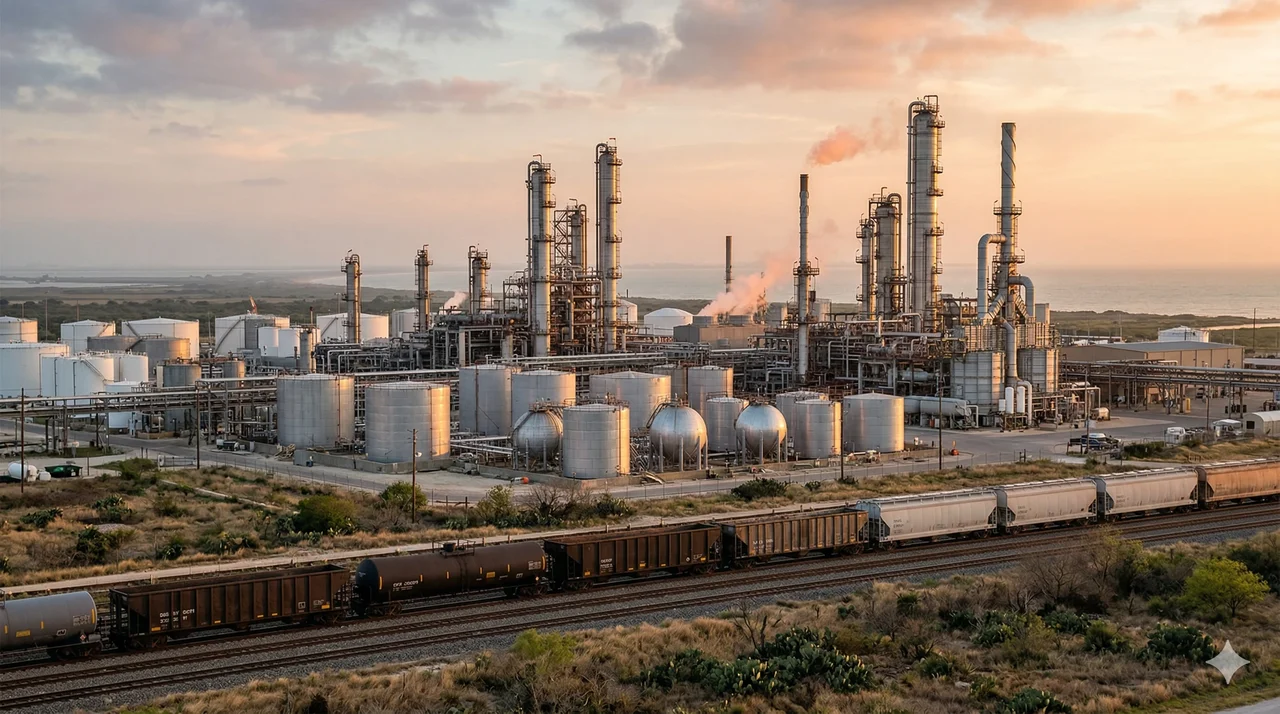
Berkshire's 2025 annual report describes OxyChem as "a top three North American manufacturer of polyvinyl chloride (PVC), chlor-alkali products and chlorinated organic chemicals," operating "21 manufacturing plants in the U.S. in ten states and two international sites in Canada and Chile" with approximately 4,000 employees and contractors5. The headquarters are in Dallas; the production heart is the Texas and Louisiana Gulf Coast.
The product chain is more elegant than the customer-facing description suggests. OxyChem starts with two basic inputs — salt and electricity — and runs them through electrolytic cells to co-produce chlorine and caustic soda. From there, chlorine combines with ethylene (sourced largely from a fifty-fifty ethane-cracker joint venture with Orbia at Ingleside, Texas) to make ethylene dichloride, then vinyl chloride monomer, then PVC resin. This is the chlorovinyl chain, and OxyChem runs it at a scale rarely matched by any single competitor.
The capacity numbers, drawn from Occidental's last 10-K as a stand-alone reporter of OxyChem's results, make "top three" feel rhetorically modest. OxyChem operates 3.2 million tons per year of chlorine capacity and is the world's largest merchant marketer; 3.3 million tons per year of caustic soda; 6.2 billion pounds per year of vinyl chloride monomer (the largest U.S. producer); and 3.7 billion pounds per year of PVC resin7. End markets are exactly what you would expect of a basic-chemicals platform: PVC pipe for water systems and construction; caustic soda for pulp, paper, and alumina refining; chlorine derivatives for water treatment, pharmaceuticals, and personal care5.
Roughly 4,000 employees, 21 U.S. plants, and a workforce in which approximately half have more than ten years of tenure10 — that is the human and physical asset base Berkshire just inherited, and it is exactly the kind of low-glamour industrial footprint Omaha tends to like.
The Moat: Low-Cost in a Concentrated Field
The U.S. chlor-alkali industry is genuinely concentrated. Five producers — OxyChem, Westlake, Olin, Formosa Plastics USA, and Shintech — account for the vast majority of domestic capacity8. Olin is the world's largest by volume; OxyChem is comfortably top-three on every product line that matters. PVC, the consumer-facing end of the chain, is similarly concentrated: OxyChem ranks third behind Shintech and Formosa8.
OxyChem's competitive strategy, stated explicitly in Occidental's 10-K disclosures, is to be the low-cost producer and compete on price7. Two structural advantages support that posture. First, geography: most of OxyChem's plants sit in the Gulf Coast petrochemical corridor, with cheap natural gas — chlor-alkali is electricity-intensive, and U.S. industrial power costs benefit directly from the shale era — and shared logistics infrastructure. Second, vertical integration: through the Ingleside joint venture, OxyChem secures roughly 1.3 billion pounds per year of internal ethylene supply, insulating the chlorovinyl chain from spot pricing on the single most important downstream feedstock57.
There is also a $1.1 billion investment story Berkshire inherits mid-flight. OxyChem's Battleground plant in La Porte, Texas, is partway through "Project Redstone," a modernization that converts the remaining diaphragm-cell chlor-alkali capacity to membrane technology12. The conversion is expected to add roughly $300 million in annualized EBITDA when complete in late 2026; capital expenditure is projected to fall by approximately $300 million per year by 2027, returning to maintenance levels12.
The cost-position story has one fresh complication. In March 2026, Shintech (a Shin-Etsu subsidiary) announced a $3.4 billion U.S. capacity expansion including a 500,000-tonne-per-year vinyl chloride monomer plant and a 310,000-tonne chlor-alkali unit in Louisiana11. That capacity will take three to five years to come online, but it telegraphs that OxyChem's biggest PVC competitor is willing to spend through the cycle to defend share. Berkshire bought a moat; the moat now needs to be defended.
$9.7 Billion, Twice: The Lubrizol Rhyme
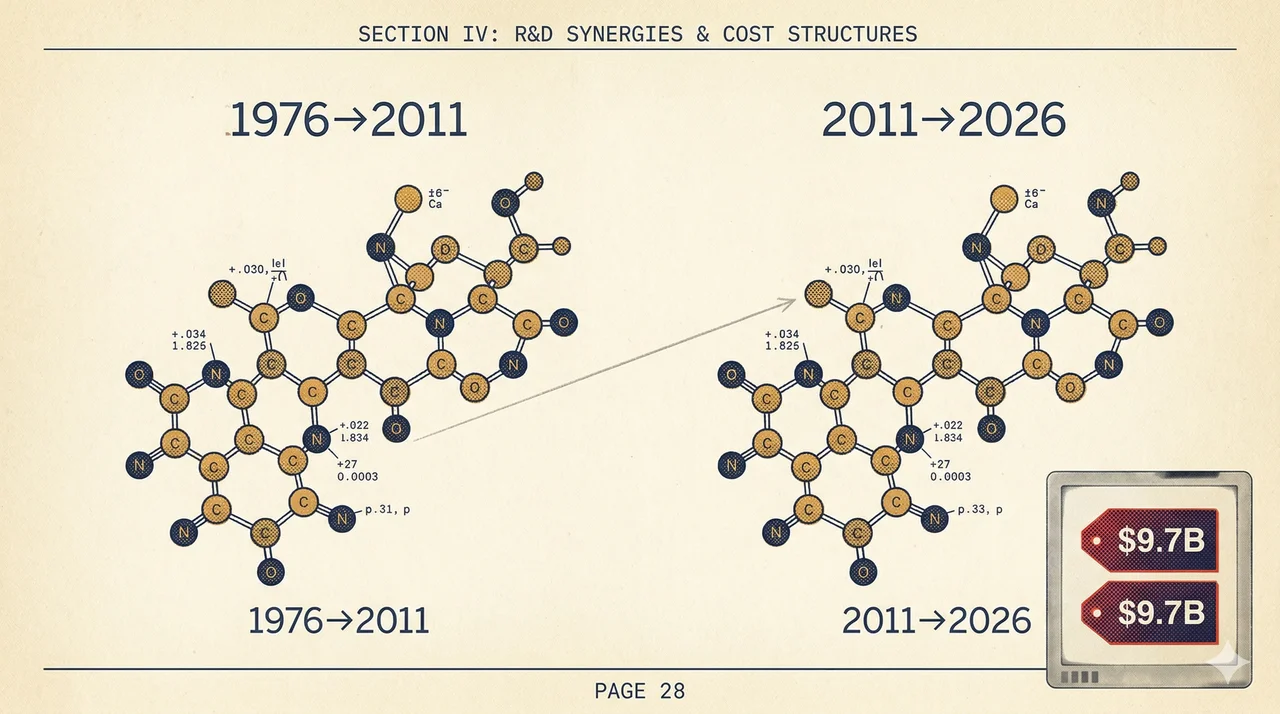
The $9.7 billion price tag deserves a brief precision check. The 2011 Lubrizol acquisition was announced as a $9.7 billion enterprise-value deal at $135 per share14, but Berkshire's own 2013 10-K records the actual cash paid for the equity as "approximately $8.7 billion," with the balance being assumed Lubrizol debt13. The 2026 OxyChem deal, by contrast, is $9.7 billion of cash on the barrelhead with Occidental retaining the legacy environmental liabilities — there is no embedded debt in the headline figure12. Round number to round number, the prices are identical; on a cash-out-the-door basis, OxyChem cost about a billion more than Lubrizol did.
| Dimension | Lubrizol (2011) | OxyChem (2026) |
|---|---|---|
| Business | Specialty chemicals (additives) | Basic chemicals (chlorovinyl chain) |
| Headline price | $9.7 billion enterprise value14 | $9.7 billion all-cash1 |
| Cash for equity | ~$8.7 billion13 | $9.7 billion2 |
| Source structure | Public-company buyout (NYSE: LZ) | Carve-out from Occidental Petroleum |
| Pre-deal CEO | James Hambrick | Wade Alleman |
| Berkshire-side oversight today | Rebecca Liebert (since 2022) | Rebecca Liebert (Jan 2026)5 |
| Cycle entry point | Mid-cycle / quietly compounding | Trough year (~50% off peak)10 |
| Inherited environmental tail | Standard for the industry | None — retained by seller2 |
What the table understates is that in 2011 Lubrizol was a hot deal by Berkshire standards — an opportunistic buy at a moment when specialty chemicals were quietly compounding and most industrial multi-arbitrage funds were not paying attention. OxyChem in 2026 is the opposite kind of buy: a tired commodity asset coming out of a brutal 2024–2025 cycle, sold by an owner under balance-sheet pressure18. The price-tag rhyme is real but the entry-point rhetoric is opposite. Lubrizol was bought into strength; OxyChem is bought into weakness.
Both deals were pitched to Buffett by trusted operating people. Both were structured as cash acquisitions of established chemical businesses with sitting management. Both will, if Berkshire's normal pattern holds, disappear into the conglomerate and reappear as a one-line annual-report disclosure for the next thirty years. The two pieces fit on the brk-b.com archive shelves next to ↗ and ↗ as siblings in Berkshire's industrial-conglomerate wing.
The Sokol Shadow
The Lubrizol deal was almost wrecked by the way it was sourced. In early January 2011, Berkshire's then-rising-star executive David Sokol bought 96,060 shares of Lubrizol for roughly $10 million17 after — and this is where the timeline matters — he had identified Lubrizol as a potential Berkshire acquisition target and arranged a meeting with its CEO. Days later, Sokol pitched the deal to Buffett. On March 14, Berkshire announced the $9.7 billion acquisition at $135 per share14, handing Sokol an immediate paper gain of roughly $3 million. He resigned at the end of the month17.
Berkshire's audit committee concluded Sokol's purchases violated company ethics policy15. Buffett, at the 2011 annual meeting, called the trades "inexcusable and inexplicable"16. Charlie Munger, asked for his own one-word diagnosis, offered "hubris." The SEC investigated and quietly declined to bring civil enforcement action in January 201317.
It is impossible to write about the Lubrizol-OxyChem rhyme without acknowledging this. The 2011 deal entered the Berkshire archive with a permanent footnote about the way it was sourced, and the sourcing footnote almost overshadowed the deal itself. By contrast, the OxyChem acquisition has been transacted with the kind of institutional cleanliness that makes for boring news copy: Buffett and Abel sourced it directly from Occidental's CEO Vicki Hollub, the disclosure was textbook, the closing was on schedule, the management team is unchanged, and there is no rumor of anybody on either side having traded the gap.
Fifteen years on, Berkshire has paid the same price for a different kind of chemicals asset, and this time the conduct around the deal is the unremarkable part. That is its own kind of progress.
A Cleaner Inheritance
The boring-news-copy point goes deeper than executive conduct. The legal structure of the OxyChem transaction is more carefully sanitized than almost any major Berkshire industrial purchase in living memory. Per Occidental's announcement, all of OxyChem's "legacy tort claims and environmental liabilities relating to historical operations outside the sold facilities" were retained by Occidental through a subsidiary called Environmental Resource Holdings, LLC, with cleanup work managed by another Occidental affiliate, Glenn Springs Holdings, Inc.2
This matters more than it sounds. Basic chemicals is not a clean industry by historical standard. Mercury chlor-alkali cells, asbestos in old plant linings, PFAS exposure, plume remediation around legacy sites, decades of EPA Superfund and state-regulator activity — every long-tenured chlor-alkali producer carries some version of these obligations. Berkshire has just bought 21 manufacturing plants in 10 U.S. states without inheriting the historical-operations liability tail that would normally come with them. Occidental kept the past; Berkshire bought the future cash flows.
For shareholders trying to think about long-term liability accrual on the Berkshire balance sheet, this is the most important single sentence in the entire deal. The tail was not assumed at all. It is also a sharp contrast to the way Berkshire has historically absorbed insurance-style tail risk through its reinsurance subsidiaries; here, it was carved off by a willing seller motivated by debt paydown, and Berkshire walked away with the operating business and none of the historical cleanup obligations.
It is the kind of deal term Buffett has spent fifty years saying he wants and almost never gets in practice. He got it once. It happened to be the last big deal he sourced as Berkshire's CEO.
Buying the Trough
The headline reason Berkshire was able to extract that kind of deal was the cycle. OxyChem is being sold near the bottom of a deep PVC and chlor-alkali downturn driven by elevated interest rates suppressing housing demand and Chinese caustic-soda overcapacity weighing on global pricing10. The numbers are stark. OxyChem's pre-tax income was approximately $1.5 billion in 2023, drifted to roughly $1.0 billion in 20249, and was guided down further to $800–900 million for 202510. That is a peak-to-trough compression of nearly 50%, in a business that has historically thrown off $1.0–$1.5 billion in pre-tax cash through the cycle.
At the $9.7 billion acquisition price, Berkshire is paying roughly eight times trough-year EBITDA and somewhere closer to six to seven times normalized EBITDA10. That is not the kind of multiple at which deal mistakes get made.
It is also the explicit counter-thesis to Berkshire's most painful industrial acquisition. In 2016, Buffett paid $32.1 billion in equity value for Precision Castparts, an aerospace components manufacturer he later admitted he had been "simply too optimistic" about on normalized profit. PCC was bought near the top of the 2016 aerospace upcycle, took an $11 billion write-down in 2020 when the pandemic gutted aircraft production, and shed approximately 30% of its workforce in the recovery19. The lesson, expensively absorbed, was about disciplined entry on cyclical industrials. ↗ describes how PCC has since clawed its way back, but the cost-of-discipline lesson is permanent.
OxyChem, by contrast, is being bought at a price that already discounts a bad cycle and gives Berkshire optionality on the upturn. Abel's first annual letter framed Berkshire's industrial group — Precision Castparts, Marmon, IMC, and Lubrizol — as positioned to "pursue incremental opportunities" in the recovery5. OxyChem joins that group at a more attractive entry price than any of its predecessors.
Why Occidental Sold
The Occidental side of the story is its own clean piece of corporate finance. Vicki Hollub, Occidental's CEO, has spent the better part of three years repairing the balance sheet that the December 2023 CrownRock acquisition burdened. Selling OxyChem lets her finish the job in a single stroke. Per Occidental's press release, the proceeds were applied to retire $5.8 billion in principal debt between mid-December 2025 and the January 2 close, and an additional $700 million was earmarked for a total $6.5 billion debt paydown — bringing Occidental's total principal debt to $15.0 billion, the target Hollub set when she announced CrownRock182.
The interest savings are substantial. Occidental estimates the debt reduction will save approximately $350–400 million per year in interest expense18. Hollub framed the rationale precisely in her January 2 statement: "This transaction strengthens our financial position and catalyzes a significant resource opportunity we've been building in our oil and gas business for the last decade."2 In other words: clean balance sheet, focus on E&P, accept that the chemicals business — however well-run — was a distraction from the upstream story Occidental wanted to tell.
For Berkshire, this is the kind of seller motivation that makes for good acquisitions. Occidental was not selling because OxyChem was a bad business; it was selling because the sale helped fund a strategic refocus and shed a cyclical earnings line that complicated equity-market storytelling. Berkshire's existing roughly 28% Occidental equity stake10 sweetens the irony: ↗ tells the story of how Buffett came to know this seller intimately. Now Berkshire owns both sides of the original integrated company — the upstream stake and the downstream chemicals — split the way Hollub wanted.
Conclusion
The OxyChem deal will be remembered for the symmetry. Two acquisitions, fifteen years apart, at the same headline price, in the same broad industry, now run by the same Berkshire executive. It is the kind of pattern Berkshire-watchers love because it suggests the model is intact across the Buffett-to-Abel transition: source the deal patiently, buy at a multiple that builds in cyclical pessimism, demand structural protections such as no inherited liabilities and retained existing management, and integrate without drama.
If the Lubrizol deal was the beginning of Berkshire's long industrial-chemicals era, OxyChem is the consolidation. Rebecca Liebert now has more than $16 billion of chemicals revenue under her line of sight; Wade Alleman keeps day-to-day stewardship of an industrial footprint that took Occidental nearly four decades to assemble; and Greg Abel inherits, on his second day in the chair, an asset that could quietly throw off a billion dollars of pre-tax cash through the cycle and considerably more in the upturn.
Buffett spent his last working year doing exactly the kind of deal he has built his reputation on — and structured it to close on the day his successor's clock started. Whether Abel turns out to be a careful continuation of that pattern or its quiet revisionist will not be known for several cycles. What is already known, on day one, is that the playbook he inherits is the same one Buffett ran in 2011, marked down to a rounder number and stripped of the historical baggage that nearly defined the original.
That is a meaningful piece of inheritance.
References
-
Berkshire Hathaway Completes Acquisition of OxyChem - berkshirehathaway.com ↩
-
Warren Buffett Watch: His Last Big Deal as Berkshire CEO Before Abel Takes Over - cnbc.com ↩
-
Berkshire Hathaway 2025 Annual Report - berkshirehathaway.com ↩↩↩↩↩
-
Berkshire Hathaway Completes $9.7 Billion Acquisition of OxyChem - icis.com ↩
-
Occidental Petroleum Corporation Form 10-K for Fiscal Year 2024 - sec.gov ↩↩↩
-
Report: Occidental May Sell OxyChem, Including PVC Resin Business - plasticsnews.com ↩↩
-
Occidental Announces 4Q 2024 Results - oxy.com ↩
-
Shintech to Invest $3.4 Billion in US Vinyl Chemicals - cen.acs.org ↩
-
OxyChem Battleground $1.1 Billion Modernization (Project Redstone) - downstreamcalendar.com ↩↩
-
Berkshire Hathaway 2013 Annual Report - berkshirehathaway.com ↩↩
-
Lubrizol Acquired by Warren Buffett's Berkshire Hathaway for $9.7 Billion - jonesday.com ↩↩↩
-
Berkshire Hathaway Audit Committee Report on Sokol's Lubrizol Trading - scribd.com ↩
-
Buffett: I Made a Big Mistake by Not Questioning Sokol on "Inexplicable and Inexcusable" Trades - cnbc.com ↩
-
David L. Sokol - en.wikipedia.org ↩↩↩
-
Occidental Finalizes $9.7 Billion Sale of OxyChem, Sharpens Oil and Gas Focus - worldoil.com ↩↩↩
-
After Write-Down, Precision Castparts is Downsizing - newequipment.com ↩