Tags: Clayton Homes / Earnings / Risk
This fanpage is not officially affiliated with Berkshire Hathaway: Disclaimer
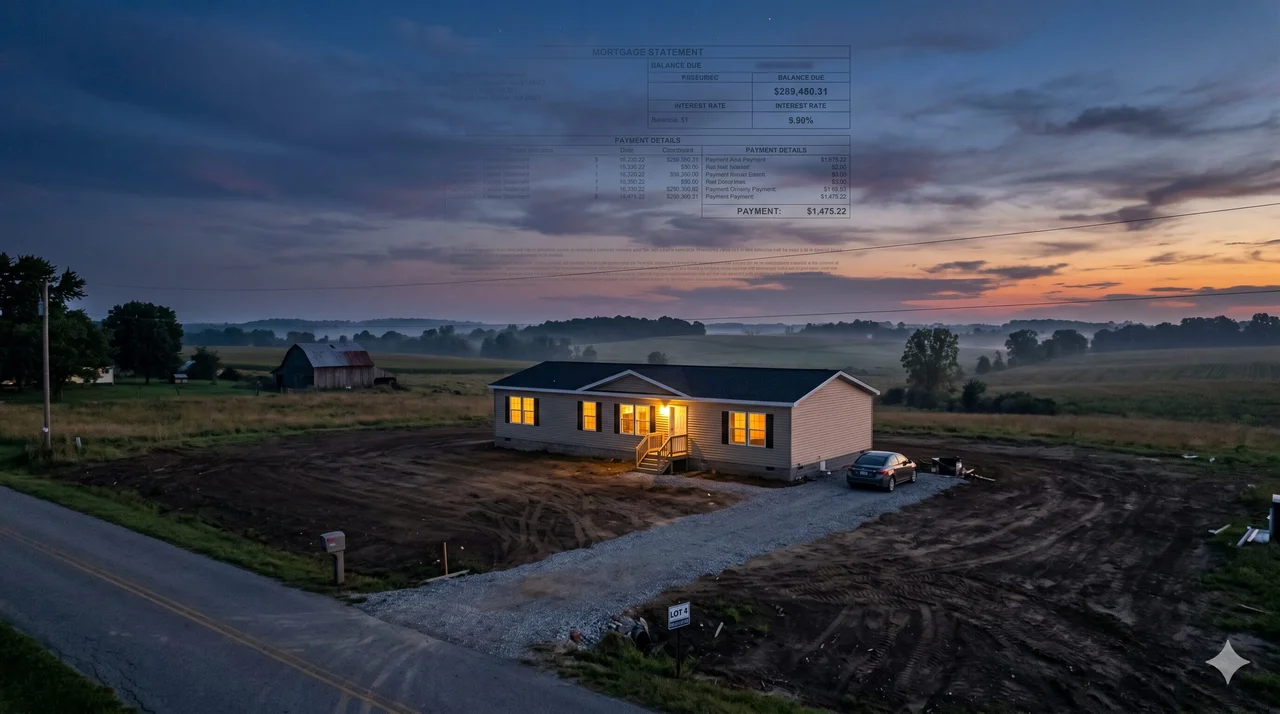
In the first quarter of 2026, Clayton Homes sold 9.7% fewer factory-built houses than the year before, watched its home-sales revenue slip $103 million, and still managed to report a financial-services line that grew 9.6% year over year1. The loan book swelled to $29.8 billion, up 7.8% in twelve months1. The provision for credit losses on those loans, meanwhile, fell from $183 million to $52 million — a 72% cut, taken while charge-offs were flat and the housing market was demonstrably softer1. Welcome to a homebuilder that has, very quietly, become a bank.
Introduction
The headline at Clayton in Q1 was that pre-tax earnings fell 8.7% to $393 million1, which scans as another mid-cycle stumble for a unit that has been under earnings pressure since 2024. But the more interesting fact is what is happening underneath the consolidated number: the home-building arm is shrinking, the finance arm is expanding, and the gap between the two is now wide enough to make Clayton a different kind of business than it was when Berkshire bought it in 2003 for roughly $1.7 billion10.
This is the financialization of a homebuilder, and the timing is uncomfortable. The Federal Reserve is holding the funds rate at 3.50–3.75%4, a level that compresses Clayton's lending spread by inflating its cost of capital. Chattel-loan borrowers — the manufactured-home buyers who do not, or cannot, finance their homes as real property — are paying interest rates several hundred basis points above conventional mortgage rates. Consumer-credit delinquencies are no longer at the floor6. And the history of captive finance arms inside American manufacturers contains some notably awkward postscripts.
This piece sits next to our recent $400K-ceiling analysis ↗, which argued that the captive lender is Clayton's competitive moat. The point here is the corollary: the moat is also a balance sheet, and a balance sheet has a credit cycle.

A loan book that doubled while the houses kept shrinking
The cleanest way to see Clayton's transformation is to put two trends on the same chart. One is unit sales, which fall in any year mortgage rates spike. The other is the loan book, which essentially never falls. The loan book has not had a down year in the last decade.
| Year-end | Net loan book ($B) | YoY growth |
|---|---|---|
| 2018 | 14.7 | — |
| 2020 | 17.1 | +7.5% CAGR |
| 2022 | 21.3 | +11.6% |
| 2023 | 23.8 | +11.7% |
| 2024 | 27.2 | +14.3% |
| 2025 | 29.5 | +8.5% |
| Q1 2026 | 29.8 | +7.8% YoY1 |
Sources: BRK 2018 10-K[^3]; BRK 2025 Annual Report[^2]; BRK Q1 2026 10-Q[^1].
Two things stand out. First, the book has roughly doubled in seven and a half years, compounding at about 10% annually through three Federal Reserve tightening campaigns, a global pandemic, a 2023 housing freeze, and a 2026 tariff war. Second — and this is the important one — the loan book accelerated fastest in the years that unit sales decelerated most sharply. Between 2022 and 2025, when Clayton's annual factory shipments fell from above 56,000 to around 49,4002, the loan book added $8.2 billion. That is not a coincidence. When the buyer pool can't afford the home, the lender writes a larger mortgage on a smaller-volume sale; and when interest rates are 6%, those mortgages earn more.
The result is a structural shift in where Clayton makes its money. The 2018 annual report observed, almost in passing, that "a significant part of Clayton Homes' earnings derives from manufactured housing lending activities"3. In 2018 the book was $14.7 billion. With it now at $29.8 billion1, the word "significant" is doing a lot more work. The Q1 2026 10-Q makes the point explicitly: financial-services revenue rose on higher average loan balances and higher average interest rates, even as home sales contracted1. The factory is the front of the business; the cash flow is increasingly upstairs in the finance office.
The provision puzzle
This is the part of the quarter that deserves to be interrogated rather than swallowed.
In Q1 2025, Clayton set aside $183 million for credit losses on home loans. In Q1 2026, that figure was $52 million1. A 72% drop in provisioning is the kind of number that warrants asking why, because it lands directly in pre-tax earnings; without it, Clayton's reported quarter would have been visibly worse.
There are two plausible readings.
The prudent reading says 2025's provision was elevated for one-time reasons — a rougher vintage from 2022–2023 cycling through, methodology changes after the post-pandemic CECL recalibrations, or simply normalisation after the surge. Full-year 2025 provisions ran $385 million, the highest in Clayton's recent history, more than double 2023's $169 million2. Mean reversion is mechanically plausible. The 97% current-loan rate (up from 96% at year-end) and the static 4.20% allowance coverage ratio both support this read1.
The less generous reading notes that net charge-offs were essentially flat year over year — $45 million in Q1 2026 versus $41 million in Q1 20251. Realised losses did not improve. The loan book grew, the housing market softened, charge-offs held steady; and yet the provision was cut by three quarters. The annualised 2026 run rate of roughly $208 million would represent a 46% step-down from 2025, while the book it backs grows. That is a noticeable change in posture, not a fact pattern, and it lands at a point in the credit cycle when prudence usually leans the other way.
The vintage data is what makes this worth watching. Clayton's "Prior" origination bucket — loans booked before 2022 — totals $11.8 billion, or 37% of the gross loan book, and accounts for $81 million of the $176 million non-performing balance1. The newer 2024–2025 vintages, originated in higher-rate conditions, are barely a fifth of the non-performing pool. The credit risk concentration is in older paper, exactly the slice that ought to be ageing through resolution rather than deteriorating. If that holds, the prudent reading wins. If it cracks, the second reading does.
The Fed is pushing on both ends of the spread
Clayton funds its loans from Berkshire affiliates — primarily Berkshire Hathaway Finance Corp. — at rates that move with the federal funds target. The Fed held that target at 3.50–3.75% through its January 2026 meeting, with two dissents favouring a cut and a staff outlook that anticipates inflation drifting back toward 2% as tariff effects wane4. The effective federal funds rate as of mid-May was 3.63%4. Markets are pricing one to two 25-basis-point cuts later in the year; the actual path will hinge on whether the labour market loosens and whether the tariff regime keeps importing inflation through manufactured-goods prices.
For Clayton, this regime cuts both ways. On the asset side, the average yield on the loan book is climbing as new originations roll on at higher rates than the older book they replace — the financial-services revenue lift in Q1 is precisely this effect1. On the liability side, the affiliate borrowings that fund the book are repricing at the same elevated short rates; the 2025 10-K disclosed a $291 million year-over-year increase in interest expense on those borrowings2, and the Q1 10-Q flags a further increase1. The spread is widening at the top and being eaten at the bottom.
The complication is that Clayton's borrowers are not paying conventional mortgage rates. The 30-year fixed conventional mortgage averaged 6.37% in early May5. Manufactured-home chattel loans — the dominant product when the home is titled as personal property rather than real estate — historically carry a premium of several hundred basis points above that, putting many Clayton borrowers in the 8.5–10% range. The Federal Housing Administration's Title I program for chattel loans, the natural government-backstopped alternative, has been moribund for years. The borrower at the bottom of the manufactured-home pool is paying near-credit-card rates on a 20- or 30-year asset.
That is a feature of the moat — it is exactly why competitors cannot enter cheaply — and a risk of it. Consumer-credit indicators are no longer pristine. The Federal Reserve's Q4 2025 charge-off and delinquency series show residential-real-estate delinquencies at 1.66% and other consumer-loan delinquencies at 2.94%; charge-off rates run 0.08% for residential and 1.21% for consumer loans broadly6. Clayton's chattel book sits closer in spirit to the consumer-loan column than to the residential-mortgage column. The broader housing market itself is barely moving — the National Association of Realtors reported existing-home sales up just 0.2% in April 2026 against a median price of $408,800 and 4.1 months of supply, none of which suggests a buyer's market about to absorb a wave of higher-quality manufactured-home demand7. The numbers are not flashing red; they are also not flashing the green they were two years ago.
Ghosts of captive finance
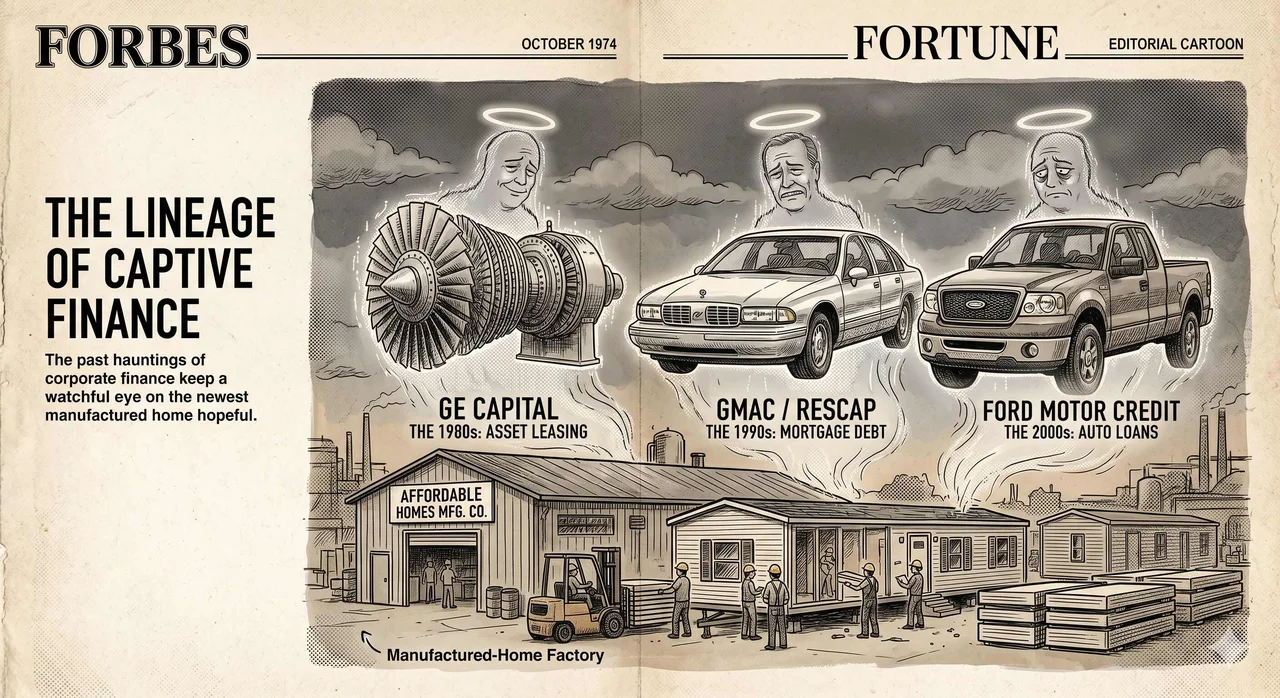
There is a reason this corner of the Berkshire empire deserves close reading: American manufacturing history is littered with the wreckage of captive finance arms that grew faster than their parent's operating discipline.
General Electric Capital was the largest and most cinematic. At its peak in the mid-2000s, GE Capital was generating somewhere between 40% and 55% of GE's consolidated earnings — figures vary by year and reporting basis, but the headline is that GE had become, to a meaningful degree, a hedge fund stapled to a turbine manufacturer. The 2008 financial crisis revealed the funding mismatch; GE drew on the FDIC's Temporary Liquidity Guarantee Program, and Warren Buffett's own $3 billion preferred-stock injection in September 2008 was widely read as a confidence signal aimed at GE Capital specifically11. The company spent the following fifteen years dismantling the business. There is no GE Capital today.
GMAC and its mortgage subsidiary Residential Capital (ResCap) were the more lethal version. ResCap originated and warehoused subprime housing loans; when those loans defaulted, the captive finance arm pulled its automotive parent into a crisis that ultimately required $17.2 billion in TARP assistance. ResCap filed for bankruptcy in May 2012 under approximately $15 billion in liabilities12. GMAC itself emerged, recapitalised, as Ally Financial. The lesson was specific: the captive lender that strayed into housing finance — adjacent to the manufacturer's customer base but not identical to it — was the one that detonated.
Ford Motor Credit is the case the manufacturer survivors point to. It has operated continuously since 1959, stayed inside its lane (auto loans backing the parent's product), and was the only Detroit captive that did not take a bailout in 2008–2009. It contributes roughly a third of Ford's pre-tax earnings today13. The discipline was structural: it never spun up a ResCap.
Clayton's lending sits closer to Ford Motor Credit than to ResCap. Vanderbilt Mortgage was founded by Jim Clayton in 1974 to finance the houses his company already sold2; 21st Mortgage came with the 2003 Berkshire acquisition. Neither lent against products the company did not manufacture. Buffett, defending Clayton at the 2015 annual meeting against a Seattle Times exposé alleging predatory practices, leaned hard on the structural insulation: Clayton retains essentially every loan it originates rather than securitising, the 3% default rate at that time, the largest regulatory fine across 91 state compliance examinations was $5,500. The skin-in-the-game model is the entire point — and it is the reason Clayton's $29.8 billion book has none of the originate-to-distribute moral hazard that detonated subprime in 2007.
The point is not that Clayton is GE Capital. The point is that captive lending at scale puts a manufacturing-industrial company's earnings on a credit-cycle clock, and credit cycles are unforgiving. Berkshire's insulation is real — the parent's $300+ billion balance sheet is not GE's 2008 funding pyramid — but the question for any captive arm is always whether the discipline that built it survives the discipline-eroding pressure of needing finance earnings to offset weaker manufacturing earnings.
The peers without a bank
The cleanest way to value Clayton's captive lender is to look at the manufactured-housing competitors that do not have one.
| Company | FY2025 Revenue | FY2025 Earnings | Captive lending | Source |
|---|---|---|---|---|
| Clayton Homes (BRK) | ~$12.9B | ~$2.0B pre-tax | $29.8B loan book | 1,2 |
| Cavco Industries | $2.0B | $211M pre-tax | CountryPlace Mortgage (small) | 8 |
| Skyline Champion | $2.5B | $201.6M net | None of consequence | 9 |
Skyline Champion is the cleanest control case: it sells homes, finances none of them, and lives entirely by manufacturing margin. In 2023, when mortgage rates spiked and manufactured-home demand collapsed, Skyline's net earnings fell from roughly $350 million to around $127 million — a 64% drop9. Clayton's unit sales fell 13.7% the same year, but its financial-services line expanded and the consolidated business absorbed the cycle without anything like that earnings hit2. The counter-cyclical earnings smoothing from the captive lender was, in the cycle that just passed, the single most valuable thing on Clayton's income statement.
Cavco's CountryPlace Mortgage exists but does not move the needle — Cavco's total revenue is one-sixth of Clayton's, and CountryPlace contributes the kind of single-digit-percent line item that flatters a quarter without redefining a business. The chattel lending market is functionally a duopoly between Vanderbilt and 21st Mortgage on one side and a small group of independents (Triad Financial, CountryPlace) on the other. Buffett's casual 2015 estimate of "around 50% of the manufactured housing market" was about unit share10; in chattel lending the concentration is materially higher.
This is the structural answer to why Clayton's pivot is not, in itself, a problem. The peers cannot follow. The peers cannot fund a $30 billion loan book against a small operating base. Berkshire can — and the moat that lets it is the same balance sheet that, in a credit cycle gone wrong, would also absorb the bill.

What this hands Greg Abel
Greg Abel inherits a Clayton that is, on its face, a slower-growing manufacturer with a sleepy quarter. The reality is that he inherits a $29.8 billion consumer-credit balance sheet that earns its spread by lending to the bottom-quartile US housing borrower at the steepest end of the rate curve, funded by Berkshire's cost of capital, in a regime where the Fed is no longer cutting and consumer credit metrics are softening at the edges. Abel's first 100 days ↗ have been characterised by capital discipline — the personal buyback, the OxyChem close, the Tokio Marine partnership. The Clayton lending book is the largest piece of consumer-credit risk inside the conglomerate, and the question for the next several quarters is whether the provision posture taken in Q1 was a return to normality or a stretch.
The earlier coverage piece on Clayton's 2024 Q3 results ↗ captured the moment when provisions were rising — the $298 million 2024 provision was, in retrospect, the front edge of the cycle Clayton was preparing for. The full-year 2024 review ↗ set the financial-services-versus-home-building split as the central structural story. What the Q1 2026 10-Q adds is that the split is still widening, and the credit reserve taken against it has just gotten thinner.
Conclusion
A homebuilder that funds its own buyers becomes, after enough years and enough compounding, a bank that happens to build houses. Clayton crossed that line some time ago — probably around the point in 2022 when the loan book passed $20 billion against an annual home-building revenue base of roughly $10 billion. The Q1 2026 numbers are a quieter way of restating that fact: unit sales fall, the loan book grows, financial-services earnings rise, and the credit-loss provision is cut hard enough to flatter the quarter.
None of this makes Clayton the next GE Capital. The architecture Jim Clayton built and Buffett defended — full retention of originated loans, conservative loan-to-values, captive servicing, a parent balance sheet that absorbs the worst-case — is the architecture of a captive lender designed not to detonate. But captive finance arms are not in trouble because of their architecture. They are in trouble because the cycle finally turns and the manufacturer needs the lender's earnings more than the lender's discipline. The next two quarters will tell us whether the 72% provision cut was prudence or pressure. As Buffett has been pointing out for fifty years, you find out who is swimming naked when the tide goes out. The tide on consumer credit has not gone out. Yet.
References
-
Berkshire Hathaway 2025 Annual Report - berkshirehathaway.com ↩↩↩↩↩
-
Berkshire Hathaway 2018 Annual Report - berkshirehathaway.com ↩
-
FOMC January 27-28, 2026 Meeting Minutes - federalreserve.gov ↩↩↩
-
Freddie Mac Primary Mortgage Market Survey, week of May 7, 2026 - freddiemac.com ↩
-
Federal Reserve Charge-Off and Delinquency Rates, Q4 2025 - federalreserve.gov ↩↩
-
NAR Existing Home Sales, April 2026 - nar.realtor ↩
-
Cavco Industries FY2025 Financial Statements - stockanalysis.com ↩
-
Skyline Champion FY2025 Financial Statements - stockanalysis.com ↩
-
Berkshire Hathaway 2014 Chairman's Letter (Clayton lending section) - berkshirehathaway.com ↩↩
-
GE Capital wind-down history, GE Investor Relations archive - ge.com ↩
-
Ally Financial's ResCap Files for Bankruptcy, May 14, 2012 - nytimes.com ↩
-
Ford Motor Company Q4 2024 Earnings Release - shareholder.ford.com ↩