Tags: Clayton Homes / Greg Abel / Taylor Morrison
This fanpage is not officially affiliated with Berkshire Hathaway: Disclaimer
On the last day of May 2026, Berkshire Hathaway agreed to buy Taylor Morrison Home Corporation for $72.50 a share — about $6.8 billion in equity, $8.5 billion counting debt.1 It is Greg Abel's first large acquisition as chief executive, and Warren Buffett's verdict was characteristically terse: "Greg did that faster than I could have done it, smoother than I could have done it, and I never talked to the CEO."4 To the wires it was a housing bet. To a shareholder who has watched Berkshire's building empire for two decades, it is something more specific: for the first time, Berkshire owns the move-up home. After twenty-two years confined to the commodity floor of American housing, Abel just bought the rest of the staircase.
Introduction
Berkshire has been in the home business since 2003. But it has been in only one part of it. Clayton Homes builds factory-built houses — manufactured and modular boxes that roll off an assembly line and onto a lot, the most affordable form of ownership-grade housing in America and, not coincidentally, the part of the market everyone else had abandoned. It is the commodity end: low price, high volume, thin per-unit margin, and a stubborn cultural stigma that Buffett spent years trying to scrub off.
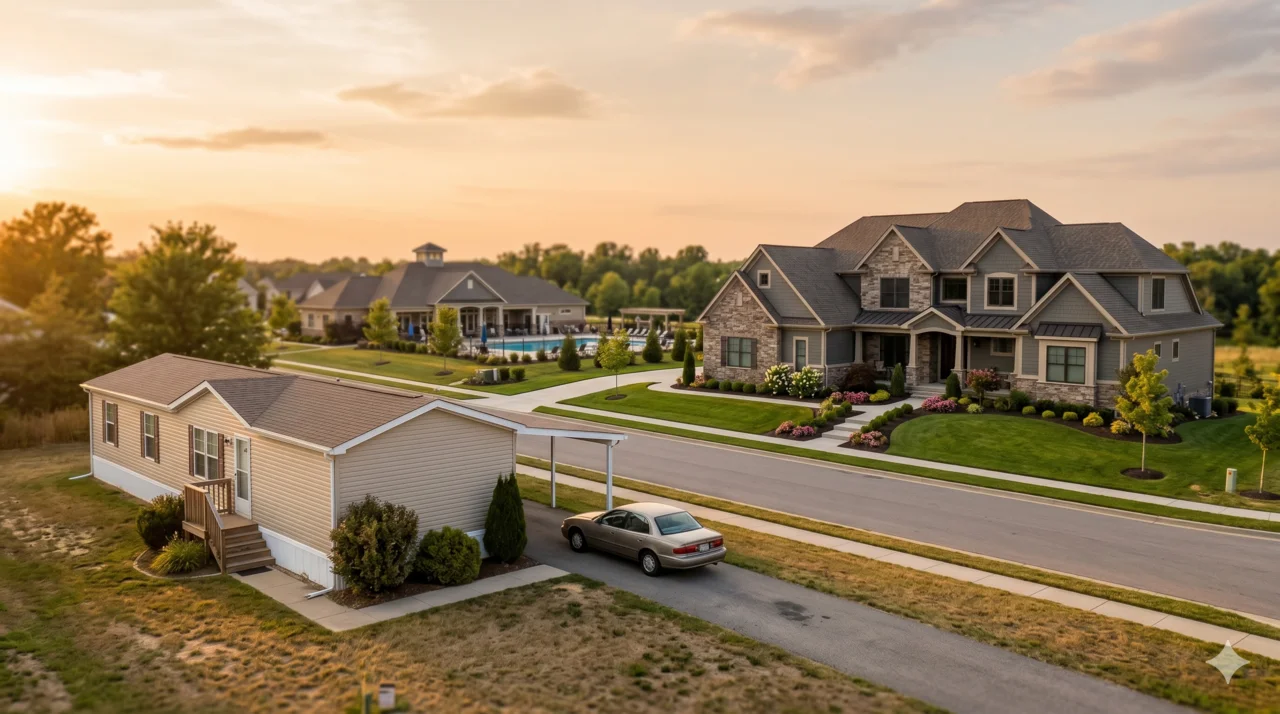
Taylor Morrison is the opposite animal. It is the nation's sixth-largest homebuilder by closings, and it sells site-built homes to move-up and resort-lifestyle buyers at an average price of $597,000.5 That is not a trailer with the stigma removed; it is a four-bedroom in a master-planned community with an Esplanade clubhouse down the street. Abel did not buy more of what Berkshire already had. He bought the rung above it — and signaled he intends to bolt it onto what Berkshire already owns. "Over time," he said, "we expect to unify our site-built homebuilding operations into a combined platform."1 For a company whose entire managerial religion is leaving subsidiaries alone, that last clause is the most interesting sentence in the press release.
Twenty-two years on the bottom rung
The Clayton story is one of Berkshire's best-loved. Buffett did not chase the company; a finance class from the University of Tennessee handed him its founder's autobiography during their annual Omaha pilgrimage in February 2003. He read it, admired the record, called the founder's son Kevin, and made an offer "based solely on Jim's book, my evaluation of Kevin, the public financials of Clayton and what I had learned from the Oakwood experience."11 The price was roughly $1.7 billion. That October, Buffett threw a graduation ceremony in Knoxville for the 40 students who sparked the deal, handing each a Berkshire B share.11
Twenty-two years on, Clayton is enormous. In 2025 it produced roughly 59,400 homes — about 49,400 factory-built and another 10,000 through its site-built arm, Clayton Properties Group — on revenue of about $12.9 billion and pre-tax earnings near $1.9 billion.12 But as this site argued in ↗ Clayton's earnings centre has quietly migrated from the factory to the loan book: its captive lenders Vanderbilt Mortgage and 21st Mortgage held $29.8 billion of chattel paper at the end of the first quarter of 2026.13 And as ↗ documented, the strategy has been to push down in price, not up — the 2026 launch of the 408-square-foot TRU Mini was Clayton aiming squarely at the buyer the conventional market has priced out.
That is the point worth dwelling on. For twenty-two years, every dollar of Berkshire's homebuilding capital sat at the bottom of the market. The average new manufactured home in America sold for about $124,800 in 2024 — Berkshire does not break out Clayton's own figure, but the segment is unmistakably the cheap one.17 Clayton Properties' site-built homes lifted the average toward $400,000, but even that is the entry-and-first-move-up band. Berkshire had no presence at all in the part of the market most Americans actually aspire to: the $500,000-and-up move-up home. Until now.
The move-up home
Taylor Morrison is older than it looks. Its corporate DNA runs back to two British construction houses — Taylor Woodrow, founded in 1921, and George Wimpey, founded in 1880 — which merged in 2007. The North American operation was sold in 2011 to a private-equity consortium led by TPG and Oaktree for roughly $950 million, then floated on the New York Stock Exchange in April 2013 at $22 a share.10 Under Sheryl Palmer — chief executive since 2015 and the only woman to chair and run a publicly traded American homebuilder — it grew by acquisition, swallowing AV Homes in 2018 and William Lyon Homes in 2020 to reach the top tier of the industry.10
Today it operates in roughly 20 markets across 12 states under three brands: Taylor Morrison for move-up and luxury buyers, Esplanade for active-adult resort communities, and Yardly for build-to-rent.14 It is, by any measure, a high-quality operator. Here is the five-year record Berkshire is buying:
| Year | Home closings revenue ($M) | Homes closed | Avg. selling price ($K) | Home-closings gross margin | Net income ($M) | Diluted EPS |
|---|---|---|---|---|---|---|
| 2021 | 7,171 | 13,699 | 524 | 20.3% | 663 | $5.18 |
| 2022 | 7,889 | 12,647 | 624 | 25.2% | 1,053 | $9.06 |
| 2023 | 7,159 | 11,495 | 623 | 23.9% | 769 | $6.98 |
| 2024 | 7,756 | 12,896 | 601 | 24.4% | 883 | $8.27 |
| 2025 | 7,755 | 12,997 | 597 | 22.5% | 783 | $7.77 |
Sources: Taylor Morrison FY2021–FY2025 earnings releases and FY2025 10-K.56789
The shape of that table matters. Margins peaked in the 2022 supercycle at 25.2% and have drifted down to 22.5% as mortgage rates lodged above 6% and buyers leaned on incentives; net income is off its 2022 high. This is a business sliding down the gentle back of a housing cycle, not a wreck. Stockholders' equity nonetheless grew every year, reaching $6.3 billion at the end of 2025.6 Berkshire is buying a cyclical leader whose cycle is cooling — which, as we will see, is exactly the condition under which it likes to write a cheque.
The whole staircase

Put the two businesses side by side and the logic of the deal becomes plain. Berkshire did not buy a competitor to Clayton. It bought the tier Clayton never reached.
| Clayton Homes | Taylor Morrison | |
|---|---|---|
| Joined Berkshire | 2003 (~$1.7B)11 | 2026 (~$8.5B EV)1 |
| How homes are built | Mostly factory-built; some site-built (CPG) | Site-built |
| 2025 homes | ~59,40012 | 12,9975 |
| Average selling price | ~$125K factory / ~$400K site-built1714 | $597,0005 |
| Typical buyer | Entry-level / affordable | Move-up, luxury, active-adult |
| 2025 revenue | ~$12.9B12 | $8.1B5 |
| Captive lender | Vanderbilt / 21st Mortgage ($29.8B book)13 | Taylor Morrison Home Funding15 |
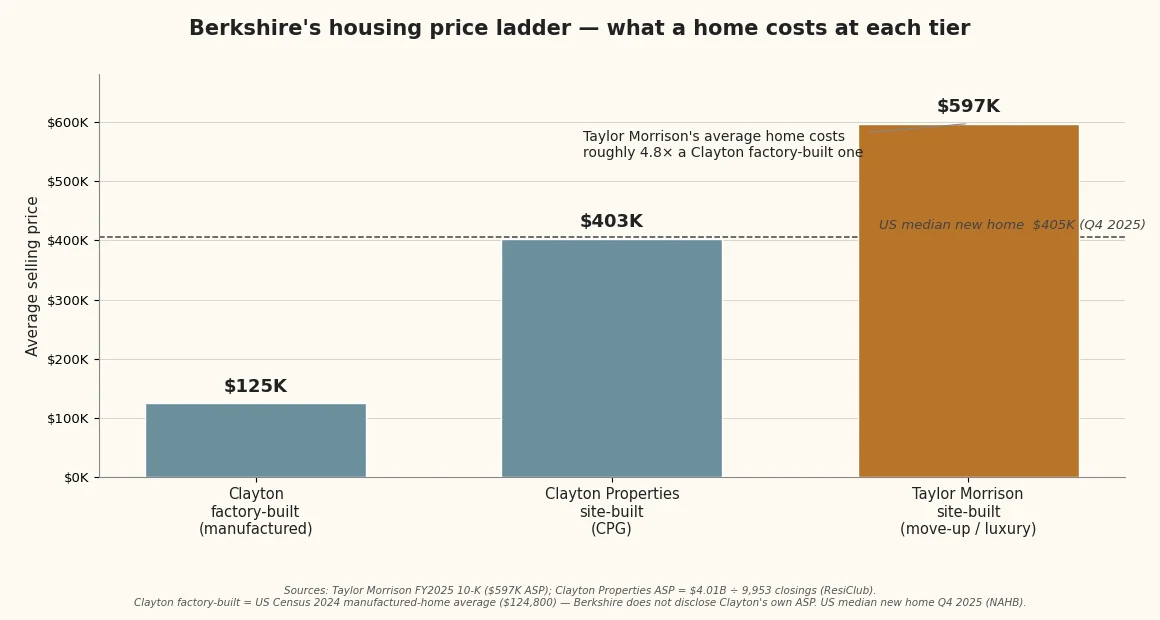
The picture is a staircase. A Clayton factory-built home averages around $125,000; a Clayton Properties site-built home around $400,000; a Taylor Morrison home $597,000 — nearly five times the factory-built figure, and comfortably above the $405,300 median new home in America.1718 Where Berkshire once owned a single step, it now owns the flight.
The scale effect is just as striking. Taylor Morrison's 12,997 closings sit alongside Clayton Properties Group's roughly 9,953 site-built closings; combine the two and Berkshire becomes, on a pro-forma basis, the fourth-largest homebuilder in the United States, trailing only D.R. Horton, Lennar and PulteGroup.1419 That is the platform Abel said he wants to unify. Berkshire did not dabble in move-up housing. In one cheque it became a national power in it.
Is $72.50 a fair price?
The question every Berkshire holder asks of any deal: did we overpay? The headline says Berkshire paid a 24% premium over Taylor Morrison's $58.50 close on May 29.1 A premium sounds expensive. The multiples say the opposite.
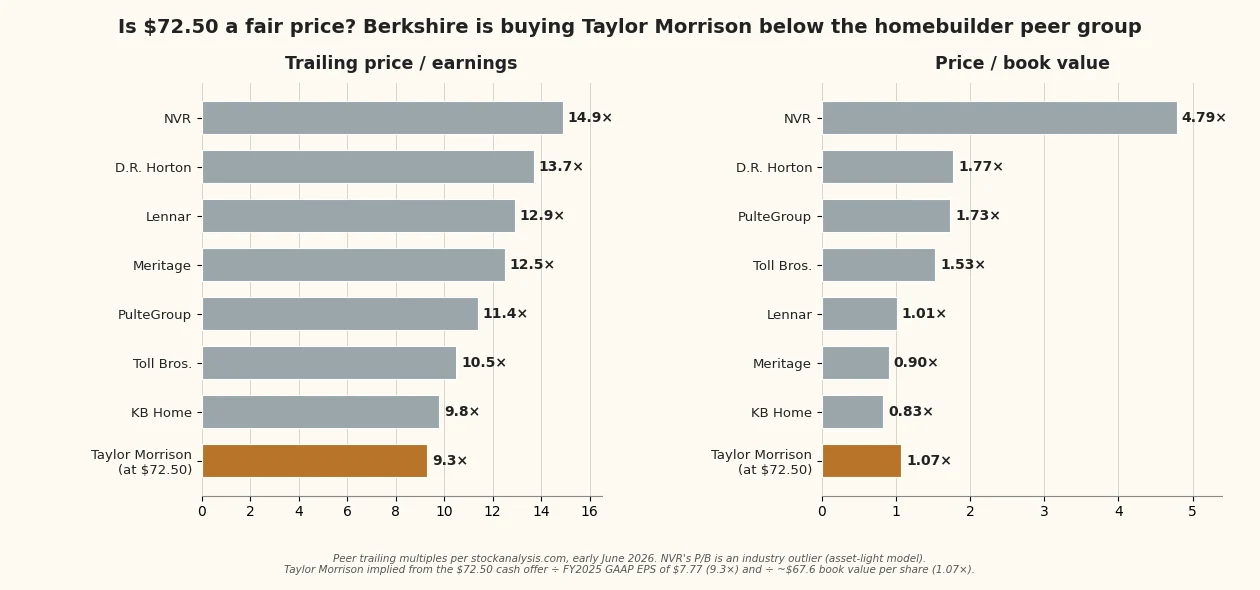
At $72.50, Berkshire is paying about 9.3 times Taylor Morrison's 2025 GAAP earnings of $7.77 a share, and roughly 1.1 times the company's book value of about $67.60.56 Against the public homebuilder group as of early June 2026, that is cheap on both counts: D.R. Horton, Lennar, PulteGroup, NVR, Meritage and Toll Brothers all trade north of 10 times earnings, and the cheapest of them — KB Home at about 9.8 times — is still dearer than the price Berkshire negotiated.16 On book value, only KB Home and Meritage trade lower than the multiple Berkshire is paying. The 24% premium was paid over a depressed price: Taylor Morrison's stock was sitting within a few percent of its 52-week low when the deal was struck, with builder sentiment near multi-year lows on stubborn mortgage rates.1618
Honesty requires the other half of the sentence. Nine times earnings is cheap against 2025, but 2025 may prove to be near the top of this cycle — first-quarter 2026 results were running well below last year's pace, and on that lower run-rate the forward multiple looks more like the mid-teens.16 Berkshire is not buying a screaming bargain on next year's numbers; it is buying a high-quality builder at trough sentiment and below replacement-level peer pricing, financing it from a cash pile that earns Treasury-bill yields in the meantime. That is the same trough-buying logic that ran through the ↗ argument about Berkshire's record cash hoard: deploy when others are fearful, not when the multiple flatters the seller. On price, Abel passed the Buffett test.
The ecosystem question
Here is where the deal stops being a housing trade and becomes a Berkshire trade. Berkshire already owns much of what goes into a house. Its building-products group — Shaw flooring, Johns Manville insulation and roofing, Benjamin Moore paint, MiTek's engineered trusses and connectors, and (until its 2026 move into Marmon) Acme Brick — generated roughly $13.8 billion of revenue in 2025.12 What Berkshire never owned, until now, was a large site-built homebuilder those products could flow into.
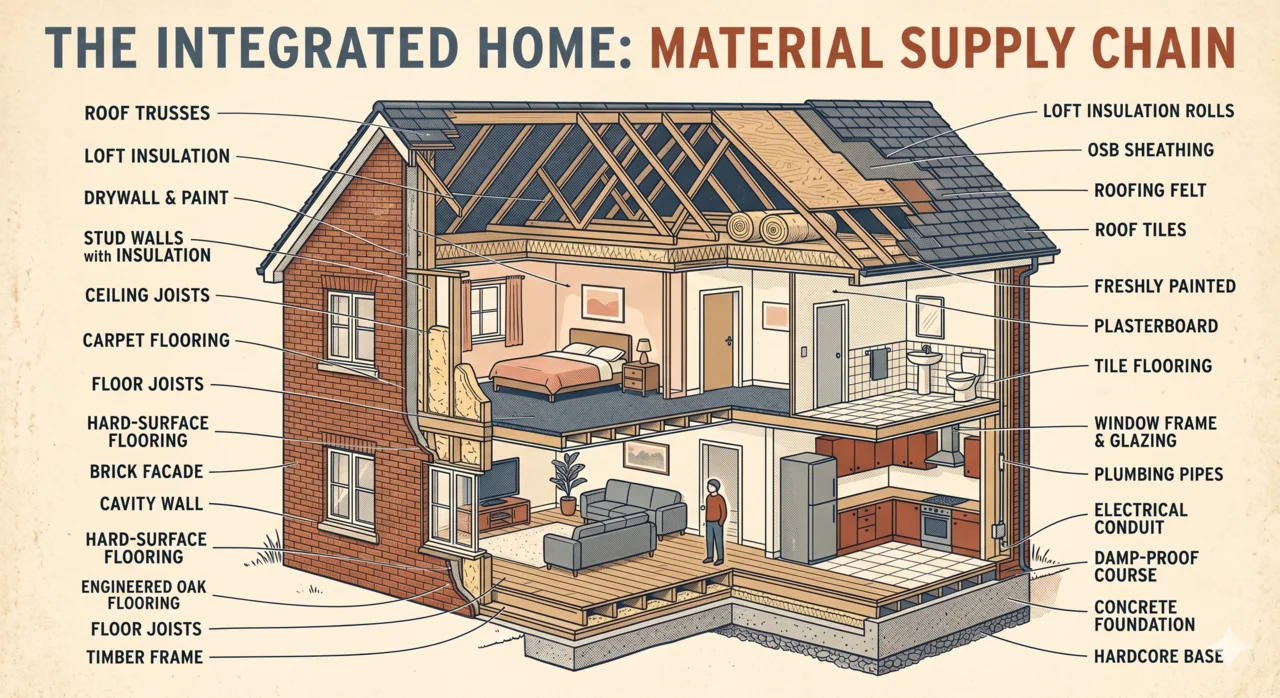
Buffett saw the connection a long time ago. In the very 2003 letter that announced the Clayton purchase, he described the model home Berkshire would display at that year's annual meeting: a Clayton house "featuring Acme brick, Shaw carpet, Johns-Manville insulation, MiTek fasteners" and furnished by Nebraska Furniture Mart.11 That was the ecosystem in miniature, written 23 years before the Taylor Morrison deal. MiTek already sells its trusses and connectors straight into the homebuilding supply chain; Shaw already wants to put hard-surface flooring under more roofs. A national builder closing nearly 13,000 homes a year is a captive customer for every one of them — exactly the kind of vertical knitting this site described in ↗.
The finance side rhymes too. Bolt Taylor Morrison Home Funding onto Clayton's Vanderbilt Mortgage and Berkshire's combined mortgage origination jumps to roughly $8.2 billion a year — top-50-lender territory — and that is before counting HomeServices of America, Berkshire's ~35,000-agent residential brokerage, as a referral channel.15 Capital, land, building materials, construction, mortgage, title, brokerage: Berkshire now owns a piece of nearly every link in the chain from raw lot to closing table.
The catch — and the genuinely novel thing about this deal — is the word "unify." Berkshire's defining promise to the businesses it buys is autonomy: founders and managers run their companies, headquarters stays out of the way. Abel's stated intention to fold Clayton's site-built builders and Taylor Morrison into "a combined platform" is, as more than one observer noted, a departure from that hands-off tradition.3 It may be the right call — homebuilding genuinely rewards scale in land and purchasing — but it is worth flagging as a real shift in style, not a cosmetic one. Sheryl Palmer stays on as CEO, which softens it.1 How far the integration actually goes is the thing to watch over the next several years.
What it says about Abel
Abel inherited a company with a near-$400 billion cash position and an expectation, fairly or not, that he would struggle to deploy it. His ↗ were full of tidy, defensive moves — the OxyChem close, a Tokio Marine stake, a buyback restart, a personal share purchase. Taylor Morrison is the first one with his fingerprints all over it: a public-company takeover, negotiated directly, in a sector he chose. Buffett's "he has launched" was an endorsement of that — the willingness to act at size.34
The deal is recognisably Buffett in its bones — a simple, understandable business, a long runway behind a structural housing shortage, a price struck at trough sentiment, paid in cash from float and Treasuries. But the integration ambition is recognisably not Buffett, and that is the tell. Abel is signalling that he will treat Berkshire's sprawl less as a museum of independent companies and more as a set of assets to be arranged. Housing is his first canvas because Berkshire already had the paint, the brick, the flooring and the mortgage desk — everything but the builder. Now it has the builder too.
Conclusion
For twenty-two years Berkshire's relationship with the American home was a one-storey affair: Clayton, the factory floor, the affordable rung, the captive loan book. The Taylor Morrison acquisition adds the upper storeys — the $597,000 move-up home, the resort community, the national site-built platform — and does it at a price below what the public market charges for any of Taylor Morrison's peers. Berkshire now stands on the whole staircase, from a $125,000 manufactured box to a $600,000 suburban move-up, and owns much of the supply chain in between. Whether Abel's promise to "unify" that sprawl into a single platform proves to be his best instinct or his first real break with the Buffett playbook is the question the next few years will answer. Either way, the man has launched — and he did it by buying a house.
References
-
Berkshire Hathaway to Acquire Taylor Morrison Home Corporation for $8.5 Billion - businesswire.com ↩↩↩↩
-
Taylor Morrison Home Corp — Form 8-K, Exhibit 99.1 (merger announcement) - sec.gov ↩
-
Buffett says Abel 'has launched' with his first big Berkshire deal: an $8.5 billion housing bet - fortune.com ↩↩
-
Berkshire Hathaway buys homebuilder Taylor Morrison in first deal under new CEO - cnbc.com ↩↩
-
Taylor Morrison Reports Fourth Quarter and Full Year 2025 Results - taylormorrison.com ↩↩
-
Taylor Morrison Reports Fourth Quarter and Full Year 2022 Results - prnewswire.com ↩
-
Taylor Morrison Reports Fourth Quarter and Full Year 2023 Results - prnewswire.com ↩
-
Taylor Morrison Reports Fourth Quarter and Full Year 2024 Results - prnewswire.com ↩
-
Taylor Morrison Home Corporation — Form 424B4 (2013 IPO prospectus) - sec.gov ↩↩
-
Berkshire Hathaway 2003 Chairman's Letter (Clayton acquisition) - berkshirehathaway.com ↩↩↩
-
Berkshire Hathaway 2025 Annual Report (Clayton & building products) - berkshirehathaway.com ↩↩
-
Berkshire Hathaway Q1 2026 Form 10-Q (Clayton loan portfolio) - sec.gov ↩
-
Berkshire Hathaway's housing market wager: acquiring Taylor Morrison - resiclubanalytics.com ↩↩
-
Berkshire-Taylor Morrison deal reshapes the mortgage picture - housingwire.com ↩
-
Taylor Morrison & homebuilder peer valuation statistics - stockanalysis.com ↩↩↩
-
Average Sales Price of New Manufactured Homes (US Census via FRED) - stlouisfed.org ↩↩
-
2026 Housing Outlook: Ongoing Challenges, Cautious Optimism - nahb.org ↩↩
-
2025 Builder 100: the largest U.S. homebuilders - builderonline.com ↩