Tags: Greg Abel / Warren Buffett / History
This fanpage is not officially affiliated with Berkshire Hathaway: Disclaimer
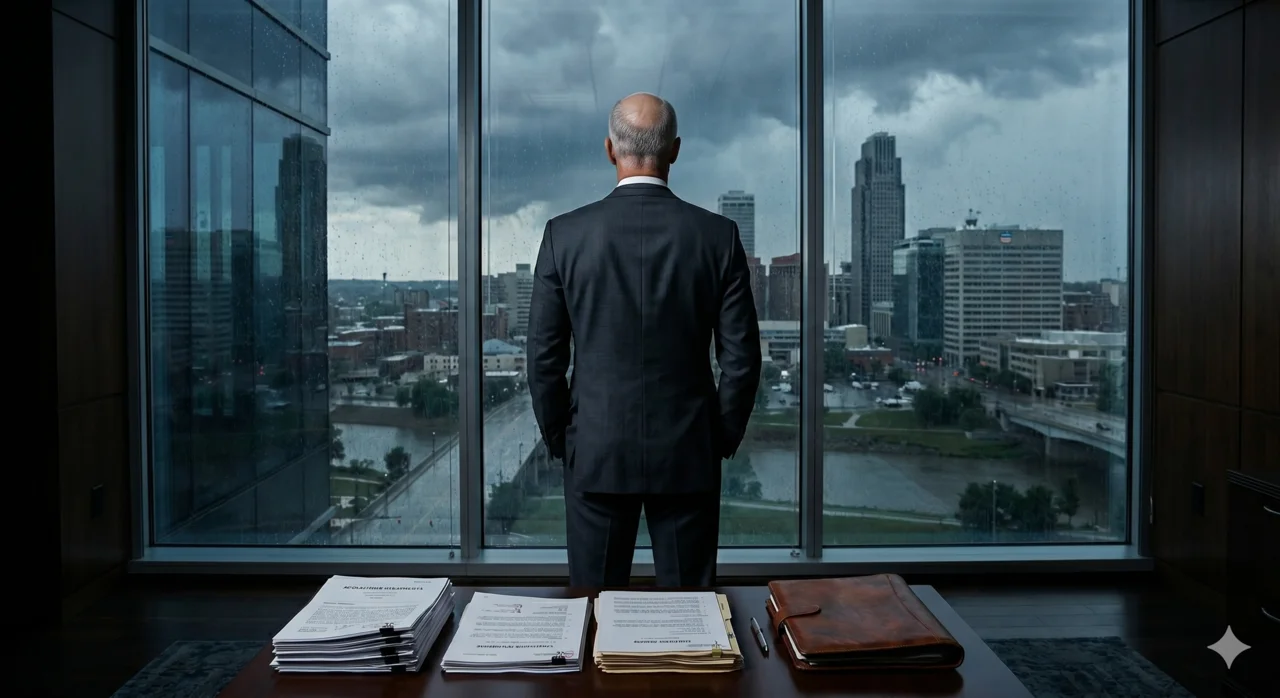
On January 1, 2026, Greg Abel walked into Berkshire Hathaway's spare Kiewit Plaza headquarters as the company's new chief executive — the first change of CEO in sixty years at a company worth nearly a trillion dollars. Warren Buffett stayed on as Chairman. By January 2, the ink was dry on a $9.7 billion chemicals acquisition. By March 4, Abel had restarted share buybacks, purchased fifteen million dollars of BRK.A with his own money, and pledged to repeat the purchase every year he holds the title. By April 17, Berkshire had made a $1.8 billion strategic investment in Japan's largest insurer, sold ¥272 billion in yen bonds, and survived the Kraft Heinz register-then-reverse episode without visible strain. Totaling 107 days. In a year of genuine geopolitical whiplash — a US-Iran war, tariff rates at their highest since 1943, a Federal Reserve on pause, and oil prices swinging between ceasefire relief and Strait of Hormuz panic — that measured pace of activity is itself the message.
Introduction
Abel is 63, born in Edmonton, Alberta, and his career has run almost entirely inside the utility business that became Berkshire Hathaway Energy. He joined CalEnergy — the geothermal producer that later became MidAmerican Energy — in 1992 as a PwC alumnus, rose as the right-hand man to David Sokol, and succeeded him as CEO in 2008. In 2018, Buffett elevated him to Vice Chairman of non-insurance operations and a seat on the board, beginning a seven-year public audition. At the 2021 shareholder meeting, Charlie Munger ended the speculation in nine words: "Greg will keep the culture." In May 2025, the board formalized what everyone already knew.1
The handover came with a balance sheet that has no precedent in corporate America. Berkshire closed 2025 with $369 billion in cash and T-bills, float of $176 billion generating passive investment income at scale, and an operating-subsidiary complex that, in 2025, produced $44.5 billion in after-tax earnings on its own2 — meaning Abel was handed not a turnaround case but an embarrassingly well-capitalized machine with an extremely difficult to-do list. What do you do with $373 billion that is neither reckless nor timid? The first 107 days suggest he has thought carefully about the answer.
What He Inherited
The financial numbers Abel walked into on January 1 are worth examining in full, because they set the context for everything that follows.
| Segment (after-tax) | 2024 | 2025 | Change |
|---|---|---|---|
| Insurance underwriting | $9.020B | $7.258B | –19.5% |
| Insurance investment income | $13.670B | $12.513B | –8.5% |
| BNSF | $5.031B | $5.476B | +8.8% |
| BHE | $3.730B | $3.979B | +6.7% |
| Manufacturing, service & retail | $13.072B | $13.647B | +4.4% |
| Other | $2.914B | $1.613B | –44.6% |
| Total operating earnings | $47.4B | $44.5B | –6.3% |
Source: Berkshire Hathaway 2025 Annual Report (10-K), February 28, 2026.2
The headline decline — $44.5 billion against $47.4 billion the prior year — is almost entirely an insurance story. GEICO's pre-tax underwriting earnings fell from $7.8 billion to $6.8 billion2 as the industry's pricing correction ran out of runway and bodily-injury severity climbed 12–14 percent. BHRG, the reinsurance operation, fell from $2.7 billion to $1.9 billion pre-tax, absorbing higher catastrophe losses in a busy year. Insurance investment income, meanwhile, declined as three Fed rate cuts in 2025 began flowing through the T-bill book. The rest of the company — BNSF, BHE, manufacturing, Clayton Homes, Pilot — held up or improved.
Buffett's 60-year tenure closed with a GAAP write-down of $8.3 billion split between Kraft Heinz and Occidental common stock2 — a farewell gift to accounting reality that does not affect operating earnings but inflated the headline swing. Abel inherits a cleaner balance sheet than the GAAP noise suggests.
107 Days of Capital Allocation
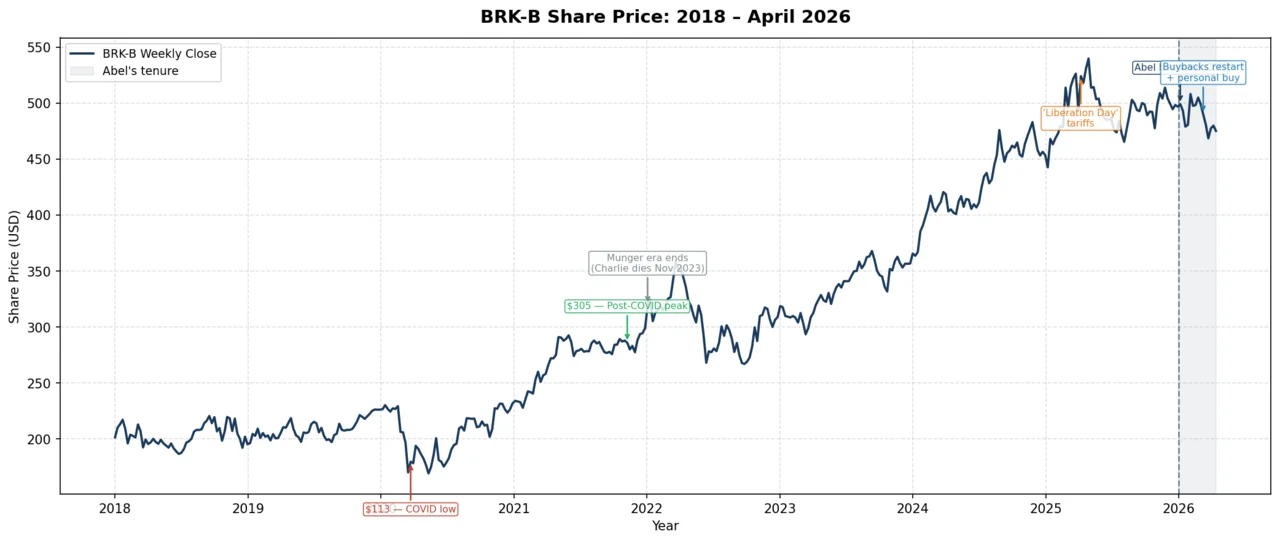
The table below is a timeline of every substantive capital move Abel has made since taking the chair:
| Date | Action | Amount | Source |
|---|---|---|---|
| Jan 2, 2026 | OxyChem acquisition closes | ~$9.5–9.7B | 4 |
| Jan 20, 2026 | Kraft Heinz shares registered for potential resale (325.4M shares) | ~$7.7B market | 5 |
| Feb 7, 2026 | OXY stake raised to ~26.9% (763,017 shares at $46.82) | ~$36M | 6 |
| Mar 4, 2026 | Share buybacks restarted (309 Class A share equivalents) | ~$226M | 7 |
| Mar 4, 2026 | Abel buys 21 Class A shares personally; pledges annual repeat | ~$15M | 7 |
| Mar 23, 2026 | NICO invests in Tokio Marine (2.49% stake + 10-yr reinsurance partnership) | ¥287.4B (~$1.8B) | 8 |
| Apr 10, 2026 | Yen bond issuance (6 tranches, 3–30 year maturities) | ¥272.3B (~$1.7B) | 9 |
Sources: Berkshire press releases, CNBC, Bloomberg, Insurance Journal (see footnotes 4–9).
The OxyChem deal ↗ was agreed before Abel technically took office — Buffett signed the October 2025 deal — but it closed on his first working day, a symbolism he will not have missed. Occidental retained all legacy environmental liabilities through Glenn Springs Holdings, a structural cleanness rare in acquisitions of this vintage. Lubrizol CEO Rebecca Liebert was handed operational oversight of OxyChem alongside the incumbent management team, continuing the management lineage between two $9.7 billion chemical deals fifteen years apart.
The Kraft Heinz episode is more interesting than the headlines suggested. Registering 325 million shares for potential resale triggered a 6 percent KHC stock drop and a wave of commentary about Abel cleaning house.5 He then said Berkshire would not sell, and Kraft Heinz separately shelved a planned split. The sequence reads less like strategic brilliance than an earnest test of the market's reaction function — and the answer (market punishes even the possibility of a sale by a 28 percent shareholder) probably told him something useful.
The personal stock purchase is the piece with the longest legs. Abel committed to spending his entire after-tax annual salary — $25 million gross, roughly $15 million after tax — on Berkshire stock every year he is CEO.7 Buffett called it "so Berkshire." That is not a compliment available to most executives; it is a description of a specific cultural behavior where the manager's personal wealth and the shareholder's interests are collapsed into the same line item.
The World He Walked Into
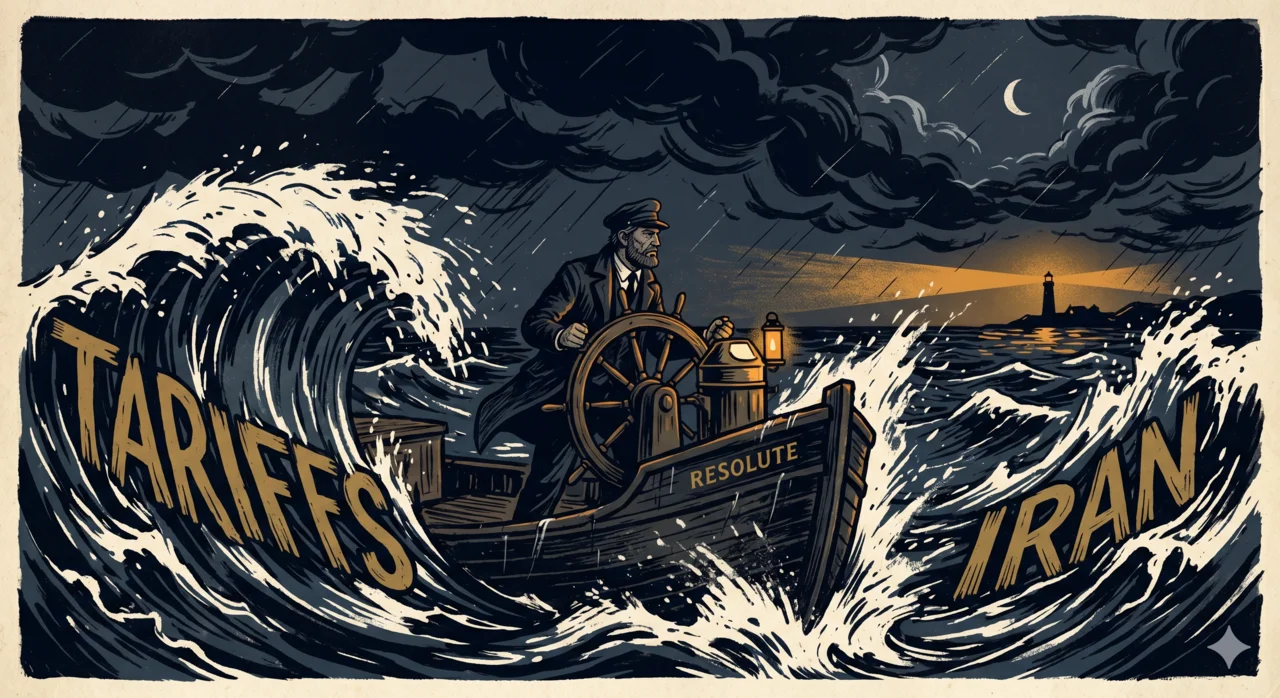
Whatever assessment of Abel's first 100 days is ultimately fair, the external environment he inherited deserves its own section. The geopolitical calendar in the first quarter of 2026 was the kind that makes macroeconomists reach for bourbon.
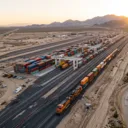
Tariffs. US average effective tariff rates hit approximately 11 percent in April 2026 — the highest since 1943.10 The 25 percent automotive tariff is already projecting an 8 percent increase in auto-parts repair costs, a direct headwind for GEICO's loss ratios over the 12–18 month pricing cycle. BNSF intermodal volumes were running roughly 8.8 percent below the prior year through the first ten weeks of 2026, as manufactured-goods imports from Asia dried up.11 The grain and agricultural-exports corridor, conversely, ran 10 percent above the prior year as customers rushed to move commodities before bilateral retaliation locked the channel. Berkshire's railroad is simultaneously two businesses with opposite sensitivities to trade policy.
US-Iran conflict. A US-Israeli military operation against Iran in February 2026 threatened Strait of Hormuz traffic — roughly 20 percent of global oil supply. Brent crude briefly hit $100.99 per barrel on April 9 before a fragile ceasefire knocked it back to $94.80; by April 12, Trump's threat of a US Navy blockade of Iranian ports pushed it back above $100.12 Diesel tracked accordingly, hitting $5.80 per gallon at the April peak — relevant for Pilot Travel Centers, which generated $42.2 billion in 2025 revenue against weaker diesel margins already, and for BNSF's fuel cost line, which ran $3 billion in 2025.2
Federal Reserve. The Fed held the funds rate at 3.50–3.75 percent at both the January and March 2026 FOMC meetings, having cut three times in 2025.13 The 10-year Treasury stood at 4.31 percent on April 10. Berkshire's $369 billion cash book earns substantial income at current rates, but the direction is unfavorable: insurance investment income fell $1.2 billion year-over-year in 2025 as the 2025 cuts began flowing through. Abel described the cash position accurately in his annual letter: "While some of this capital is required to support our insurance operations and protect Berkshire against extreme scenarios, it also constitutes our dry powder."2
Put together: Abel took the chair on the day an oil war started, tariffs were being challenged in federal court and replaced with successors, and the rate cycle that had made Berkshire's T-bill book a profit center was turning. He handled all of it by doing basically nothing dramatic. That is, at Berkshire, a decision.
Three Fires to Fight
The surface-level capital allocation story is interesting. The harder story is the set of structural challenges embedded in the subsidiaries Abel now owns.
BHE and PacifiCorp. The wildfire liability at Berkshire's utility subsidiary ↗ remains the most financially significant open question in the portfolio. Cumulative reserves stand at $2.85 billion against an estimated $50 billion in outstanding claims — with PacifiCorp's equity base of roughly $9–10 billion providing limited buffer. On April 8, 2026, the Oregon Court of Appeals overturned the foundational James class action verdicts on procedural grounds, potentially pausing 160 scheduled follow-on damages trials.14 S&P had flagged possible junk-downgrade risk on BHE as recently as late 2025. Abel's framing in the annual letter — "PacifiCorp is not an insurer of last resort and should not be treated as a deep pocket" — is legally accurate and structurally important, but an Oregon Supreme Court appeal is expected. BHE earned $3.979 billion after tax in 2025, up 6.7 percent, partly because wildfire loss accruals fell to $100 million from $346 million the prior year.2 The improvement is real. The exposure is not resolved.
GEICO. The insurance turnaround that produced $7.8 billion in pre-tax underwriting earnings in 2024 is facing its first real test since Todd Combs' restructuring. Pre-tax earnings fell to $6.8 billion in 2025 — still exceptional by any industry benchmark but driven by a deteriorating environment: bodily injury severity up 12–14 percent, competitor rate reductions eroding retention, and the first hints of tariff-driven parts-cost inflation. Abel acknowledged in the letter that the industry is seeing "decelerating or reversal of pricing trends" and that GEICO "can expect less property and casualty business for a period of time."2 The combined ratio of 84.7 percent remains best-in-class; the trajectory is the concern.
BNSF and the operating margin gap. ↗ BNSF delivered $5.476 billion in after-tax earnings in 2025, up 8.8 percent, with pre-tax earnings of $8.055 billion and an operating margin of 34.5 percent — the best in years.2 Abel promptly noted in the letter that "the gap to the industry's best remains too wide" and that each one-percentage-point improvement in operating margin generates approximately $230 million in additional cash flow. The subtext is that BNSF has been running below its peer group on operating ratio for years, and the tariff environment arriving in 2026 — which cuts intermodal volumes while pushing fuel costs higher — is not the ideal backdrop for a margin-improvement campaign. He made the commitment anyway.
The First Letter
Abel's February 28 annual letter runs twenty-one pages and reads as a considered, deliberate statement of continuity and quiet ambition. The word that appears most often is "culture." He quoted Munger's 2021 remark directly. He committed to decentralization: "Decisions are made faster, with better knowledge and greater conviction, when they are made by those who are closest to the business and have accountability for its outcomes. This will not change."2 He quoted Buffett's 1991 Salomon testimony — "Lose money for the firm, and I will be understanding; lose a shred of reputation for the firm, and I will be ruthless" — as his own operating principle.
He also said something about his tenure that deserves attention: "I will not be your CEO for the next 60 years as simple arithmetic makes that — shall we say — an ambitious plan. However, 20 years from now... my intention is that you — or your descendants — will be proud that your company is even stronger."2 That is a 20-year time horizon published in a first letter. Most incoming CEOs speak in three-year cycles. Abel is telling shareholders that he intends to run the business as a long-horizon owner — and that Berkshire's test is not the next quarter but the next generation.
On management succession beneath him, two appointments are worth noting: CFO Chuck Chang will succeed Marc Hamburg on June 1, 2026 (Hamburg stays through June 2027 to manage the transition), and Mike O'Sullivan has been named Berkshire's first-ever corporate General Counsel — a sign that the conglomerate is quietly institutionalizing its legal and financial infrastructure for a post-Buffett scale it knows is coming.
The Elephant in the Room
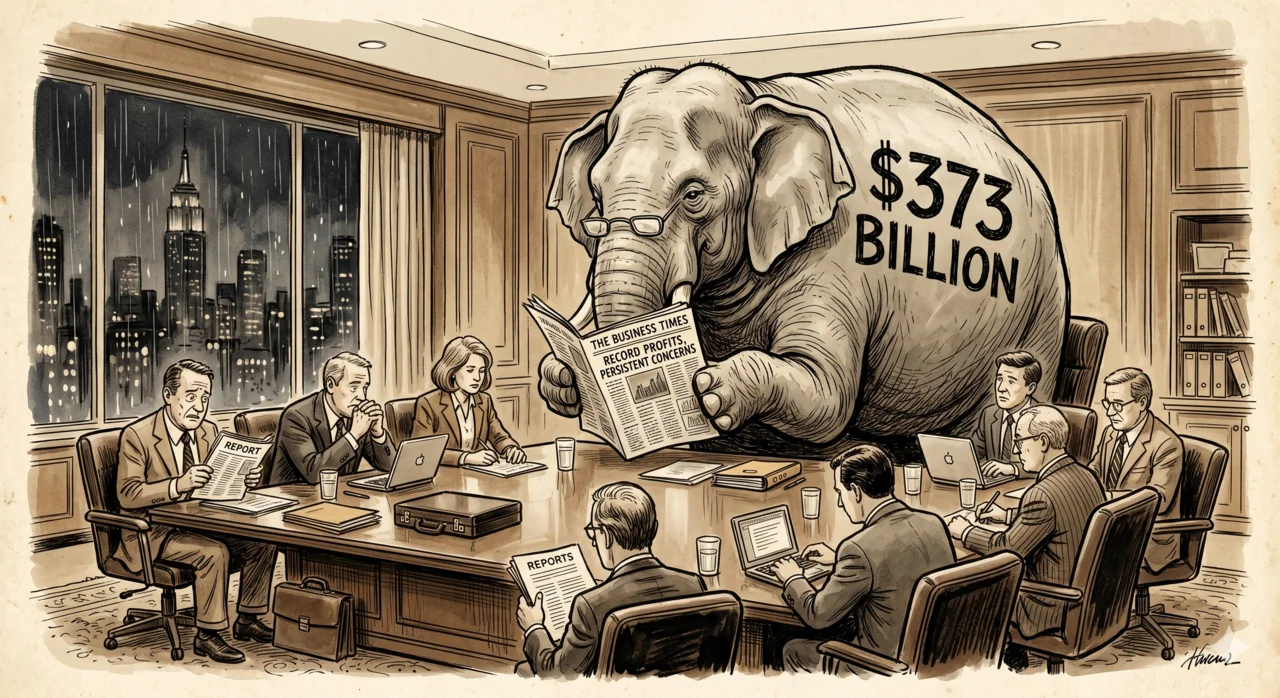
The central question — the one that will define whether Abel's tenure is remembered as a worthy continuation or a long anticlimax — is what he does with the cash. He ended 2025 with $369 billion in cash and T-bills. Add back the $9.5 billion spent on OxyChem, and the Q3 2025 peak was $381 billion.2 He has restarted buybacks, but $226 million is a rounding error on that balance. The Tokio Marine investment is $1.8 billion — meaningful in absolute terms, negligible as a fraction of the pile.
Abel addressed this directly: "Many times in Berkshire's history, some observers have suggested that our substantial cash position signals a retreat from investing. It does not."2 He also reminded shareholders that Berkshire can move without financing contingencies — a structural advantage in auction processes where speed matters. At Berkshire's current scale, an acquisition would need to exceed $50 billion to materially deploy the pile. There are fewer than a dozen publicly traded businesses in the world that meet Berkshire's quality criteria at that size, and most are not for sale.
The historical parallel worth examining is Buffett's own first years. When Buffett took control of Berkshire in 1965, he already had two activist investments running — Dempster Mill, where he had replaced management and was liquidating trapped assets for a 186 percent gain, and Sanborn Map, where the investment portfolio was worth more than the entire stock price. Both were cases of capital trapped inside declining businesses, patiently extracted. Abel's 107-day record — OxyChem (a trough-priced industrial with a structural moat), Kraft Heinz (a willingness to admit a mistake, then reverse when the reversal served shareholders better), the Tokio Marine partnership (patient relationship capital in a market where Berkshire has already deployed $15 billion) — shows an investor with a similar instinct for structure over headlines.15
Whether the elephant arrives in year two or year five matters enormously to shareholders running return calculations on $373 billion of idle capital. Abel's implied answer: when the price is right and the business is understood, not before.
Conclusion
Greg Abel's first 107 days as Berkshire Hathaway CEO produced more capital activity than most observers expected and less drama than most headlines implied. The OxyChem close, the Tokio Marine stake, the buyback restart, and the personal share purchase form a coherent picture: a capital allocator who moves when he sees value, does not force transactions when he doesn't, and is willing to put his own money where his shareholder letter is.
The harder challenge is not the capital — it is the businesses. BHE carries a wildfire liability that has not been resolved. GEICO is navigating its first post-restructuring headwind cycle. BNSF is committed to closing an operating margin gap in a tariff year that makes intermodal volumes unpredictable. And all of this is playing out against an external environment — tariffs at 80-year highs, an active conflict in the Persian Gulf, a Federal Reserve on hold — that creates genuine uncertainty in nearly every Berkshire subsidiary simultaneously.
The shareholders who will judge Abel's tenure, as he acknowledged, may include the descendants of the shareholders reading his first letter. That is a strange sentence for an annual report, and it was almost certainly written intentionally. At Berkshire, that is how the culture persists: not by mandate, but by leaders who mean it when they say they think in decades.
References
-
Greg Abel — Wikipedia - en.wikipedia.org ↩
-
Berkshire Hathaway 2025 Annual Report (10-K) - berkshirehathaway.com ↩↩↩↩↩↩↩↩↩↩↩↩
-
BRK-B Historical Stock Price - stockanalysis.com ↩
-
Berkshire Hathaway Completes $9.7B Acquisition of OxyChem - icis.com ↩
-
Berkshire Set to Exit 28% Stake in Kraft Heinz After Rare Buffett Blunder - cnbc.com ↩
-
Berkshire Hathaway OXY Stake — Form 4 February 2026 - fintel.io ↩
-
Berkshire Begins Repurchasing Shares; CEO Greg Abel Buys $15M in Stock - cnbc.com ↩
-
Berkshire's NICO to Acquire 2.49% Stake in Tokio Marine - insurancejournal.com ↩
-
Berkshire Sells $1.7B in Yen Bonds — Third Largest Deal Ever - barchart.com ↩
-
State of US Tariffs, April 2, 2026 - budgetlab.yale.edu ↩
-
North America Freight Insights — Intermodal Q1 2026 - chrobinson.com ↩
-
Iran War, Oil Prices, and the Strait of Hormuz — April 2026 - cnbc.com ↩
-
FOMC Minutes — March 18, 2026 - federalreserve.gov ↩
-
Oregon Appeals Court Overturns James Wildfire Class Action - insurancejournal.com ↩
-
Greg Abel's First Big Move Had Warren Buffett's Personal Approval - cnbc.com ↩