Tags: Clayton Homes / Expansion / Innovation
This fanpage is not officially affiliated with Berkshire Hathaway: Disclaimer
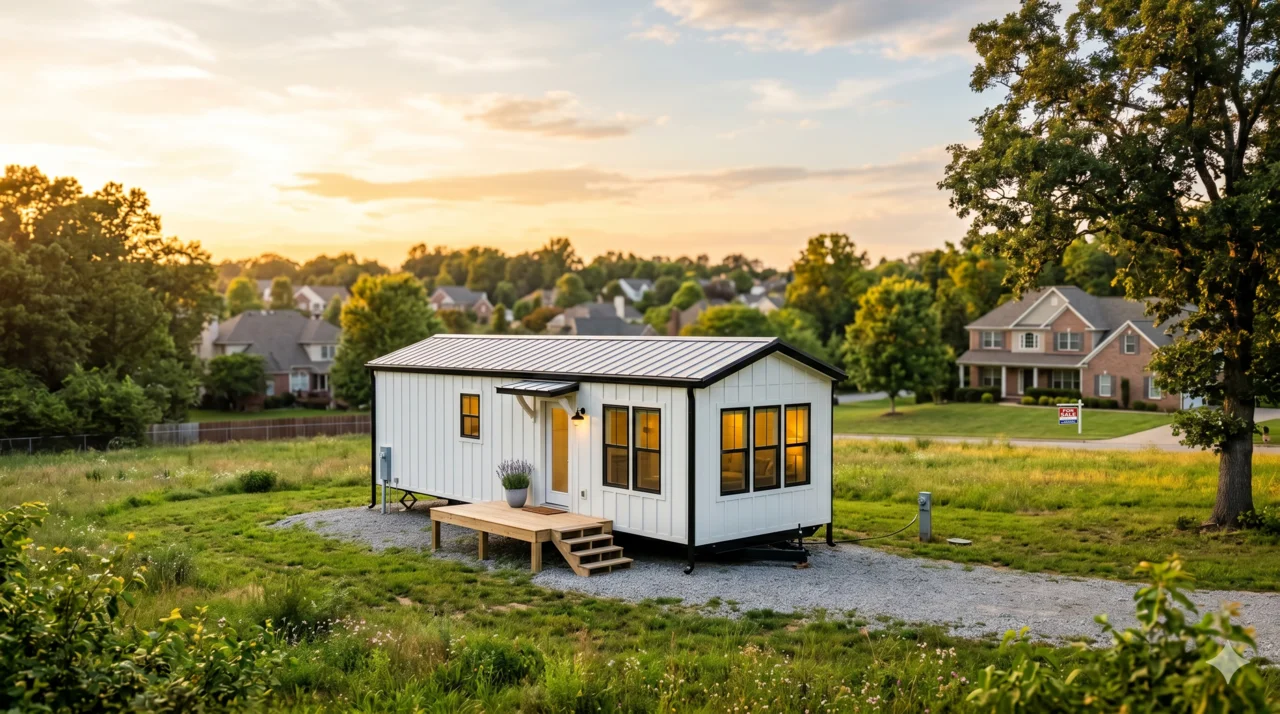
On March 17, 2026, in a convention hall in Biloxi, Mississippi, Clayton Homes unveiled a house small enough to park in a double garage. The TRU Mini — 408 square feet, one bedroom, one bathroom, debuted at the Biloxi Manufactured Home Show1 — is not a lifestyle product for urban minimalists who subscribe to glossy tiny-home magazines. It is Clayton's latest answer to a problem that has outlasted every policy attempt to solve it: 74.9 percent of American households cannot afford the median-priced new home today.2 Whether 408 square feet of factory-built ambition can put a dent in a 4.7-million-unit housing shortage3 reveals a great deal about both the structural limits of manufactured housing and the unusual strengths that Berkshire Hathaway brings to a market nobody else wants to finance through the full rate cycle.
Introduction
The numbers are worth stating plainly. The median new home in the United States sold for $405,300 in the fourth quarter of 2025.4 The median household income is roughly $80,000. Mortgage rates remain above 6 percent. Nearly three-quarters of American households are priced out of the market for a new home.2 A housing supply gap estimated at 4.7 million units3 compounds the problem — there are not enough homes, at any price point, to house the population that needs them, and the gap has been widening for a decade.
The manufactured housing industry has always sat at the intersection of this problem and a set of obstacles — regulatory, cultural, financial — that have prevented it from growing into its theoretical role. The HUD Code, introduced in 1976, established federal construction and safety standards that gave factory-built homes a regulatory foundation. Yet the stigma of the trailer park has proven more durable than any legislative rebrand. Today, 22 million Americans live in manufactured homes5 — the largest single source of non-subsidized affordable housing in the country — and the industry supplies roughly 10 percent of new single-family starts.6 That share has barely moved in two decades, even as the affordability crisis has compounded.
Clayton Homes, which Berkshire Hathaway acquired in 20037, is the dominant company in this market. It generated $12.9 billion in revenue in 2025 and shipped 59,400 homes — 49,400 off-site units and 10,000 site-built.8 Its captive loan portfolio, operated through Vanderbilt Mortgage and 21st Mortgage, stands at $29.5 billion.8 In March 2026, it shipped a one-bedroom home to a convention floor in Mississippi to make a point about where the affordability floor actually sits, and what ownership might still mean for buyers the conventional market has given up on.
From Tennessee Car Lots to National Dominance
The origin story has an almost archetypal Berkshire quality to it: a business nobody thought was interesting, run by people who understood it better than the market did.
Jim Clayton started in the late 1950s selling used cars in Madisonville, Tennessee. He noticed buyers asking about the cheap trailers parked near his lot. He saw what the car business had taught him — factory standardization, dealer distribution, installment financing — and applied it to homes. A factory could produce a home faster and cheaper than a contractor could frame one on a lot. The financing could be structured the same way as a car loan, for buyers who would never qualify for a bank mortgage. The distribution could run through a retail network, the way appliance dealers moved refrigerators.7
Clayton Homes went public in 1994. Kevin Clayton, Jim's son, became CEO and spent the late 1990s building the integrated model that Berkshire would eventually acquire: manufacturing, retail, and a captive financial services arm under one roof. Warren Buffett read Jim Clayton's autobiography, First a Dream, which Kevin had sent after a University of Tennessee business school visit. Buffett called Kevin within weeks.7 By August 2003, Berkshire owned Clayton Homes for approximately $1.7 billion.7
The acquisition looked, from the outside, like a manufactured-housing play. It turned out to be something more durable. The financial services arm — Vanderbilt Mortgage and 21st Mortgage — lent buyers the money to purchase Clayton homes, and then serviced those mortgages for 25 years. In 2013, that loan portfolio stood at $13.6 billion across 326,569 mortgages.9 By 2025, it had grown to $29.5 billion.8 The manufacturing business needed the financing arm to reach buyers the conventional mortgage market rejected. The financing arm needed the manufacturing scale to generate originations that justified its overhead. Two flywheels, one integrated competitive position.

The 408-Square-Foot Answer
The TRU Mini's Buttercup model measures 12 feet by 36 feet. It has 8-foot flat ceilings, DuraCraft cabinets, Frigidaire appliances, and upgraded window casings.1 It contains one bedroom and one bathroom. The specific retail price was not disclosed at launch — Clayton distributes through retail home center partners rather than direct-to-consumer channels, and pricing is negotiated regionally based on land, installation, and local costs.
The TRU Mini builds on Clayton's TRU product line, which has focused on attainable housing for 15 years.1 But 408 square feet is a meaningful compression of even that floor — most manufactured homes range from 700 to 2,000 square feet, sized for families who need functional shelter at one-third to one-half the cost of comparable site-built construction.
The compression is arithmetic, not aesthetic. The difference between a 1,200-square-foot manufactured home and a 408-square-foot TRU Mini isn't quality or ambition — it's the monthly payment. A smaller home financed at $60,000 to $90,000 produces a materially lower payment than a standard manufactured home at $150,000 to $180,000. For buyers already at the margin of what they can service, that difference determines whether ownership — an asset, an equity stake, a hedge against the rent spiral — is possible at all.
The renter paying $1,400 per month in a secondary market for a studio apartment owns nothing at the end of that period. The buyer who finances a TRU Mini and places it on a leased lot or purchased land owns a depreciating but real asset. That distinction is not trivial in a market where wealth transmission is almost entirely determined by whether a family accumulated home equity or didn't.
Clayton by the Numbers
Clayton's revenue and earnings over the past four years trace the business's principal vulnerability and its principal strength:
| Year | Revenue | Pre-Tax Earnings | Off-Site Units | Site-Built Units | Loan Portfolio |
|---|---|---|---|---|---|
| 2022 | $12.7B | ~$2.3B | ~43,500 | ~7,000 | ~$21B |
| 2023 | $11.4B | $2.0B | ~38,000 | ~7,500 | $23.9B |
| 2024 | $12.4B | $1.9B | ~46,000 | ~8,700 | $27.2B |
| 2025 | $12.9B | $1.9B | 49,400 | 10,000 | $29.5B |
Sources: Berkshire Hathaway Annual Reports 2024–2025. 8
The 2023 revenue decline from $12.7 billion to $11.4 billion — a 10.3 percent drop — demonstrates the rate transmission mechanism without ambiguity.8 When mortgage rates surged, unit sales fell 13.7 percent. Buyers who had stretched to afford payments at 5 percent found the same home unaffordable at 7 percent. Manufacturing capacity doesn't insulate you from rate risk at the margin of affordability; it exposes you to it, because every buyer Clayton serves is already at the edge of what they can service.
The recovery in 2024 and 2025 reflects stabilizing rates and normalized buyer expectations. The loan portfolio continued growing even through the 2023 downturn — rising from $23.9 billion to $27.2 billion — which is the counterintuitive Berkshire characteristic. The financing arm originates through cycles because it has Berkshire's balance sheet behind it, not a bank regulator's stress-test capital requirement. ↗
Pre-tax earnings have remained roughly stable at $1.9 billion to $2.0 billion through the entire period, including the revenue trough. That resilience comes from the financial services segment: when manufacturing volume falls, the servicing income on a $29.5 billion loan portfolio doesn't stop. The two-segment structure acts as a natural hedge — not perfect, but meaningful.
The Competitive Ledger
Clayton's primary public competitors in HUD-code manufactured housing are Skyline Champion and Cavco Industries. The three together account for roughly half of all HUD-code units produced annually.10
| Producer | Market Position | Key Characteristics |
|---|---|---|
| Clayton Homes (BRK) | #1 | Vertical integration: design, manufacturing, finance, retail. 83%+ homes to DOE Zero Energy Ready standard. $29.5B captive loan portfolio. 8 |
| Skyline Champion | #2 (~19.9% HUD-code share 10) | 46 manufacturing plants; 2024 Regional Homes acquisition added 7 facilities and 40 retail centers; developing digital-to-consumer sales channel. |
| Cavco Industries | #3 (~10–12% est.) | R&D-focused; smaller scale but investing in energy-efficient product design and direct retail. |
| Legacy Housing & others | Fragmented remainder | Regional producers; collectively ~30–40% of HUD-code output; limited financing integration. |
Sources: Manufactured Home Pro News; Berkshire Hathaway 2025 Annual Report. 108
The competitive framing that most industry commentary misses: this is not primarily a manufacturing contest. Skyline Champion is a capable manufacturer. Cavco is competent and investing. The decisive advantage isn't factory count or floor plan breadth — it is financing integration.
Clayton's Vanderbilt Mortgage and 21st Mortgage give it an origination channel that operates independently of the conventional lending market. When the Federal Home Loan Bank system tightens underwriting for manufactured housing — as it periodically does — and when Fannie Mae's MH Advantage and Freddie Mac's CHOICEHome programs face political uncertainty, Clayton can still close a sale that no other manufacturer's retail network can finance. Skyline Champion's retail partners depend on third-party lenders. When those lenders retreat, Skyline's sales volume retreats with them. Clayton's does not, because the lender is the same company.
The 2023 cycle illustrated this directly. Clayton's unit sales fell, but the financial services segment held. Skyline Champion's revenue declined 24.5 percent in fiscal year 2024 as the rate environment hit its dealer network hard.10 The structural difference between a company with captive financing and one without it is most visible precisely when conditions deteriorate.
The DOE Zero Energy Ready rate — 83 percent of Clayton homes in 20258 — adds a second layer of competitive differentiation that is less dramatic but durable. As energy codes tighten nationally and utility costs compound for buyers who are already financially stretched, the operating cost of the home matters as much as the purchase price. Clayton reached scale compliance with DOE standards before most competitors had organized a response. That lead is widening, not closing. ↗
Why 59,400 Homes Isn't Enough — and Why Clayton Builds Them Anyway
Here is the uncomfortable arithmetic. Clayton shipped 59,400 homes in 2025.8 The United States is short approximately 4.7 million homes.3 At Clayton's current output, and assuming the gap stays fixed, filling it would take roughly 79 years. The entire HUD-code manufactured housing industry, which produced approximately 88,700 units in 2025,6 would need 53 years operating at capacity and building nothing else to close the same gap.
The conclusion is not that manufactured housing is irrelevant. It is that no single private actor can solve a structural market failure that required decades of zoning restriction, underinvestment, and policy neglect to create. Most municipalities still restrict manufactured housing to designated parks, which constrains lot supply regardless of how many factories Clayton operates. The conventional mortgage market for HUD-code homes remains materially more restrictive than for site-built lending, limiting buyer access regardless of manufacturing cost. The 2023 experience demonstrated that the buyers Clayton serves are among the most rate-sensitive in any segment of the housing market.
Set against those constraints, 59,400 homes per year is not a failure of ambition. It is the realistic output of the dominant player in a segment that operates within zoning walls, financing stigma, and a rate environment that its buyers feel before almost anyone else in the economy.
What Clayton's scale actually provides is different from what the headline output number suggests. The $29.5 billion loan portfolio and the manufacturing network together create a market-stabilizing function: when rates spike and conventional home sales crater, manufactured housing is often the only ownership pathway still accessible for buyers at the median-minus income range. Clayton's capacity to originate through a downturn, backed by Berkshire's balance sheet, means that function doesn't disappear when it's most needed.
The Berkshire angle — the one that rarely appears in manufactured housing analysis — is the patient capital structure that makes the long-term bet rational. ↗ Berkshire entered 2026 with $373.3 billion in cash and T-bills.8 Clayton doesn't compete with GEICO or BNSF for capital allocation in any given quarter. It doesn't service a credit facility that a bank can pull at the first sign of housing weakness. Its financing arm can fund buyers that no standalone housing company could reach — because the funding source is a conglomerate that has never had a liquidity crisis and has no intention of starting.
That patient-capital advantage is invisible in Clayton's revenue line. It surfaces in the decisions a competitor would not make — like developing a 408-square-foot product segment during a recovery year in a market that is still digesting its steepest rate shock in a generation, when the shorter-term commercial logic would be to chase the recovering midmarket instead.
Conclusion
The $400,000 ceiling is a real structural problem with structural roots — zoning law, lot supply, labor cost, mortgage-market access — that a factory in Tennessee cannot legislate away. The TRU Mini is a genuine but modest response: one product, for one segment of buyers, solving one part of a crisis that will require policy reform to address at scale.
What Clayton Homes demonstrates, across twenty-three years of Berkshire ownership, is that the manufactured housing position — correctly structured — is sturdier than its cyclicality suggests. The 2023 revenue trough resolved. The loan portfolio kept growing through it. The manufacturing capacity was not dismantled. When rates normalized, output recovered.
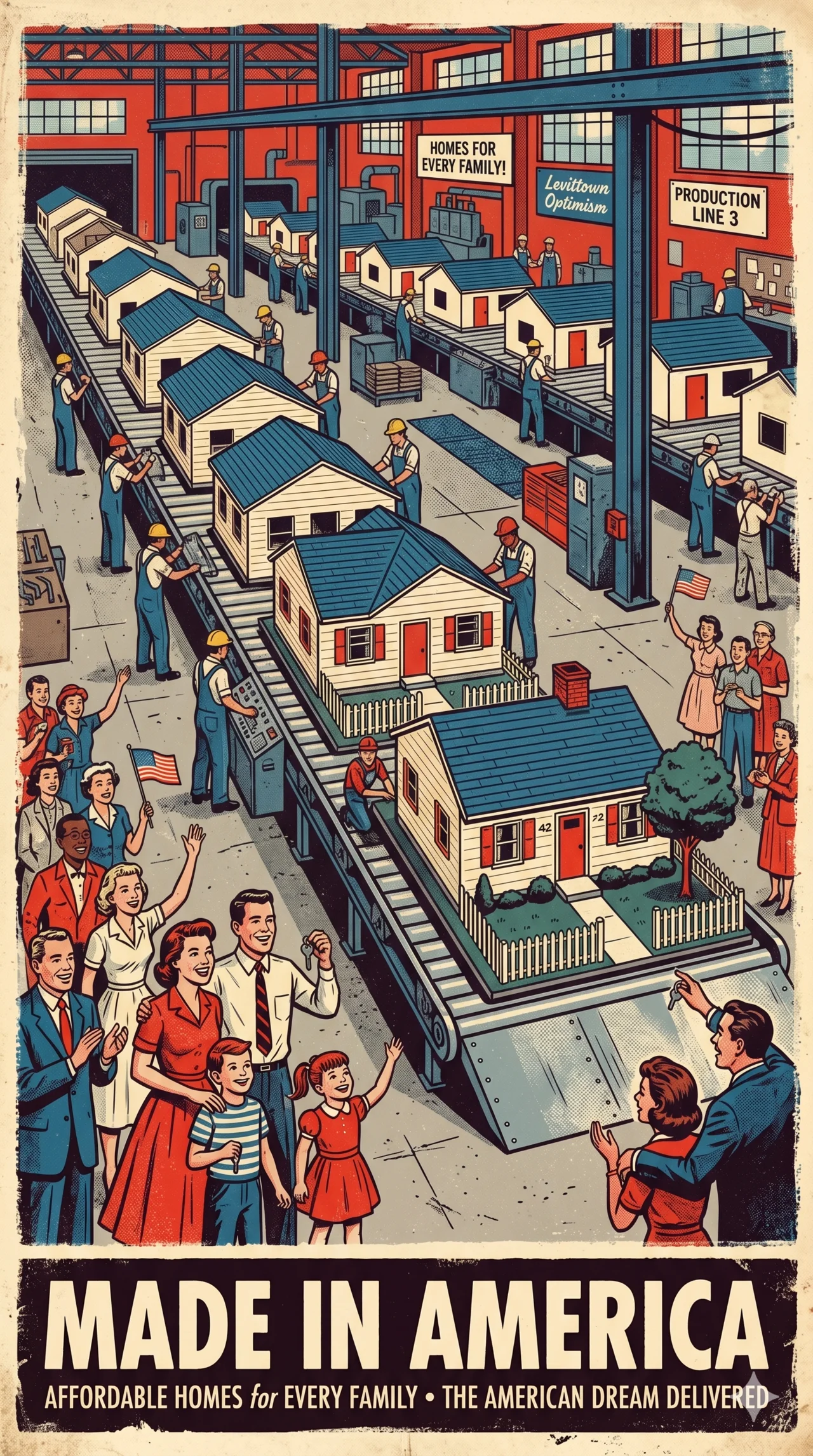
The Levittown analogy is instructive but limited. When Levitt & Sons applied assembly-line methods to site-built homes in postwar Long Island — 17,000 homes, late 1940s to early 1950s, at roughly $8,000 each11 — nobody asked whether they were solving the housing crisis. They were doing what they could with the tools and capital they had, and the effect was that 17,000 families owned a home who otherwise would not have. Clayton is building 59,400 of those outcomes annually. The scale is different, the tools are more sophisticated, and the structural barriers are arguably harder. The underlying logic is the same: factory production, captive financing, and patience.
The TRU Mini will either become the entry product that defines Clayton's next decade or get quietly retired when mortgage rates drop enough to revive demand for larger homes. That depends on variables Berkshire cannot control: zoning boards, FHA loan standards, and the Federal Reserve's rate path. What Berkshire can control is showing up — with a factory, a $29.5 billion loan portfolio, and a 408-square-foot house for buyers the market has otherwise abandoned — and still being there when the cycle turns.
References
-
Clayton Debuts TRU Mini Home Collection - prnewswire.com ↩↩↩
-
NAHB: Affordability Posts Mild Gains in Second Half of 2025 - nahb.org ↩↩
-
Zillow Research: US Housing Shortage Estimate - zillow.com ↩↩↩
-
US Census Bureau: New Residential Sales, Q4 2025 - census.gov ↩
-
Manufactured Housing Institute: Industry Data - manufacturedhousing.org ↩
-
NAHB Eye on Housing: Manufactured Homes, April 2025 - eyeonhousing.org ↩↩
-
Berkshire Beyond Buffett: The Enduring Value of Values - Columbia University Press (Lawrence A. Cunningham, 2014) ↩↩↩↩
-
Berkshire Hathaway 2025 Annual Report - berkshirehathaway.com ↩↩↩↩↩↩↩
-
Berkshire Hathaway 2013 Annual Report - berkshirehathaway.com ↩
-
Manufactured Home Pro News: Market Share Analysis - manufacturedhomepronews.com ↩↩
-
Smithsonian Magazine: The Birth of American Suburbia (Levittown) - smithsonianmag.com ↩