Tags: Helzberg / Ben Bridge / Borsheims
This fanpage is not officially affiliated with Berkshire Hathaway: Disclaimer
"If you don't know jewelry, know the jeweler." Warren Buffett wrote that sentence in his letter for 1988, explaining why Berkshire Hathaway had just bought 80% of an Omaha jewelry store without taking inventory, verifying receivables or auditing anything at all.1 Most people, he argued, "feel like babes in the woods when purchasing jewelry. They can judge neither quality nor price." A customer who cannot choose a stone has to choose a seller instead, and being that seller is worth something. Borsheims took it as volume rather than mark-up. Berkshire bought the same position twice more, in Kansas City and Seattle, and a third time at one remove, in a factory that supplies other jewelers. Call it the trust premium: the business a jeweler wins because the customer cannot judge the stone. Thirty-seven years later the stone has lost the scarcity that made judging it matter. A diamond grown in a laboratory now sits at the centre of 61% of American engagement rings, up from 12% in 2019.23 De Beers realised an average of $97 a carat on its rough in the first nine months of 2026, 37% below the same months of 2025 and less than half the $197 it got across 2022.45 Berkshire's three jewelry retailers employ 40% fewer people than they did in 2003.6 This piece asks whether the trust premium survives when the thing being trusted turns into a commodity. The evidence from Omaha, Kansas City and Seattle is that Berkshire's jewelers stocked the lab-grown stone earlier than almost anyone, made money on it, and are being consolidated under Greg Abel regardless.
Buffett Bought the Customer's Trust, Not the Stone
The Borsheims purchase was the purest statement of the idea. The Friedman family ran the store on Rose Blumkin's creed, "Sell cheap and tell the truth": one location, a huge inventory, rapid turnover, shrewd buying and "incredibly low expenses."1 Two years later Buffett put numbers on it. Borsheims ran operating costs of "about 18% of sales compared to 40% or so at the typical competitor," carried an inventory "ten or more times the size of that at the typical fine-jewelry store," and, he believed, did more volume than any jewelry store in the United States except Tiffany's in New York. "What works with diapers works with diamonds," he wrote.7
That line is easy to misread. Borsheims did not win because diamonds were like diapers. It won because they were not: a shopper can price a box of nappies at a glance, but cannot tell one clarity grade from the next or a fair price from a mark-up. Low cost mattered because it let a jeweler the customer already trusted also be the cheapest one in town. Trust was the moat and cost was the drawbridge. By 1999 Buffett was telling shareholders that Borsheims operated "on a gross margin that is fully twenty percentage points below that of its major rivals."8
The other three purchases ran on the same logic, and mostly on referral. Helzberg's Diamond Shops came in April 1995, paid for in Berkshire stock, with 166 stores in 25 states.9 Barnett Helzberg Jr. had pitched Buffett on a Fifth Avenue sidewalk a year earlier, a story Lawrence Cunningham later reconstructed from the family's account.10 Helzberg then vouched for Ben Bridge, a fourth-generation Seattle chain that Berkshire bought in 2000 "half for cash and half for stock" after a phone call and before any face-to-face meeting.11 In 2007 a Ben Bridge supplier, Dennis Ulrich, called Buffett and built Richline, which makes karat gold, silver and gem-set jewelry for mass merchants, chains and department stores. Buffett admitted it was "far below the earnings threshold we normally require."12
| Business | Joined Berkshire | Terms | At purchase | 2025 | The case Buffett made |
|---|---|---|---|---|---|
| Borsheims (Omaha) | 1989, 80% | Undisclosed; "a one-page contract and... a large check"1 | One store | One store, 139 staff6 | "If you don't know jewelry, know the jeweler"1 |
| Helzberg (North Kansas City) | April 1995, 100% | Berkshire stock9 | 166 stores in 25 states9 | 161 stores in 34 states, 1,523 staff613 | An owner-operator who sought Berkshire out10 |
| Ben Bridge (Seattle) | July 2000 | Half cash, half stock11 | 65 stores11 | Nine western states, 483 staff613 | "They would be in charge"11 |
| Richline (manufacturer) | July 2007 | Undisclosed; two suppliers bought together12 | Jewelry for chains and department stores | Four units, 2,023 staff6 | "Far below the earnings threshold we normally require"12 |
Every row rests on the same asymmetry. The retailers sold judgment the customer lacked, and Richline sold product to retailers who sold that judgment. None of them was bought because diamonds were scarce. They were bought because diamonds were hard to read.
The Laboratory Ended the Diamond's Scarcity
Grading certificates and online sellers had long since let a shopper compare one stone with another on paper. What the laboratory removed was scarcity. A stone that can be grown again tomorrow is priced by the cost of growing it, and that cost keeps falling. The diamond analyst Paul Zimnisky measured how quickly the gap opened: "As recently as 2016, a 1-carat lab-diamond sold for only 10% less than an equivalent natural diamond; by the end of 2022, the differential had widened to as much as 80%."14
The engagement ring, the purchase a mall jeweler's year turns on, split in two. The Knot's surveys of American couples found lab-grown centre stones in 12% of engagement rings in 2019, 46% in 2023 and 52% in 2024. The 2025 survey put it at 61%, "a 239% increase since 2020."32 Couples bought bigger stones for less money: average spend on an engagement ring fell every year from $6,000 in 2021 to $5,200 in 2024.3
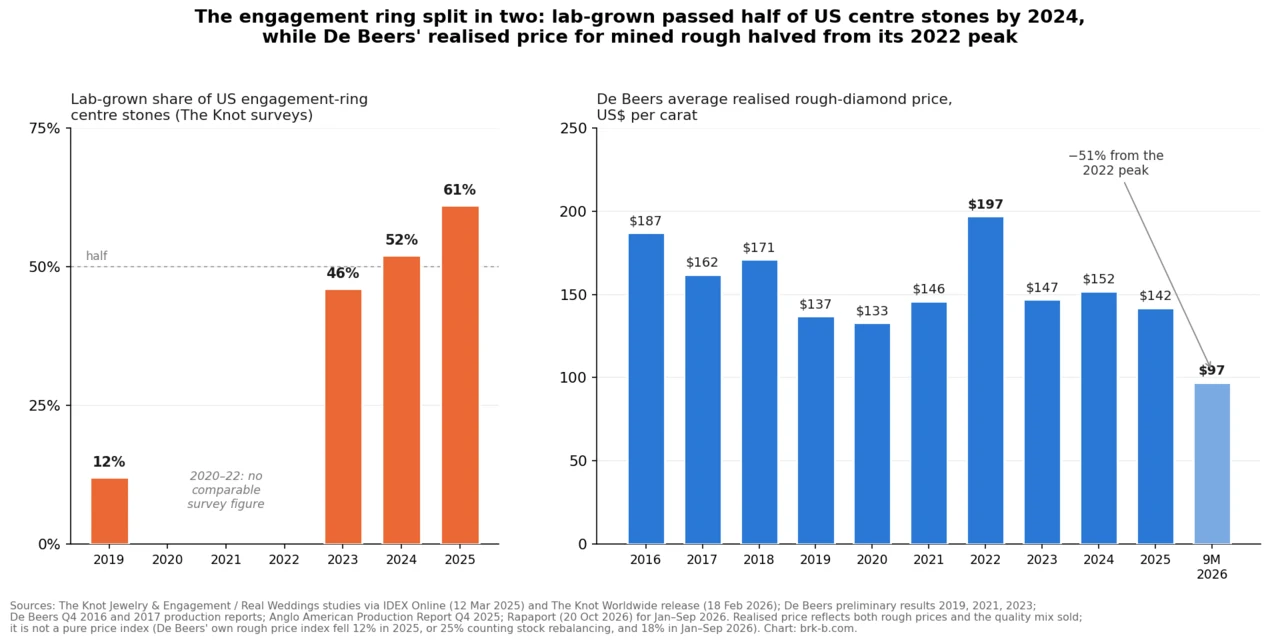
The mined side did not hold its price either. De Beers' average realised price, which blends the price of rough with the quality of what it happened to sell, fell from $197 a carat in 2022 to $142 in 2025, "primarily driven by a 12% decrease" in its rough price index, or 25% once De Beers' own stock-rebalancing sales are counted.515 The first nine months of 2026 came in at $97, on an 18% further fall in the index.4 In May 2025 De Beers said it was closing Lightbox, the lab-grown brand it had launched in 2018 "at a then-shocking $800-a-carat price point."16 Its parent, Anglo American, is trying to sell De Beers, and in February 2026 said it was "in the advanced stages of discussions with a select group of interested parties."17
Gold, the other raw material in every ring, moved the opposite way. The World Gold Council counted 117.3 tonnes of American jewelry gold in 2025, down 11% from 131.9 tonnes, while spending rose 28% to $13 billion.18 Fewer grams at a higher price: the customer is paying more for the metal and less for the stone.
Berkshire's Jewelers Stocked the Lab Early
The easy version of this story has Berkshire's family jewelers, the very picture of old-fashioned retail, flattened by a technology they refused to carry. The record says the opposite.
Borsheims, Buffett's showcase store, had been "very quietly carrying man-made diamonds since November" 2016, its president and chief executive Karen Goracke told National Jeweler in May 2017, adding that most comments about the stones were inquisitive. "We realize they are part of the industry, whether you are in favor of them or not."19 According to Helzberg's then president, it was one of the first major jewelry retailers to sell lab-grown diamonds, in 2017.20 Richline launched a lab-grown brand, Grown With Love, in October 2018, to be "sold at the jewelry departments of J.C. Penney and Macy's."21 That was the same year De Beers launched Lightbox at its $800 price point.16
Helzberg's chief executive, Brad Hampton, was candid in November 2024 about how it had worked out. "We continue to see very healthy demand for lab-grown diamonds in the engagement business," Hampton told JCK, adding that "we have seen some impact on retail prices" and that lab-grown "continues to be a financially very healthy part of our business."22 In the same interview the 163-store chain said it was dropping "Diamonds" from its name to become "just plain Helzberg."22 The filings show the change. In 2019 Berkshire's 10-K said all 222 Helzberg stores traded as Helzberg Diamonds or Helzberg Diamonds Outlet. By 2025 there were 161, trading under either of those names or as plain Helzberg.2313
The one listed comparable shows the same split from the other side. Signet, the listed jewelry chain behind Blue Nile, told investors in March 2026 that lab-grown had grown to "just north of 20%" of its fashion jewelry and that "we're under 50% for bridal." Its chief executive added that natural stones skew "more towards higher-end" and are "probably more of an AUR story," meaning higher average unit retail, or price per piece.24 The natural diamond is becoming a luxury good and the lab-grown one a fashion and price good. A mall chain in between has to sell both.
The Counters Shrank Before the Stone Took Over
So Berkshire's jewelers were early. They also got smaller, and the timing complicates the lab-grown story rather than confirming it.
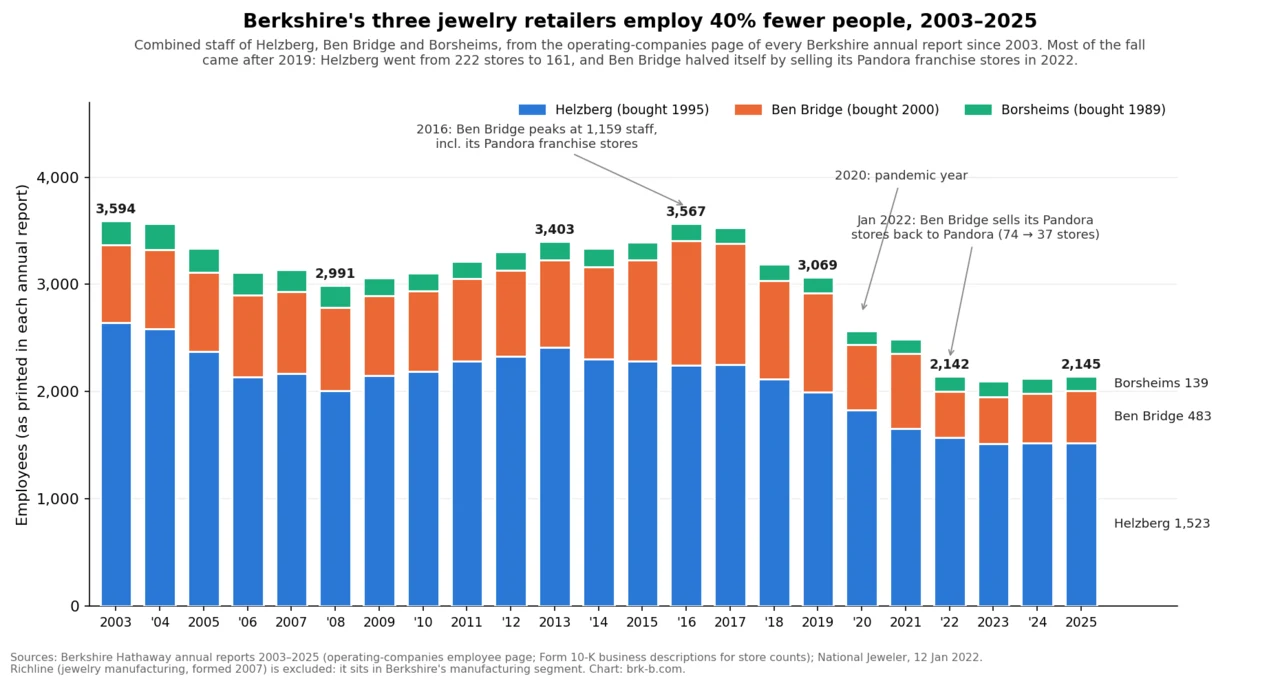
The combined staff of Helzberg, Ben Bridge and Borsheims, as printed in every Berkshire annual report, was 3,594 in 2003 and still 3,567 in 2016. By 2025 it was 2,145.6 Most of the fall came after 2019, and three things drove it, none of them mainly about diamonds. Helzberg cut its fleet from 222 stores to 161, and by 2024 was moving stores "from mall to off-mall locations."231322 The pandemic brought "significantly lower sales in 2020 for our jewelry stores."25 In January 2022 Ben Bridge sold its Pandora franchise stores back to Pandora, "effectively cutting its store count in half": the 10-K went from 74 stores to 37.2627 Berkshire later described this as "a gain in 2022 from the divestiture of certain jewelry stores."28 The biggest single drop on the chart was a sale of charm-bracelet franchises, not a casualty of the diamond lab.
Borsheims shrank differently. A single store has no fleet to prune, yet its staff fell from 228 in 2003 to 139 in 2025, a 39% decline.6 Part of the answer is probably what it stopped selling. As late as the 2024 annual report it sold "fine jewelry, watches, crystal, china, stemware, flatware, gifts and collectibles."28 The 2025 report calls it "a high-volume retailer of luxury jewelry, engagement rings, watches, home décor and repair services."13 Giving up a giftware floor is a retail decision, not a diamond one, and it is a reminder that this chart cannot be read as a lab-grown body count.
What the chart cannot show is profit, because Berkshire stopped publishing it. The disclosure trail is short.
| Year | What Berkshire told shareholders about jewelry |
|---|---|
| 1998 | Jewelry segment (Borsheims and Helzberg): revenue $440m, operating profit $39m29 |
| 1999 | Revenue $486m (+15.7%), operating profit $51m (+30.8%)8 |
| 2005 | Jewelry revenue $801m, now reported inside the retail group30 |
| 2006 | Jewelry revenue $815m, the last jewelry revenue figure in the annual report30 |
| 2009 | Jewelry revenue down 12%; "in the aggregate our jewelry businesses posted a pre-tax loss"31 |
| 2026 | "Three jewelry businesses" listed under "other retailing," with no figures32 |
In 1999 the jewelry segment, Borsheims and Helzberg together, earned a 10.5% operating margin on under half a billion dollars of revenue. Today it is too small to be broken out of a retailing group in which car dealerships produce about 70% of revenue. In the first half of 2026 Berkshire said only that "several of our other retailing businesses continued to experience sluggish customer demand."32
Abel Has Already Merged Two of the Counters
The most telling change is not in the store counts. In August 2025 Ben Bridge became part of "a newly created united Berkshire Hathaway Jewelry Group alongside Helzberg," with Helzberg's Brad Hampton as group chief executive, and Ben Bridge's chief executive, Lisa Bridge, was to depart. Both chains "will maintain their distinct identities."33
Set that beside what Buffett wrote when he bought Ben Bridge in 2000: "It was vital to the family that the company operate in the future as in the past. No one wanted another jewelry chain to come in and decimate the organization with ideas about synergy and cost saving (which, though they would never work, were certain to be tried). I told Ed and Jon that they would be in charge."11 Twenty-five years later another jewelry chain did come in. It was Berkshire's own.
Berkshire has not said why it combined them, and none of this proves the combination is a mistake. The likeliest reasons are the ones on the chart: two fleets that had shrunk, one of them by half, and a chief executive departing. Cheaper lab-grown stones add a third. A smaller ticket brings fewer dollars per sale to pay a store's rent and staff, which makes buying well at scale worth more. "Shrewd buying" was already on Buffett's 1988 list of what made Borsheims work;1 one buying desk for two chains is that idea applied across a group. It is also the same pattern this site traced at MiTek, where a subsidiary's side-businesses were quietly handed to sister company Marmon ↗. Abel's Berkshire is willing to consolidate below the holding-company line in a way Buffett's Berkshire promised the Bridges it would not. That is a change in what Berkshire offers a family seller, a point this site made about the deals Berkshire can no longer make ↗.
The Trust Premium Narrowed, It Did Not Vanish
The bear case writes itself: a moat built on what the customer does not know cannot survive a product that removes the not-knowing. It is half right. On the lab-grown stone the premium has shrunk, though not to nothing. Helzberg calls lab-grown "a financially very healthy part of our business."22 The trouble is the size of the ticket. A stone that gets cheaper every year brings in fewer dollars per sale, and a mall store's rent and payroll do not shrink with it.
So the jewelers are moving from grading stones to curating what customers still want help choosing. At the top is the expensive natural stone, the sale Signet calls "an AUR story," which is the kind of sale a store like Borsheims was built for.24 Then come the settings and the karat gold they are made of, which Richline supplies to other retailers.12 Then come the things that are not diamonds at all. Ben Bridge now runs seven boutiques for watch brands including Rolex, Tudor, Grand Seiko, Omega, IWC and Breitling, and Borsheims added repairs to its own description in 2025.13 The watch counters carry a risk of their own, because an authorised dealer sells someone else's brand on that brand's terms. None of this is quite the business Buffett bought. It is closer to See's Candies, which earns its price on an occasion and a feeling rather than an ingredient ↗.
That is a narrower business than the one Buffett bought, and the numbers say so: fewer stores, fewer people, one shared group where there were two families. It is not a dead one. The test for shareholders is whether the new jewelry group can earn on the trust premium that remains while its stones get cheaper every year, and Berkshire will not publish the answer. Brad Hampton, explaining in 2024 why Helzberg was taking "Diamonds" off its name, insisted: "we are absolutely not moving away from diamonds."22 Both things can be true. The diamonds are still in the case. What came off the sign was the word that used to tell a customer why they needed a jeweler at all.
How this article was made: thesis and editing by Anthropic Claude Opus 5.5 with the brk-b.com editor; research, drafting and charts by Anthropic Claude Opus 5.5, with research assistance from Anthropic Claude Sonnet 5.5; independent review of the draft by Google Gemini 4 Argon; fact-check of every citation against its source by Anthropic Claude Sonnet 5.5.
References
-
Berkshire Hathaway 1988 Chairman's Letter - berkshirehathaway.com — “They can judge neither quality nor price. For them only one rule makes sense: If you don't know jewelry, know the jeweler.” ↩↩↩
-
The Knot Worldwide Unveils 2026 Real Weddings Study (18 Feb 2026) - theknotww.com — “61% of engagement rings now feature lab-grown center stones – a 239% increase since 2020” ↩↩
-
52% of Engagement Rings are Now Lab Grown (12 Mar 2025) - idexonline.com — “The figure for 2023 was 46 per cent and in 2019 it was just 12 per cent.” ↩↩↩
-
Anglo American, Production Report for the third quarter 2026 (20 Oct 2026) - angloamerican.com — “Consolidated average realised price (US$/ct) | 97 | 155 | (37)%” (Q3 year-to-date, De Beers) ↩↩
-
De Beers Group, Preliminary Financial Results for 2022 - debeersgroup.com — “The average realised price rose by 35% to $197/ct” ↩↩
-
Berkshire Hathaway Annual Reports 2003–2025, operating-companies employee page - berkshirehathaway.com — combined staff of Helzberg, Ben Bridge and Borsheims: 3,594 (2003), 3,567 (2016), 2,145 (2025) ↩↩↩
-
Berkshire Hathaway 1990 Chairman's Letter - berkshirehathaway.com — “…our operating costs, which run about 18% of sales compared to 40% or so at the typical competitor.” ↩
-
Berkshire Hathaway 1999 Annual Report - berkshirehathaway.com ↩
-
Berkshire Hathaway 1995 Annual Report (Form 10-K) - berkshirehathaway.com ↩
-
Lawrence A. Cunningham, Berkshire Beyond Buffett: The Enduring Value of Values (2014) - cup.columbia.edu ↩
-
Berkshire Hathaway 2000 Chairman's Letter - berkshirehathaway.com — “No one wanted another jewelry chain to come in and decimate the organization with ideas about synergy and cost saving…” ↩↩
-
Berkshire Hathaway 2007 Annual Report (letter and Form 10-K) - berkshirehathaway.com ↩↩
-
Berkshire Hathaway 2025 Annual Report (Form 10-K) - berkshirehathaway.com — “…a chain of 161 retail jewelry stores in 34 states… Helzberg Diamonds®, Helzberg Diamonds Outlet® or Helzberg®” ↩↩↩↩
-
Paul Zimnisky, Lab-Diamond Sales Grow as Prices Fall (2 Jan 2023) - paulzimnisky.com ↩
-
Anglo American, Production Report for the Fourth Quarter 2025 (RNS, 5 Feb 2026) - londonstockexchange.com via ticker.app — “The full year consolidated average realised price declined by 7% to $142/ct” ↩
-
De Beers Shutting Down Lightbox, Its Lab-Grown Diamond Business (8 May 2025) - jckonline.com ↩↩
-
Anglo American Slashes De Beers' Value by Nearly Half (22 Feb 2026) - rapaport.com ↩
-
World Gold Council, Gold Demand Trends Full Year 2025: Jewellery - gold.org — “But the decline in volume was eclipsed by a 28% rise in spending to US$13bn.” ↩
-
Diamonds, including man-made, the focus at Borsheims (12 May 2017) - nationaljeweler.com ↩
-
Helzberg's New Lab-Grown Diamond Collection Earns SCS Certification (28 Mar 2023) - nationaljeweler.com ↩
-
Richline to Sell Lab-Grown Brand at J.C. Penney, Macy's (31 Oct 2018) - jckonline.com ↩
-
Rob Bates, Helzberg Diamonds Drops the Word 'Diamonds' (4 Nov 2024) - jckonline.com — “[Lab-grown] continues to be a financially very healthy part of our business.” ↩↩↩↩↩
-
Berkshire Hathaway 2019 Annual Report (Form 10-K) - berkshirehathaway.com — “…a chain of 222 retail jewelry stores in 36 states… all stores operate under the name Helzberg Diamonds® or Helzberg Diamonds Outlet®” ↩↩
-
Signet Jewelers Q4 FY2026 earnings call transcript (19 Mar 2026) - fool.com — “Now, I would say in natural, that skews more towards higher-end and is probably more of an AUR story.” ↩↩
-
Berkshire Hathaway 2020 Annual Report - berkshirehathaway.com ↩
-
Ben Bridge Is Selling Its Pandora Franchise Stores Back to the Brand (12 Jan 2022) - nationaljeweler.com ↩
-
Berkshire Hathaway 2021 and 2022 Annual Reports (Form 10-K) - berkshirehathaway.com ↩
-
Berkshire Hathaway 2024 Annual Report (Form 10-K) - berkshirehathaway.com — “…the impact of a gain in 2022 from the divestiture of certain jewelry stores.” ↩↩
-
Berkshire Hathaway 1998 Annual Report - berkshirehathaway.com ↩
-
Berkshire Hathaway 2005 and 2006 Annual Reports - berkshirehathaway.com ↩
-
Berkshire Hathaway 2009 Annual Report - berkshirehathaway.com — “…in the aggregate our jewelry businesses posted a pre-tax loss.” ↩
-
Berkshire Hathaway Form 10-Q, second quarter 2026 - berkshirehathaway.com ↩
-
Lisa Bridge to Depart Ben Bridge Jeweler (11 Aug 2025) - nationaljeweler.com ↩