Tags: See's Candies / Warren Buffett / History
This fanpage is not officially affiliated with Berkshire Hathaway: Disclaimer
On January 3, 1972, a company called Blue Chip Stamps bought a West Coast candy maker for $25 million. The sellers had wanted $40 million. The company carried $10 million in excess cash, making the true asking price $30 million. The buyer, not yet fully appreciative of what he was purchasing, refused to go above $25 million — and meant it. The sellers caved. That $5 million gap between ask and close is arguably the most consequential negotiation standoff in the history of American capitalism, because the buyer was Warren Buffett, the company was See's Candies, and the lessons extracted from it over the following five decades would reshape how the world thinks about brands, pricing power, and the true nature of business value 1.
Introduction
The See's acquisition is the most studied deal in Berkshire Hathaway's history, and for good reason: it is the transaction that turned Buffett from a cigar-butt investor into a franchise investor. Every retrospective Buffett has written about See's — in 1983, 1991, 1999, 2007, 2011, and 2014 — adds another layer to the same argument. The candy company's financial returns are extraordinary on their own terms: roughly $2.8 billion in cumulative pre-tax earnings on approximately $65 million of total invested capital, a 43-fold return 135. But the financial returns are not the point. The point is that See's was the laboratory where Buffett and Munger developed the concept of economic goodwill — the idea that a business can be worth far more than its tangible assets because of intangible advantages like brand loyalty and pricing power. That concept, first articulated in the 1983 annual letter using See's as the example, became the intellectual foundation for every great Berkshire investment that followed 2. ↗
This article reconstructs the full financial arc from primary sources — every figure traced to a specific Berkshire annual letter or annual report — and argues that See's is the most important intellectual investment Buffett ever made. Not the most profitable. Not the largest. The most important, because without See's there might have been no Coca-Cola in 1988, no full GEICO buyout in 1996, no Iscar in 2006. The candy company taught Buffett what a great business looks like, and that education has compounded for fifty years.
The Candy Cash Machine
The financial record of See's under Berkshire ownership is documented across more than a dozen annual letters, though Buffett stopped breaking out See's-specific figures after 2014. What follows is a reconstruction from primary sources — every number sourced to a specific letter or annual report segment table.
The story begins with modest numbers. In 1972, See's had $29 million in sales and $4.2 million in pre-tax earnings, operating on about $8 million in net tangible assets — a roughly 60 percent pre-tax return on invested capital 13. The company sold 16 million pounds of candy annually through roughly 170 stores, almost all in California 3. By any standard measure, it was a small regional confectioner.
What happened next is best told through the data Buffett himself disclosed at intervals across four decades:
| Year | Revenue | Pre-tax / Operating Profit | Cumulative Pre-tax | Capital Employed | Source |
|---|---|---|---|---|---|
| 1972 | $29M | $4.2M | — | $8M net tangible assets | 1991 letter 1 |
| 1983 | $134M | ~$27M pre-tax | — | ~$20M net tangible assets | 1983 letter 2 |
| 1991 | $196M | $42.4M | $410M+ distributed | $25M net worth | 1991 letter 1 |
| 1999 | $306M | $74M (24% margin) | $857M | — | 1999 letter / AR 610 |
| 2007 | $383M | $82M | $1.35B | $40M | 2007 letter 3 |
| 2011 | — | $83M (record) | $1.65B | less than zero (net of cash) | 2011 letter 4 |
| 2014 | — | — | $1.9B | — | 2014 letter 5 |
| ~2025 | — | — | ~$2.8B (estimated) | — | Author's estimate |
The 2025 estimate requires transparency. After 2014, Berkshire stopped disclosing See's-specific earnings in both the letter and the segment tables — the candy maker was folded into a broader "retail businesses" category alongside jewelry, home furnishings, and kitchen products 10. The ~$2.8 billion figure is an extrapolation: $1.9 billion confirmed through 2014, plus approximately eleven years of earnings at the ~$80 million annual run rate See's had maintained since 2007. It could be higher or lower, but the order of magnitude is sound. The article flags this as an estimate throughout.
The intermediate years are documented with remarkable granularity in the early letters. The 1983 annual letter contains an operating table covering 1976 through 1983 — revenue, after-tax profit, pounds of candy sold, and store count — that reveals the underlying physics of the business 2:
| Year | Revenue | After-tax Profit | Pounds Sold | Stores |
|---|---|---|---|---|
| 1976 | $56.3M | $5.57M | 20.55M | 173 |
| 1977 | $62.9M | $6.15M | 20.92M | 179 |
| 1978 | $73.7M | $6.18M | 22.41M | 182 |
| 1979 | $87.3M | $6.33M | 23.99M | 188 |
| 1980 | $97.7M | $7.55M | 24.07M | 191 |
| 1981 | $112.6M | $10.78M | 24.05M | 199 |
| 1982 | $123.7M | $11.88M | 24.22M | 202 |
| 1983 | $133.5M | $13.70M | 24.65M | 207 |
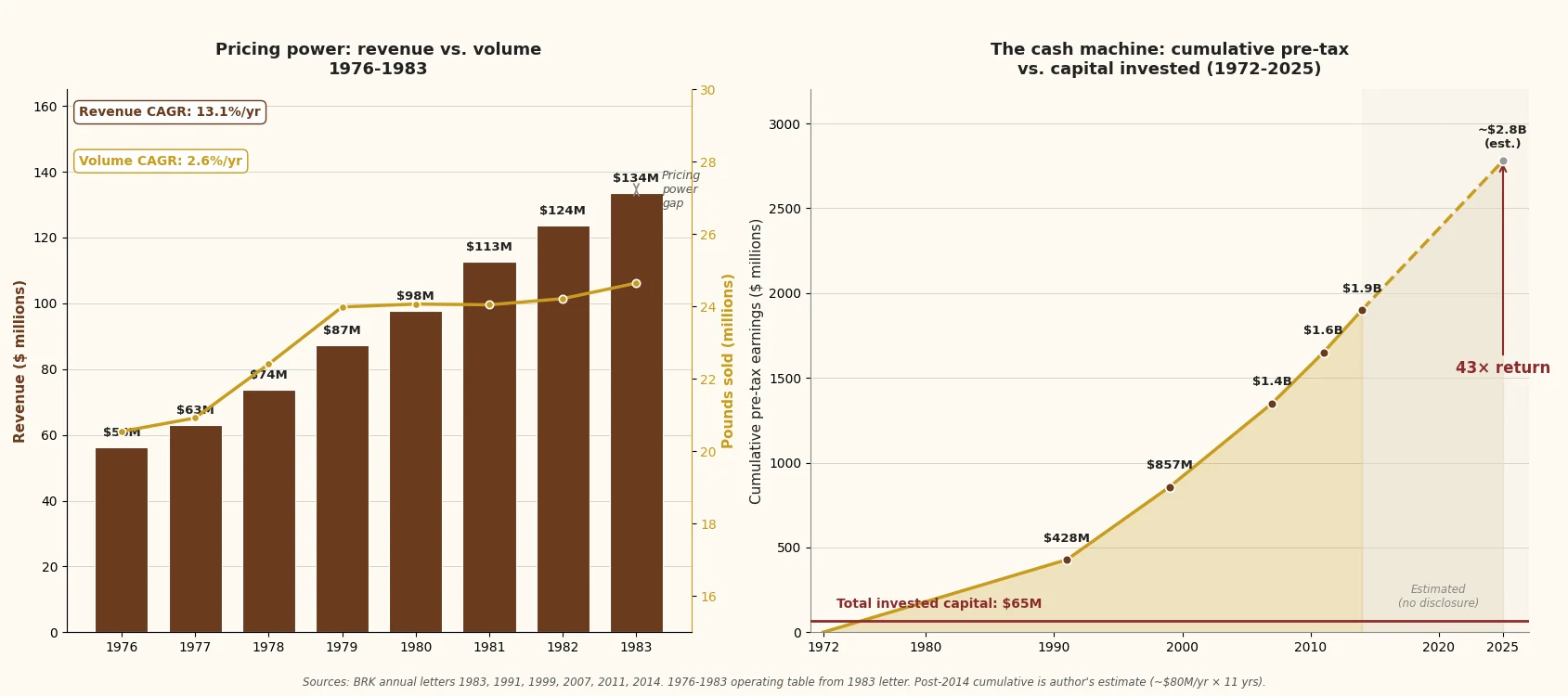
Read the table carefully. From 1976 to 1983, pounds sold grew from 20.6 million to 24.7 million — about 2.6 percent annually. Store count grew from 173 to 207 — about 2.6 percent annually. But revenue grew from $56 million to $134 million — 13.1 percent annually. After-tax profit grew from $5.6 million to $13.7 million — 13.7 percent annually 2. The gap between volume growth and revenue growth is pricing power. See's raised prices every year without losing customers. That gap — the difference between how fast the candy left the door and how fast the dollars came in — is the entire argument of this article made visible in eight rows of data.
The same pattern extends across the full fifty years. From 1972 to 2007, pounds sold grew from 16 million to 31 million — roughly 2 percent annually 3. Revenue grew from $29 million to $383 million — roughly 7.7 percent annually 13. The volume doubled. The revenue multiplied thirteenfold. Everything beyond the volume growth was price.
The Capital That Didn't Need Spending
The second remarkable feature of See's is how little capital it required to produce this earnings growth. The 2007 letter states the case with characteristic clarity: See's had $8 million in net tangible assets when purchased in 1972. By 2007, the capital required to run the business was $40 million. That means Berkshire reinvested only $32 million over thirty-five years to handle "the modest physical growth — and somewhat immodest financial growth — of the business." In the meantime, pre-tax earnings totaled $1.35 billion. All of that, except for the $32 million, was sent to Berkshire 3.
By 2014, the cumulative reinvestment had risen to $40 million, and cumulative pre-tax earnings to $1.9 billion 5. Total invested capital over fifty years: approximately $65 million ($25 million purchase price plus $40 million reinvestment). Cumulative pre-tax return: roughly 43 times invested capital.
But even the 43-fold return understates the economic magic, because See's did not retain those earnings — it distributed them. The 1991 letter explains the mechanism: See's operated with $25 million in net worth by 1991, up from $7 million at acquisition. The $18 million increase represented reinvested earnings. "See's remaining pre-tax profits of $410 million were distributed to Blue Chip/Berkshire during the twenty years for these companies to deploy (after payment of taxes) in whatever way made most sense" 1.
By 2011, the distribution had gone so far that See's year-end carrying value on Berkshire's balance sheet was less than zero, net of cash. Buffett added a parenthetical: "Yes, you read that right; capital employed at See's fluctuates seasonally, hitting a low after Christmas" 4. The candy company had been so thoroughly drained of capital — every dollar of earnings sent upstream to Omaha — that its book value went negative after the holiday rush. It was, in accounting terms, a business worth less than nothing. In economic terms, it was a perpetual cash machine.
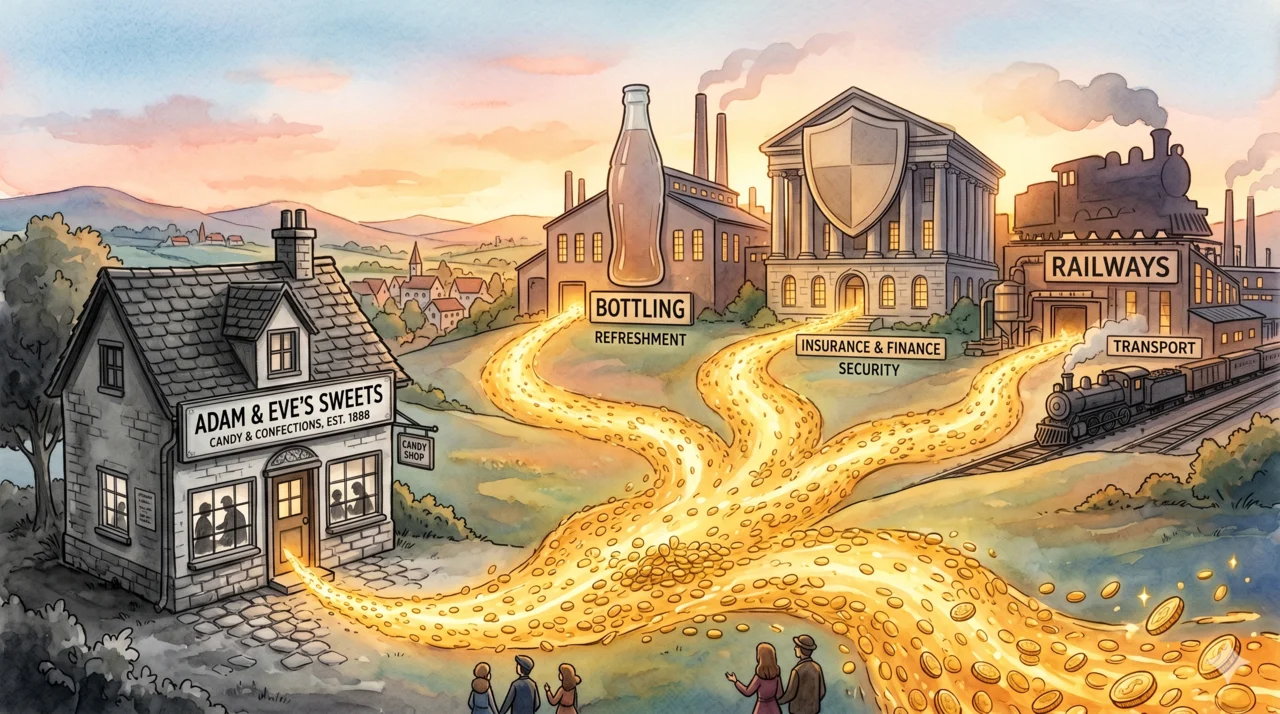
The 2014 letter connects the cash-pump mechanism to Berkshire's broader architecture: "See's has thus been able to distribute huge sums that have helped Berkshire buy other businesses that, in turn, have themselves produced large distributable profits. (Envision rabbits breeding.)" 5 The metaphor is deliberate and precise: See's was the Adam and Eve of Berkshire's conglomerate empire, the original cash source that funded the acquisition of other cash-generating businesses, which funded still others. The 2007 letter makes the same point more colorfully: "Just as Adam and Eve kick-started an activity that led to six billion humans, See's has given birth to multiple new streams of cash for us. (The biblical command to 'be fruitful and multiply' is one we take seriously at Berkshire.)" 3 ↗
The annualized return tells a humbler story than the cumulative figures. $65 million to $2.8 billion over fifty-three years is roughly 7.5 percent compound annual growth, pre-tax 135. That is a perfectly good return, but it is not the stuff of legend. The legend is what Berkshire did with the cash. See's distributed roughly $2.7 billion in pre-tax earnings to Berkshire over five decades, and Berkshire deployed that cash into investments that compounded at far higher rates. The See's cash machine bought pieces of Coca-Cola, American Express, and GEICO. It helped fund the BNSF acquisition. The economic magic was not in See's standalone compounding — it was in the redeployment.
Economic Goodwill: The Lesson and the Paradox
The financial record is impressive, but it is not why See's matters. See's matters because it was the case study through which Buffett and Munger articulated the concept of economic goodwill — the idea that transformed Berkshire from a deep-value shop into a franchise investor.
The 1983 annual letter contains an appendix titled "Goodwill and its Amortization: The Rules and The Realities." It is the most important piece of investment philosophy Buffett ever wrote, and it uses See's as its sole worked example. The core definition: "businesses logically are worth far more than net tangible assets when they can be expected to produce earnings on such assets considerably in excess of market rates of return. The capitalized value of this excess return is economic Goodwill" 2.
The appendix then walks through the See's acquisition in meticulous accounting detail. Blue Chip Stamps bought See's in 1972 for $25 million. See's had $8 million in net tangible assets. The $17 million difference was recorded as accounting goodwill, to be amortized at $425,000 per year for forty years. By 1983, after eleven years of amortization, the goodwill on the balance sheet had been reduced to $12.5 million. Berkshire owned 60 percent of Blue Chip, so its share was $7.5 million 2.
Then the 1983 Blue Chip merger added more. Berkshire acquired the remaining 40 percent of Blue Chip, and under purchase accounting, the fair value of the shares given up had to be allocated across the net assets received. The result: $28.4 million in new goodwill assigned to See's, on top of the $7.5 million remaining from the original purchase. Total See's goodwill on Berkshire's books after the merger: approximately $36 million 2.
The 1999 letter revisits these figures and reveals the paradox: by the late 1990s, the accounting goodwill had been amortized down to about $21 million 6. But over the same period, See's economic goodwill had exploded. In 1983, See's earned about $27 million pre-tax on $11 million in net operating assets. By 1997, it earned $59 million on just $5 million in net operating assets 6. The accounting books showed See's losing two-thirds of its goodwill. The economic reality showed it multiplying many times over.
The distinction between "net tangible assets" and "net operating assets" matters here. The 1983 appendix reports "$20 million in net tangible assets" — which includes seasonal cash, inventory, and receivables. The 1999 letter reports "$11 million in net operating assets" for the same year — which strips out the cash See's holds temporarily during the holiday season. By 1997, See's net operating assets had fallen to $5 million 6, because Berkshire was draining the cash out as fast as it arrived. The business was generating $59 million in pre-tax profit on $5 million in operating capital — a return of more than 1,000 percent. The accounting books, meanwhile, were dutifully amortizing goodwill at $1 million per year, as if the business were slowly dying.
Buffett's point was not that accounting is wrong — he explicitly disclaimed having a better system 2. His point was that investors who rely on book value, or who subtract amortization charges to estimate "real" earnings, will systematically underestimate businesses like See's. The entire Berkshire Hathaway architecture — a holding company whose intrinsic value far exceeds its book value — rests on this insight. See's was where the insight was born.
The 1983 appendix also contains an inflation argument that remains relevant four decades later. Buffett contrasted See's (which needed only $8 million in tangible assets) with a hypothetical mundane business earning the same $2 million but requiring $18 million in tangible assets. Under a doubling of the price level, both businesses would need to double their nominal capital to maintain operations. See's would need an additional $8 million. The mundane business would need $18 million. After inflation, See's would have gained $25 million in nominal value on an $8 million investment — more than $3 of value for every $1 invested. The mundane business would have gained $18 million on an $18 million investment — a dollar for a dollar, no better than a savings account 2. "During inflation," Buffett concluded, "Goodwill is the gift that keeps giving" 2.
The Education That Bought Coca-Cola
The financial returns and the accounting insight would be enough to make See's legendary. But the deepest return was intellectual. Buffett said it himself, most explicitly in the 2014 letter: "through watching See's in action, I gained a business education about the value of powerful brands that opened my eyes to many other profitable investments" 5. The 1991 letter is even more direct: "ownership of See's has taught us much about the evaluation of franchises. We've made significant money in certain common stocks because of the lessons we learned at See's" 1.
The causal claim is inherently unquantifiable — we cannot prove that Coca-Cola would not have happened without See's. Buffett was already moving toward quality businesses before 1972; the Washington Post investment came in 1973, and the GEICO relationship began in 1951. But the pattern is clear. Before See's, Buffett was a cigar-butt investor who bought mediocre businesses at deep discounts. After See's, he became a franchise investor who bought wonderful businesses at fair prices. ↗
Coca-Cola is the cleanest example. In 1988, sixteen years after the See's purchase, Buffett began buying Coca-Cola stock. The thesis was pure See's: a brand with pricing power, a business that required minimal tangible capital, a franchise that could raise prices without losing customers. The Coca-Cola investment has since generated tens of billions in gains and is still held. It is, in essence, See's at global scale.
The same logic extended to every major acquisition. GEICO's direct-to-consumer model was a form of brand franchise. Iscar's cutting-tools business had the same pricing power and capital efficiency as See's. Even the BNSF acquisition — a capital-intensive railroad — was justified by the franchise logic: BNSF owns an irreplaceable right-of-way that cannot be replicated, the railroad equivalent of See's brand. ↗
The 2007 letter frames See's as the prototype against which all other businesses are measured. Buffett described three types of "savings accounts": the great one that "pays an extraordinarily high interest rate that will rise as the years pass" (See's), the good one that "pays an attractive rate of interest that will be earned also on deposits that are added" (FlightSafety, which requires reinvestment to grow), and the gruesome account that "both pays an inadequate interest rate and requires you to keep adding money at those disappointing returns" (airlines) 3. The entire taxonomy of Berkshire's capital allocation — which businesses to buy, which to hold, which to let go — traces back to the See's prototype.
Buffett almost missed it. The 1991 letter is candid: "Charlie and I, not yet fully appreciative of the value of an economic franchise, looked at the company's mere $7 million of tangible net worth and said $25 million was as high as we would go (and we meant it). Fortunately, the sellers accepted our offer" 1. The 2007 letter repeats the confession: "I almost blew the See's purchase. The seller was asking $30 million, and I was adamant about not going above $25 million. Fortunately, he caved. Otherwise I would have balked, and that $1.35 billion would have gone to somebody else" 3. The $5 million gap between the true asking price and the final price is the most consequential $5 million in Berkshire's history.
The Feel-Good Business
The numbers and the philosophy are half the story. The other half is human, and it is worth telling because it explains why See's — a tiny candy company generating less than 0.1 percent of Berkshire's earnings — occupies such outsized real estate in Buffett's letters and shareholders' affections.
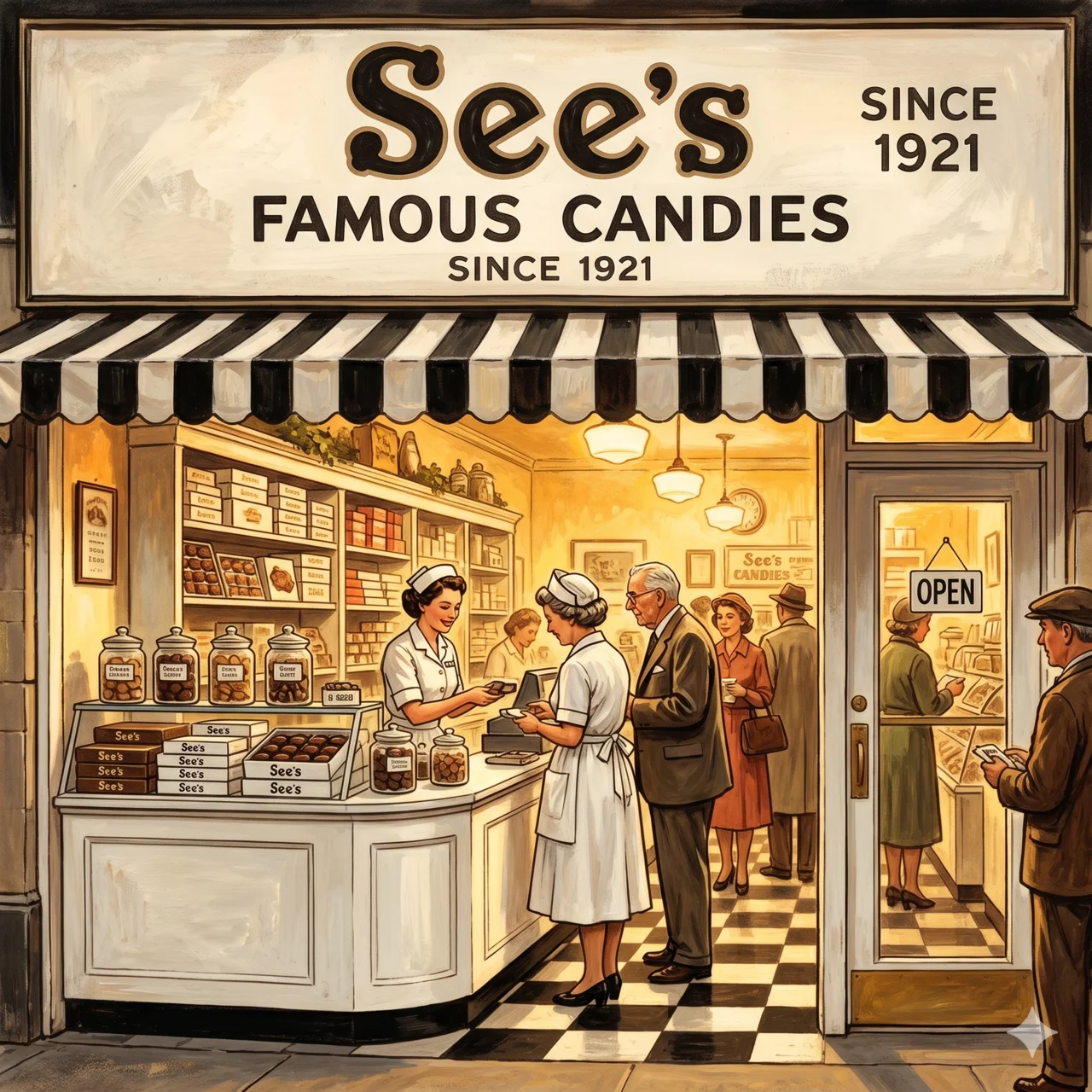
Mary See founded the company in 1921 in Los Angeles, using recipes she had developed over decades. The first shop opened on Western Avenue, and the black-and-white porcelain storefronts that became the company's signature followed across California through the 1920s and 1930s. By the Great Depression, See's operated thirty shops. The 2020 letter describes Mary See as someone who "set out to deliver an age-old product that she had reinvented with special recipes," adding "quaint stores staffed by friendly salespeople" 7. Buffett's tribute is characteristically direct: "Today, Mrs. See's creations continue to delight customers while providing life-long employment for thousands of women and men. Berkshire's job is simply not to meddle with the company's success. When a business manufactures and distributes a non-essential consumer product, the customer is the boss. And, after 100 years, the customer's message to Berkshire remains clear: 'Don't mess with my candy'" 7. The website, he added: "try the peanut brittle" 7.
Chuck Huggins ran See's for thirty-four years, from the day of acquisition in 1972 until Brad Kinstler took over in 2006. The 1999 letter contains what may be the most charming equation in the history of financial reporting: "When he took charge of See's at age 46, the company's pre-tax profit, expressed in millions, was about 10 percent of his age. Today he's 74, and the ratio has increased to 100 percent. Having discovered this mathematical relationship — let's call it Huggins' Law — Charlie and I now become giddy at the mere thought of Chuck's birthday" 6. The math: at age 46 (1972), pre-tax profit was ~$4.6 million (10 percent of 46). At age 74 (1999), pre-tax profit was $74 million (100 percent of 74). The law held.
The 1991 letter reveals that Huggins's compensation arrangement was "conceived in about five minutes and never reduced to a written contract" — a handshake deal that remained unchanged for twenty years 1. This is the Berkshire way: find the right person, trust them completely, and let them run the business. The 2007 letter notes that Brad Kinstler, who replaced Huggins in 2006, was a rare cross-subsidiary transfer — he had previously run Forest River — and that "in his two years, profits at See's have increased more than 50 percent" 3.
The 1990 letter tells a story that captures the bond between See's and its customers. After fifteen years, the Albuquerque store's lease was endangered: the landlord wanted See's to move to an inferior location and pay higher rent. The store's manager, Ann Filkins, urged customers to protest. 263 responded with letters and phone calls. A reporter picked up the story. The landlord, faced with what Buffett called "a consumer uprising," offered a satisfactory deal 11. Try to imagine 263 people writing letters to save a candy store. That is economic goodwill made flesh.
At the annual meeting, See's operates a kiosk that has become a shareholder ritual. The 2022 letter reports that See's rang up 3,931 transactions on Saturday — roughly "10 sales per minute during its prime operating time," selling "products that haven't been materially altered in 101 years" 9. The 2025 letter, Greg Abel's first as CEO, mentions See's by name as a cultural touchstone: "from See's Candies to GEICO and everything in between" 8. The candy company has become shorthand for Berkshire itself — the small, beloved, fiercely independent business that represents everything the conglomerate is supposed to be.
Conclusion
See's Candies is a paradox worth sitting with. It is a business that has barely grown — 2 percent annual volume growth over fifty years, in an industry where per-capita consumption does not increase, concentrated in a single region of a single country. It accounts for less than 0.1 percent of Berkshire Hathaway's earnings. Berkshire stopped breaking out its financials separately more than a decade ago. By the standards of a modern conglomerate, it is a rounding error.
And yet it is, arguably, the most important investment Warren Buffett ever made. Not because of what it earned — though $2.8 billion in cumulative pre-tax profit on $65 million of capital is respectable — but because of what it taught. The 1983 appendix on economic goodwill, written around See's, is the foundational document of modern Berkshire. The cash See's distributed funded the acquisitions that built the empire. The lessons See's taught enabled the investments that made the fortune.
The honest assessment matters. See's geographic concentration — roughly 80 percent of sales from California as of 1991 1 — is a structural risk that has not gone away. The boxed-chocolates industry is unexciting; per-capita consumption is flat. The post-2014 disclosure gap means the most recent decade of earnings is estimated, not confirmed. And the intellectual-capital argument is inherently unquantifiable: we cannot prove that Buffett would not have discovered franchise investing without See's, only that he said he did.
But the weight of evidence is overwhelming. Buffett returned to See's in his letters six times over four decades, each time adding a new layer to the same argument. He called it the "prototype of a dream business" 3. He said it gave him "a business education" 5. He said Berkshire "made significant money in certain common stocks because of the lessons we learned at See's" 1. He compared it to Adam and Eve 3. The candy company that almost was not bought, over a $5 million disagreement, became the intellectual cornerstone of the largest and most successful holding company in history. That is worth more than $2.8 billion.
References
-
Berkshire Hathaway 1991 Chairman's Letter — "Twenty Years in a Candy Store" - berkshirehathaway.com ↩↩↩↩↩↩↩↩↩↩↩
-
Berkshire Hathaway 1983 Chairman's Letter — Appendix: "Goodwill and its Amortization: The Rules and The Realities" - berkshirehathaway.com ↩↩↩↩↩↩↩↩↩
-
Berkshire Hathaway 2007 Chairman's Letter - berkshirehathaway.com ↩↩↩↩↩↩↩↩↩↩↩↩↩
-
Berkshire Hathaway 2011 Chairman's Letter - berkshirehathaway.com ↩
-
Berkshire Hathaway 2014 Chairman's Letter — "Berkshire — Past, Present and Future" - berkshirehathaway.com ↩↩↩↩↩↩
-
Berkshire Hathaway 1999 Chairman's Letter - berkshirehathaway.com ↩↩↩↩
-
Berkshire Hathaway 2020 Chairman's Letter - berkshirehathaway.com ↩↩↩
-
Berkshire Hathaway 2025 Chairman's Letter (Greg Abel's first) - berkshirehathaway.com ↩
-
Berkshire Hathaway 2022 Chairman's Letter — See's annual meeting kiosk data - berkshirehathaway.com ↩
-
Berkshire Hathaway 2000 Annual Report — segment table reorganization - berkshirehathaway.com ↩
-
Berkshire Hathaway 1990 Chairman's Letter — Albuquerque store anecdote - berkshirehathaway.com ↩