Tags: FotL / History / Warren Buffett
This fanpage is not officially affiliated with Berkshire Hathaway: Disclaimer
When Berkshire Hathaway offered to buy Fruit of the Loom on November 1, 2001, it was already one of the company's creditors. Early in the bankruptcy Berkshire had bought Fruit's public and bank debt at about 50% of face value, collected roughly a 15% current return while the case dragged on, and built a position of 10% of the senior debt that Buffett expected to return about 70% of face.1 Twenty-five years later, that bid looks like one of the best-priced purchases Berkshire made in the 2000s, and almost everything Fruit did with its freedom afterwards looks worse. The bargain came from the bankruptcy court rather than the brand. When Fruit started buying other companies at full price, apparel sales nearly doubled while pre-tax earnings rose, at their best, by less than a third. The one acquisition that compounded was the one Berkshire ran apart from Fruit.
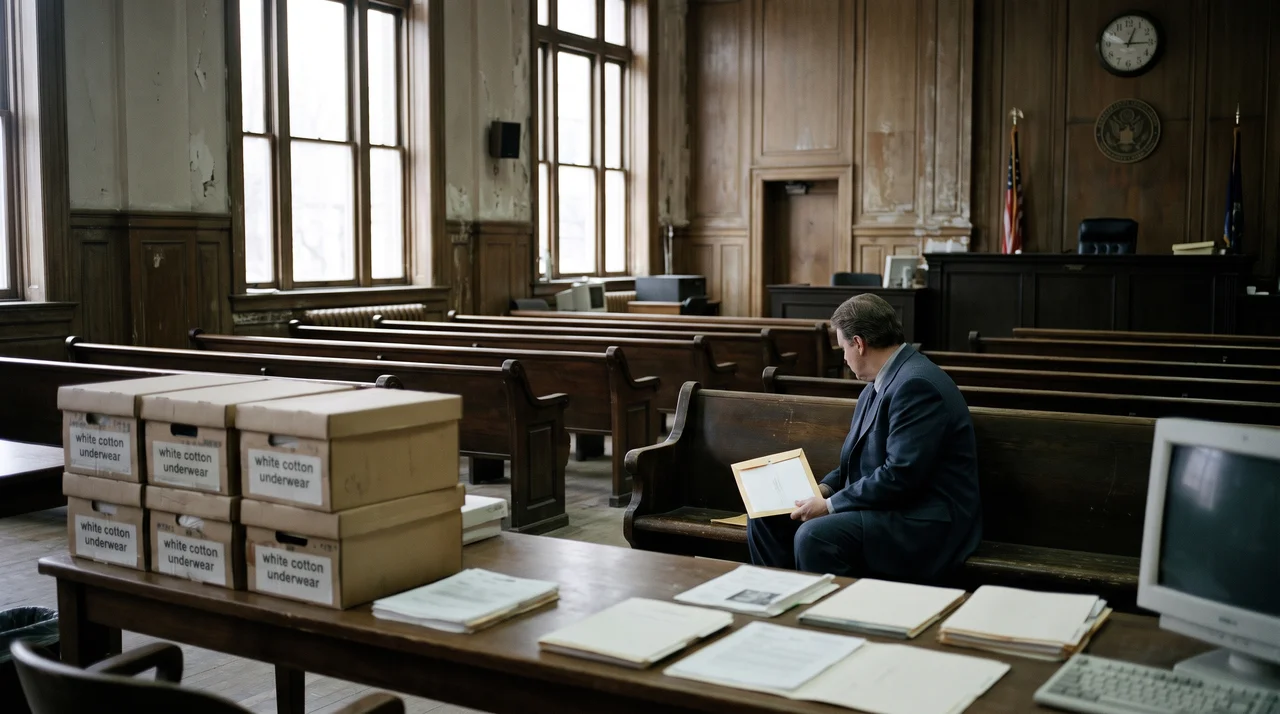
Berkshire Was a Creditor Before It Was a Bidder
Fruit of the Loom filed for Chapter 11 on December 29, 1999, carrying more than $1.4 billion of debt and interest payments of over $100 million a year.2 Its own filings blamed acquisitions that "did not achieve the cash flow levels anticipated," including a 1993-94 diversification into sportswear and licensed apparel that cost about $350 million, financed mostly with debt.3 Buffett's summary in the 2001 letter was shorter: "a victim both of too much debt and poor management."4
Berkshire's debt purchase is the detail most retellings skip. It was not a toehold for leverage in the negotiation. Buffett called its effect on the price "a small amount."1 The same paragraph of the 2001 letter places Fruit in a 50-year line of distressed-debt calls that included Chrysler Financial, Texaco and RJR Nabisco, "all of which returned to grace."1 (The Texaco episode is told in ↗.) What it shows is the order of operations. Berkshire looked at Fruit first as a distressed bond, priced at half of face and paying 15% while it waited, and only then as a business. By the time it bid, it had already been paid to study the company from the inside of the capital structure.
The offer itself was built for a seller with no alternatives. Berkshire attached no financing conditions, even though the offer had to stay open for months, and it made one demand: John Holland, the operating chief who had run Fruit in its best years and returned to rescue it, had to stay on as CEO. "To us, John and the brand are Fruit's key assets," Buffett wrote.5 Holland had retired in 1996, and in his absence management "loaded the company with debt, in part to make a series of acquisitions that proved disappointing." Back in charge, he had already cut employment "from a bloated 40,000 to 23,000."6
The Bankruptcy Court Set a Price No Seller Would Have Accepted
The announced price was $835 million in cash, "subject to significant reduction for certain liabilities."7 The reduction was real. Berkshire's second-quarter 2002 10-Q recorded the purchase, effective April 30, 2002, "at a cost of $730 million."8 For that, Berkshire got a business that had sold $1.34 billion of goods in 2001 and earned $70.1 million at the operating line that year, its last full year in Chapter 11.9 On those reported trough earnings, which carried $46.5 million of plant-closure charges, the price was about 10.4 times operating profit. That is not an obvious steal.9 Against the more than $200 million of annual pre-tax earnings Fruit had made in its best years, it was.14
Nobody bid against it. Fruit's 10-K describes Berkshire as the winner of a court-approved auction "which followed a six-month marketing process";2 when the auction day came in December 2001, it drew no rival bidders at all.10 The court-approved disclosure statement shows who paid for that silence. Secured creditors were estimated to recover about 68% of their claims, unsecured creditors about 10%, and shareholders nothing.11 Berkshire's expected 70% recovery on its own senior bonds sits right beside that 68% estimate. As a creditor it took roughly the same haircut as everyone else. As the buyer it got the business at the price that haircut implied.
Four months later Berkshire bought Garan, the maker of Garanimals, for $60 a share, or about $270 million.12 Together the two purchases cost roughly $1.0 billion. In 2003, their first full year inside Berkshire, they earned $260 million before tax on revenues of $1,459 million.13 That is a 26% pre-tax return on the purchase price in year one, and it was earned in a business Buffett himself described as operating "in a much more competitive environment" than Fruit's glory years.6 It is not a pure bankruptcy return. Garan was bought from public shareholders, and Berkshire never split the $260 million between the two, but Fruit was nearly three-quarters of the cost.
This was not Buffett's first discount on the brand. In 1955 his employer, Graham-Newman, had its holding company buy Union Underwear, then a Fruit of the Loom licensee, for $15 million, $9 million of it in non-interest-bearing notes payable only out of future earnings.14 Both times the brand came cheap because the deal structure made it cheap, through deferred notes in 1955 and the bankruptcy court in 2001, not because the market undervalued underwear.
Under Holland, the Brand Gained Share at 15% Margins
For three years the purchase did what Buffett said it would. Fruit's share of men's and boys' underwear sold through mass merchants such as Wal-Mart and Target rose from 44.2% in 2002 to 48.7% in 2005. In women's and girls' intimates through the same channel, it rose from 13.7% to 24.7%.15 "A gain like that in a major category doesn't come easy," Buffett wrote, and credited Holland.
The reported numbers kept pace. Berkshire published a separate apparel line until 2005, covering Fruit, Garan, Fechheimer's uniforms ↗ and the H.H. Brown and Justin footwear businesses ↗. Its pre-tax margin held between 14% and 15% every year from 2002 to 2005, against less than 1% in 2000, before Fruit arrived.16
| Year | Apparel revenue ($M) | Pre-tax earnings ($M) | Pre-tax margin | What the group contained |
|---|---|---|---|---|
| 2000 | 678 | 6 | 0.9% | Footwear and uniforms, before Fruit16 |
| 2002 | 1,619 | 229 | 14.1% | Fruit from 30 April, Garan from 4 September16 |
| 2003 | 2,075 | 289 | 13.9% | First full year of Fruit and Garan16 |
| 2005 | 2,286 | 348 | 15.2% | Last year before the bolt-ons16 |
| 2012 | 4,149 | 251 | 6.0% | Now including Russell, Vanity Fair and Brooks17 |
| 2013 | 4,293 | 315 | 7.3% | Same17 |
| 2014 | 4,335 | 455 | 10.5% | After restructuring, "discontinuing unprofitable business"17 |
The gap between 2005 and 2012 is not an accident of disclosure. Berkshire folded apparel into "other manufacturing" in 2006 and showed it again as its own line, restated, only in the 2014 annual report.17 What happened inside that gap is the next part of the story.
Then Fruit Went Shopping at Full Price
In 2006 Fruit became a buyer. It paid $18 a share in cash for Russell Corporation, and Berkshire's note to the accounts records about $600 million in cash.18 Buffett put the price at "about $1.2 billion (including assumed debt)."19 Russell brought Russell Athletic, Jerzees, Spalding and a running-shoe company called Brooks.20 In 2007 Fruit added VF Corporation's intimate-apparel business, including Vanity Fair, Vassarette and Lily of France, for $350 million. That business had sold more than $800 million in 2006 and earned about $50 million at the operating line.21
Buffett liked the pattern and said so. The two deals added "about $2.2 billion to Fruit's sales" and about 23,000 employees. He wrote that Berkshire loved placing such businesses "under managers, such as John Holland at Fruit, who have already shown their stuff," and concluded: "In effect, we leverage the managerial talent already with us by these tuck-in deals. We will make many more."19
The irony is hard to miss. Fruit had gone bankrupt the first time partly because it bought companies with borrowed money that did not earn their keep.3 Berkshire removed the debt, and Fruit's appetite for acquisitions came back. About $1.55 billion went into the two bolt-ons, including Russell's assumed debt. That was more than the roughly $1.0 billion Berkshire had paid for Fruit and Garan together, and none of it came at a bankruptcy discount.
Twice the Sales, Less Profit
The 2007 annual report delivered the first verdict. Fruit's pre-tax earnings "declined in 2007 as a result of operating losses from the newly acquired women's intimate apparel operations."22 In 2008, apparel pre-tax earnings fell 34%, "primarily due to lower sales volume and costs incurred to consolidate certain operations of Russell and Vanity Fair Brands."23
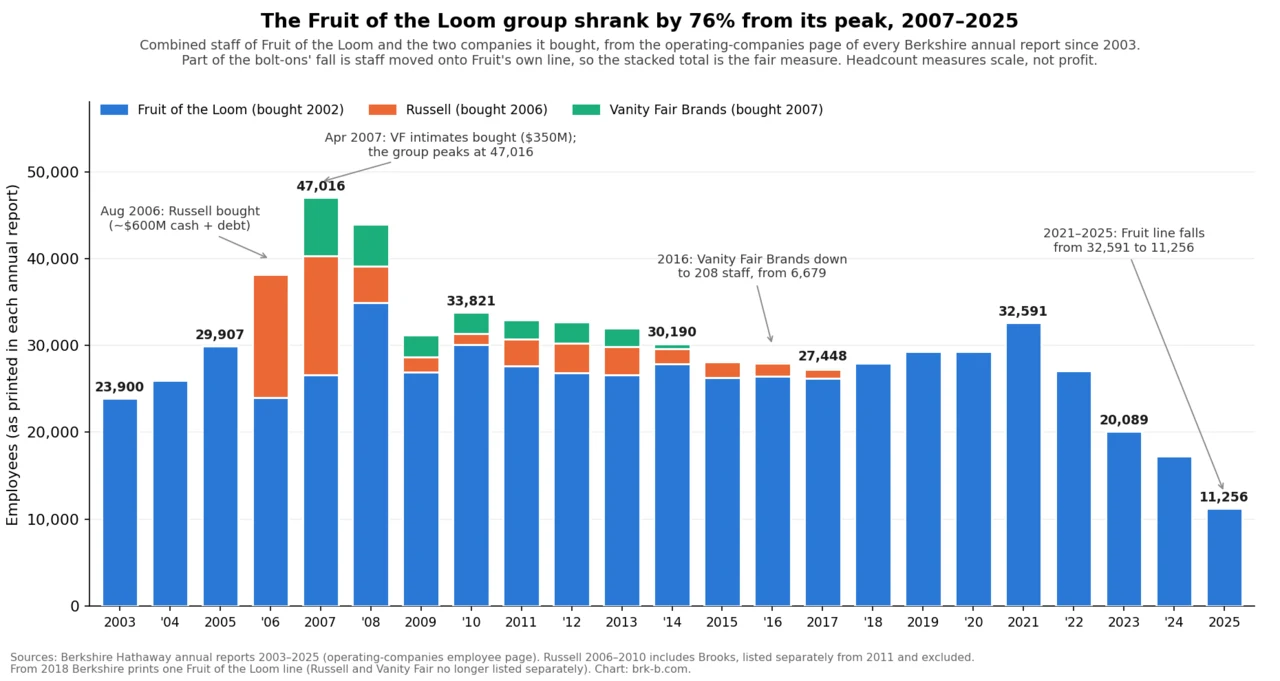
When Berkshire finally showed the apparel numbers again, the comparison was blunt. Between 2005 and 2012, apparel revenue rose 81%, from $2,286 million to $4,149 million, while pre-tax earnings fell 28%, from $348 million to $251 million.1617 The margin fell from 15.2% to 6.0%. 2012 was a weak year, so take the best one instead. In 2014 the group earned $455 million, $107 million more than in 2005.17 Credit every dollar of that gain to the bolt-ons, ignoring Brooks's growth and Fruit's own, and the $1.55 billion spent on Russell and Vanity Fair earned about 7% pre-tax. The 2002 purchases earned 26% in their first full year. As reported, the two groups are close to like-for-like. Berkshire's 2014 report describes the later one as "six apparel businesses (led by Fruit of the Loom which includes Russell athletic apparel and Vanity Fair Brands women's intimate apparel)." Its other members (Garan, Fechheimer, the footwear companies) were already there in 2005, with Brooks the main addition.17 That makes the comparison flattering, if anything, because by 2012 Brooks was growing fast.
The rest is a record of shrinkage. Earnings recovered to $455 million in 2014 after restructuring that "included discontinuing unprofitable business."24 In 2015 Fruit "exited an unprofitable intimate apparel business in Europe."25 Fruit's European intimates came from the VF purchase, which included the Lou, Gemma and Belcor brands in Europe.21 In 2017 Russell Athletic said it would "transition away from the team uniform business."26 In May 2026, Russell Brands sold its Australian subsidiary, including the Sherrin football brand and the Spalding licence for Australia and New Zealand, to Gray-Nicolls Sports.27
The headcount tells the same story without needing a segment table. Berkshire's annual reports list every operating company's employees, and from 2006 to 2017 they listed Russell and Vanity Fair separately, each marked as "A Fruit of the Loom, Inc. Company."28 Vanity Fair Brands went from 6,679 employees in 2007 to 208 in 2016. Russell went from 14,105 in 2006 to 1,020 in 2017.28 Part of that is staff moving onto Fruit's own line as operations were consolidated: in 2008 the Fruit line jumped by more than 8,000 while Russell's fell by more than 9,000.28 The fair measure is the combined total, which peaked at 47,016 in 2007 and stood at 27,448 in 2017, 42% lower.28 Fewer people is not decay in itself, since Holland's own rescue began with a cut from 40,000 to 23,000.6 But a cut that follows an acquisition spree undoes the spree.
The One Bolt-On That Worked Was Lifted Out
The best counter-argument to this piece arrived inside Russell. Russell had bought Brooks at the end of 2004 for $115 million in cash.29 Under Jim Weber it grew into something no other part of the Fruit group became. By 2011 Berkshire's annual report listed Brooks as a company of its own, and Buffett was calling it "our running-shoe company," with sales up 34% that year, "its tenth consecutive year of record volume."30 Brooks, which is private, reported passing $1.1 billion in annual revenue for the first time in 2021.31 Its staff grew from 346 in 2011 to 1,420 in 2025, while the Fruit line went the other way.28
So the honest version of the thesis has an exception, and the exception sharpens it. The one thing Fruit bought that compounded was a business with its own manager, a growth market and pricing power. It was not a commodity line to be merged into Fruit's plants, and Berkshire chose to run it apart from the Fruit group. Brooks was already compounding when Russell bought it, so the credit belongs to Weber's business rather than to Fruit's management. By 2014, Lawrence Cunningham estimated that Brooks alone was worth roughly what Berkshire had paid for all of Russell, on a rule of thumb of twice sales.38 Brooks may well have redeemed the Russell price on its own. That does not show the tuck-in strategy worked. The parts that were tucked in shrank. The part that was lifted out grew.
| Purchase | Year | Price | Bought from | What became of it |
|---|---|---|---|---|
| Fruit of the Loom (basic apparel) | 2002 | $730M recorded cost8 | Chapter 11 estate; no rival bidder10 | Share gains and 14-15% group margins to 20051516; staff down to 11,256 by 202528 |
| Garan | 2002 | ~$270M ($60/share)12 | Public shareholders | Still a separate subsidiary (3,118 staff in 2025)28 |
| Russell Corp. | 2006 | ~$600M cash; ~$1.2B incl. debt1819 | Public shareholders18 | 14,105 staff (2006) to 1,020 (2017)28; team uniforms exited 201726; Australian arm sold 202627 |
| Brooks (inside Russell) | 2006 | Russell paid $115M in 200429 | Came with Russell | Listed on its own by 2011; revenue above $1.1B in 20213031 |
| Vanity Fair Brands (VF intimates) | 2007 | $350M21 | VF Corporation | Operating losses in 200722; 6,679 staff to 208 by 201628; a European intimates business exited 201525 |
Since 2021, the Core Has Shrunk Too
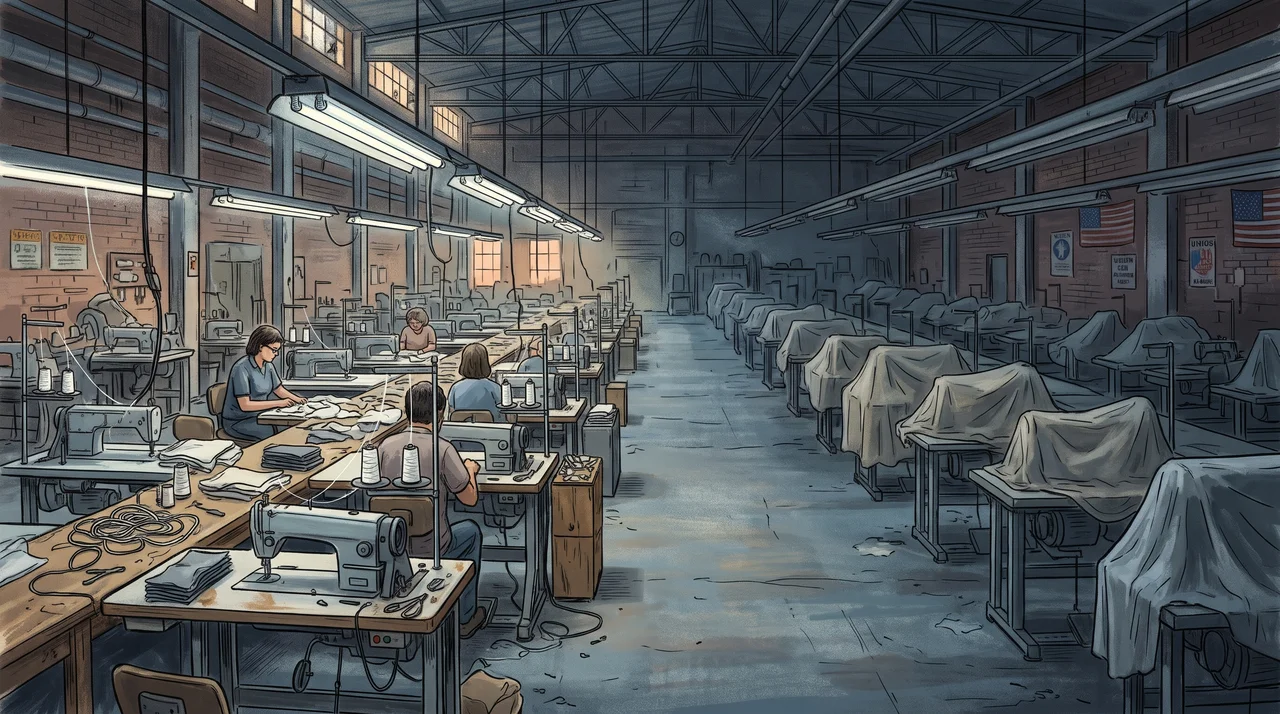
It would be convenient to stop at the bolt-ons, but the evidence after 2021 does not allow it. The single line Berkshire has printed for Fruit of the Loom since 2018, with Russell and Vanity Fair no longer listed separately, went from 32,591 employees in 2021 to 11,256 in 2025. That is a 65% fall in four years.28 Berkshire's own commentary follows the same arc. In 2022, earnings of the apparel and footwear businesses fell 68.0%.32 In 2023 their earnings rose, yet "certain of our apparel and footwear businesses took actions in 2023 to reduce inventories and right-size operations."33 In both the first and second quarters of 2026, Berkshire said consumer-products revenue declined partly because of "the impacts of exiting unprofitable lines of business at Fruit of the Loom."34
Berkshire has never published Fruit's own earnings, so headcount cannot say whether the smaller Fruit is more profitable or merely smaller. It does say the business Buffett bought for "the strength of the brand"7 is being cut back hard twenty-five years later. The brand has not protected the volume. Berkshire's 2024 and 2025 reports put Fruit's revenue declines down to lower sales volumes.35 Shareholders should read that as a limit on the original purchase, not a contradiction of it. A 26% first-year return on the price is a bargain. A brand that keeps its volume through every retail cycle would be a moat, the kind See's Candies ↗ shows with price increases, and Fruit has not shown one. The two are easy to confuse when the same name is printed on both.
The Discount Can't Be Bought Twice
The lesson for the Abel era is about where Berkshire's edge in a commodity business comes from. It does not come from the brand, which Fruit had in 1999 when it went bankrupt. Nor does it come from managerial leverage, which is what Buffett expected the tuck-ins to deliver and what a 7% best case does not show. It comes from the moment of purchase. When a business is sold by creditors who need certainty, to a buyer who brings no financing conditions and was already in the debt, the price can be set below what any healthy seller would accept. That discount is earned once, on the day of purchase. Every later acquisition bought from a healthy seller starts without it, and Fruit's bolt-ons showed what that costs.
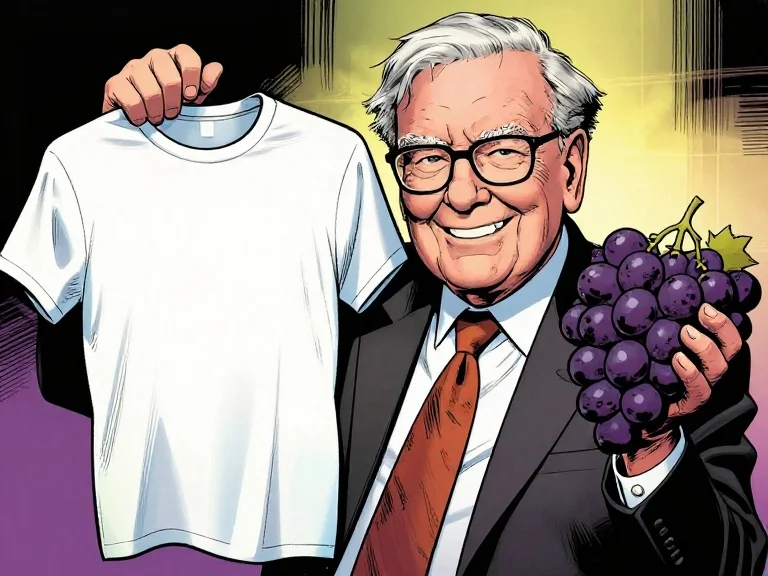
Buffett once summed up the business with a line Alice Schroeder recorded: "We cover the asses of the masses."36 It is still true, more or less literally. The brk-b.com editor owns Fruit of the Loom underwear and, when putting it on, points out to the family that this is Berkshire merchandise. The family rolls its eyes.37 The editor is wearing the part of the story that worked, the part Berkshire bought in bankruptcy court.
How this article was made: thesis and editing by Anthropic Claude Opus 5.5 with the brk-b.com editor; research, drafting and chart by Anthropic Claude Opus 5.5, with research assistance from Anthropic Claude Sonnet 5.5; independent review of the draft by Google Gemini 4 Argon; fact-check of every citation against its source by Anthropic Claude Sonnet 5.5.
References
-
Berkshire Hathaway 2001 Annual Report, Chairman's letter - berkshirehathaway.com — “Early in the Fruit of the Loom bankruptcy, we purchased the company’s public and bank debt at about 50% of face value… we earned about a 15% current return. Our holdings grew to 10% of Fruit’s senior debt, which will probably end up returning us about 70% of face value.” ↩↩↩
-
Fruit of the Loom, Ltd., Form 10-K for fiscal 2001 - sec.gov ↩↩
-
Fruit of the Loom, Ltd., Form 10-K for fiscal 2001 (history of indebtedness) - sec.gov ↩↩
-
Berkshire Hathaway 2001 Annual Report, Chairman's letter - berkshirehathaway.com ↩
-
Berkshire Hathaway 2001 Annual Report, Chairman's letter - berkshirehathaway.com ↩
-
Berkshire Hathaway 2001 Annual Report, Chairman's letter - berkshirehathaway.com — “While correcting these problems, John also reduced employment from a bloated 40,000 to 23,000.” ↩↩↩
-
Berkshire Hathaway news release, 1 November 2001 - berkshirehathaway.com ↩↩
-
Berkshire Hathaway Form 10-Q, quarter ended 30 June 2002 - sec.gov — “…at a cost of $730 million.” ↩
-
Fruit of the Loom, Ltd., Form 10-K for fiscal 2001 (selected financial data) - sec.gov ↩↩
-
"Auction at Fruit of the Loom fails," 19 December 2001 - irishtimes.com ↩
-
Fruit of the Loom, Form 8-K Exhibit 99.1, Disclosure Statement, February 2002 - sec.gov — “…to be approximately 68% of their Allowed Claims.” ↩
-
Berkshire Hathaway Form 10-Q, quarter ended 30 September 2002 - sec.gov ↩
-
Berkshire Hathaway 2003 Annual Report, management's discussion - berkshirehathaway.com — “During 2003 these two businesses generated combined revenues of $1,459 million and pre-tax earnings of $260 million.” ↩
-
Berkshire Hathaway 2001 Annual Report, Chairman's letter - berkshirehathaway.com ↩↩
-
Berkshire Hathaway 2005 Annual Report, Chairman's letter - berkshirehathaway.com ↩
-
Berkshire Hathaway 2002 Annual Report and 2005 Annual Report, non-insurance revenue and pre-tax earnings tables - berkshirehathaway.com ↩↩
-
Berkshire Hathaway 2014 Annual Report, manufacturing table - berkshirehathaway.com — “Apparel … 4,335 4,293 4,149 … 455 315 251” ↩↩↩↩
-
Russell Corporation press release, 17 April 2006 - sec.gov; Berkshire Hathaway 2006 Annual Report, notes - berkshirehathaway.com ↩
-
Berkshire Hathaway 2006 Annual Report, Chairman's letter - berkshirehathaway.com — “In effect, we leverage the managerial talent already with us by these tuck-in deals. We will make many more.” ↩↩
-
Russell Corporation press release, 17 April 2006 - sec.gov ↩
-
Berkshire Hathaway 2007 Annual Report, management's discussion - berkshirehathaway.com ↩
-
Berkshire Hathaway 2008 Annual Report, management's discussion - berkshirehathaway.com — “Pre-tax earnings from apparel declined 34%, primarily due to lower sales volume and costs incurred to consolidate certain operations of Russell and Vanity Fair Brands.” ↩
-
Berkshire Hathaway 2014 Annual Report, management's discussion - berkshirehathaway.com ↩
-
Berkshire Hathaway 2017 Annual Report - berkshirehathaway.com ↩
-
"Russell Throws in the Towel on Uniforms," SGB Media, 29 September 2017 - sgbonline.com ↩
-
Clayton Utz media release, May 2026 - claytonutz.com ↩
-
Berkshire Hathaway annual reports 2003-2025, operating-companies employee page (2025 shown) - berkshirehathaway.com — “Fruit of the Loom … 11,256” (2025); 32,591 (2021) ↩↩↩↩↩↩
-
Berkshire Hathaway 2011 Annual Report - berkshirehathaway.com ↩
-
"Brooks Passes $1B in Revenue for First Time," Front Office Sports, 23 February 2022 - frontofficesports.com ↩
-
Berkshire Hathaway 2022 Annual Report, management's discussion - berkshirehathaway.com ↩
-
Berkshire Hathaway 2023 Annual Report, management's discussion - berkshirehathaway.com ↩
-
Berkshire Hathaway Form 10-Q, first quarter 2026 and second quarter 2026 - berkshirehathaway.com — “…the impacts of exiting unprofitable lines of business at Fruit of the Loom…” ↩
-
Berkshire Hathaway 2025 Annual Report and 2024 Annual Report, consumer products discussion - berkshirehathaway.com ↩
-
Alice Schroeder, The Snowball: Warren Buffett and the Business of Life (Bantam, 2008) - book ↩
-
The brk-b.com editor, in conversation, 5 November 2026 - brk-b.com ↩
-
Lawrence A. Cunningham, Berkshire Beyond Buffett: The Enduring Value of Values (Columbia University Press, 2014), chapter on Brooks - book — “As a rule of thumb, shoe companies are worth twice sales, making Brooks as valuable today as what Berkshire paid for all of Russell…” ↩