Tags: Greg Abel / OxyChem / Taylor Morrison
This fanpage is not officially affiliated with Berkshire Hathaway: Disclaimer
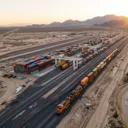
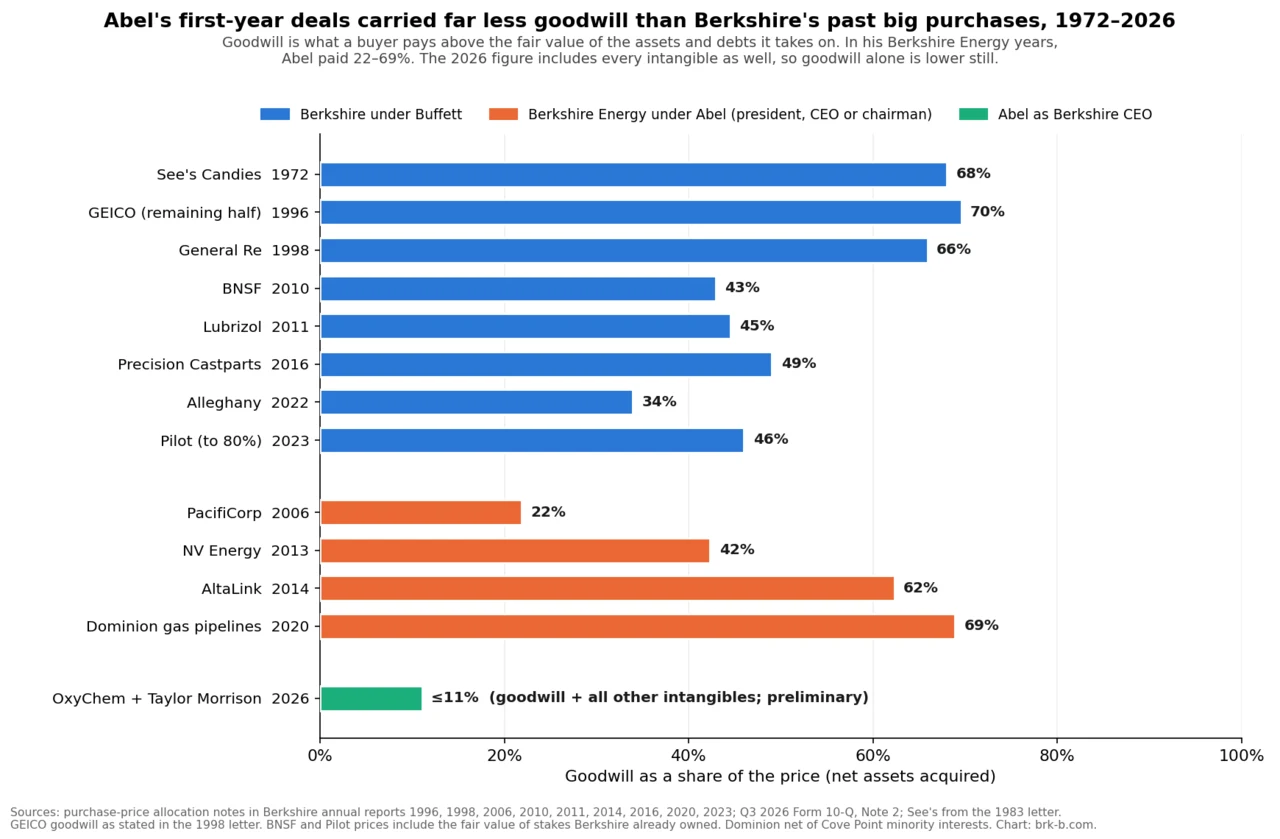
Greg Abel spent about $16.2 billion on two companies in his first year as Berkshire Hathaway's chief executive, and the third-quarter 10-Q shows what the money bought. Of that sum, $1.8 billion went to goodwill and every other intangible combined, about 11 cents on the dollar.1 The rest bought chlorine plants, building lots and unsold houses at what the accountants judged them to be worth. The big Buffett-era deals in the chart below put between 34 and 70 cents of every dollar into goodwill alone.2 So did Abel's own deals in the years he ran Berkshire Energy, at 22 to 69 cents.3 Two deals are a first impression, not a doctrine, and the allocation is still preliminary. But the impression is specific. Abel is not buying the way Buffett learned to buy, and he is not buying the way Abel used to buy either. Low goodwill does not mean he paid little. It means he paid for what the assets are worth and almost nothing for earning power beyond them, which is precisely what Buffett's 1983 essay defined goodwill to be. The businesses that fit that description are heavy and cyclical, and the same essay said such businesses earn poor returns.
Eleven Cents of Goodwill on the Dollar
Berkshire's Note 2 lumps the two acquisitions together: OxyChem, bought from Occidental Petroleum on January 2 for about $9.4 billion, and Taylor Morrison, bought for $72.50 a share, about $6.8 billion, and closed on July 24.1 One caveat belongs up front. OxyChem was agreed on October 1, 2025, while Buffett was still chief executive; Abel took the job on January 1, 2026, the day before it closed.4 Taylor Morrison was his from signing to closing. The combined table is short enough to read in full.
| OxyChem + Taylor Morrison, combined (preliminary) | $ millions | Share of net assets |
|---|---|---|
| Inventories (mostly homes and land) | 7,622 | 47% |
| Property, plant and equipment | 7,287 | 45% |
| Other assets | 4,027 | 25% |
| Goodwill and other intangible assets | 1,796 | 11% |
| Cash | 528 | 3% |
| Liabilities assumed (incl. $2,100 of Taylor Morrison debt) | (5,038) | (31%) |
| Net assets acquired | 16,222 | 100% |
Source: Berkshire Hathaway Q3 2026 Form 10-Q, Note 2.1 Shares are of net assets acquired, which equal the combined price; the asset lines sum to more than 100% because liabilities are netted below them.
Goodwill is the plug in that table. A buyer marks every asset and every debt it takes on to fair value; whatever the price exceeds that net figure by is goodwill. Berkshire does not split the $1.8 billion between the two deals. For OxyChem, its 2025 annual report said "goodwill is not expected to be material."5 Its preliminary values put OxyChem's assets at $10.7 billion, about $7.0 billion of it property, plant and equipment, against $1.3 billion of liabilities: a $9.4 billion price for $9.4 billion of fair-valued stuff.6
Set against fifty years of Berkshire purchases, that line is an outlier, as the chart below shows. The Taylor Morrison half of the story, and the logic of buying a homebuilder at all, is in our earlier piece on the deal.↗ This piece is about the shape of the cheque.
Buffett Started Out Buying Windmills Below Book
The deals in that chart show where Berkshire ended up. It started somewhere else, and in one respect Abel's first year rhymes with the start.
In the late 1950s Buffett bought into Dempster Mill Manufacturing, a windmill and irrigation-pump maker in Beatrice, Nebraska. The stock sold for $18 a share against a book value of $72, a quarter of book, and "the assets were windmills, irrigation equipment, and its own manufacturing" plant.7 Alice Schroeder describes the method plainly: "Since Dempster was just another cigar butt, Warren applied his cigar-butt technique, which was to keep buying a stock as long as it continued to sell below book value." If the price rose he sold; if it did not, he ended up in control and could "liquidate—its assets at a profit."8

Berkshire Hathaway itself came the same way. Buffett's partnership bought its first shares in December 1962 at $7.50, "a wide discount from per-share working capital of $10.25 and book value of $20.20." He called it picking up "a discarded cigar butt that had one puff remaining in it."9 The puff was free; the rest of the cigar was a New England textile mill. Charlie Munger later put a number on what such businesses earn once you own them and keep reinvesting: "after twenty years of doing it, somehow you've earned a return of only about four percent per annum. That's the textile business."10
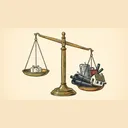
That is the first lesson in the history, and it is load-bearing here. Buying hard assets below their value protected Buffett's capital. It did not compound it. The rhyme with 2026 is in what was bought, not in what was paid: Dempster cost a quarter of its book value, while OxyChem cost about 1.8 times the book value its seller carried, as the numbers further down show.
See's Taught Berkshire to Pay for What It Couldn't Touch
The turn came in 1972. Blue Chip Stamps, a Berkshire affiliate, bought See's Candies for $25 million "at which time See's had about $8 million of net tangible assets."11 That is $17 million of goodwill, 68% of the price. It nearly did not happen. "They had such an ingrained habit of underbidding," Schroeder writes, "that it was like swallowing live guppies for them to pay the asking price." Munger's colleague Ira Marshall told them, "You're underestimating quality," and Munger's verdict was short: "We changed our mind."12
Eleven years later Buffett wrote the theory down in an appendix to the 1983 letter: "businesses logically are worth far more than net tangible assets when they can be expected to produce earnings on such assets considerably in excess of market rates of return. The capitalized value of this excess return is economic Goodwill."13 By 1989 it had become the line every shareholder can recite: "It's far better to buy a wonderful company at a fair price than a fair company at a wonderful price. Charlie understood this early; I was a slow learner."14 Buffett described the in-between years to Schroeder as a reformation: "I would listen to Martin Luther one day and the Pope the next. Ben Graham, of course, being the Pope."15
Munger's own accounting of where the money came from is blunt: "Much of the first $200 or $300 million came from scrambling around with our Geiger counter. But the great bulk of the money has come from the great businesses."16 The See's ledger itself, a few million dollars of tangible assets throwing off cash for fifty years, is reconstructed in our earlier piece.↗ The goodwill column in the chart is the price of that lesson, paid again and again.
Size Brought the Steel Back, With the Goodwill Attached
The See's model has a ceiling. There are not enough See's to absorb Berkshire's cash, and by 2009 Buffett said so: "In earlier days, Charlie and I shunned capital-intensive businesses such as public utilities." He was now "quite willing to enter businesses that regularly require large capital expenditures," expecting "only that these businesses have reasonable expectations of earning decent returns."17
So Berkshire went back to steel, rail and pipe. But it went back the expensive way, paying premiums for quality the way the See's lesson taught. BNSF's 2010 allocation carried $14.8 billion of goodwill on $34.5 billion; Precision Castparts in 2016 carried $16.0 billion of goodwill and another $23.5 billion of other intangibles on $32.7 billion.2 Buffett was candid about the arithmetic. In 2006 his manufacturing, service and retailing companies "earned a pleasing 25% on average tangible net worth," but because Berkshire bought "many of them, however, at large premiums to net worth," the return on what Berkshire actually paid fell to 10.8%.18 The goodwill cost Berkshire more than half of the return the businesses themselves earned.
And goodwill can be wrong. In 2020 Berkshire wrote off about $10 billion of goodwill tied to Precision Castparts, and Buffett's verdict was unambiguous: "I paid too much for the company."19 Accumulated goodwill impairments stood at $13.0 billion at September 30, 2026, against $83.4 billion of goodwill still on the balance sheet; four reporting units carrying $9.2 billion of it cleared their carrying values by less than 20% at the last annual test.20 Our piece on Precision Castparts argues the foundry has since earned its way back.↗ The write-down stays on the books regardless. A deal with no goodwill has nothing of that kind to write down.
Abel Paid Up for Utilities Like Everyone Else
The tempting conclusion is that Abel is a careful buyer who simply refuses to pay for air. His own record says otherwise. At MidAmerican, later Berkshire Hathaway Energy, he was president when it bought PacifiCorp and chief executive or chairman for three more large deals. Every one carried substantial goodwill.
| Deal | Abel's role | Net assets acquired ($m) | Goodwill ($m) | Goodwill share | What the filing says the goodwill paid for |
|---|---|---|---|---|---|
| PacifiCorp, 2006 | President and COO21 | 5,120 | 1,118 | 22% | Excess over fair value "allocated as goodwill to the PacifiCorp reportable segment"21 |
| NV Energy, 2013 | Chairman, president and CEO22 | 5,596 | 2,369 | 42% | "the long-term opportunity to improve operating results through the efficient management of operating expenses and the deployment of capital"22 |
| AltaLink, 2014 | Chairman, president and CEO23 | 2,728 | 1,700 | 62% | "the opportunities to invest in Alberta's electric transmission infrastructure"23 |
| Dominion gas transmission and storage, 2020 | Chairman24 | 2,514 | 1,732 | 69% | "the long-term opportunity to improve operating results"24 |
Net assets and goodwill from the purchase-price allocations in Berkshire's 2006, 2014 and 2020 annual reports;3 roles and stated rationales from MidAmerican/Berkshire Hathaway Energy 10-Ks. Dominion net assets are after $3.9 billion of Cove Point minority interests.
There is a structural reason for those numbers. A regulated utility earns a return on the book value of its assets, so its plants are not written up on acquisition; NV Energy's assets subject to rate-setting were "assumed to approximate their carrying values and, therefore, no fair value adjustments have been reflected."22 Any premium a buyer pays for a utility therefore lands in goodwill almost by definition. What Abel paid it for, by the filings' own account, was growth: room to invest capital at regulated returns for decades.
That makes 2026 a change, but the cause needs stating carefully. It is not simply that Abel bought heavier assets. BNSF's track and locomotives are as heavy as industry gets, and BNSF still carried 43% goodwill.2 It is that he paid roughly what the identifiable assets are worth. In Buffett's 1983 vocabulary, goodwill is the capitalised value of earnings above a normal return on those assets.13 The man who paid 62 cents of goodwill on the dollar for the right to build Alberta's transmission lines has just bought a chlorine maker and a homebuilder and paid their sellers for almost no excess earning power at all. That is a choice about what to pay for, not a personality trait.
Low Goodwill Does Not Mean a Low Price
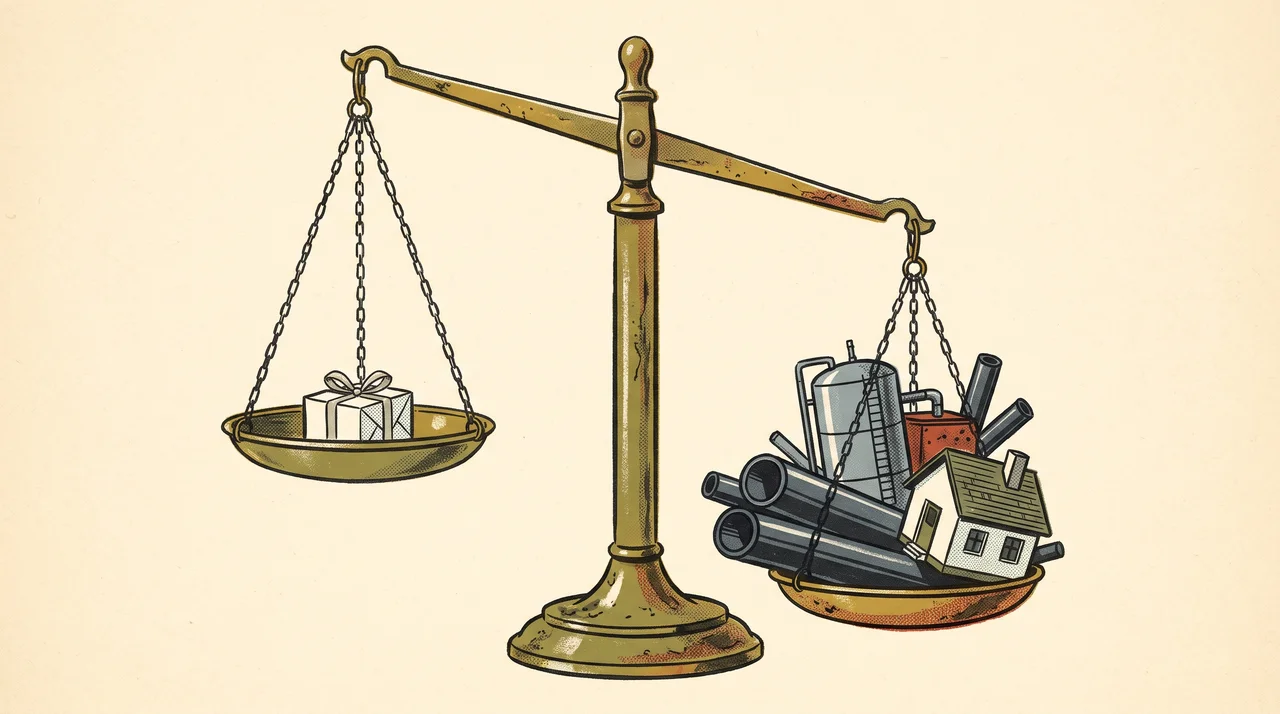
It would be easy to read the 11% as a bargain. It is not, or not in the sense a value investor means.
Occidental carried OxyChem at year-end 2025 as a business held for sale: $6,520 million of assets, including $4,442 million of property, plant and equipment, and $1,196 million of liabilities.25 That is about $5.3 billion of net book value. Berkshire paid $9.4 billion, about 1.8 times what the seller carried it at. The premium did not vanish; it moved. Berkshire's preliminary values put OxyChem's property, plant and equipment at about $7.0 billion, some $2.6 billion above Occidental's figure.6 The plants were revalued upward, so the premium shows up as plant rather than as goodwill.
Taylor Morrison was closer to cheap. Its first-quarter 2026 balance sheet, the last before the deal was signed, showed $6,248 million of stockholders' equity and 93.4 million shares, about $66.88 of book value per share, of which $663 million was its own goodwill.26 At $72.50, Berkshire paid about 1.08 times book, and about 9.3 times the $7.77 of diluted earnings per share the company reported for 2025.27 That is a fair price for a homebuilder near the bottom of a housing cycle, and it is the half of the year that looks most like the old Graham discount.
The difference between the two kinds of premium matters for what shareholders will see. Under today's American accounting rules, goodwill "is not amortized, but rather is reviewed annually for impairment."23 A goodwill-heavy deal therefore flatters reported earnings, with no annual charge for the premium unless it goes bad. A premium paid in written-up plant is depreciated every year, out of earnings. Berkshire's own disclosure says as much: OxyChem's pre-tax earnings of $71 million in the third quarter and $192 million in the first nine months of 2026 "included the effects of incremental depreciation and amortization expense related to acquisition accounting fair value adjustments."28 Buffett's 1983 appendix was written partly to warn readers that the old rule, a goodwill charge against income every year for forty years, understated See's true economics.11 Under today's rules the shoe is on the other foot. Abel's kind of deal now carries the accounting charge, and Buffett's kind no longer does.
The 1983 Warning Gets Its Test
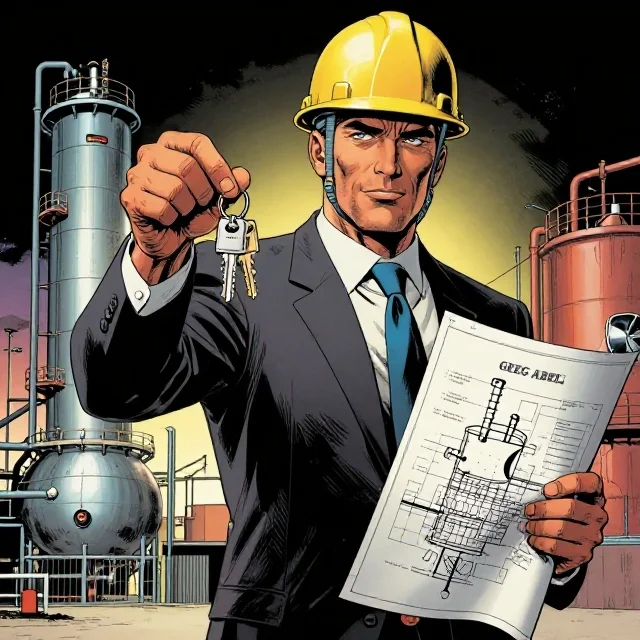
The same 1983 appendix that taught Berkshire to pay for goodwill contains a sentence aimed squarely at the businesses Abel has just bought. "For years the traditional wisdom – long on tradition, short on wisdom – held that inflation protection was best provided by businesses laden with natural resources, plants and machinery, or other tangible assets ('In Goods We Trust'). It doesn't work that way. Asset-heavy businesses generally earn low rates of return."29 Chlorine plants and a land bank are tangible assets in the most literal sense.
The early numbers do not contradict him, though they overstate the case against Abel. Annualise OxyChem's nine-month result and it earns roughly $256 million pre-tax, about 2.7% on a $9.4 billion price, after the extra depreciation on its written-up plants, a drag the filing does not quantify.28 The fair yardstick is what Buffett's goodwill-heavy businesses earned on what Berkshire paid for them, 10.8% in 2006 on his own figures.18 OxyChem's pre-tax number is a quarter of that before any tax. The case for the deal is the cycle. Under Occidental the chemical segment earned $2,508 million in 2022, $1,531 million in 2023 and $1,124 million in 2024,30 which is 27%, 16% and 12% of Berkshire's price. Abel's own description stresses the assets rather than any brand: "Management prioritizes efficient execution over volume, supported by an integrated asset base and access to low-cost raw materials."31 Our earlier piece set the deal against Lubrizol, which paid a specialty premium that never earned out.↗ OxyChem carries no such premium. It is a bet that a commodity cycle turns.
Taylor Morrison, the other $6.8 billion, reads differently. At 9.3 times its 2025 earnings per share, the price implies an after-tax earnings yield of about 10.7%, level with Buffett's yardstick on day one.27 The cycle cuts that way too, though: Taylor Morrison's diluted earnings for the first quarter of 2026 were $1.01 a share, against $2.07 a year earlier.26 Berkshire now reports it inside its building products group, so its own numbers will surface only in passing.1 Of the two deals, it is the one that looks most like a fair company at a fair price, and the least like a bet.
So the first impression comes down to a prediction we can check, for as long as Berkshire keeps reporting OxyChem by name. If OxyChem's pre-tax line in the 2028 annual report still shows under 5% on its $9.4 billion price, depreciation drag and all, the 1983 sentence will have won, and Abel will have paid a fair price for Dempster without the discount that made Dempster work. If it shows double digits, he will have bought a commodity cycle near its low with nothing on the balance sheet to impair. Either way, shareholders will read the answer in the depreciation line, not the goodwill line.
How this article was made: thesis and editing by Anthropic Claude Opus 5.5 with the brk-b.com editor; research, drafting, chart and image prompts by Anthropic Claude Opus 5.5, with research assistance from Anthropic Claude Sonnet 5.5; independent review of the draft by Google Gemini 4 Argon; fact-check of every citation against its source by Anthropic Claude Sonnet 5.5.
References
-
Berkshire Hathaway Q3 2026 Form 10-Q — Note 2, Business acquisitions - berkshirehathaway.com — “Inventories 7,622 … Property, plant and equipment 7,287 … Goodwill and other intangible assets 1,796 … Liabilities assumed 5,038 … Net assets $ 16,222” ↩↩↩
-
Berkshire Hathaway annual reports 1996–2023 — Business acquisitions notes (purchase-price allocations) - berkshirehathaway.com — goodwill / net assets acquired or, for GEICO and General Re, total consideration ($m): GEICO 1996 ~1,600 / ~2,300 (goodwill as stated in the 1998 letter); General Re 1998 14,500 / ~22,000; BNSF 2010 14,803 / 34,495; Lubrizol 2011 3,877 / 8,704; Precision Castparts 2016 16,011 (plus 23,527 other intangibles) / 32,658; Alleghany 2022 3,900 / 11,505 (final allocation); Pilot 2023 6,605 / 14,365. BNSF and Pilot include the fair value of stakes already owned. ↩↩↩
-
Berkshire Hathaway 2006, 2014 and 2020 annual reports — Business acquisitions notes - berkshirehathaway.com — goodwill / net assets acquired ($m): PacifiCorp 1,118 / 5,120 (2006); NV Energy 2,369 / 5,596 and AltaLink 1,700 / 2,728 (2014, assets less liabilities); Dominion gas transmission and storage 1,732 / 2,514 after noncontrolling interests (2020, preliminary; the 2021 report's final goodwill of 1,741 gives 69.3%). ↩
-
Berkshire Hathaway 2025 Annual Report — Notes (OxyChem) and Executive Officers - berkshirehathaway.com — “OxyChem… pursuant to a definitive agreement as of October 1, 2025”; “Effective January 1, 2026, Mr. Abel became Berkshire’s Chief Executive Officer.” ↩
-
Berkshire Hathaway 2025 Annual Report — Notes, subsequent event (OxyChem) - berkshirehathaway.com — “assets will primarily consist of property, plant and equipment, trade receivables, inventories, equity method investments and intangible assets. Goodwill is not expected to be material.” ↩
-
Berkshire Hathaway Q2 2026 Form 10-Q — Note 2, Business acquisitions - berkshirehathaway.com — “Preliminary values of OxyChem’s assets as of the acquisition date were $10.7 billion, consisting primarily of property, plant and equipment (approximately $7.0 billion)… Preliminary values of its liabilities as of the acquisition date were $1.3 billion.” ↩↩
-
Alice Schroeder, "The Snowball: Warren Buffett and the Business of Life", Chapter 25: The Windmill War; Bantam, 2008 ↩
-
Alice Schroeder, "The Snowball", Chapter 25: The Windmill War; Bantam, 2008 ↩
-
Warren Buffett, 2014 Letter to Shareholders — "Berkshire — Past, Present and Future" - berkshirehathaway.com — “The stock was then selling for $7.50, a wide discount from per-share working capital of $10.25 and book value of $20.20. Buying the stock at that price was like picking up a discarded cigar butt that had one puff remaining in it.” ↩
-
Charlie Munger, "A Lesson on Elementary, Worldly Wisdom as It Relates to Investment Management & Business", in "Poor Charlie's Almanack: The Wit and Wisdom of Charles T. Munger", ed. Peter D. Kaufman ↩
-
Warren Buffett, 1983 Chairman's Letter — Appendix: "Goodwill and its Amortization: The Rules and The Realities" - berkshirehathaway.com — “Blue Chip Stamps bought See’s early in 1972 for $25 million, at which time See’s had about $8 million of net tangible assets.” ↩↩
-
Alice Schroeder, "The Snowball", Chapter 34: Candy Harry; Bantam, 2008 ↩
-
Warren Buffett, 1983 Chairman's Letter — Goodwill appendix - berkshirehathaway.com ↩↩
-
Warren Buffett, 1989 Chairman's Letter — "Mistakes of the First Twenty-five Years" - berkshirehathaway.com ↩
-
Alice Schroeder, "The Snowball", Chapter 30: Jet Jack; Bantam, 2008 ↩
-
Charlie Munger, "A Lesson on Elementary, Worldly Wisdom", in "Poor Charlie's Almanack", ed. Peter D. Kaufman ↩
-
Warren Buffett, 2009 Letter to Shareholders - berkshirehathaway.com — “In earlier days, Charlie and I shunned capital-intensive businesses such as public utilities… we are today quite willing to enter businesses that regularly require large capital expenditures.” ↩
-
Warren Buffett, 2006 Letter to Shareholders — Manufacturing, Service and Retailing Operations - berkshirehathaway.com — “…earned a pleasing 25% on average tangible net worth last year… We purchased many of them, however, at large premiums to net worth… and that fact reduces the earnings on our average carrying value to 10.8%.” ↩↩
-
Berkshire Hathaway 2020 Annual Report — Chairman's letter and goodwill note - berkshirehathaway.com — “That year, Berkshire purchased Precision Castparts (“PCC”), and I paid too much for the company.” / “pre-tax goodwill impairment charges of $10.0 billion … of which approximately $10 billion related to PCC.” ↩
-
Berkshire Hathaway Q3 2026 Form 10-Q — Note 12 and Critical Accounting Policies - berkshirehathaway.com — “Net of accumulated goodwill impairments of $13.0 billion as of September 30, 2026”; “goodwill of acquired businesses of $83.4 billion… Goodwill of these reporting units totaled approximately $9.2 billion.” ↩
-
MidAmerican Energy Holdings 2006 Form 10-K (accession 0001081316-07-000007) - sec.gov — Abel listed as “MEHC’s President and Chief Operating Officer”; PacifiCorp purchase price excess “allocated as goodwill to the PacifiCorp reportable segment.” ↩
-
MidAmerican Energy Holdings 2013 Form 10-K — NV Energy acquisition - sec.gov — “the fair value of the Nevada Utilities’ assets acquired and liabilities assumed subject to these rate-setting provisions are assumed to approximate their carrying values and, therefore, no fair value adjustments have been reflected” ↩
-
Berkshire Hathaway Energy 2014 Form 10-K (accession 0001081316-15-000003) — AltaLink acquisition - sec.gov — “The goodwill reflects the value for the opportunities to invest in Alberta’s electric transmission infrastructure… Goodwill is not amortized, but rather is reviewed annually for impairment” ↩
-
Berkshire Hathaway Energy 2020 Form 10-K (accession 0001081316-21-000011) — Dominion gas transmission and storage acquisition - sec.gov — Abel listed as “BHE’s Chairman”; goodwill “reflects the value paid primarily for the long-term opportunity to improve operating results”. ↩
-
Occidental Petroleum 2025 Form 10-K — OxyChem held for sale - sec.gov — “Property, plant and equipment, net 4,442 … Total assets held for sale $ 6,520 … Total liabilities held for sale $ 1,196” ↩
-
Taylor Morrison Home Corp Q1 2026 Form 10-Q (accession 0001628280-26-026535) - sec.gov — “Goodwill 663,197 … Total stockholders’ equity 6,248,154” ($000, March 31, 2026); 93,427,654 shares outstanding as of April 22, 2026; diluted earnings per share $1.01 for the quarter against $2.07 a year earlier. ↩↩
-
Taylor Morrison Home Corp 2025 Form 10-K - sec.gov — diluted earnings per common share $7.77 (2025). ↩↩
-
Berkshire Hathaway Q3 2026 Form 10-Q — MD&A, Manufacturing (industrial products) - berkshirehathaway.com — “OxyChem generated pre-tax earnings of $71 million in the third quarter and $192 million in the first nine months of 2026, which included the effects of incremental depreciation and amortization expense related to acquisition accounting fair value adjustments.” ↩↩
-
Warren Buffett, 1983 Chairman's Letter — Goodwill appendix - berkshirehathaway.com — “Asset-heavy businesses generally earn low rates of return – rates that often barely provide enough capital to fund the inflationary needs of the existing business” ↩
-
Occidental Petroleum 2024 Form 10-K — Segment results and earnings - sec.gov — “Chemical 1,124 1,531 2,508” ($m; 2024, 2023, 2022) ↩
-
Greg Abel, 2025 Letter to Shareholders - berkshirehathaway.com ↩