Tags: Forest River / History / Tariffs
This fanpage is not officially affiliated with Berkshire Hathaway: Disclaimer
On June 21, 2005, an intermediary faxed Warren Buffett a two-page letter about an Indiana company he had never heard of, run by a man he had never met. One week later, over dinner at Omaha's Happy Hollow Club, Buffett and Pete Liegl shook hands on the sale of Forest River for roughly $800 million. Liegl died nineteen years later at his desk, age 80, having built what Buffett called a business no competitor "came close to" — a ten-billion-dollar recreational-vehicle empire that Berkshire shareholders have rarely seen, rarely heard about, and almost never discussed at the annual meeting. This is the story of how it got there, and why the road ahead is the bumpiest it has been since the deal was signed.
Introduction
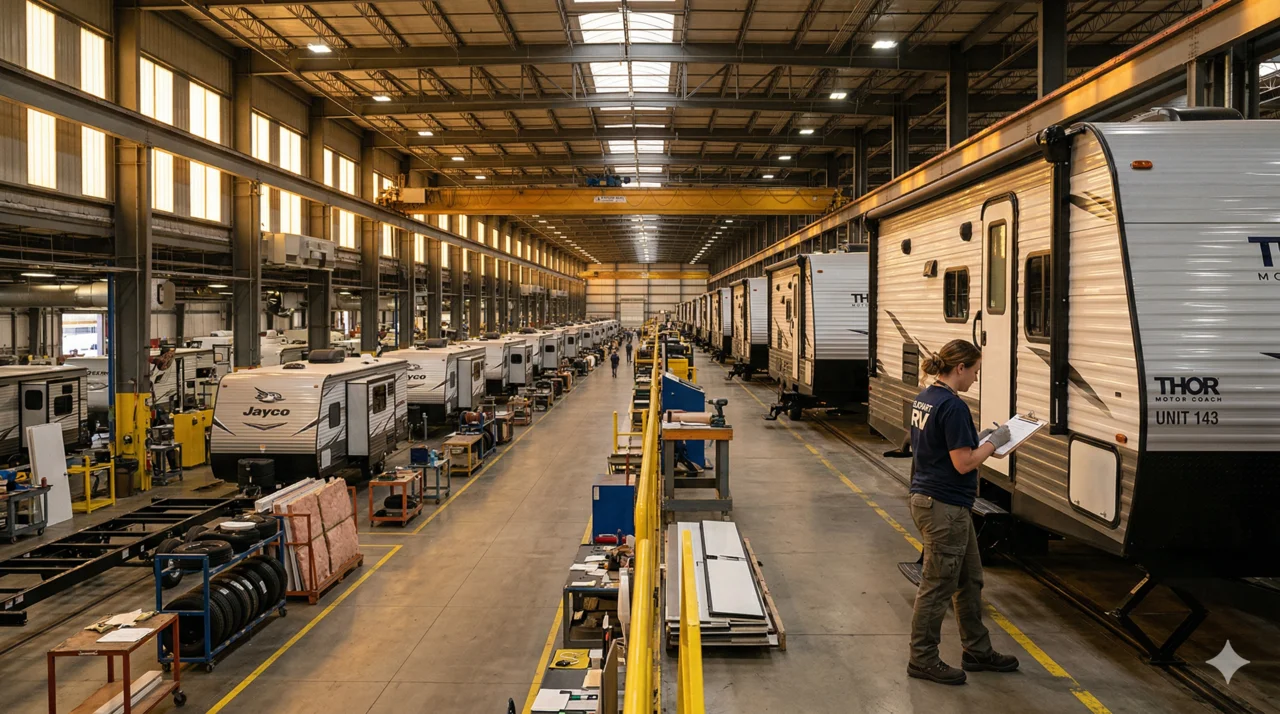
Forest River is the largest Berkshire subsidiary almost nobody talks about. It manufactures more travel trailers, fifth wheels, pontoon boats, cargo vans, and small transit buses than any single competitor on the North American continent, operates more than 100 plants spread across Indiana and beyond, and employs roughly 11,000 people1. In most years it has generated revenues comparable to, or larger than, Thor Industries — the publicly traded "market leader" everyone actually covers2. Yet it has never had its own dedicated story on these pages, has never had an investor day, and its founder Pete Liegl never attended a Berkshire annual meeting that anyone can recall.
The silence is about to break. Liegl's death in November 2024 ended the longest uninterrupted one-man reign in Berkshire's operating portfolio. His successor Doug Gaeddert inherited a business mid-recovery from the worst RV cycle since 2008 — and within months of taking over as sole CEO, found himself staring at a trade war, an Iranian oil shock, and seven-and-a-half-percent consumer loan rates all at once3. For a business that sells large, heavily financed, gasoline-powered discretionary purchases into the American middle class, the macro picture of spring 2026 could hardly be more hostile.
Berkshire bought Forest River because its founder was a natural operator who promised to run the company exactly as he already had. That model delivered almost two decades of compounding with zero management interference from Omaha. Whether it survives the next two years — under a new CEO, into the teeth of every headwind at once — will tell us something important about how the post-Buffett Berkshire handles its quieter, lumpier manufacturers.
The Twenty-Minute Deal
To understand Forest River, start with the Rockwood brand — founded in 1972, bounced through a Bangor Punta acquisition, a Lear Siegler consolidation, and finally a Forstmann Little leveraged buyout in the late 1980s4. One of the minority owners Forstmann eventually dealt with was a young Indiana operator named Peter Liegl, who, with a partner, had acquired Rockwood through a vehicle called Van American. The combined business went public as Cobra Industries, tried to chase growth with debt, and filed for bankruptcy in 1995. Liegl walked out, waited for the assets to come available, and in January 1996 bought the husk of his old company out of bankruptcy court. He named the new entity Forest River, kept it debt-free, and spent the next nine years quietly compounding it into a $1.6 billion business5.
Buffett's 2024 shareholder letter — written shortly after Liegl's death — is the closest thing we have to a first-person account of the acquisition. "I first heard of Forest River on June 21, 2005," Buffett wrote. "On that day I received a letter from an intermediary detailing relevant data about the company… The writer said that Pete, the 100% owner of Forest River, specifically wanted to sell to Berkshire. He also told me the price that Pete expected to receive. I liked this no-nonsense approach."1
Buffett spent the next several days calling RV dealers. What they told him must have been flattering, because on June 28 he arranged a meeting in Omaha. Liegl brought his wife Sharon and his daughter Lisa. Within a few minutes the two men had also priced the real estate Liegl personally owned and leased to the company — Buffett accepted Liegl's valuation without sending an appraiser. Then came the compensation conversation that is now part of Berkshire folklore:
"Well, I looked at Berkshire's proxy statement," Liegl said, "and I wouldn't want to make more than my boss, so pay me $100,000 per year." Plus, he added, a bonus of ten percent of earnings above a threshold1.
The four of them had dinner at the Happy Hollow Club. Liegl told RV Business shortly afterward that he had chosen Berkshire because "they have the horsepower" and "Forest River had no debt before this, and Forest River has no debt after this."6 The $800 million price was never officially disclosed at the time — it leaked years later, survives in the industry press, and implies Buffett paid roughly half of annual revenue for a business that would more than double its top line within eight years25. Even by 2005 standards, for a private, debt-free, founder-run cash generator, it was a bargain.
Kingdom of Campers
Liegl used Berkshire's capital base and hands-off culture the way a gardener uses good soil — by planting more of what already worked. Between 2005 and 2013, Forest River bolted on Rance Aluminum (2007), Coachmen (2008), Shasta (2010), and Dynamax (2011)7. Plant count climbed from about 60 in 2005 to 82 by 2010. Employee count went from 5,400 at acquisition to 8,770 by year-end 2013, when the company disclosed $3.3 billion in revenue — up 24% year-over-year, with pre-tax earnings up 32%8. That is roughly a doubling of the business every six years, achieved without a single Omaha-driven initiative, without a new ERP system, without a consultant, and, as far as anyone can tell, without a single corporate-strategy slide deck.
The brand portfolio is the visible half of the iceberg. Cherokee, Rockwood, Salem, Wildwood, Surveyor, Sunseeker, Entrada, Forester, Georgetown — and on the water, Berkshire, South Bay, Trifecta, and Dockside pontoon boats — each operates more like an autonomous factory than a branded marketing unit9. Liegl's management philosophy, to the extent he articulated one, was to hire plant managers who behaved like owners, pay them accordingly, and intervene only when things broke. It is very nearly the same philosophy Buffett applied to Liegl himself.
| Year | Revenue (est.) | Employees | US market share | Key event |
|---|---|---|---|---|
| 2005 | $1.6B | 5,400 | — | Berkshire acquisition, $800M5 |
| 2013 | $3.3B | 8,770 | — | Post-crisis doubling complete8 |
| 2018 | ~$7B | 12,002 | ~33% | First tariff shock hits H210 |
| 2021 | +40% YoY | 13,457 | ~36% | Pandemic peak, record headcount11 |
| 2022 | +8% | 12,994 | ~42% | Market-share peak, tied with Thor12 |
| 2023 | −26.2% | 11,907 | ~42% | Worst unit decline since 200813 |
| 2024 | +6.4% | 11,425 | ~35% | Liegl dies November, age 801 |
| 2025 | positive rev, softer margins | 11,252 | ~36% | Gaeddert sole CEO; tariffs return14 |
Sources: Berkshire annual reports 2013, 2018–2025; Berkshire Beyond Buffett; Buffett 2024 shareholder letter. Market-share figures are the September readings Berkshire cites in each report.
The First Tariff Shock
Students of the next few paragraphs should notice that Forest River has been here before. In March 2018, President Trump invoked Section 232 of the Trade Expansion Act to impose 25% tariffs on imported steel and 10% on aluminum. Forest River's full-year 2018 revenue still rose 2.6%, buoyed by a strong first half, but Berkshire's 2018 annual report was unusually blunt about the damage in the back half of the year: second-half unit sales fell 7%, and fourth-quarter pre-tax earnings dropped 28% "by higher material costs" attributed "in part, to the effects of U.S. tariffs on steel products"10.
Buffett rarely names a policy cause in print. He did here, and the language is worth noting: a 25% tariff on one input material wiped out almost a third of quarterly earnings in a single quarter at one of his largest manufacturing subsidiaries. Forest River builds travel trailers whose frames, chassis crossmembers, and sidewall studs are disproportionately steel and aluminum. There is no design workaround, no substitute material, and — for the most competitive low-end product in the industry — almost no pricing power. Liegl simply absorbed the hit for a quarter, then passed it along in 2019 model-year prices. The 2019 revenue decline of 12.9% that followed was partly him paying for that price increase with volume10.
The 2018 episode is the blueprint for what comes next, with one difference: in 2018, the tariff was 25% on raw steel. In 2026, it is 50%, applied more broadly, and stacked with new duties on "derivative articles" containing significant steel, aluminum, or copper content14. We will return to this.
Peak, Cliff, and the Climb Back
The COVID boom and its hangover are the defining macroeconomic events of Forest River's last five years. With Americans unable to travel abroad but flush with stimulus cash, RV demand exploded. Forest River's 2021 revenue surged 40.2% year-over-year on 27.6% higher unit volumes11. Headcount peaked at 13,457 — the highest in company history. Market share, which Berkshire tracks on a September rolling basis, climbed from around 33% in 2018 to 42% by late 2022, briefly tying Thor Industries for the industry lead for the first time in the Berkshire era12. For one strange, brief moment, Elkhart's quieter billion-dollar family-owned manufacturer was the largest RV maker in the United States.
Then came the cliff. As the Federal Reserve raised rates through 2022 and the stimulus wound down, RV demand collapsed — and it collapsed faster than almost any consumer-durables category. Forest River's 2023 revenue fell 26.2% on a 29.3% drop in unit sales13. Industry-wide shipments bottomed at 313,174 units, the lowest figure since the depths of the 2008–2009 crisis15. Berkshire's 2023 annual report attributed the collapse with unusual specificity to "the impact of rising interest rates, inflation and other macroeconomic conditions." Shareholders of ↗ Clayton Homes will recognize the language: the same rate-sensitivity that hammered manufactured housing hit the RV side of the portfolio simultaneously, for the same reason.
Recovery has been slow and uneven. 2024 revenue rose 6.4% on 7.9% higher units. Industry shipments climbed to 333,733 in 2024 and 342,220 in 2025, with the RVIA forecasting a median of 349,300 units for 2026 — still 20% below the 2021 peak15. Forest River's margins meanwhile softened: the 2025 annual report notes that Forest River pre-tax earnings declined on the year "primarily attributable to lower gross margins from sales mix changes"14. Translation: the recovery has been in cheaper entry-level trailers, not the high-margin diesel pushers and luxury fifth wheels that paid the bills in 2021.
The Gaeddert Handoff
Pete Liegl died in November 2024, eighty years old, still showing up to work. Buffett's tribute in the 2024 annual report is the longest encomium he has given a non-Munger, non-Jain operator in years — and well worth reading in full alongside ↗ the earnings background. "Pete was a natural," Buffett wrote. "No competitor came close to his performance."1 The phrase "contributed many billions to their aggregate wealth" is the closest Buffett has come to quantifying what Forest River has actually meant to Berkshire shareholders over nineteen years — an admission, buried in a paragraph, that a business most investors have never heard of produced a return measured in multiples of the purchase price.
Succession was handled the way most things at Forest River are handled: internally, quickly, and with minimal fanfare. In January 2025, Forest River announced a co-CEO structure with Doug Gaeddert running the RV division and David Wright running the commercial, bus, and marine businesses, supported by longtime CFO Darrel Ritchie16. By March, Wright had announced his retirement, and Gaeddert became sole CEO. Gaeddert has been at Forest River for 25 years — he knew Liegl, he knows the plant managers, and he knows the brands. The continuity is deliberate, and it is Berkshire-typical: promote from within, keep the culture, avoid the outside hire that has broken so many founder-operated subsidiaries after the founder leaves.
But this is still, unambiguously, the first real management test at Forest River since the deal was signed. Gaeddert is running a business into macro headwinds that Liegl never faced: not because Liegl was lucky, but because every one of them is hitting at the same time.
Headwinds From Tehran to Treasury
Start with tariffs. In June 2025, the Trump administration raised the Section 232 tariff on imported steel and aluminum from 25% to 50%14. In April 2026, a new proclamation applied a flat 25% tariff to "derivative articles" containing substantial steel, aluminum, or copper content — a category that catches most of the bolt-on subassemblies Forest River imports from Asian suppliers. Tariffs on China-origin components now stack to a combined effective rate above 55% when you add the reciprocal, fentanyl, and Section 301 duties together. Indonesian lauan plywood, a structural material used in almost every RV wall panel, was rescued by a February 2026 bilateral agreement that cut its rate from 27% to zero — one of the few pieces of good news14. RVIA estimates the overall impact at a 10% to 25% price increase on a typical new RV, depending on how the trade war evolves17. The 2018 episode cost Forest River one quarter of earnings; the 2026 episode is structurally larger, broader, and already in effect. Forest River's situation here rhymes with ↗ BNSF's own tariff exposure, though the railroad at least collects a toll on whatever moves — the RV maker only collects if the end customer still buys.
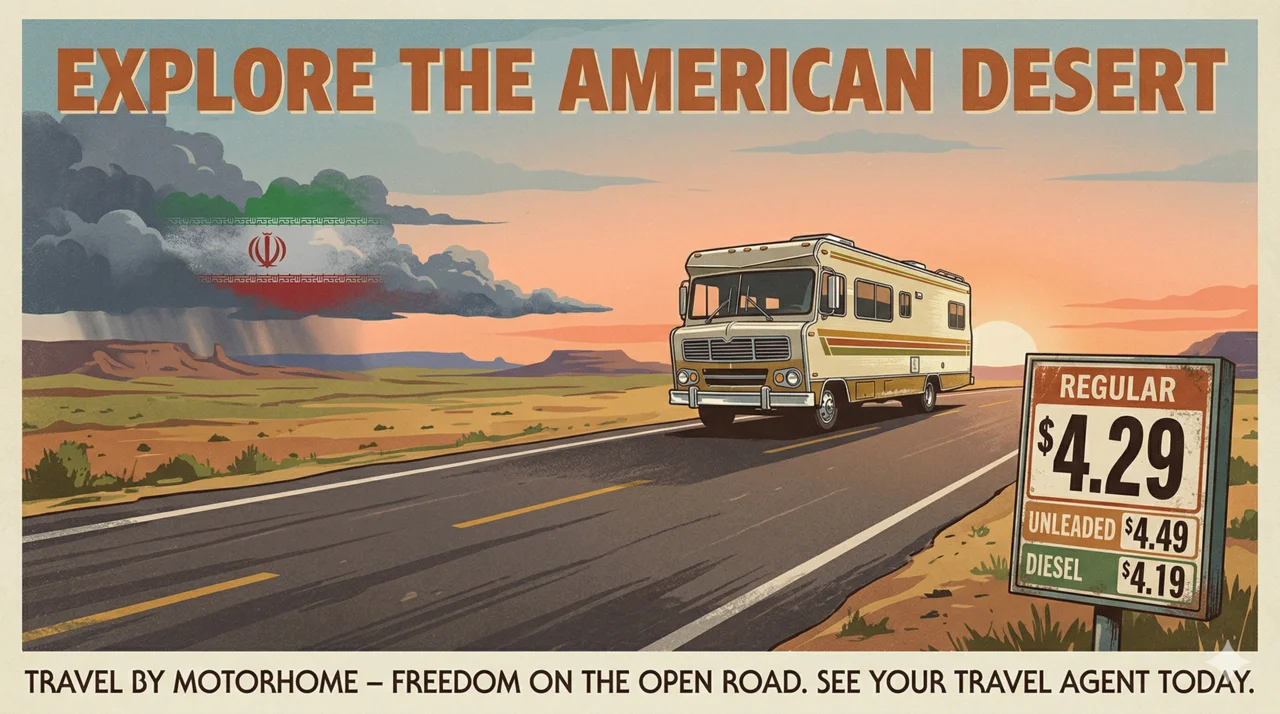
Now add oil. The current Iran conflict has pushed global oil prices up more than 25% since fighting intensified, with U.S. retail gasoline running above $4 a gallon — the highest since the 2022 Russia-Ukraine spike18. Morgan Stanley estimates that a 10% oil price increase driven by supply shock adds roughly 0.35 percentage points to U.S. headline CPI over three months, with real consumer spending declining two to three months afterward and staying depressed for another five to six. This matters disproportionately for Forest River because recreational vehicles average 7 to 14 miles per gallon. A Class A diesel motorhome burning 9 mpg on a 2,000-mile summer trip costs around $900 in fuel at $4 gas versus $675 at $3 — and it is the discretionary trip that marginal buyers cancel first when the fuel bill crosses a psychological line.
Now add financing. Recreational vehicles are among the most heavily financed discretionary purchases in the American economy; the buyer of a $70,000 fifth wheel typically puts 10% down and finances the rest over 15 to 20 years. As of April 2026, the average new RV loan rate is 7.53% and the average used RV loan rate is 7.69%, with the Federal Reserve holding the target range at 4.25–4.50% since December 202419. On a $65,000 financed balance over 180 months, 7.53% produces a monthly payment of roughly $603; at 4.50% (the pre-2022 norm) the same loan runs $497. That hundred-dollar-a-month gap is, empirically, the difference between a yes and a no for a large slice of the RV buyer base. Industry analysts at Statistical Surveys Inc. have concluded that financing costs correlate more strongly with registration trends than consumer confidence readings do — a striking finding, because consumer confidence is what the press writes about and what the Fed tracks20. As counter-intuitive as it sounds for a business selling vacation homes on wheels, Forest River is right now a pure interest-rate play.
| Macro factor | 2018 shock | 2026 shock | Forest River exposure |
|---|---|---|---|
| Steel/aluminum tariff | 25% (2018) | 50% + derivative 25% stack (2025–26) | Primary input cost14 |
| China parts tariff | ~25% (Section 301) | ~55% combined stack | Appliances, electronics, fixtures17 |
| US retail gasoline | ~$2.70/gal avg | >$4.00/gal (Iran shock) | Direct operating cost for owners18 |
| Fed funds rate | ~2.25% (peaked 2.50%) | 4.25–4.50% (held since Dec 2024) | Financing drives ~80%+ of sales19 |
| Typical new RV loan rate | ~5.5% | 7.53% | $100+/mo payment delta on $65K loan19 |
| Industry units (year) | 483K (2018) | 342K (2025) | Still ~30% below 2018 peak15 |
The silver lining, and it is a real one, is demographic. The RV buyer in 2025 is radically younger than the RV buyer of 2015. Median owner age has fallen from 53 in 2021 to 49 in 202521. Sixty-five percent of RV owners are now under 55 — a historic reversal for an industry whose marketing for decades assumed retirees. Millennials and Gen Z make up 61% of new campers; the average first-time buyer is 33 years old. An estimated 18 million Americans now describe themselves as "digital nomads," and KOA projects roughly a million new camping households in 2025 alone. This is the structural case that keeps RVIA's 2026 forecast pointing upward despite the macro picture, and it is the reason Gaeddert — who runs the towables division that sells disproportionately to younger, lower-income buyers — is the right Liegl successor for this moment.
It is also the reason Berkshire has not made a single noise about divesting Forest River, despite the timing that recently attached to ↗ other problematic holdings. A subsidiary with a twenty-year compounding track record, a cheap acquisition basis, a founder-quality successor, and a long demographic tailwind is not the business you sell into a cyclical trough. It is the business you ride through.
Conclusion
Forest River is the purest expression of the Berkshire acquisition model that still exists in the portfolio. Buffett paid a reasonable price to a founder who wanted a permanent home; left him entirely alone; watched him compound the business at double-digit rates for nineteen years; wrote him a warm eulogy when he died; and promoted the next guy from within. The interference from Omaha over that entire period, as best anyone can tell, consisted of signing the check and cashing the dividends.
What makes the next two years interesting is that every single macroeconomic tailwind Liegl rode — cheap steel, cheap financing, cheap fuel, low interest rates, pandemic cash, domestic tourism mandated by closed borders — has reversed. The tariff regime that cost Forest River a quarter of earnings in 2018 is back and twice as large. The Fed funds rate sits at a level that visibly prices out tens of thousands of marginal buyers. Gasoline has crossed $4. A new CEO, however deeply steeped in the culture, is running his first full business cycle without the founder in the next office. And the cheerful Omaha annual meeting, where Buffett has in the past named Forest River among his proudest acquisitions, is increasingly Abel's rather than Warren's to host.
None of which means Forest River will not do fine. The demographic case is real, the cost discipline is inherited, and the U.S. RV market has been declared dead more times than the permabears at Berkshire annual meetings. But the next time Forest River appears in the consumer-products line on Berkshire's quarterly earnings page, read the commentary carefully. If the decline is in earnings but not in market share, Gaeddert is playing the cycle correctly. If it is in both, the macro is winning — and for the first time in nineteen years, Berkshire will learn what happens when Forest River meets a headwind the founder did not design around. Pete Liegl's last joke, and it is a characteristic one, is that he left exactly one year before the storm.
References
-
2024 Annual Report — Chairman's Letter (Pete Liegl tribute) - berkshirehathaway.com ↩↩↩↩
-
Thor Industries FY2024 Net Sales and Competitive Context - finance.yahoo.com ↩↩
-
Forest River Announces CEO, CFO, Management Updates - rvbusiness.com ↩
-
Lawrence A. Cunningham, Berkshire Beyond Buffett, Columbia Univ. Press (Forest River chapter, pp. 155-157) - books.google.com ↩
-
Forest River Inc. — corporate history, founding, acquisition price - en.wikipedia.org ↩↩
-
RV Business, July 20, 2005 — Liegl comments on Berkshire acquisition - rvbusiness.com ↩
-
2005 Berkshire Annual Report — Forest River acquisition disclosure - berkshirehathaway.com ↩
-
2013 Berkshire Annual Report — Forest River $3.3B revenue, +24% YoY - berkshirehathaway.com ↩
-
Forest River Inc. — current brand portfolio - forestriverinc.com ↩
-
2018 Berkshire Annual Report — Forest River tariff impact, Q4 earnings -28% - berkshirehathaway.com ↩↩
-
2021 Berkshire Annual Report — Forest River +40.2% revenue, 13,457 employees - berkshirehathaway.com ↩
-
2022 Berkshire Annual Report — Forest River 42% market share peak - berkshirehathaway.com ↩
-
2023 Berkshire Annual Report — Forest River -26.2% revenue, interest-rate commentary - berkshirehathaway.com ↩
-
2025 Berkshire Annual Report — Forest River margin softness, employee count - berkshirehathaway.com ↩↩↩↩
-
RVIA — RV Shipments End 2025 with 342,220 Units; 2026 Forecast - rvia.org ↩↩
-
RVBusiness — Forest River Announces CEO/CFO Management Updates (Jan 2025) - rvbusiness.com ↩
-
How New Tariffs Are Shaping the RV Industry - gobastion.net ↩
-
Iran War Threatens Prolonged Impact on Energy Markets as Oil Prices Rise - aljazeera.com ↩
-
Bankrate — Current RV Loan Rates and Fed Funds Context (April 2026) - bankrate.com ↩
-
SSI — Top Five RV Industry Takeaways from 2025 - rvbusiness.com ↩
-
CSM Research — Generational Market Transformation, RV Demographics 2025 - csm-research.com ↩