Tags: Pilot / Earnings / Risk
This fanpage is not officially affiliated with Berkshire Hathaway: Disclaimer
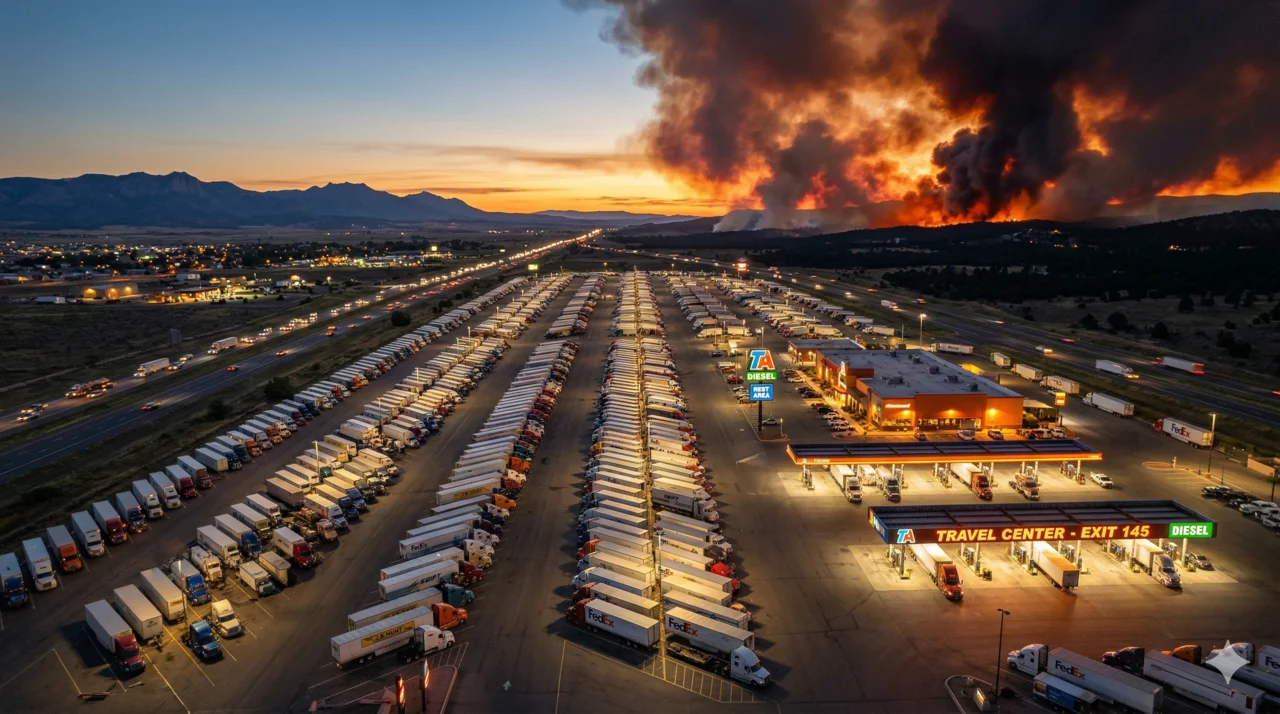
Pilot Travel Centers' 2025 was a disaster — pre-tax earnings collapsed 69% to just $190 million on $42.2 billion in revenue 1. Now the Iran war has sent diesel past $5 per gallon 2. For Berkshire's most troubled subsidiary, the oil spike is either a lifeline or the final blow. Greg Abel isn't hiding his frustration, and the numbers tell a story that every Berkshire shareholder needs to understand.
Introduction
When Berkshire Hathaway first invested in Pilot Travel Centers in 2017, Warren Buffett was buying into the largest truck stop network in North America at an enterprise value of roughly $7.1 billion 3. By the time Berkshire completed its full acquisition in January 2024, that valuation had ballooned to $13 billion for the final 20% stake — despite earnings that had already begun their downward slide 3. The math is uncomfortable: Berkshire paid up for a business that has since delivered diminishing returns.
Pilot's trajectory reads like a cautionary tale about commodity businesses. From peak pre-tax earnings of $2.33 billion in 2022 — a year when Russian sanctions and supply chaos sent diesel prices to the stratosphere — earnings have cratered in three consecutive years: $1 billion in 2023, $614 million in 2024, and now a paltry $190 million in 2025 134. That's a 92% decline from peak to trough in just three years.
And yet, there's a twist. The 2026 Iran war has unleashed the largest oil supply disruption in history, sending diesel prices surging 34% in under a month 2. For a company that sells approximately 16 billion gallons of fuel per year 3, even a penny per gallon in margin improvement translates to $160 million in additional profit. The question isn't whether the oil spike matters to Pilot — it's whether it matters enough to reverse a structural decline that goes far deeper than fuel prices.
Let us dig into the wreckage, and then the opportunity.
The 2025 Collapse: Anatomy of a 69% Earnings Decline
To understand Pilot's 2025, you have to understand what drove 2022's bonanza — and why it couldn't last. In 2022, the Russian invasion of Ukraine created extreme diesel price volatility. Wholesale prices swung wildly, and fuel retailers who could time their purchases and manage the wholesale-to-retail spread earned extraordinary margins. Pilot sold 18.4 billion gallons at fat spreads, generating $2.33 billion in pre-tax earnings on $72.7 billion in revenue 3.
By 2025, the world had normalized. The DOE/EIA average weekly retail diesel price settled at $3.65 per gallon, roughly 10 cents below 2024 levels 1. Lower prices meant lower revenue per gallon, thinner wholesale margins, and reduced fuel surcharge income from commercial customers. Revenue fell to $42.2 billion — down 10% from 2024's $46.9 billion and a staggering 42% from the 2022 peak 14.
But the revenue decline only tells part of the story. Berkshire's 2025 annual report attributed the earnings collapse to a toxic cocktail of margin compression and cost inflation:
- Lower wholesale fuel margins — the bread and butter of Pilot's business model eroded as diesel prices stabilized and competitive intensity increased
- Lower in-store gross margins — the convenience store side, which typically generates over 60% of gross profit at fuel retailers, also weakened 5
- Higher SG&A expenses — employee compensation, benefits, insurance, and maintenance costs all rose, squeezing profitability from the other direction
- Charges from fuel-related balance sheet adjustments — accounting write-downs that reflected the new reality of lower fuel values in inventory 1
The only bright spots were lower interest expense from reduced borrowing and some gains from asset dispositions 1. Cold comfort when your earnings have fallen 92% from their peak.
| Year | Revenue | Pre-Tax Earnings | Fuel Sold (Gallons) | Avg. Diesel Price |
|---|---|---|---|---|
| 2022 | $72.7B | $2.33B | 18.4B 3 | ~$5.50 |
| 2023 | $56.8B | ~$1.0B | 16.2B 3 | ~$4.20 |
| 2024 | $46.9B | $614M | ~16B (est.) | $3.75 1 |
| 2025 | $42.2B | $190M | ~16B (est.) | $3.65 1 |
There is, however, a number in Pilot's 2025 results that Berkshire would rather you focus on: $1.7 billion in net operating cash flow — actually an improvement over 2024 1. How does a company earning $190 million generate $1.7 billion in cash? Depreciation and amortization (which hit $832 million in 2023 alone 3), working capital changes, and reduced capital expenditure all contribute. Abel has signaled that as "operations continue to strengthen and capital needs normalize, we expect more cash to be returned to Berkshire" 1. Translation: the asset is throwing off cash even if the income statement looks terrible.
The Iran Oil Spike: Diesel at $5 and Climbing
On February 28, 2026, U.S.-Israeli airstrikes against Iran triggered the closure of the Strait of Hormuz, through which roughly 20% of global oil supplies had been flowing 2. The result was what CNBC described as "the biggest oil supply disruption in history" ↗.
For diesel — the lifeblood of Pilot's business — the impact was immediate and dramatic. U.S. diesel prices surged from roughly $3.90 per gallon to $5.04 by mid-March, a 34% increase and the fastest four-week pace of increase ever recorded 26. By late March, prices in some regions were approaching $5.30-$5.40, with California hitting $7.07 and Seattle at $6.67 6. Brent crude had spiked from the low $70s to over $100 per barrel, a 40%+ jump 2.
For Pilot, this creates a deeply ambiguous situation. The conventional wisdom says higher fuel prices are good for truck stops — more revenue per gallon, fatter dollar-denominated margins, more fuel surcharge income. But the reality is far more nuanced.
The bull case: When diesel prices spike rapidly, fuel retailers can sometimes capture wider spreads between their wholesale acquisition cost and the retail pump price. Pilot's AI-powered fuel pricing system, developed with Infor Coleman machine learning, achieves 99.99% fuel margin accuracy and is designed to optimize exactly this kind of volatile pricing environment 7. The system analyzed 36 months of historical data and is projected to generate an additional $750,000 per year in margin improvements — modest in absolute terms, but a sign that Pilot is investing in the kind of technology that separates winners from losers in commodity retail 7.
The bear case: Research consistently shows that during rapid price spikes, retail fuel margins actually compress because stations are reluctant to pass through wholesale increases too quickly for fear of losing customers 5. The windfall from oil price spikes accrues primarily to upstream producers and refiners, not retail fuel stations 5. Pilot's 2023 experience confirmed this — when oil prices were volatile but trending downward, wholesale margins shrank dramatically.
The wildcard: Volume. At $5+ per gallon, demand destruction becomes a real threat. U.S. diesel volume at fuel retailers was already down approximately 3% year-over-year in the October 2025 to February 2026 period, before the Iran spike 8. ACT Research's Trucking Volume Index hit a four-year high in February 2026, partly driven by a January winter storm creating freight backlogs 9. But ACT's own analysts warned that higher oil prices have "effectively negated any tariff benefit to consumers" and could slow economic and freight volume growth 9.
Abel's Frustration and the Structural Challenge
Greg Abel's comments about Pilot in his first annual letter as CEO were notably blunt for a company that normally wraps operational disappointments in diplomatic language. His most revealing line: "We first invested in Pilot in 2017, however, our ability to manage it was contractually delayed until 2023. That mistake will not happen again" 1 ↗.
That's a remarkable admission. Abel is essentially saying that Berkshire overpaid for a business it couldn't control, and by the time it gained full management authority, the business had already deteriorated significantly. The valuation history confirms this: the $19.8 billion enterprise value implied by the 2023 purchase had shrunk to $13 billion by the 2024 final acquisition — a $6.8 billion destruction of value in a single year 3.
The structural challenge goes beyond fuel prices. Pilot's cost base has inflated significantly:
- Employee headcount stands at roughly 29,300, up 100 from the prior year 1
- Depreciation and amortization hit $832 million in 2023, nearly double the $436 million in 2022, reflecting the heavy capital investment required to modernize 675 travel centers 3
- Interest costs peaked at $437 million in 2023 (nearly double 2022's $224 million), though these have since declined as Berkshire reduced borrowing 3
On the positive side, Pilot's operational improvements are real. The Pro Preference Score — a third-party measure of professional driver satisfaction — rose to 35% in 2025, up from 27% in 2022, making Pilot the second-ranked network in the industry 1. Top 10 customer concentration remains at just 10% of diesel volume 1, suggesting a well-diversified customer base. And the 94 unconsolidated joint venture operations provide additional reach without the capital intensity of full ownership 1.
The trucking industry itself is at a peculiar inflection point. The ACT Capacity Index has been in neutral-to-contraction territory for 11 consecutive months at 48.0 in February 2026 9. Carriers are exiting, private fleets are shrinking, and FMCSA enforcement actions targeting nondomiciled CDL drivers are further constraining supply 9. This is actually bullish for Pilot in the medium term — fewer carriers means the survivors drive more miles and consume more fuel. But in the short term, the Iran-driven diesel spike threatens to accelerate carrier exits by crushing margins for small fleets that can't pass through fuel surcharges fast enough.
| Iran War Impact | Pre-War (Feb 2026) | Post-War (Mar 2026) | Change |
|---|---|---|---|
| U.S. Diesel Price | ~$3.90/gal | $5.04-$5.37/gal | +34-38% 26 |
| Brent Crude | ~$67-73/bbl | $100-$120/bbl | +42-65% 2 |
| Diesel Volume (YoY) | -3% | TBD (likely worse) | Demand destruction risk 8 |
| Trucking Capacity Index | 48.0 (contraction) | Under pressure | Carrier exits accelerating 9 |
| Fuel Cost % of Fleet Ops | 30-40% | Rising sharply | Margin squeeze on truckers 10 |
The $160 Million Question: Does a Penny Per Gallon Matter?
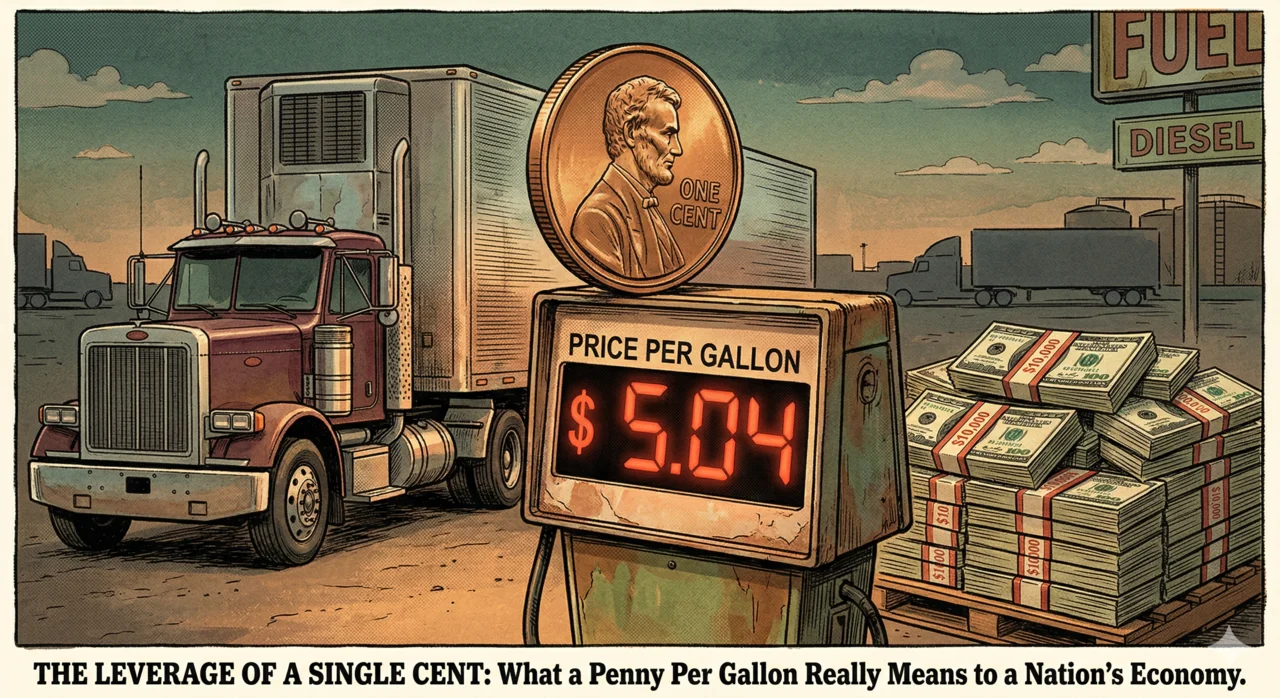
Here's the math that keeps Pilot interesting despite the grim earnings trend. The company sells roughly 16 billion gallons of fuel per year 3. At that volume, even tiny margin improvements have enormous earnings leverage:
- +1 cent/gallon = $160 million additional pre-tax profit
- +2 cents/gallon = $320 million — nearly doubling 2025's entire pre-tax earnings
- +5 cents/gallon = $800 million — returning to 2023-level profitability
This is both the promise and the curse of Pilot's business model. The upside from volatile fuel markets is real and enormous. But so is the downside — a 1 cent margin compression wipes out almost an entire year's earnings at 2025 levels.
The Iran war creates conditions that could widen Pilot's margins. Fuel retailers generally earn wider percentage-based margins when absolute prices are high, even if cents-per-gallon margins compress during the initial spike 5. Once prices stabilize at a new, higher level — as they appear to be doing in the $5.00-$5.40 range — retailers can normalize their spreads and earn more on each gallon. Pilot's AI pricing system is specifically designed to capture these micro-opportunities 7.
Moreover, Pilot's non-fuel revenue could benefit. Higher diesel prices mean truckers spend more time at truck stops while waiting for loads (slower velocity = more dwell time = more food, coffee, and shower purchases). The 675 travel centers with full amenities are positioned to capture this ancillary spending — historically about 60% of convenience store gross profit at fuel retailers 5 ↗.
But the demand destruction risk is the elephant in the room. The Washington Post reported that fuel costs now represent 30-40% of total fleet operating costs, and the diesel spike threatens to "batter the nation's truckers and farmers" 10. At $5+ diesel, marginal carriers — the small owner-operators who are already barely profitable — will park their trucks. The IRU (International Road Transport Union) noted that EU diesel prices have risen 20%, with Spain at EUR 1.79/liter and Ireland at EUR 2.30/liter, threatening global freight flows 6. If trucking volumes decline materially, Pilot's gallon count drops, and no amount of margin improvement can compensate.
Conclusion
Pilot Travel Centers enters the Iran oil crisis as Berkshire Hathaway's most vulnerable subsidiary — and paradoxically, the one with the most to gain from volatile fuel markets. The 69% earnings collapse in 2025 was a structural problem, not just a cyclical one: rising costs, compressed margins, and a business model that needs either high prices or high volatility to generate outsized returns 1.
The Iran war provides volatility in spades. Diesel at $5+ per gallon creates conditions where Pilot's AI-optimized pricing, massive scale (675 locations, 16 billion gallons), and operational improvements could translate a few cents of margin into hundreds of millions in earnings. The $1.7 billion in operating cash flow proves the business generates real economic value even in a terrible earnings year 1.
But Abel isn't betting Berkshire's reputation on a war-driven commodity spike. His blunt admission about the 2017 deal structure — "that mistake will not happen again" — signals a leader focused on structural fixes, not hoping for favorable fuel markets 1. The Pro Preference Score improvements, the reduced borrowing costs, and the AI pricing investments are the quiet work of a management team trying to build a business that can earn through-cycle returns regardless of what diesel costs.
For Berkshire shareholders, Pilot is the subsidiary that tests your faith in the conglomerate model. In 2022, it generated $2.33 billion and looked like a masterstroke. In 2025, at $190 million, it looks like a mistake ↗. The truth, as with most Berkshire investments, probably lies in the decade ahead — and in whether Greg Abel can do what Buffett's contractual constraints prevented: turn America's largest truck stop network into a consistent earner worthy of the Berkshire name.
The Iran war won't save Pilot. But it might buy Abel the time and the capital to save it himself.
References
-
Pilot's 2025 Profits Plunge Despite Strong Cash Flow - freightpulse.us ↩↩↩↩↩↩↩↩↩↩↩↩↩↩↩↩
-
Diesel prices surge to $5 per gallon as Iran war disrupts global oil supplies - www.cnbc.com ↩↩↩↩↩
-
Pilot's drop in profits led to lower valuation in final Berkshire purchase - www.freightwaves.com ↩↩↩↩↩↩↩↩↩↩
-
Pilot had weaker performance in '25: Berkshire letter - finance.yahoo.com ↩↩
-
Oil Price Fluctuations and Fuel Margin Risk - www.mostedge.com ↩↩↩↩↩
-
War in Iran: fuel prices remain high and volatile - www.iru.org ↩↩↩
-
Pilot Flying J Uses AI to Boost Fuel Margin Accuracy - csnews.com ↩↩↩
-
Tracking retail fuel trends: February 2026 - www.upside.com ↩
-
ACT: Trucking Volumes Rise, Capacity Tightens as Fuel Prices Cloud Outlook - www.truckinginfo.com ↩↩↩↩
-
Lasting surge in diesel prices would batter nation's truckers, farmers - www.washingtonpost.com ↩