Tags: Risk / Earnings / BHE
This fanpage is not officially affiliated with Berkshire Hathaway: Disclaimer
Less than three months into Greg Abel's tenure as CEO, the 2026 Iran war is delivering a real-time stress test across Berkshire Hathaway's empire. From a $2 billion energy windfall to soaring marine insurance rates and fuel price shocks rippling through BNSF, Pilot, and GEICO, every major subsidiary feels the tremors. Here is how each pillar of Berkshire is navigating the crisis — and why the conglomerate may emerge stronger than ever.

Introduction
On February 28, 2026, joint U.S.-Israeli airstrikes against Iran triggered what the International Energy Agency called the "largest supply disruption in the history of the global oil market" 1. Within days, Gulf oil production collapsed by at least 10 million barrels per day, Brent crude surged from roughly $64 to $120 per barrel, and the S&P 500 shed 4.55% 12. U.S. gasoline prices jumped 32% in three weeks, from $2.98 to $3.93 per gallon 1.
For Berkshire Hathaway, with its sprawling empire of energy assets, insurance operations, railroads, and truck stops, the question isn't whether the war matters — it's how much and for whom. The timing is especially poignant. Greg Abel officially succeeded Warren Buffett as CEO on January 1, 2026 ↗, inheriting a $1 trillion market cap company with $373 billion in cash and a portfolio of businesses designed — whether by genius or luck — to thrive in exactly this kind of chaos 34.
As Buffett himself said in a 2014 CNBC interview: "If we went into some very major war, the value of money would go down... The last thing you'd want to do is hold money during a war. You're going to be a lot better off owning productive assets" 5. Abel now gets to prove that Berkshire's productive assets are as war-proof as advertised.
Let us walk through the empire, subsidiary by subsidiary.
The Energy Windfall: Chevron, Occidental, and Cove Point
If there is one corner of Berkshire's portfolio that is cheering the crisis (in strictly financial terms), it is the energy book. Buffett spent years building massive positions in oil — and the Iran war has turned those bets into a bonanza.
Chevron, in which Berkshire holds approximately 130 million shares worth around $26 billion, has surged 33.5% year-to-date 6. Buffett added 8.09 million shares in Q4 2025, just weeks before the conflict erupted 6. Chevron's break-even sits near $50 per barrel; at $100 WTI, per-barrel profits roughly double compared to the $70 environment of late 2025. The company reported record 2025 operating cash flow of $33.9 billion 6.
Occidental Petroleum tells an even more dramatic story. Berkshire holds roughly 265 million shares (~29% of the company), and OXY is up 46.1% year-to-date 67. Add in the $9.7 billion OxyChem acquisition that closed on January 2, 2026 — structured when WTI was a modest ~$55 — and you have textbook Buffett timing 7. Financial media attributes a combined ~$2 billion portfolio gain to the conflict-driven oil spike alone 6.
Then there's the quieter gem: Cove Point LNG, BHE's 75% stake in a Maryland-based LNG export terminal ↗. With European natural gas prices nearly doubling to over EUR 60/MWh and Gulf LNG transit (20% of global supply) severely disrupted, Cove Point sits in a privileged position 1. Its capacity is fully subscribed under 20-year take-or-pay contracts with Sumitomo and GAIL India 8, providing stable revenue while the energy scarcity narrative pushes up the strategic value of every molecule of American LNG.
| Energy Asset | BRK Stake | YTD Performance | Iran War Impact |
|---|---|---|---|
| Chevron (CVX) | ~130M shares (~$26B) | +33.5% | Doubled per-barrel margins above $100 WTI 6 |
| Occidental (OXY) | ~265M shares (~29%) | +46.1% | Permian assets = strategic domestic supply 7 |
| Cove Point LNG (BHE) | 75% | N/A (private) | LNG scarcity; long-term contracts lock in revenue 8 |
| Combined portfolio windfall | — | — | ~$2 billion estimated gain 6 |
The Subsidiary Stress Test: BNSF, Pilot, GEICO, and Insurance
Beyond the energy portfolio, the Iran war sends shockwaves through Berkshire's operating companies in ways both obvious and subtle.
BNSF Railway enters the crisis from a position of strength. Full-year 2025 revenue was $23.4 billion with after-tax earnings of $5.5 billion — up 8.8% despite flat volumes 9. The railroad had actually benefited from lower fuel prices in 2025, which reduced its own costs. Now the calculus reverses: higher diesel prices increase BNSF's fuel expense, but the railroad passes these through via fuel surcharges to shippers. In 2025, falling fuel prices had been a headwind to surcharge revenue 9. The Iran spike should reverse that dynamic, boosting top-line revenue even as underlying freight demand faces uncertainty. BNSF's $3.6 billion capital program for 2026 signals Abel's confidence in the long game 9 ↗.
Pilot Travel Centers is where the plot thickens. After a brutal 2025 — revenue down to $42.2 billion, pre-tax earnings cratering 69% to just $190 million — the Iran oil shock is a double-edged sword 10. Higher diesel prices should boost top-line revenue (Pilot sells approximately 16 billion gallons per year), and fuel margins tend to expand in volatile environments. But sustained $5+ diesel could suppress trucking miles, and Pilot's 2023 experience showed that extreme price volatility can compress wholesale margins unpredictably 10 ↗. For Abel, Pilot is the subsidiary where the Iran war could either catalyze a recovery or deepen the earnings hole.
GEICO stands to benefit modestly. Higher gasoline prices historically reduce miles driven, which lowers claim frequency — a welcome tailwind for an insurer whose bodily injury severity surged 12-14% in 2025 11. GEICO's 2025 pretax underwriting profit was $6.8 billion on a combined ratio of roughly 84.7% — excellent, but down from a historic-best 81.5% in 2024 as the company reinvested aggressively in advertising and technology 11 ↗. A reduction in driving activity could ease the claims pressure, though repair cost inflation from a broader economic disruption could offset the gain.
The reinsurance operations (BHRG and Gen Re) present the most nuanced picture. Standard property/casualty reinsurance policies contain war exclusion clauses, limiting direct loss exposure 12. But the real story is in specialty lines. Marine hull war risk premiums have surged fivefold — from 0.2% to over 5% of vessel value in extreme cases 1213. Five major P&I clubs have cancelled Persian Gulf coverage entirely 13. Aviation war risk is severely constrained, with over 4,000 daily flight cancellations 12. For Berkshire's reinsurers, this is opportunity knocking: hardening specialty rates create a chance to deploy capital at attractive prices. But Abel has signaled discipline, noting that Berkshire "will write less property and casualty business for a period of time" given the soft broader market 14. The question is whether the Iran war hardens rates enough to make Abel reach for the pen.
| Subsidiary | FY 2025 Earnings (After-Tax) | Iran War Direction | Key Mechanism |
|---|---|---|---|
| BNSF | $5.5B 9 | Neutral to positive | Fuel surcharge pass-throughs offset cost increases |
| Pilot Travel Centers | $190M pretax 10 | Mixed | Revenue boost from higher prices; volume risk if economy slows |
| GEICO | $6.8B pretax 11 | Slightly positive | Reduced driving → fewer claims; offset by repair cost inflation |
| BHRG / Gen Re | $1.9B pretax 14 | Opportunity | War exclusions limit losses; specialty rates hardening dramatically |
| BHE (total) | $4.0B 4 | Moderate positive | Cove Point LNG, pipeline throughput, energy scarcity narrative |
Abel's War Chest: $373 Billion and the Buffett Playbook
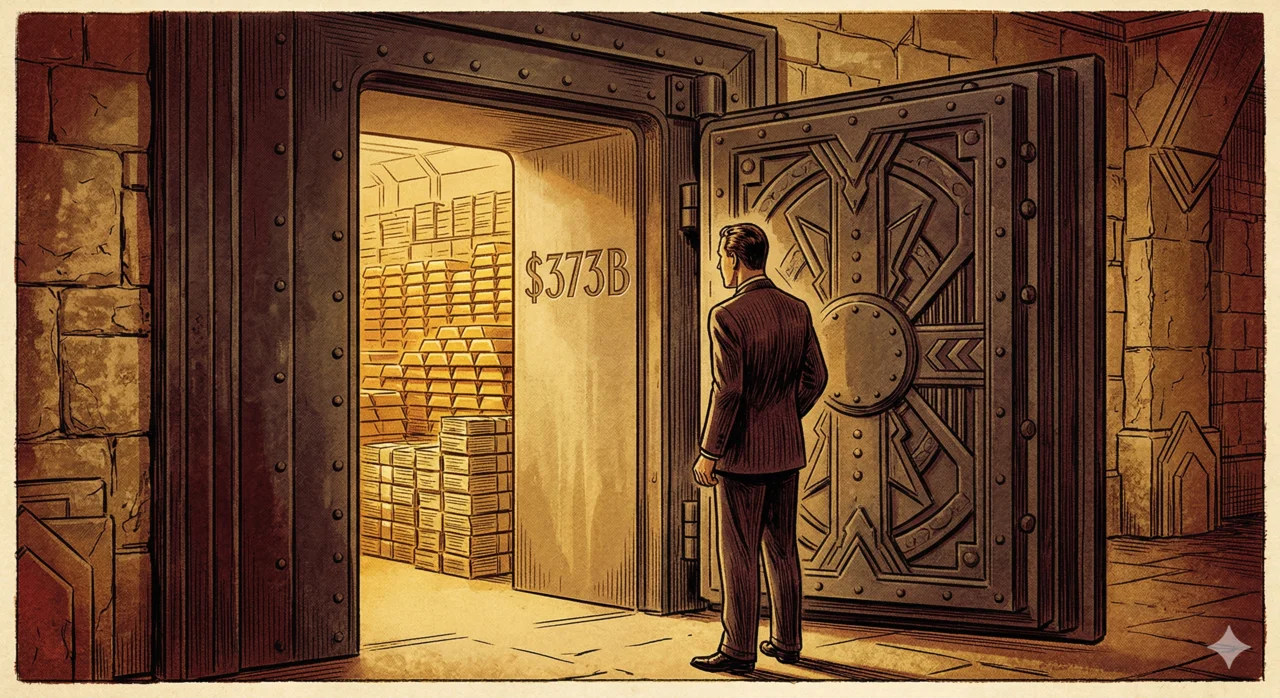
Perhaps the most powerful weapon in Berkshire's arsenal isn't any single subsidiary — it's the $373 billion cash pile 3. To put that in perspective, it exceeds the market capitalization of 477 of the 500 S&P 500 companies 3. In a war-driven downturn, while competitors scramble for liquidity, Abel can go shopping.
He's already signaling willingness to act. In March 2026, Berkshire announced a $1.8 billion investment in Tokio Marine, Japan's premier property-casualty insurer 3. Abel also resumed share buybacks for the first time since mid-2024 and invested $15 million of his own money into Berkshire stock 3 — a personal vote of confidence that echoes Buffett's famous conviction.
Historically, Berkshire has thrived during geopolitical crises. During the Gulf War, the 2008 financial crisis, and the COVID panic, Buffett deployed capital aggressively when others were paralyzed by fear. His famous dictum — "Be fearful when others are greedy, and greedy when others are fearful" — is the operational playbook Abel inherited 5. The Iran war, for all its human tragedy, may provide exactly the kind of market dislocation that unlocks Berkshire's next great deal.
The consolidated picture reinforces this resilience. FY 2025 total operating earnings came in at $44.5 billion (down 6.2% from 2024's $47.4 billion), with shareholders' equity at $719.7 billion and total assets of $1.22 trillion 4. Insurance float — essentially free money that funds investments — reached $176 billion 4. Even a sustained oil shock and modest recession would barely dent this fortress.
| Berkshire Consolidated | FY 2025 | FY 2024 | Change |
|---|---|---|---|
| Operating Earnings | $44.5B | $47.4B | -6.2% 4 |
| Cash & T-Bills | $373B | $334B | +$39B 3 |
| Insurance Float | $176B | $171B | +$5B 4 |
| Shareholders' Equity | $719.7B | $651.6B | +10.4% 4 |
| Equity Portfolio | $297.8B | $272B | +9.5% 4 |
Conclusion
The 2026 Iran war is Greg Abel's baptism by fire — and so far, the conglomerate is performing as designed. The energy portfolio is generating billions in windfall gains. The insurance empire's war exclusions limit downside while creating opportunities in hardening specialty markets. The railroad and truck stops face mixed but manageable headwinds. And the $373 billion cash fortress stands ready to pounce on whatever dislocations the crisis creates.
If anything, the conflict highlights why Buffett built Berkshire the way he did: a diversified, cash-rich, counter-cyclical machine that can absorb shocks others cannot survive. Abel's early moves — the Tokio Marine investment, the resumed buybacks, the personal stock purchase — suggest he understands the playbook and intends to follow it.
As Buffett told shareholders in 2020: "Never bet against America" 5. With the largest cash pile in corporate history, the largest insurer by float, and energy assets that profit from the very crisis that terrifies the market, Berkshire Hathaway under Greg Abel may be the ultimate stress-test survivor. The Iran war is not Abel's burden — it's his audition. And so far, the reviews are favorable.
References
-
Economic impact of the 2026 Iran war - en.wikipedia.org ↩↩↩↩
-
Stock market today: Dow drops 800 points as Iran war escalates - www.cnbc.com ↩
-
All the highlights from Berkshire CEO Abel's first shareholder letter - www.cnbc.com ↩↩↩↩↩
-
Berkshire Hathaway Inc. Reports FY 2025 Results (8-K) - www.stocktitan.net ↩↩↩
-
Buffett's War-Time Investing Philosophy Is Playing Out in Real Time - 247wallst.com ↩↩↩
-
Warren Buffett Bought 8 Million Shares of This Oil Stock - www.fool.com ↩↩↩↩↩
-
Occidental Petroleum Is Up 9% Since the Iran Conflict - www.fool.com ↩↩
-
Nervous About the Oil Crisis? This Market-Crushing Stock Has You Covered - www.fool.com ↩
-
For BNSF, 2025 Revenue, Volume Flat - www.railwayage.com ↩↩↩
-
Pilot's 2025 Profits Plunge Despite Strong Cash Flow - freightpulse.us ↩↩
-
GEICO Ends 2025 With $6.8 Billion Profit - coverager.com ↩↩
-
War with Iran: Implications for the Insurance Market - www.kennedyslaw.com ↩↩↩
-
Maritime Insurers Cancel War Risk Cover in Persian Gulf - www.insurancejournal.com ↩↩
-
Berkshire Hathaway Expects to Write Less Premium: Abel - www.artemis.bm ↩