Tags: BHE / Risk / ESG
This fanpage is not officially affiliated with Berkshire Hathaway: Disclaimer
We have written about PacifiCorp's wildfire troubles before — first when the accruals started piling up in late 2023 ↗, then in the context of BHE's valuation in 2025 ↗. Back then, the picture was murky: a few jury verdicts, a growing reserve line, and a lot of uncertainty. Now, two years into the litigation cycle, we have a much clearer picture — and it is both more alarming and, as of April 2026, slightly more hopeful than the early indicators suggested.
Introduction
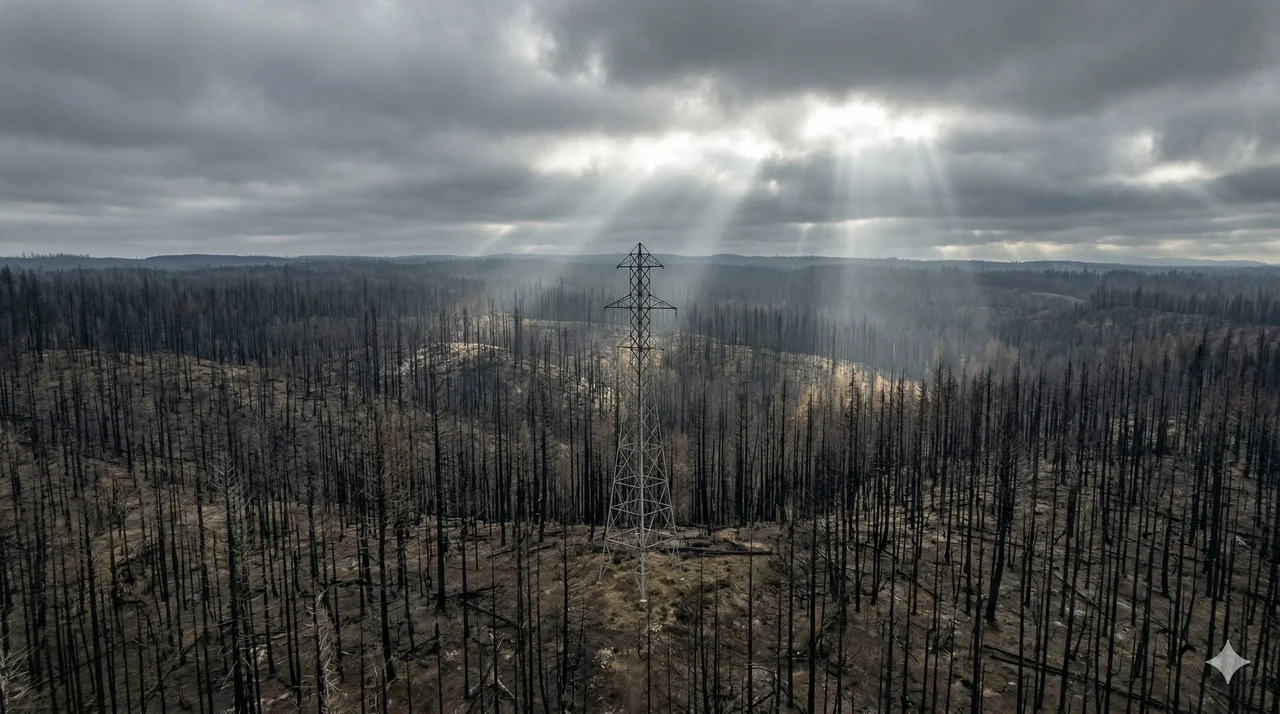
On September 7, 2020, a historic windstorm swept across Oregon and Northern California. Sustained winds exceeding 50 mph toppled trees onto power lines, snapped poles, and scattered embers across bone-dry forests already weakened by a record drought. The resulting fires burned over 500,000 acres and destroyed more than 2,000 structures1. PacifiCorp — the regulated utility subsidiary that Berkshire Hathaway Energy acquired in 2006 for $5.1 billion in cash plus $4.3 billion in assumed debt2 — found itself at the center of the worst utility-wildfire litigation since PG&E's 2019 bankruptcy.
What followed has been a slow-motion financial earthquake. Cumulative wildfire reserves have reached $2.85 billion3. Settlements have consumed $2.2 billion4. The company's insurance — just $530 million, all exhausted before 2024 — covered a fraction of the damage3. And looming over everything: approximately $50 billion in outstanding claims from roughly 1,700 remaining plaintiffs in the James class action3.
Then, on April 8, 2026, the Oregon Court of Appeals overturned the foundational class action verdicts. It was the first genuine good news PacifiCorp had received in three years of litigation. But is it enough?
The Scoreboard: Where Things Stand
Let's start with the numbers. The financial toll through December 31, 2025, as reported in Berkshire's 10-K, tells a story of escalating then stabilizing reserves:
| Year | Pre-tax Wildfire Accrual | Cumulative Reserves | Key Event |
|---|---|---|---|
| 2022 | $64M | ~$500M | McKinney Fire (CA); early Oregon filings |
| 2023 | $1,900M | ~$2,400M | First jury verdict ($92M); mass claims filed5 |
| 2024 | $346M | ~$2,750M | Damages trials begin; $3.8B bond issuance6 |
| 2025 | $100M | ~$2,850M | $150M bulk settlement; $575M federal deal3 |
The declining annual accruals look reassuring — $1.9 billion in 2023 falling to $100 million in 2025. But accruals reflect management's estimate of probable losses. The gap between what PacifiCorp has reserved ($2.85 billion) and what plaintiffs are claiming ($50 billion) is not a rounding error. It is a philosophical disagreement about what this company owes.
On the settlement side, PacifiCorp has been methodically working through the docket. The $575 million federal settlement in February 2026 resolved all known government claims across six fires — the 242 Fire, Archie Creek, Echo Mountain Complex, and South Obenchain in Oregon, plus the Slater and McKinney fires in California7. A separate $150 million bulk settlement in November 2025 resolved claims from 1,434 individual plaintiffs at roughly $107,000 per person8. Combined with earlier settlements, PacifiCorp reports total payouts of approximately $2.2 billion4.
But the James class action — the big one — remains very much alive.
The James Case: Anatomy of an Existential Lawsuit
The James v. PacifiCorp class action, filed on September 30, 2020, is the case that could break PacifiCorp. It aggregates claims from the 2020 Labor Day fires into a single proceeding in Multnomah County, Oregon. The June 2023 jury verdict found PacifiCorp grossly negligent, reckless, and guilty of willful trespass — and awarded $92 million to just 17 plaintiffs3.
That verdict unlocked the floodgates. As of December 2025, approximately 1,760 mass complaints have been filed, with roughly 1,700 individual plaintiffs still in active litigation3. Each mass complaint specifies $5 million in economic damages and $25 million in noneconomic damages, plus punitive claims. Oregon law permits doubling of economic damages for gross negligence and trebling for willful trespass3. The theoretical maximum — if every remaining plaintiff received full damages — exceeds $48 billion.
No one expects full theoretical damages. But the actual jury verdicts have been severe enough to keep PacifiCorp's management awake at night:
| Trial | Date | Plaintiffs | Award per Plaintiff | Total |
|---|---|---|---|---|
| First liability trial | June 2023 | 17 | ~$5.4M avg | $92M3 |
| Damages trial #1 | Jan 2024 | 9 | $4.5–8.5M | ~$58M9 |
| Damages trial #2 | Mar 2024 | 10 | $1.75–3.5M | ~$26M9 |
| Trial #15 | Feb 2026 | 16 | ~$19M | $305M10 |
| Aggregate through Dec 2025 | ~$738M (109 plaintiffs)3 | |||
The average across all completed trials: roughly $6.8 million per plaintiff. PacifiCorp has posted $606 million in supersedeas bonds to stay execution of these judgments while appeals proceed — bonds that accrue 9% annual interest under Oregon law3.
Here is the math that haunts BHE's balance sheet: 1,700 remaining plaintiffs multiplied by $6.8 million equals $11.6 billion. Against PacifiCorp's shareholders' equity of approximately $9–10 billion11. Even at the lower end of the damages range, the arithmetic does not work.
The April Reprieve
On April 8, 2026, a three-judge panel of the Oregon Court of Appeals delivered PacifiCorp's first significant legal victory. The court reversed the foundational James class action verdicts, finding that the trial court erred by allowing jurors to "assume that the evidence in the trial applies to all class members" when the lawsuit combined claims from four separate fires in different locations12.
The ruling was procedural, not exonerative. The court did not say PacifiCorp was not negligent. It said the lower court improperly treated four distinct fire events — the 242 Fire, Echo Mountain Complex, South Obenchain, and the Santiam Canyon fires — as a single unified case. This matters enormously because the Santiam Canyon claims rest on the weakest factual foundation. The Oregon Department of Forestry's final report, released in March 2025, concluded that embers from the pre-existing Beachie Creek Fire — a lightning-sparked fire that began on August 16, 2020 — caused 12 fires within the Santiam Canyon. The ODF found that "PacifiCorp's power lines did not contribute to the overall spread of fire into the Santiam Canyon"3.
The practical impact: over $1 billion in damage awards overturned. More than 160 damages trials that were scheduled through 2027 could be paused or restructured12. If the case is remanded for separate trials per fire — the likely outcome — PacifiCorp's exposure on the Santiam Canyon claims could shrink dramatically.
But the Archie Creek, Echo Mountain, and South Obenchain claims remain on solid ground for plaintiffs. And Oregon's plaintiffs' bar is already signaling an appeal to the Oregon Supreme Court12. The reprieve is real, but it is not a resolution.
When Companies Burn: The Bankruptcy Precedents
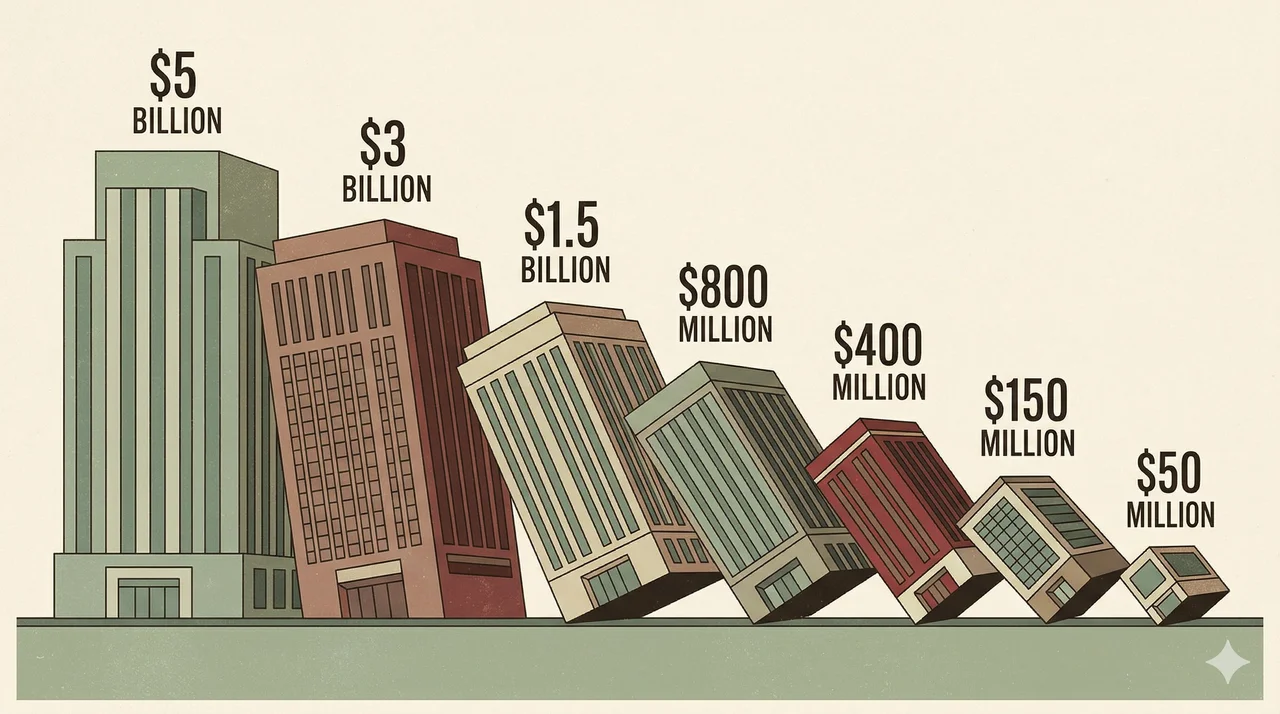
PacifiCorp's predicament is not without precedent. Several major corporations have faced tort liabilities that threatened or achieved their destruction. The parallels are instructive — and sobering.
PG&E — the direct ancestor. Pacific Gas & Electric filed for Chapter 11 on January 29, 2019, after its equipment was linked to a series of California wildfires from 2015 to 2018, including the Camp Fire that killed 85 people13. PG&E's total liability resolution: $25.5 billion — $13.5 billion to fire victims, $11 billion to insurers and subrogation funds, and $1 billion to government entities13. The critical legal difference: California operates under "inverse condemnation," a strict-liability doctrine that holds utilities responsible for any wildfire damage caused by their equipment regardless of negligence. Oregon, by contrast, uses a negligence standard — PacifiCorp was actually found not liable under inverse condemnation14. Yet the negligence verdicts alone have produced an exposure trajectory that rivals PG&E's.
Johns-Manville — the asbestos template. The world's largest asbestos products manufacturer filed Chapter 11 in August 1982 with 12,500 lawsuits pending and new suits arriving at 425 per month15. Johns-Manville's bankruptcy created the Section 524(g) trust model that has since been used in dozens of mass tort resolutions. In a twist that Berkshire shareholders may find grimly ironic, Johns-Manville eventually became a Berkshire subsidiary — Berkshire acquired the reorganized company in 2001. The asbestos wave ultimately bankrupted more than 100 companies, including W.R. Grace (filed 2001, emerged 2014), Owens Corning, Federal-Mogul, Armstrong, and USG15.
BP Deepwater Horizon — survival by scale. The 2010 Gulf oil spill cost BP approximately $69 billion in total, including an $18.7 billion federal and state settlement and over $12 billion in private claims16. BP's share price fell 55% and the company briefly teetered on genuine bankruptcy risk. It survived because it had $250 billion in assets and robust cash flow from global oil production. The lesson: scale is the ultimate bankruptcy shield — a lesson that has obvious implications for PacifiCorp's relationship with its parent.
Purdue Pharma and Takata round out the gallery. Purdue filed in 2019 under the weight of opioid litigation; Takata's U.S. subsidiary filed in 2017 after its defective airbags killed dozens and triggered a $1 billion criminal penalty17. Both companies were ultimately sold or dissolved. Neither had a parent with $373 billion in cash.
The pattern across all these cases: mass tort liability can destroy even large, profitable companies. The variable that determines survival is not legal merit — it is financial capacity to absorb the losses while the legal process grinds forward. Which brings us back to Berkshire.
The Berkshire Backstop — and Its Limits
PacifiCorp is not a standalone company. It sits inside Berkshire Hathaway Energy, which sits inside Berkshire Hathaway, which as of year-end 2025 held $373.3 billion in cash and Treasury bills4. The implicit assumption in the bond market — the reason PacifiCorp can still issue investment-grade debt — is that Berkshire would not allow a subsidiary of BHE to default.
But that assumption is being tested. S&P downgraded PacifiCorp to BBB- in November 2025, one notch above junk18. Moody's cut the company to Baa2, with preferred stock already at Ba1 — junk territory19. Barclays identified "significant and increased risks" to PacifiCorp's cash position, while JPMorgan sees "more risk to the downside" on PacifiCorp corporate bonds18. In its November 2025 quarterly filing, PacifiCorp itself warned of a potential "liquidity crisis" and stated it "may have insufficient liquidity to support ongoing operations" if downgraded below investment grade20.
The structural vulnerability runs deeper than PacifiCorp. BHE's capital structure features a cross-default provision: a PacifiCorp default would trigger acceleration of approximately $21 billion in publicly-traded BHE senior notes11. This is the mechanism by which a subsidiary wildfire problem could metastasize into a holding-company crisis. PacifiCorp's dividend to BHE has already been suspended for "several years"3.
To fund settlements, PacifiCorp issued $3.8 billion in first mortgage bonds in January 2024 at rates between 5.10% and 5.80%6 — investment-grade pricing that reflects the market's bet on Berkshire's implicit support. Without that bet, PacifiCorp's borrowing costs would be dramatically higher, and the settlement math would be correspondingly worse.
The BHE valuation story tells the tale in a single data point: Greg Abel purchased a 1% BHE stake in 2022 at an implied $87–88 billion valuation. The Scott family sold their 8% stake in 2024 at an implied $49 billion11. A 45% value erosion in two years, almost entirely attributable to the wildfire litigation discount.
The Regulatory Compact Under Strain
Greg Abel's first annual letter as Berkshire's CEO drew a precise line on PacifiCorp. "PacifiCorp is not an insurer of last resort and should not be treated as a deep pocket," he wrote. "Accountability, paired with principled opposition to unwarranted liability, is essential to preserving the regulatory compact that governs utilities"4.
That phrase — "the regulatory compact" — is the key to understanding what is really at stake. The compact is simple: utilities accept an obligation to serve all customers in their territory, submit to rate regulation, and invest capital in infrastructure. In return, they earn a reasonable return on that invested capital, with the understanding that extraordinary liabilities will be managed through the regulatory process, not unlimited tort exposure.
PacifiCorp's wildfire litigation threatens to break that compact. If a utility can be held liable for tens of billions in tort damages from a single weather event — even when its own regulator finds its equipment was not the primary cause of the fire spread — the economics of utility ownership change fundamentally.
Buffett himself acknowledged the miscalculation at the May 2025 shareholder meeting. "We made a mistake by not carving it up into the seven states that we were buying," he said. And more bluntly: "There's a lot of states that so far have been very good, decent to operate in and there are some now that are rat poison"21.
Legislative reform has been the obvious solution — and it has largely failed where PacifiCorp needs it most. Seven states enacted various wildfire liability caps and utility protection frameworks in 2025, including Utah, which Abel calls the "gold standard"22. But Oregon — PacifiCorp's primary litigation battleground — killed both wildfire reform bills (House Bill 3197 and House Bill 3666) without floor votes. Their authors cited "dreadful timing" given local anger at PacifiCorp22. California's utility regulators separately ruled in 2024 that they lack authority to cap PacifiCorp's 2020 wildfire payouts23. The states where PacifiCorp faces the greatest liability are precisely the states least willing to provide legislative relief.
Meanwhile, PacifiCorp has invested over $1 billion through 2024 in wildfire prevention — covered conductors, undergrounding, microprocessor relays, remote fault detection, vegetation management — with approximately $2 billion more planned for 2025–202724. The investment is real, but California's Office of Energy Infrastructure Safety flagged deficiencies in PacifiCorp's vegetation management, noting unremediated work orders leaving vegetation near energized infrastructure25. The utility is simultaneously spending billions to prevent future fires while being sued for billions over past ones.
The Road Ahead
The April 2026 appeals ruling reshapes the litigation landscape, but it does not end the war. Several scenarios remain in play.
In the best case for PacifiCorp, the remand leads to fire-by-fire trials. The Santiam Canyon claims — backed by the ODF's finding that PacifiCorp's lines were not the primary cause — settle cheaply or are dismissed. The remaining fires (Archie Creek, Echo Mountain, South Obenchain) produce per-plaintiff awards closer to the $1.75–3.5 million range than the $19 million Trial #15 outlier. Total incremental cost: perhaps $3–5 billion beyond current reserves, manageable with Berkshire's backing.
In the worst case, the Oregon Supreme Court reverses the appellate ruling and reinstates the class action framework. The 160+ scheduled trials proceed. Per-plaintiff awards average near the $19 million level that S&P flagged as its junk-downgrade trigger18. Total exposure balloons past $30 billion. PacifiCorp's equity is wiped out. The cross-default provision activates against BHE's $21 billion in senior notes. Berkshire steps in with a multi-billion-dollar equity injection — possible, given $373 billion in cash, but at a scale that would make it one of the largest internal capital rescues in corporate history.
The most likely outcome sits between these extremes. PacifiCorp continues settling in tranches — the November 2025 bulk deal at $107,000 per plaintiff suggests many claimants will accept modest sums rather than wait years for trial. The fire-by-fire retrial framework reduces Santiam Canyon exposure. BHE absorbs the cost through suspended dividends and continued bond issuances backed by Berkshire's implicit guarantee. PacifiCorp's credit rating stabilizes at BBB-, battered but investment-grade. The total cost of the 2020 fires, when the last claim is resolved sometime in the 2030s, lands somewhere between $5 billion and $10 billion — devastating for PacifiCorp as a standalone entity, but survivable within Berkshire's ecosystem.
Conclusion
The PacifiCorp wildfire saga is, at its core, a stress test of the Berkshire Hathaway model. The model says: buy good businesses, let competent managers run them, and deploy capital at attractive returns. It does not say: anticipate that a single weather event in a single state can generate $50 billion in claims against a subsidiary you bought for $5.1 billion.
Buffett called some states "rat poison." Abel insists PacifiCorp is "not an insurer of last resort." The Oregon Court of Appeals has offered a procedural lifeline. But the deeper question — whether unlimited tort liability is compatible with regulated utility ownership — remains unanswered. PG&E went bankrupt over the same question. Johns-Manville went bankrupt over a different version of it. BP survived because it was simply too large to fail under the weight.
PacifiCorp has something PG&E did not: a parent with $373 billion in cash and a CEO who has already demonstrated willingness to deploy capital decisively ↗. Whether that backstop is a strength or a moral hazard — whether it encourages the legal system to treat Berkshire as an infinitely deep pocket — is the question that will define BHE's next decade.
The fires of September 2020 lasted days. Their financial afterburn will last decades. For Berkshire shareholders watching from Omaha, the trial by fire is far from over.
References
-
PacifiCorp wins victory in Oregon wildfire lawsuit - opb.org ↩
-
Buffett pays $5.1 billion for PacifiCorp - nbcnews.com ↩
-
Berkshire Hathaway 2025 Annual Report (10-K), Note 27 - berkshirehathaway.com ↩↩↩↩↩↩↩↩↩
-
Greg Abel's 2025 Annual Letter - seekingalpha.com ↩↩↩↩
-
PacifiCorp's Q3 2023 Results: A Tale of Growth Amidst the Embers - brk-b.com ↩
-
PacifiCorp agrees to pay $575M to settle federal wildfire claims - justice.gov ↩
-
PacifiCorp reaches $150 million settlement with over 1,400 wildfire victims - ktvz.com ↩
-
Oregon Wildfire Verdict: PacifiCorp Liability - expertinstitute.com ↩
-
PacifiCorp owes one billion in Oregon wildfire class action - opb.org ↩
-
What Is the Value of Berkshire Hathaway Energy in 2025? - brk-b.com ↩↩↩
-
Berkshire electric utility's court win could save it billions - cnbc.com ↩↩↩
-
Wildfires pushed PG&E into bankruptcy — should other utilities be worried? - utilitydive.com ↩↩
-
Beyond Inverse Condemnation: Oregon Jury Finds Utility Liable - natlawreview.com ↩
-
Bankruptcy Trusts and Asbestos Litigation - americanbar.org ↩↩
-
Deepwater Horizon oil spill - wikipedia.org ↩
-
Takata Airbag Injury Trust FAQ - takata-airbaginjurytrust.com ↩
-
PacifiCorp credit downgrade amid wildfire liabilities - insurancejournal.com ↩↩↩
-
PacifiCorp's credit downgraded amid wildfire liabilities - ourtownsantiam.com ↩
-
PacifiCorp warns of bankruptcy risk - wweek.com ↩
-
Abel and Buffett on BHE wildfire risk at 2025 shareholder meeting - carriermanagement.com ↩
-
PacifiCorp involved in bills limiting utility wildfire liability - oregoncapitalchronicle.com ↩↩
-
Oregon cannot cap PacifiCorp wildfire payouts, regulators decide - oregoncapitalchronicle.com ↩
-
PacifiCorp Wildfire Prevention and Mitigation Plan - pacificorp.com ↩
-
California OEIS approves PacifiCorp 2025 Wildfire Mitigation Plan Update - energysafety.ca.gov ↩