Tags: Warren Buffett / ESG / Greg Abel / BHE
This fanpage is not officially affiliated with Berkshire Hathaway: Disclaimer
Berkshire Hathaway votes down every ESG shareholder proposal and publishes no conglomerate-wide sustainability report. Yet its subsidiaries have poured $38 billion into renewables, retired 22 coal units, and built some of the most progressive supply chains in American manufacturing. The real ESG record hides in plain sight — in the 10-K.
Introduction
There is a version of the Berkshire Hathaway story where the company is an ESG laggard. In this telling, Warren Buffett's conglomerate stubbornly refuses to publish a consolidated sustainability report, the board recommends shareholders vote "no" on every climate and diversity proposal that reaches the proxy ballot, and the company's governance committee has stated, in writing, that it "does not seek diversity, however defined" when nominating directors 1. Climate Action 100+, the investor coalition managing over $54 trillion in assets, once scored Berkshire dead last among large utilities on climate disclosure 2. MSCI rates the company BB — Average — on its ESG scale 3.
That version is accurate. It is also incomplete.
Because there is a parallel version where Berkshire Hathaway Energy has invested a cumulative $38.0 billion in wind, solar, geothermal, and transmission infrastructure through December 31, 2025 4. Where BNSF Railway's customers avoided 24.6 million metric tons of CO₂ equivalent emissions in 2024 alone by shipping freight on rail instead of trucks — the equivalent of pulling 5.7 million cars off the road 5. Where Fruit of the Loom certified 100% of its production to OEKO-TEX standards in 2024, a year ahead of schedule 6. Where Clayton Homes became the first single-family off-site builder to commit all residential manufactured homes to DOE Zero Energy Ready specifications 7.
Both versions are true. The gap between them is what makes Berkshire's ESG story worth understanding — not as a corporate PR exercise, but as a case study in what happens when a decentralized conglomerate does the work without doing the paperwork.
The Wind Baron's Ledger
The centerpiece of Berkshire's quiet ESG record is Berkshire Hathaway Energy, and the story starts with Greg Abel.
In 2003, Abel — then running MidAmerican Energy Holdings — launched a $323 million wind project in Iowa, at the time the largest wind farm in the world, generating 310 MW of power for 85,000 homes 8. The investment was not driven by regulatory mandates or shareholder activism. Iowa had no renewable portfolio standard requiring it. Abel saw cheap wind, flat land, and a customer base that would benefit from stable, fuel-free generation costs. He built anyway.
By 2007, MidAmerican had committed another $1 billion to nearly double Iowa's wind capacity 8. By 2021, BHE had achieved what almost no other American utility had: wind self-sufficiency in Iowa, generating approximately 25.2 million MWh from wind against customer demand of 24.6 million MWh 9. On Earth Day 2024, BHE's Iowa wind farms produced 100% of Iowa electricity demand for the entire day 8.
Buffett noticed. His 2021 shareholder letter contained the most explicit sustainability commentary he ever published:
"BHE's record of societal accomplishment is as remarkable as its financial performance. The company had no wind or solar generation in 2000. It was then regarded simply as a relatively new and minor participant in the huge electric utility industry. Subsequently, under David Sokol's and Greg Abel's leadership, BHE has become a utility powerhouse and a leading force in wind, solar and transmission throughout much of the United States." 9
He added a pointed clarification: "The profile you will find there is not in any way one of those currently-fashionable 'green-washing' stories. BHE has been faithfully detailing its plans and performance in renewables and transmissions every year since 2007." 9
The numbers in the 2025 10-K tell the cumulative story:
| Year | Cumulative Renewables Investment | Coal Units Retired | GHG Reduction vs. 2005 |
|---|---|---|---|
| 2021 | $30.1 billion10 | 16 | ~20%10 |
| 2022 | $31.6 billion11 | 16 | >27%11 |
| 2023 | $34.1 billion12 | 18 | >34%12 |
| 2024 | $35.4 billion13 | 18 | >38%13 |
| 2025 | $38.0 billion4 | 22 | 30%4 |
A note on that 2025 GHG figure: it appears to decline from the prior year's ">38%" to "30%." Each figure is reported as of the respective year-end in its own 10-K filing, and the apparent step-down likely reflects a methodology or boundary change rather than backsliding — BHE retired four additional coal units during 2025 and added $2.6 billion in new renewables investment. The 10-K does not explain the discrepancy, so we report each year's figure as filed 4 13.
As of December 31, 2025, BHE's generating portfolio tells its own story:
| Energy Source | Net Owned Capacity (MW) | Share of Portfolio |
|---|---|---|
| Wind | 13,6424 | 37.0% |
| Natural Gas | 12,4304 | 33.7% |
| Coal | 6,8564 | 18.6% |
| Solar | 2,1224 | 5.8% |
| Hydroelectric | 9844 | 2.7% |
| Nuclear | 4554 | 1.2% |
| Geothermal | 3774 | 1.0% |
| Total | 36,8664 | 100% |
Wind alone exceeds coal by nearly two to one in owned capacity. Combined renewables, nuclear, and hydro — 17,580 MW — dwarf coal's 6,856 MW. BHE also has 320 MW of battery storage in operation and another 543 MW under construction, plus 1,949 MW of new generation capacity being built across Iowa, Nevada, Montana, West Virginia, and California 4.
And BHE did all this while keeping rates 24% below the national retail average, with all its markets priced in the "double-digit range" beneath that benchmark, as Abel noted in his first shareholder letter as CEO 14. The Iowa advantage is even starker: according to analyst estimates, BHE's Iowa rates run roughly 61% below those of the state's competing utility, which generates less than 10% of its power from wind 15. Three hyperscale data center operators — the kind of customers every utility in America is courting — chose Iowa in part because of BHE's renewable energy profile 15.
This is the economics-first ESG argument that Buffett always preferred: you don't need a sustainability report when the rate structure is the report. ↗
Rails Over Roads
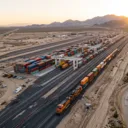
BNSF Railway and BHE together account for more than 90% of Berkshire's direct greenhouse gas emissions 4. If BHE is the renewables story, BNSF is the modal-shift story — the argument that rail freight is an environmental good by virtue of what it displaces.
The math is straightforward: rail moves one ton of freight approximately 500 miles on a single gallon of diesel 5. Trucks cannot come close. BNSF estimates that its customers avoided 24.6 million metric tons of CO₂ equivalent in 2024 by choosing rail over road — the carbon output of 5.7 million passenger vehicles 5.
BNSF's own fuel efficiency hit 1.15 gallons per 1,000 gross ton-miles in 2024, a 13% improvement since 2004 and a 28% improvement since 1996 5. To be fair, BNSF trails some Class I peers on this metric — Union Pacific reported 1.08 gallons and Canadian National 0.88 — but the trend line is consistently downward, and BNSF's 30% GHG reduction target by 2030 against a 2018 baseline is codified in its filings 4.
On technology, BNSF has deployed 360 Tier 4 locomotives (the cleanest available diesel standard), with 65% of its fleet now at Tier 3 or better. Energy management systems run on over 4,000 locomotives. In California, 35 battery-electric yard trucks are in service, and the railroad is field-testing B20/R80 renewable diesel blends — 20% biodiesel and 80% renewable diesel — that reduce particulate matter by up to 35% 5 16.
Buffett made this argument plainly in his 2021 letter: "If the many essential products BNSF carries were instead hauled by truck, America's carbon emissions would soar." 9 It is one of the few times he explicitly framed a subsidiary's operations in environmental terms.
The Factory Floor
The ESG ledger extends beyond energy and transportation. Across Berkshire's manufacturing and consumer subsidiaries, several have built sustainability programs that would be headline material at any other conglomerate — but rarely get noticed inside Berkshire's decentralized structure.
Fruit of the Loom manufactures 89% of what it sells in its own facilities across 12 countries, employing over 17,000 people 6. In 2024, FotL achieved 100% OEKO-TEX certification across all production — one year ahead of its original 2025 target 6. The company holds WRAP, BSCI, SMETA, WCA, and ERSA certifications, has published its supplier list since 2012, maintains 305 trained medical professionals on staff globally, and reports that 126 of its 370 suppliers (34%) have unions or workers' councils on-site 6. For a $2 billion apparel subsidiary that few Berkshire shareholders could name, this is a remarkably transparent supply chain.
Clayton Homes, Berkshire's manufactured housing unit, took a different path to the same destination. In May 2023, Clayton committed to building all residential manufactured homes to Department of Energy Zero Energy Ready Home specifications by January 1, 2024 — becoming the first single-family off-site builder to make that pledge at scale across 39 certified facilities 7. Clayton's homes — priced between $100,000 and $300,000 — come standard with hybrid heat pump water heaters, low-E argon windows, high-efficiency HVAC, ENERGY STAR appliances, LED lighting, and smart thermostats. The company reinvests DOE tax credits to offset material costs for buyers 7. In a housing market where the national median home price hovers near $400,000 and the country faces a four-million-unit supply shortage, Clayton's model is as much a social impact story as an environmental one. ↗
The Proxy Paradox
If the operational record is this strong, why does Berkshire's ESG reputation lag so far behind?
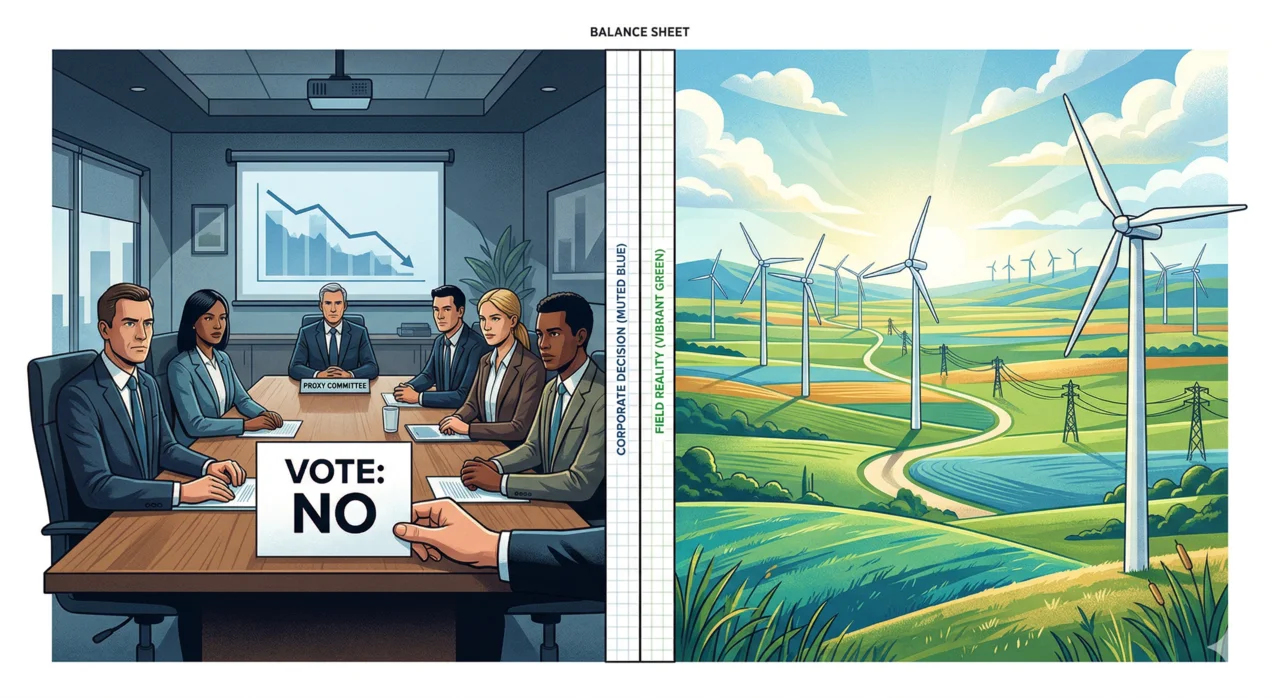
The answer lives in Omaha's proxy ballots. At the May 2025 annual meeting, Berkshire's board recommended "no" on all seven shareholder proposals, including a request from the As You Sow Foundation to disclose the ratio of clean energy financing to fossil fuel financing, a proposal from Whistle Stop Capital for a board committee to oversee diversity and inclusion, and a Tulipshare Capital resolution on AI risk governance. All received less than 2% support in the final vote 1.
This is not new. Between 2021 and 2023, a climate risk management resolution gained majority support among independent shareholders — excluding Buffett's controlling block — for three consecutive years, reaching approximately 50% of independent votes 17. The board's response was consistent: decentralization means these matters belong at the subsidiary level, not the holding company level. The governance committee's position that it "does not seek diversity, however defined" applied specifically to director nominations 1.
The result is a structural paradox. BHE publishes detailed renewables data in the 10-K every year — as Buffett noted, since 2007 9. BNSF publishes annual impact reports with granular fuel efficiency and emissions data 16. FotL publishes its full supplier list. But Berkshire Hathaway Inc. publishes nothing at the consolidated level. The U.S. Equal Employment Opportunity Commission data for the combined workforce — approximately 387,800 employees at year-end 2025, of which 19% are unionized — is posted on berkshirehathaway.com under a sustainability link, but that is the extent of the parent company's ESG disclosure 4.
For ESG rating agencies that evaluate at the parent level, this is disqualifying. MSCI's BB rating and Sustainalytics' 20.7 (Low Risk) score reflect the aggregated picture: a conglomerate that still operates coal plants, runs diesel locomotives, just acquired a chlor-alkali chemicals business ↗, and declines to produce the consolidated reporting that would let analysts credit the subsidiary-level progress 3.
Buffett's implicit argument was always that the work matters more than the report about the work. BHE's rates were the proof. BNSF's ton-miles were the proof. He viewed ESG disclosure mandates as top-down impositions that conflicted with Berkshire's operating autonomy — the same autonomy that let Abel build $38 billion of wind farms without asking permission from a sustainability committee.
Whether this is principled decentralization or willful opacity depends on where you sit. The answer is probably both.
Abel's Inheritance
Here is what makes the timing interesting: the man who built the renewables portfolio is now running the conglomerate.
Greg Abel joined CalEnergy in 1992, became its president by 1998, and ran what became BHE after Berkshire's acquisition in 2000 8. Every dollar of that $38 billion cumulative investment flowed through his capital allocation decisions. When he launched the $323 million Iowa wind project in 2003, it was the largest in the world. When BHE achieved Iowa wind self-sufficiency in 2021, Abel had been running the operation for over two decades. The $7.1 billion in third-party wind tax equity investments that BHE facilitated happened on his watch 4.
Now Abel sits in a different chair. His first shareholder letter as CEO — February 2026 — struck a tone that was unmistakably his own. On BHE, he wrote: "BHE's objective is straightforward: to deliver affordable and reliable energy service for its customers. That responsibility has grown as the industry enters a significant investment cycle, driven by rising electricity demand from artificial intelligence computing and by increasing wildfire risk." 14
On culture, he framed Berkshire's identity as stewardship: "Your capital is commingled with ours, but it does not belong to us. Our role is stewardship. That stewardship has shaped a culture and reinforced a set of values that are not the result of our success, but the reason for it." 14
And on BNSF's 2025 resolution with the Swinomish Indian Tribal Community — settling a longstanding dispute over crude oil shipments across Tribal lands — Abel wrote with a directness Buffett rarely applied to social issues: "BNSF acknowledged its past mistakes and apologized, paving the way for mutually beneficial agreements that allow it to meet customer needs while operating safely on Tribal lands." 14 ↗
None of this guarantees a shift in Berkshire's proxy voting or consolidated ESG reporting. Abel has given no indication that he plans to publish a conglomerate-wide sustainability report or reverse the board's posture on shareholder proposals. The decentralization doctrine is deep in Berkshire's DNA — and Abel, who benefited from it more than anyone, is unlikely to dismantle it.
But the quiet ledger keeps growing. BHE has 1,949 MW of new generation under construction and 543 MW of battery storage on the way 4. BNSF is field-testing hydrogen and battery-electric locomotives 4. Clayton is building zero-energy-ready homes at scale. The man who started it all — with a $323 million bet on Iowa wind before anyone was watching — now runs the whole show.
Conclusion
Berkshire Hathaway's ESG record is a paradox wrapped in a 10-K. The company that refuses to produce a sustainability report has invested more in wind energy than most companies that do. The board that recommends "no" on every climate proposal employs a CEO who built the largest wind portfolio of any American regulated utility. The conglomerate rated BB by MSCI operates subsidiaries that would score well above average on their own.
The gap is not hypocrisy — it is architecture. Berkshire's decentralized model lets each subsidiary pursue sustainability on its own terms, driven by economics and operational logic rather than parent-company mandates. BHE built wind because wind was cheap. BNSF improves fuel efficiency because diesel is expensive. Clayton builds zero-energy homes because DOE tax credits lower the sticker price. FotL certifies its supply chain because customers and regulators demand it.
The result is an ESG record that is real but illegible at the holding-company level — substantial in substance, invisible in structure. Buffett's quiet ledger. Abel's to spend.
References
-
Berkshire Hathaway 2025 Proxy Statement - berkshirehathaway.com ↩↩↩
-
How Berkshire Hathaway fed investors a flawed narrative about their climate progress - grist.org ↩
-
Berkshire Hathaway ESG Scores & Ratings - marketbeat.com ↩↩
-
Berkshire Hathaway 2025 Annual Report (10-K) - berkshirehathaway.com ↩↩↩↩↩↩↩↩↩
-
BNSF Fuel Efficiency and Emissions Reduction - bnsf.com ↩↩↩↩↩
-
Fruit of the Loom Sustainability - fotlinc.com ↩↩↩↩
-
Clayton Commits to Build All Residential Manufactured Homes to DOE Zero Energy Ready Home Specifications - prnewswire.com ↩↩↩
-
Meet Greg Abel: The Iowan Chosen to Succeed Berkshire Hathaway CEO Warren Buffett - governorswindenergycoalition.org ↩↩↩↩
-
Berkshire Hathaway 2021 Annual Report - berkshirehathaway.com ↩↩↩↩↩
-
Berkshire Hathaway 2021 Annual Report (10-K, p. K-10) - berkshirehathaway.com ↩
-
Berkshire Hathaway 2022 Annual Report (10-K, p. K-10) - berkshirehathaway.com ↩
-
Berkshire Hathaway 2023 Annual Report (10-K, p. K-10) - berkshirehathaway.com ↩
-
Berkshire Hathaway 2024 Annual Report (10-K, p. K-10) - berkshirehathaway.com ↩
-
Berkshire Hathaway 2025 Annual Report — Abel Shareholder Letter - berkshirehathaway.com ↩↩↩↩
-
Warren Buffett's Berkshire Hathaway Energy: An Example of ESG Excellence - kailashconcepts.com ↩↩
-
BNSF 2023 Impact Report - bnsf.com ↩↩
-
A Closer Look at Berkshire Hathaway's ESG Proposals - kingswell.io ↩