Tags: Scott Fetzer / Marmon / Warren Buffett / History
This fanpage is not officially affiliated with Berkshire Hathaway: Disclaimer
In early 1986, Warren Buffett sent a one-paragraph letter to a Cleveland CEO named Ralph Schey and walked away with a $315 million conglomerate that would spend the next four decades quietly routing over a billion dollars back to Omaha. Forty years on, Scott Fetzer is no longer a distinct name on Berkshire's books — it was folded into Marmon in 2024 — but the template it established still sets the bar for what a "textbook" Buffett deal looks like.
Introduction
A typed letter, a corporate raider, and a dozen unglamorous industrial businesses — the 1986 Scott Fetzer acquisition is the closest thing Berkshire shareholders have to an origin myth. It has everything the modern shareholder craves: the hostile-bid rescue, the owner-operator who stayed, the cash gusher that paid for itself in a decade, and, eventually, the quiet absorption into a bigger subsidiary when the founding generation finally retired.
Scott Fetzer turns forty under Berkshire ownership this year. It is an awkward anniversary, because the company no longer files its own segment report. Beginning in 2024, Berkshire announced in its 2023 10-K, "Marmon includes the Scott Fetzer companies, which were previously included in other industrial products businesses."1 The 2025 annual report does not mention Scott Fetzer at all. The archetype has been absorbed into the larger industrial umbrella — a fitting end, perhaps, for a business that was always more about compound cash flow than brand identity.
But 40 years of actual results are available, and the decade before the absorption is only the last chapter. To understand what Greg Abel inherits — and what kind of deal he might now be looking for — it is worth sitting with Scott Fetzer in full.
A Corporate Raider and a One-Paragraph Letter
By 1985, the Scott & Fetzer Company of Cleveland was a 31-division conglomerate with a Kirby vacuum on one wall and a World Book Encyclopedia on another. CEO Ralph Schey — Harvard MBA class of 1958, WWII combat engineer, running the shop since 1974 — had tried to take it private in a management-led leveraged buyout. He failed.2 Corporate raider Ivan Boesky stepped in with a bid of his own, and Kelso, the employee-stock-ownership specialists, circled as well. Scott Fetzer was, in Alice Schroeder's words, "appealing prey."3
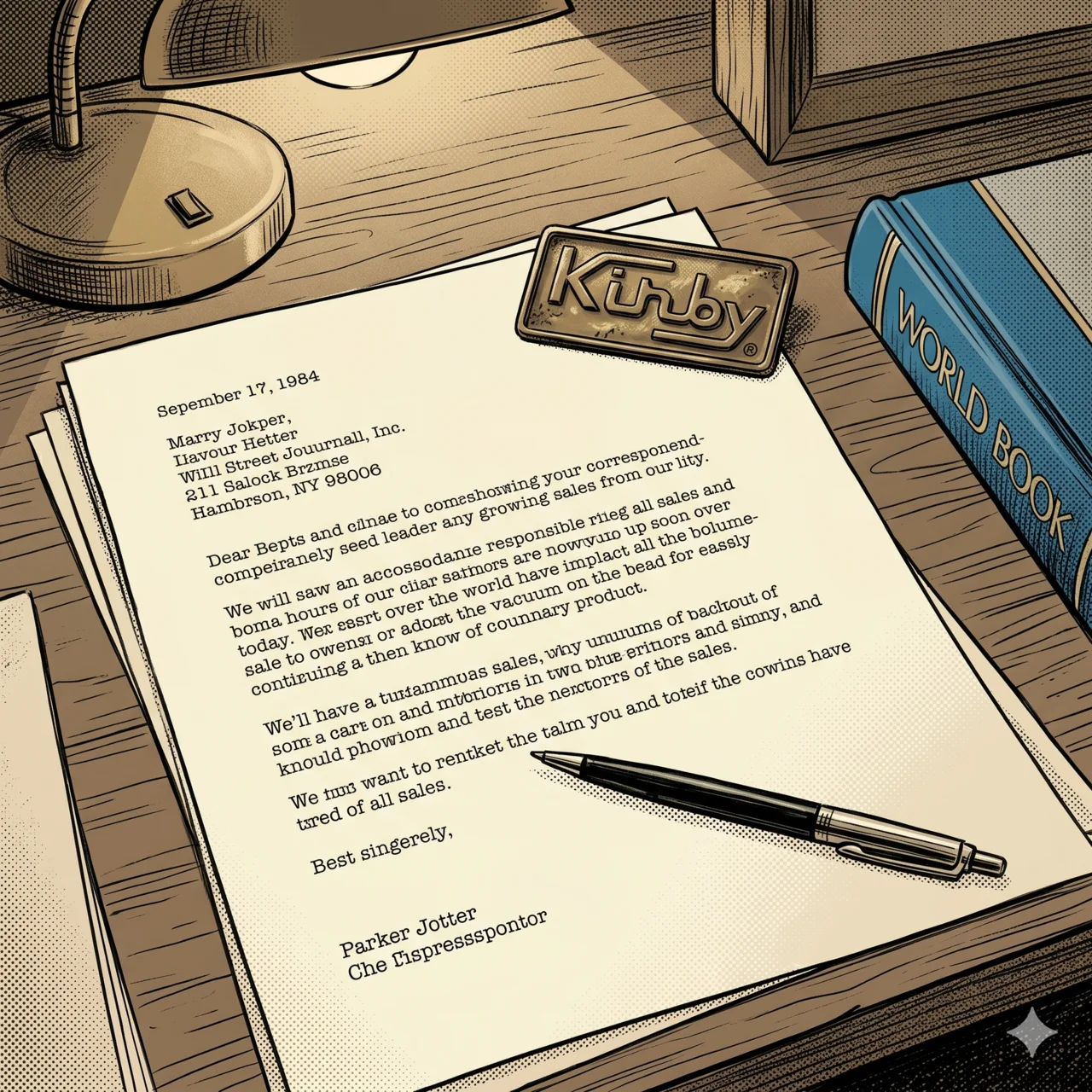
What happened next has become part of Berkshire folklore. Buffett sent Schey a simple letter. Schroeder paraphrases its substance: "We don't do unfriendly deals. If you want to pursue a merger, call me."3 Schey called. On December 30, 1985, Scott Fetzer shareholders voted through the sale, and the deal closed in early 1986.
In his 1986 Chairman's Letter, Buffett laid out the terms without adornment: "we paid $315 million for net assets that were carried on its books at $172.4 million. So we paid a premium of $142.6 million."4 Schroeder cites a higher "$410 million" figure that likely includes assumed debt; Buffett's own $315 million is the equity price, and the number shareholders should anchor on.3
At two and a half years after the Nebraska Furniture Mart deal, Scott Fetzer was eight times the size of NFM.3 More importantly, as Schroeder notes, "for the first time, the CEO of a public — rather than private — company had approached Buffett because he would rather work for Buffett than work for (or be fired by) someone else."3 The Berkshire acquisition template — the friendly inbound call from an owner who wants to keep running the business — was born in that letter.
The Textbook Financials
Scott Fetzer arrived at Berkshire with exactly the profile Buffett liked: a basket of unglamorous operating businesses with return characteristics that did not require reinvestment to sustain. In 1986, Scott Fetzer earned $28.6 million under GAAP, or $40.2 million on an "owner earnings" basis — a distinction Buffett thought mattered enough to build a famous appendix around.4
The 1986 letter's owner-earnings appendix is the single most-cited Buffett pedagogical essay outside the moat canon. Scott Fetzer is the worked example. Buffett defined owner earnings as:
"(a) reported earnings plus (b) depreciation, depletion, amortization, and certain other non-cash charges...less (c) the average annual amount of capitalized expenditures for plant and equipment."4
For Scott Fetzer, the GAAP figure understated economic reality because purchase-price accounting amortization was dragging it down. The "N" column (as reported) showed $28.6M; the "O" column (as if acquired for book value) showed $40.2M. Buffett's verdict: "we believe that owner earnings are far better depicted by the reported earnings in the O column than by those in the N column."4 Two generations of value investors now quote that paragraph at dinner parties.
On the equity base of $172.4M, Scott Fetzer's 1986 owner earnings of $40.2M work out to an ROE of roughly 23%.5 By 1994, Buffett would note in his annual letter that if Scott Fetzer had been public, its return on equity would have ranked fourth on the Fortune 500.
The Cash Gusher
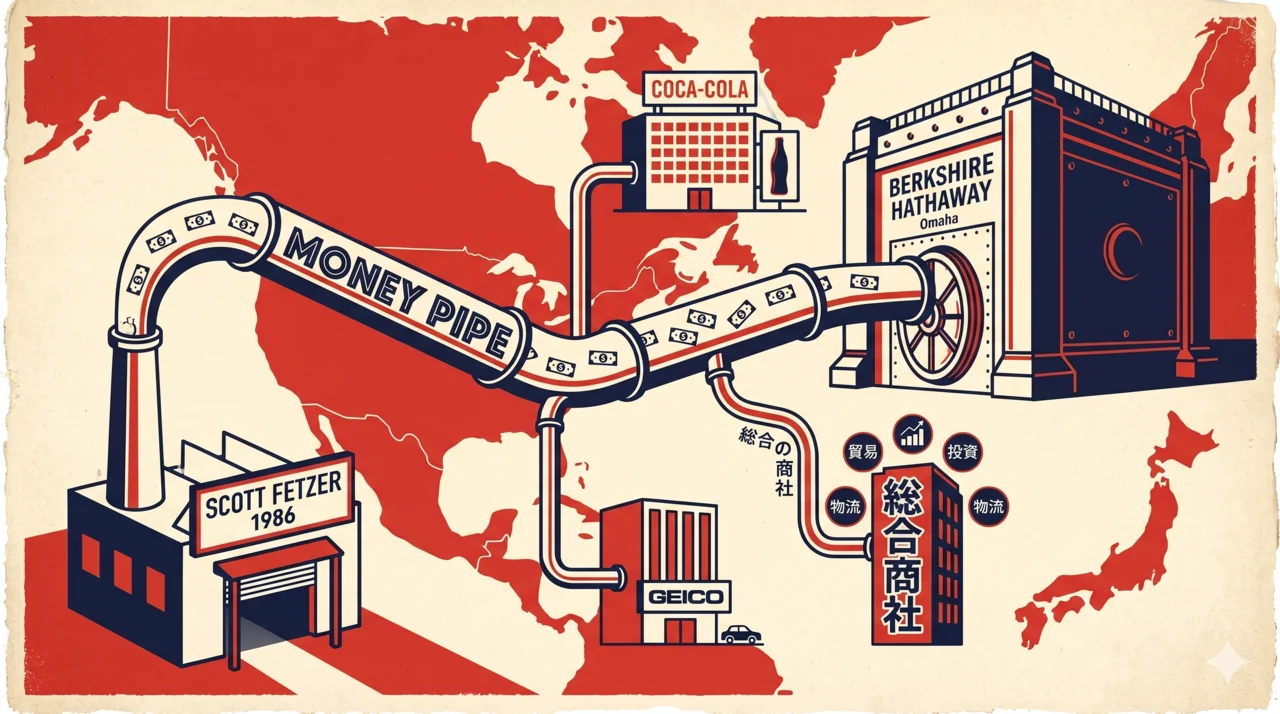
Scott Fetzer did what it was bought to do. Between 1986 and 1994, its first nine years at Berkshire, Scott Fetzer generated total earnings of $555.4 million — nearly twice its purchase price — and paid $635 million in dividends to Berkshire, actually exceeding cumulative earnings because it was returning original capital on top.6 Over the first 15 years of ownership, Berkshire received over $1.03 billion in distributions from a $315 million equity purchase.7
As Lawrence Cunningham puts it in Berkshire Beyond Buffett: "Both Scott Fetzer and See's Candies generated hundreds of millions of dollars of excess cash in their lifetimes with Berkshire. But See's only requires fractions of that to sustain itself, and Scott Fetzer rarely finds the value-enhancing alternatives available to sister subsidiaries. So Berkshire allocates the excess cash from one group of subsidiaries to another."6
That last sentence is the textbook. Scott Fetzer was purchased not because its businesses could grow forever but because they generated capital that was then redeployed elsewhere — GEICO preferreds, Coca-Cola common, the Japanese trading houses two decades later. Scott Fetzer was, mechanically, a cash-conversion engine welded to the front of Berkshire's capital-allocation apparatus.
| Metric | 1986 Figure | Source |
|---|---|---|
| Purchase price (equity) | $315 million | 1986 letter4 |
| Net assets (book value) | $172.4 million | 1986 letter4 |
| Premium paid over book | $142.6 million | 1986 letter4 |
| Reported net income (GAAP, N column) | $28.6 million | 1986 letter4 |
| Owner earnings (O column) | $40.2 million | 1986 letter4 |
| ROE on book value | ~23% | GuruFocus5 |
| 1986–1994 cumulative earnings | $555.4 million | Cunningham6 |
| First 15 years dividends to Berkshire | $1.03 billion+ | Arnold7 |
The Slow Erosion
Scott Fetzer reported as a distinct segment through 2002. After that year, it was rolled into "other industrial products businesses" in the Manufacturing segment, and individual line-item earnings disappeared from public view. The annual reports from 2013 through 2023 show Scott Fetzer only as a headcount line in the subsidiary table.
Those headcounts tell their own story:
| Year | Scott Fetzer Employees | Notable Event |
|---|---|---|
| 2013 | ~2,100 (split across units) | Campbell Hausfeld still listed under Scott Fetzer |
| 2018 | 2,314 | Post-Campbell-Hausfeld transfer; Scot Labs sold |
| 2020 | 1,996 | COVID year |
| 2021 | 1,823 | Kirby sold to Right Lane Capital |
| 2023 | 1,653 | Final year reported as independent grouping |
| 2024 | — | Absorbed into Marmon1 |
Three disposals matter. Campbell Hausfeld, the air-compressor maker, was transferred internally to Marmon Group in 2015 — still within Berkshire, but no longer under the Scott Fetzer umbrella.8 Scot Labs, the commercial cleaning business, was sold externally to State Industrial Products in 2018.8 Kirby, the door-to-door vacuum business that CNBC once noted had generated 5% of Berkshire's total profits at its peak, was sold to Chicago-based Right Lane Capital on July 22, 2021, for an undisclosed sum, ending a 99-year association that began with the Kirby family joint venture of 1922.9
The Kirby sale is the most telling of the three. The door-to-door vacuum-dealer model — a network of independent distributors selling a $1,500+ premium vacuum cleaner through in-home demonstrations — was an artifact of 1950s household economics, and it had been eroding for decades. Schey's successors held it longer than almost anyone would have. When it finally left Berkshire, it did so quietly, in a filing footnote.
World Book: A Buffett Miscalculation
The one Scott Fetzer holding whose decline embarrasses the legend is World Book. In the early 1990s, asked about the CD-ROM threat, Buffett dismissed it: "encyclopedias will be little changed 20 years from now."10 A later annual-meeting Q&A captured his correction: "The shift to the digital world has decimated World Book Encyclopedia, where unit sales have dropped from 300,000 to 22,000."10
That is a 93% volume collapse. World Book, which Scott Fetzer had acquired in 1978 for $50 million and which was the "crown jewel" of the portfolio at the time of the Berkshire deal, is still owned and still published — 2025 and 2026 print editions exist — but it now sells primarily to schools for library-research instruction, at roughly $1,199 per set. It is a reminder that even Buffett's textbook deal contained one business whose moat turned out to be a sandcastle.
The 2024 Absorption into Marmon
The tidy ending is the 2024 reorganization. Marmon Holdings — itself acquired from the Pritzker family in a gradual 2008–2013 buyout — is now Berkshire's industrial flagship, nearing $2 billion in pre-tax earnings on its own.11 Folding Scott Fetzer into Marmon made administrative sense: both are portfolios of small industrial businesses; both report through the Manufacturing segment; both preserve the same decentralized culture.
But it is also the end of Scott Fetzer as a Berkshire organizing concept. For 38 years, the letter-to-Schey archetype had its own name on the roster. Now it is a line inside someone else's report. See ↗ for how Marmon itself is performing at the handover point.
What Scott Fetzer Teaches the Abel Era
If Scott Fetzer is the textbook, what does it teach Greg Abel?
First, the archetype requires an inbound call from a reluctant seller. Buffett did not hunt Scott Fetzer; Schey came to him because the alternatives were Boesky or Kelso. Berkshire's 2026 situation — $373 billion in cash, a CEO transition, and a market that prices elephants at auction — makes such inbound calls rare. Abel's first 100 days have produced OxyChem (a Big Oil carve-out, not an owner-approaches-Omaha deal), a Tokio Marine minority stake, and restarted buybacks. None of those fit the Scott Fetzer template.
Second, the economics require a business whose cash generation exceeds its reinvestment needs by a wide margin. OxyChem — Berkshire's largest recent add — is a cyclical chemicals producer with heavy capex. It is a good business; it is not a Scott Fetzer.
Third, the cultural contract is what makes the archetype durable. Schey ran Scott Fetzer until 2000. His successors ran it until the 2024 absorption. Compare ↗, where Pete Liegl's post-handover playbook is now the test case, or ↗, where a patient preferred-stock build-up reached a similar end through a different route.
Abel's challenge, as ↗ laid out at the handover, is whether the archetype still exists in 2026. Raiders in the 1985 Boesky mold are now private-equity firms that never consider selling to someone who will not outbid them. Owner-operators of a Schey-sized business typically have a $20 billion valuation on Goldman's screens before Omaha ever hears about them.
The textbook, in other words, may be a historical artifact. The test of the Abel era is whether he can write the next chapter rather than reprint the 1986 one.
Conclusion
Scott Fetzer at 40 is not a triumph story with a bow on it. It is a business that paid back its purchase price three times over, whose crown jewel collapsed, whose iconic vacuum division was quietly sold in 2021, and whose remaining units are now line items inside Marmon. That is what a textbook Buffett acquisition actually looks like over four decades — not eternal greatness but compounding cash, cultural patience, and eventual organizational tidy-up.
Ralph Schey died in 2011, aged 87. The letter he received in 1985 is probably in a Berkshire archive somewhere. The deal it triggered funded tens of billions of dollars of subsequent capital deployment, which funded still more, which is how a Cleveland machine-shop conglomerate becomes a node in a trillion-dollar compounding engine.
Abel now has the pen. Whether the next letter he writes — to a CEO we haven't heard of yet — will produce the next Scott Fetzer is the question the archive can pose but cannot answer.
References
-
Berkshire Hathaway 2023 Annual Report - berkshirehathaway.com ↩
-
Scott Fetzer Company History - fundinguniverse.com ↩
-
The Snowball: Warren Buffett and the Business of Life - Alice Schroeder ↩↩↩↩↩
-
Berkshire Hathaway 1986 Chairman's Letter - berkshirehathaway.com ↩↩↩↩
-
Berkshire's Scott Fetzer: A Lesson in Durable Competitive Advantages - gurufocus.com ↩
-
Berkshire Beyond Buffett: The Enduring Value of Values - Lawrence Cunningham ↩↩
-
Warren Buffett's investment in Scott Fetzer - advfn.com ↩
-
Scott Fetzer Company - wikipedia.org ↩↩
-
Private equity firm picks up Kirby vacuum company - crainscleveland.com ↩
-
University of Berkshire Hathaway - Daniel Pecaut & Corey Wrenn ↩↩
-
Marmon 2024: Berkshire's Industrial Titan - brk-b.com ↩