Tags: BHRG / Japan / Earnings
This fanpage is not officially affiliated with Berkshire Hathaway: Disclaimer
A simultaneous shrink-and-step-in. Berkshire Hathaway Reinsurance Group's first-quarter property-casualty premiums earned fell 6.2% year-over-year while written premiums slipped 2.3%1 — and on April 1, the day after the quarter closed, a ten-year whole-account quota-share with Tokio Marine switched on, expected to generate "meaningful premium volumes" over its term2. Two opposite-direction moves driven by the same logic: walk away from a soft market in the United States, sign a structured book in Japan.

Introduction
Two numbers from the Q1 2026 10-Q tell most of the story. BHRG's property-casualty division collected $4,912 million in earned premiums against $5,235 million a year earlier — a 6.2% decline.1 The Berkshire MD&A is unusually direct about why: "The property volume decline was attributable to the impacts of increased competition and lower rates."2 Translation: BHRG saw what the market would pay, did the math, and walked away.
That same paragraph in the filing introduces a contract that changes the shape of BHRG's book for the next decade. National Indemnity Company entered into "a whole account reinsurance agreement" with subsidiaries of Tokio Marine Holdings, "on a quota-share basis," covering "a portion of the net non-life premiums written" with a ten-year term that began April 1, 2026.2 The deal headline was already covered when the partnership was announced ↗. What the Q1 filing reveals is the operational logic behind it: BHRG is rotating reinsurance capital from one bucket to another, not contracting overall.
For shareholders unfamiliar with reinsurance plumbing, the rest of this article explains what these contracts mean, why the cycle matters, where the precedent lies, and how to size the move against Berkshire's $176 billion float3.

What a Whole-Account Quota-Share Actually Is
Reinsurance is insurance for insurance companies, and it comes in three principal flavours. Berkshire's own 2025 10-K supplies the textbook: under a quota-share — also called proportional or pro-rata — "the reinsurer shares proportionally in the original premiums and losses of the direct insurer." Excess-of-loss treaties, by contrast, "provide for the indemnification… of all or a portion of the loss in excess of an agreed upon amount or 'retention.'"14 Facultative reinsurance is the third flavour: deal-by-deal, negotiated one risk at a time.
A 30% quota-share with no embellishments means the reinsurer takes 30% of every dollar of premium and pays 30% of every dollar of claim, ceding commission aside. The reinsurer is, in effect, a silent partner riding the cedent's underwriting performance.
What makes the Tokio Marine arrangement structurally different from a routine quota-share is the word whole-account. The cession applies across the cedent's entire book of non-life business — every line, every geography — rather than only one segment such as marine cargo or earthquake catastrophe. NICO is therefore not picking off Tokio Marine's most attractive lines; it is buying a strip of the whole portfolio. That structure has three consequences worth understanding.
It produces immediate premium scale. Tokio Marine reported net premiums written of roughly ¥5.43 trillion for fiscal year 202511 — about $36.2 billion at prevailing exchange rates and enough to make Tokio Marine one of the world's larger non-life insurers. Even a low-single-digit cession produces material premium flow.
It diversifies across lines. NICO assumes Japanese auto, Japanese fire, marine, North American specialty, and the rest in the same proportion Tokio Marine itself does. There is no adverse-selection asymmetry — the reinsurer cannot be cherry-picked.
It aligns incentives. Because the reinsurer participates across the full book, the partnership benefits when Tokio Marine's underwriting culture stays strong, not when one line outperforms. Ajit Jain made the point at the May 2 annual meeting in his characteristically dry register: he was comfortable because Tokio Marine "are a quality company" that does "first-class business in a first-class way."7
The quota-share percentage is not disclosed in either the 10-Q or any press coverage. Jain confirmed that key terms "are not spelled out in a lot of detail."7 Anyone quoting a number is guessing.
Premiums Written, Premiums Earned: Two Numbers, Two Stories
The headline figures from Q1 are easy to misread without one piece of accounting plumbing. Premiums written is the contractual amount of new policies bound during the period — the full year of premium on a January 1 annual policy hits the written line on January 1. Premiums earned is only the portion already corresponding to coverage delivered: by March 31, that same policy has earned 25%. The remainder sits in an unearned premium reserve, a balance-sheet liability waiting to be released as time passes.
In a shrinking book this distinction generates the asymmetry visible in BHRG's quarter. Premiums written fell 2.3% — the new business intake. Premiums earned fell 6.2% — the depletion of an older, larger book through the income statement. The earnings-line decline is steeper because the in-force base accumulated over prior soft quarters is now bleeding through. Premiums earned is a lagging indicator of underwriting decisions made several quarters before.
The same accounting will work in reverse when the Tokio Marine treaty starts producing volume. The 10-Q notes Q1 2026 contribution from the deal was zero because the contract incepts April 1.2 Through the rest of 2026 we will see written premiums step up immediately while earned premiums grow more gradually — the opposite of the BHRG P/C trajectory.
| BHRG P/C reinsurance | Q1 2026 | Q1 2025 | Δ |
|---|---|---|---|
| Premiums written | $5,992M | $6,135M | −2.3% |
| Premiums earned | $4,912M | $5,235M | −6.2% |
| Loss & LAE ratio | 58.7% | 68.7% | −10.0 pp |
| Expense ratio | 28.3% | 30.0% | −1.7 pp |
| Combined ratio | 87.0% | 98.7% | −11.7 pp |
| Pre-tax underwriting | $637M | $68M | +$569M |
Source: Berkshire Hathaway Q1 2026 10-Q1.

The Soft Market: Why Discipline Matters Now
Property-casualty reinsurance moves in cycles. After large catastrophe losses or capital impairments, capacity tightens, prices climb, and terms become more selective — the hard market. As capital recovers, competitors return, and benign loss years accumulate, capacity floods back and prices erode — the soft market.
The current cycle has turned decisively soft in property reinsurance. Guy Carpenter's U.S. Property Catastrophe Rate-on-Line Index fell 12% at the January 1, 2026 renewals6, and a further round of double-digit declines followed at the April 1 renewals despite the brief war in the Persian Gulf and the diesel-price spike that accompanied it.5 Insurance-Linked Securities — the alternative-capital flow from pension funds and hedge funds into catastrophe-bond and sidecar structures — has continued to grow alongside traditional reinsurer balance sheets, producing a buyer's market with cedents extracting concessions across Asia-Pacific and the Americas.5
Buffett's 2025 shareholder letter laid out the consequence in plain prose: "The reinsurance sector has attracted significant increases in available capital from both the traditional and alternative markets, which together with a more benign reinsured catastrophe loss burden in 2025 in most major regions has led to significant price declines in property reinsurance… As long as these phases of the cycle endure, we expect to write less reinsurance premium."3 The 2024 letter put the doctrine in sharper terms: "We must never write inadequately-priced policies in order to stay in the game. That policy is corporate suicide."4
The BHRG Q1 retreat is the doctrine in action. Total premium volumes already showed two consecutive years of decline at the annual level — premiums written of $20,168 million in 2025 against $21,899 million in 2024 and $22,360 million in 20233 — and Q1 2026 extends the trend. This is not a one-quarter blip. It is policy.
Jain's Property-Cat Wilderness
There is an Ajit Jain quote from 2011, given to NDTV India, that should be required reading for any shareholder thinking about BHRG's posture today: "The last 15 years has been a difficult time. Prices have not been attractive and even though we have had some presence in the property-cat business in the last 15 years, it really has been minimal."13 He was describing the period from 1996 to 2011 — fifteen years during which BHRG essentially stayed out of property catastrophe reinsurance because the prices on offer did not warrant the capital exposure. The architect of the reinsurance machine ↗ simply waited.
That history is the proof point. BHRG is not philosophically committed to property reinsurance. It is committed to underwriting profit. When prices reward capital, it deploys; when they do not, it sits.
The current cycle differs from 1996–2011 in one important respect: the alternative capital that has crowded in is sticky in a way that traditional reinsurer capital was not. Catastrophe bonds with three-year covers, sidecar structures with multi-year commitments, and quota-share retrocessions backed by pension funds are less responsive to a single bad cat year than traditional reinsurers were in the past. The soft phase may last longer than the historical median. BHRG's posture suggests management agrees.
A second Q1 detail reinforces the discipline-not-contraction reading. While P/C premiums shrank, BHRG's life and health book grew — premiums written of $1,318 million against $1,243 million the year before, a 6.0% increase, with pre-tax earnings up $56 million1. BHRG is not retreating from reinsurance. It is rotating within reinsurance.
The IAG Precedent No One Mentions
The Tokio Marine arrangement is being discussed as if it were a structurally novel contract for Berkshire. It is not. The 2025 annual report contains, in plain language, a description of an existing whole-account quota-share that is almost identical in shape: "A significant portion of the NICO Group's annual reinsurance premium currently derives from a 20% quota-share agreement with Insurance Australia Group Limited ('IAG') that expires on December 31, 2029. IAG is a multi-line insurer in Australia, New Zealand and other Asia-Pacific countries."3
Read the structure: a fixed quota-share percentage, applied to the whole non-life book, of a multi-line Asia-Pacific insurer, on a multi-year term. That is the Tokio Marine template a generation early. Berkshire already runs this kind of contract at scale and has done so for years.
The implications are reassuring on two fronts. The Tokio Marine arrangement is not an experiment — NICO has institutional muscle memory for managing this exact reinsurance shape. And it is a deliberate scale-up: Tokio Marine writes net premiums that are roughly five times IAG's, the term is ten years rather than five, and the partnership extends to joint M&A rather than reinsurance alone8. The Equitas deal of 2007 and the AIG adverse-development cover of 2017 — Berkshire's two most famous large reinsurance transactions — were retroactive run-off contracts on legacy books, structurally distinct from a forward-looking whole-account quota-share910. The Tokio Marine treaty is the first prospective deal of comparable scale, and it sits squarely on the IAG precedent.
Float Arithmetic: Sizing the Tokio Marine Deal
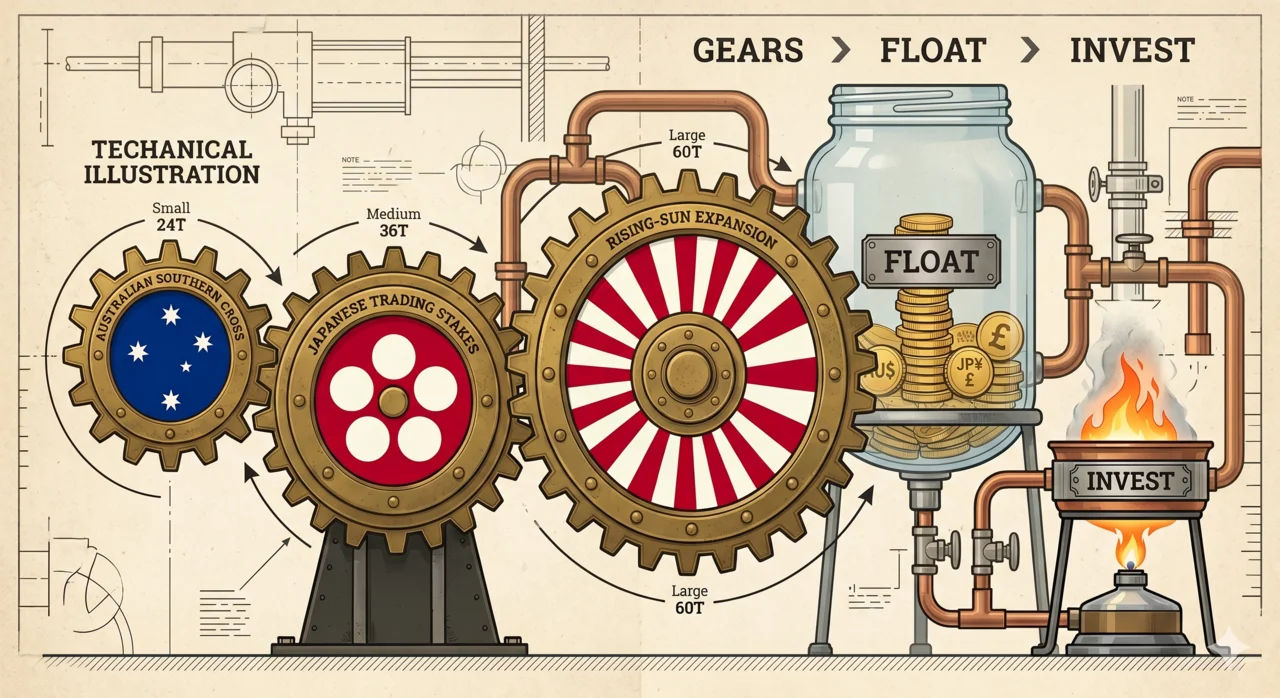
Float is the policyholder funds an insurer holds and invests between premium receipt and claim payment — Berkshire's float was $176 billion at year-end 2025, up from $171 billion at year-end 2024 and $88 billion a decade earlier3. Float is the engine that converts insurance premiums into a permanent investment war chest.
A whole-account quota-share is a particularly clean way to grow float. Premiums arrive predictably; the cedent administers the underlying business and absorbs operational complexity; the reinsurer simply shares proportionally and invests the difference between premiums received and claims paid plus expenses. If Tokio Marine writes ¥5.43 trillion of net non-life premiums annually11 — roughly $36.2 billion — then a low-single-digit cession produces something on the order of $1–2 billion in incremental annual premium for NICO. A double-digit cession would scale that into the $4 billion range. We do not know which it is. Whatever the figure, it is meaningful in the context of BHRG P/C premiums earned that totaled $20.4 billion across all of 20253.
| Whole-account quota-shares NICO has run | Cedent | Term | Cession |
|---|---|---|---|
| IAG quota-share | Insurance Australia Group | Through 2029 | 20% |
| Tokio Marine quota-share | Tokio Marine Holdings | 10 years from April 1, 2026 | Not disclosed |
Sources: Berkshire 2025 Annual Report3; Q1 2026 10-Q2.
Add ten years of accumulating float on a disciplined book and the deal does what Berkshire's reinsurance machine has been doing for four decades: produce investable capital faster than claims consume it. The current $373 billion cash and Treasury pile gives Greg Abel — and the now-incoming insurance chief Charlie Shamieh, named two days after the May 2 annual meeting to succeed Jain12 — exactly the kind of slowly-arriving, structured premium flow that a top-of-cycle U.S. property book could not provide at acceptable terms. The Abel-era playbook ↗ is starting to show its preferences.
A Caveat on the Earnings Improvement
One reading of the Q1 figures could over-attribute the improvement to underwriting brilliance. The combined ratio fell from 98.7% to 87.0%1, a remarkable 11.7-point swing. Most of that swing is timing rather than philosophy.
Q1 2026 saw no significant catastrophe losses; Q1 2025 absorbed roughly $770 million in cat charges1. Favourable prior-year reserve development reduced 2026 losses by $260 million against $330 million in 2025 — modestly less helpful than a year ago. In other words, the loss-ratio improvement is largely a clean-quarter effect. The real underwriting story is the volume retreat, which is genuinely deliberate and informative about BHRG's strategy. The earnings-line numbers are not strategic signal in the same way; they are weather.
This nuance matters because the next bad cat quarter — and there will be one — will produce the opposite optical pattern. Combined ratios will spike; some commentary will read it as a discipline failure. It will be neither. It will be the same thing the soft prices are: cycle. The same caution applies on the direct-insurance side, where GEICO's loss and expense ratios both moved the wrong way this quarter ↗ — different mechanism, same lesson about reading single quarters.
Conclusion
The shape of Berkshire's reinsurance book five years from now will look different from today. Less discretionary U.S. property; more structured Asia-Pacific quota-share; a Japanese cornerstone partnership running for a decade alongside the existing Australian one. The strategic logic is consistent — write where prices are adequate, walk away where they are not, build float through structures that align with disciplined cedents — but the geographic and structural mix is rotating in real time.
The Q1 2026 numbers are the first quarter where both halves of that rotation are visible in the same filing. The retreat is in the income statement; the entry is on the page right next to it, with an April 1 effective date. Greg Abel inherited an insurance machine tuned by Ajit Jain over forty years, and the Tokio Marine treaty is one of the last major architectural decisions Jain will have stamped before handing the operation to Charlie Shamieh. It is, in that sense, both a quarterly result and a generational one.
For shareholders, the lesson is the one Buffett has been repeating for decades: in reinsurance, doing nothing is sometimes the highest-value activity. BHRG just did some of that, and used the same quarter to do something Berkshire has been preparing to do for years.
References
-
Berkshire Hathaway Q1 2026 10-Q — BHRG segment results, lines 1659–1685. ↩↩↩↩↩
-
Berkshire Hathaway Q1 2026 10-Q — MD&A, lines 1669–1676. ↩↩↩↩
-
Berkshire Hathaway 2025 Annual Report - berkshirehathaway.com ↩↩↩↩↩↩
-
Berkshire Hathaway 2024 Annual Report - berkshirehathaway.com ↩
-
Reinsurance Rates Continued Softening During April Renewals, Despite Iran War - insurancejournal.com ↩↩
-
January reinsurance renewal "accelerated softening" drives double-digit declines: Guy Carpenter - artemis.bm ↩
-
Details TBD: Berkshire's Jain, Abel Describe Tokio Marine Strategic Pact - carriermanagement.com ↩↩
-
Berkshire Hathaway's NICO to acquire 2.5% stake in Tokio Marine - reinsurancene.ws ↩
-
Equitas to Acquire up to $7 Billion of Additional Reinsurance Protection from National Indemnity Company - berkshirehathaway.com ↩
-
AIG Partners with Berkshire Hathaway Unit on Reinsurance Agreement - businesswire.com ↩
-
Tokio Marine Holdings Annual Highlights - tokiomarinehd.com ↩↩
-
Berkshire Selects Gen Re's Shamieh to Succeed Jain as Insurance Chief - insurancejournal.com ↩
-
Buffett's Prince of Risk: Ajit Jain Q&A Transcript - kingswell.io ↩
-
Berkshire Hathaway 2025 Form 10-K — definitions of quota-share and excess-of-loss reinsurance. ↩