Tags: GEICO / Earnings / Tariffs
This fanpage is not officially affiliated with Berkshire Hathaway: Disclaimer
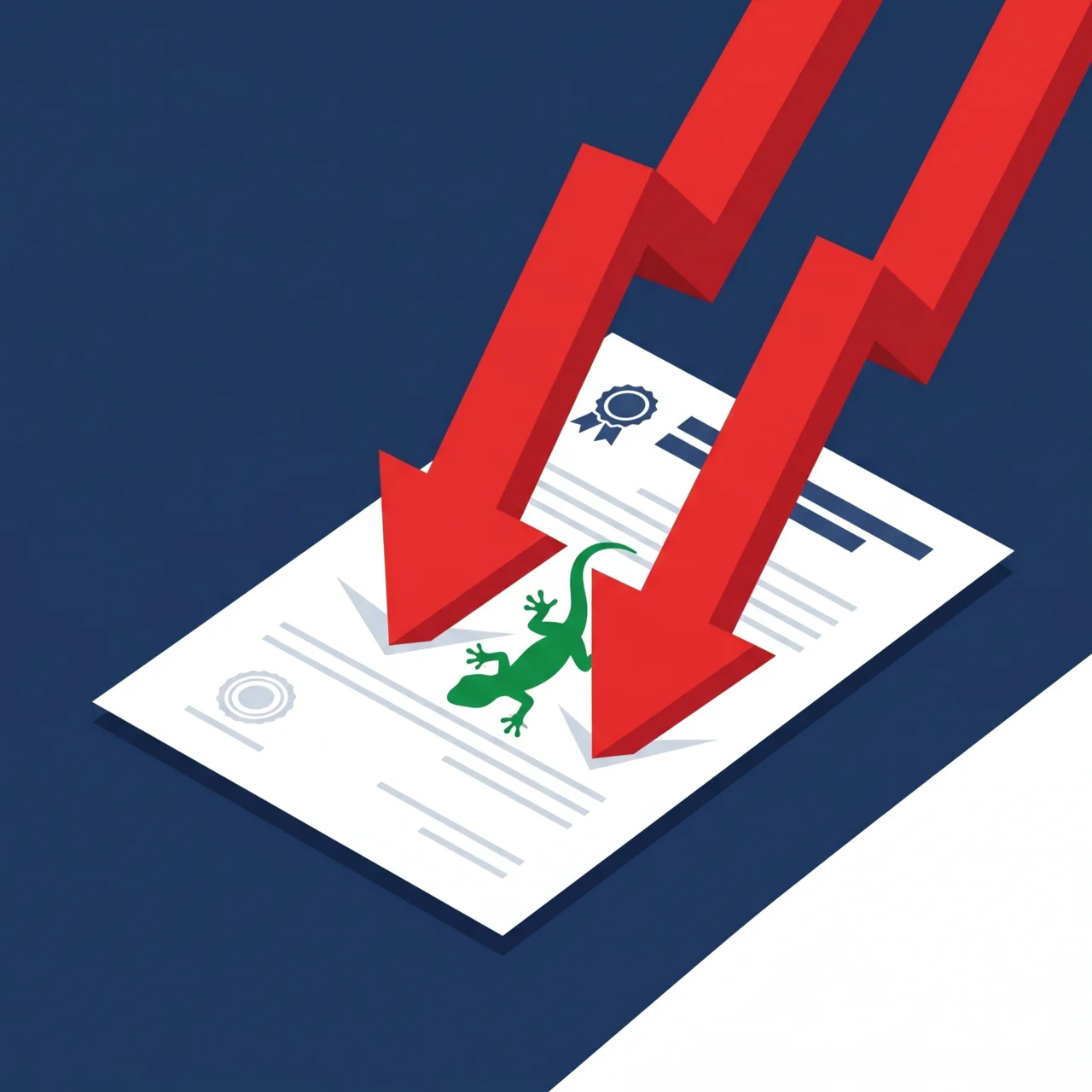
Q1 2026 was the first quarter in three years where both halves of GEICO's combined ratio moved against the company at the same time. Losses up 4.9 percentage points on repair-cost inflation and bodily-injury severity. Expenses up 2.6 points on a 29% surge in what the 10-Q calls "policy acquisition-related expenses" 1. The combined ratio jumped from 79.8% to 87.3% and pre-tax underwriting earnings dropped 34.8%. The mainstream read will blame tariffs. Half the story is hiding on the other side of the ledger — and that half points to a structural shift Nancy Pierce inherited her first quarter as CEO.

Introduction
Todd Combs's transformation, when it ran clean, was the story of trading one ratio for the other. Cut headcount by 14,000, cap advertising at $838 million (a 14-year low), let the expense ratio drop to a barely-believable 9.7%. Even when severity ran hot, the cost moat could absorb it. The math worked. Berkshire shareholders saw the result in 2024: $7.81 billion in pre-tax underwriting profit on an 81.5% combined ratio ↗.
What Q1 2026 shows is what happens when both ratios move the wrong way at once. Frequency rebounded. Severity stayed elevated on bodily injury. And on the cost side, expenses jumped 29.3% on a "policy acquisition-related" line that bundles advertising, agent commissions, and a new distribution channel that nobody outside the trade press is talking about.
The temptation will be to read this as a tariff quarter. It is partly that. But it is also Nancy Pierce's first earnings as GEICO CEO, Greg Abel's first solo annual meeting in Omaha as Berkshire CEO, and the first quarterly read on a strategic shift in how GEICO acquires customers ↗.
The Anatomy of a Twin Squeeze
The Q1 line, pulled directly from the Q1 2026 10-Q 1:
| Metric | Q1 2026 | Q1 2025 | Change |
|---|---|---|---|
| Premiums written | $11,674M | $11,506M | +1.5% |
| Premiums earned | $11,186M | $10,752M | +4.0% |
| Losses and LAE | $8,277M | $7,424M | +11.5% |
| Underwriting expenses | $1,493M | $1,155M | +29.3% |
| Loss ratio | 73.9% | 69.0% | +4.9 pp |
| Expense ratio | 13.4% | 10.8% | +2.6 pp |
| Combined ratio | 87.3% | 79.8% | +7.5 pp |
| Pre-tax underwriting earnings | $1,416M | $2,173M | -34.8% |
Source: BRK Q1 2026 10-Q 1
What Combs almost never let happen was both lines moving against the company in the same quarter. When severity flared, he tightened expenses. When expenses ramped to fund growth, the loss ratio was supposed to be steady or improving. Q1 2026 broke that pattern. Both halves of the combined ratio bent at once.
That single fact is the Twin Squeeze.
The Loss Side: Why "Tariffs" Is Only Half a Sentence
Bodily-injury claims frequency rose 5–7% YoY. Property-damage and collision frequency rose 2–4%. That part is almost mechanical — driving has fully normalized post-COVID, and the BLS-tracked motor vehicle maintenance and repair index ran +6.1% YoY in March 2026 2. The Manheim Used Vehicle Value Index hit 215.3 in Q1, up 6.2% YoY 3; total-loss settlements rise with that.
The interesting part is severity:
- Bodily-injury severity: +12 to 14% YoY
- Property-damage and collision severity: +2 to 4% YoY 1
Bodily-injury severity does not move on parts prices. It moves on medical costs and attorney representation rates. The 12-14% is a legal-and-medical inflation signal hiding inside an "auto insurance" earnings line. Property-damage severity at +2-4% is the actual tariff signal — and it is the smaller half. The 25% U.S. tariff on imported auto parts touches roughly 44% of OEM collision parts sold domestically; body shops are seeing about $100 added to the average parts line on a typical repair order 4. That is real, but it is not what is dragging the loss ratio.
This is why "tariffs explain the loss ratio" is too neat a sentence. Half of the loss-ratio move is courtroom math, and that does not reverse when the tariff schedule changes. Pierce inherits a structural medical-and-legal severity environment that was elevated pre-tariff and stays elevated post-tariff. The same tariff context that is hammering BNSF intermodal volumes ↗ is contributing to GEICO's loss ratio, but the dominant driver is on a different ledger entirely.

The Expense Side: A New Channel No One Was Watching
The 10-Q describes the 29.3% expense jump in one sentence: "These increases were primarily driven by increased policy acquisition-related expenses." It also notes — almost in passing — that GEICO's "insurance agency (third-party commissions, net of operating expenses) are included as a reduction of underwriting expenses" 1.
That second sentence is the new news.
GEICO has spent ninety years as a direct-to-consumer insurer. The lizard mascot, the call centers, the geico.com quote engine — none of it required intermediaries. Then in October 2025, GEICO showed up at the Applied Net 2025 conference (the largest gathering of independent insurance agents in the U.S.) for the first time ever and rolled out GEICO Broker Now, a digital-first quoting platform built on top of Zywave's TurboRater comparative rater 56. Independent agents — the people GEICO spent ninety years routing around — can now bind GEICO policies through a comparative quoting engine.
Let that settle. The crown jewel of Berkshire's insurance empire, the company whose entire historical advantage was eliminating the broker, just put itself on broker rate sheets. That is a strategic shift on the order of an annual letter footnote, except it didn't get a footnote.
The financial footprint shows up where you would expect: as commission expense embedded in "policy acquisition-related expenses." There is no separate line in the 10-Q. The advertising line is also up — Progressive disclosed in its Q1 earnings call that it spent more on media in Q1 2026 than in any prior quarter, roughly +20% YoY in media spend 11, and GEICO is in the same race. The two effects compound. The bundled disclosure means we cannot separate them, but the combined slope is clear: GEICO is paying simultaneously for advertising, for new-channel commissions, and for the expense-ratio penalty that comes with both.
The expense moat is not gone. At 13.4%, GEICO is still about 7 points below Progressive's 20.5% 10. But the gap is closing, and it is closing because GEICO is choosing to close it.
Omaha, May 2: What Abel and Jain Said
Abel's first solo annual meeting on May 2 confronted the GEICO question directly. The framework he laid out is the most important piece of color out of the meeting:
"GEICO employees are charged with finding ways to balance among three key measures of success this year — the combined ratio, the rate of customer retention and PIF growth — at a time when competition in the auto insurance space is ramping up." 8
Translation: GEICO is now publicly trading off three goals at once. Under Combs the three were sequential — first the combined ratio, then growth. Abel just put them on the same scorecard.
On growth itself, Abel was blunt: "It's not going to be easy to just restart the growth engine" 8. On the customer environment: "Anytime you increase a customer's insurance premium, people start evaluating and shopping. And we've seen unprecedented shopping activity across the auto space" 8. He called the 87.3% combined ratio "exceptional" — defensible framing, but the word choice itself is a tell about how the C-suite wants the quarter discussed.
Nancy Pierce appeared in a prerecorded video. Her message was tighter than Abel's: "What I'm really focused on is our customer loyalty and retention. We want to improve those. The best way for us to grow is to retain every one of our customers" 8. A 39-year insider, taking over from an outsider who specialized in subtraction, has chosen retention as her opening priority. That is consistent with GEICO's traditional cost-per-acquisition arithmetic — it is cheaper to keep an existing customer than to win one back from Progressive — but it is also a tell about where the loss-ratio pressure is coming from. When premium adjustments push existing customers to shop, the natural defense is loyalty mechanics, not new-customer ads.
Ajit Jain was less specific on the Q1 numbers but made one comment relevant to the Twin Squeeze. On AI, he said: "Right now, what we are seeing is AI being used as a productivity tool, as a mechanism for reducing labor costs and doing routine, repetitive things. I do not think AI will reach a point where you can make tradeoffs on pricing and claim settlement in the near term" 8. The Combs-era thesis was that AI would eventually compress both ratios. Jain just said: not yet. The Twin Squeeze isn't a tech-implementation gap to be patched in two quarters; it is the friction of running an insurance company in 2026 without that compression yet available.
The Progressive Comparison: Same Combined Ratio, Different Trajectory
Progressive's Q1 2026 combined ratio came in at 86.4% 10. GEICO's came in at 87.3%. That is essentially a tie. The interesting line is below it.
| Q1 2026 Metric | Progressive | GEICO |
|---|---|---|
| Combined ratio | 86.4% | 87.3% |
| Expense ratio | 20.5% | 13.4% |
| Net premiums written | $23.6B (+6.5%) | $11.7B (+1.5%) |
| Personal lines PIF growth | +9% YoY | +2% YoY 8 |
| Direct auto PIF growth | +12% | n/a |
| Q1 media spend YoY | +20% (record) | not disclosed |
Sources: Progressive Q1 2026 earnings call 11, Carrier Management 10, BRK 10-Q 1.
Progressive grew personal-lines policies in force 9% YoY. GEICO grew them 2% 810. Progressive's net premiums written rose 6.5%; GEICO's rose 1.5%. Progressive is spending 7 points more per premium dollar on expenses, and the result is roughly four times faster policy growth.
That asymmetry is what the Twin Squeeze does not yet resolve. GEICO is paying for growth — through advertising and new agency commissions — but the policies aren't arriving at Progressive's pace. Snapshot has been running for over a decade; DriveEasy, GEICO's telematics product, has been running for seven years. Progressive said in its Q1 earnings call that this was its largest media-spend quarter ever and that cost-per-sale stayed "under our targeted acquisition cost" 11 — meaning the marginal Progressive ad still works. GEICO is spending into the same shopping wave with less data depth and a younger telematics dataset, and the marginal ad isn't converting at the same rate.
That is the buying-growth-on-credit risk: spend now, hope the policies arrive in 2027. Q1 says they haven't arrived yet.
Allstate's Deceptive 81.9
A complication: Allstate's Q1 2026 auto recorded combined ratio came in at 81.9 — well below GEICO's 87.3 12. Headlines that ran the comparison made GEICO look like the laggard. The headlines were wrong.
Allstate's quarter benefited from approximately $820 million in favorable prior-year reserve development, which lifted the recorded combined ratio by roughly 8.8 percentage points 12. Strip the release out and Allstate's underlying auto combined ratio for the quarter is 89.5 — worse than GEICO's 87.3. Reserve releases mean the 2024-2025 vintages were over-reserved; they say nothing about Q1 2026 underwriting quality.
The takeaway: GEICO's 87.3% is a clean read on Q1 economics. Allstate's 81.9% is part Q1 economics, part 2024 reserve correction. State Farm's 2025 full-year auto combined ratio was 93.5% 13. Even with the Twin Squeeze, GEICO at 87.3% leads the U.S. retail auto market on real underwriting profitability — the discomfort is in the direction, not the absolute level.
What to Watch in Q2 and Q3
Three readings will tell whether the Twin Squeeze is transient or structural:
- PIF growth. Pierce just publicly committed to retention as the primary metric. If PIF growth accelerates above 2% in Q2 — say toward 4% — the acquisition spend is converting and the Twin Squeeze is investment, not erosion. If PIF stays at 2% with the expense ratio still north of 13%, the math is breaking.
- Loss-ratio direction. Bodily-injury severity at +12-14% is unlikely to reverse in a quarter — courts and medical costs do not behave that way. Frequency could ease as gasoline prices recover from the post-Iran-ceasefire Brent slide. Watch the loss ratio for stabilization around 73-74% versus continued drift higher.
- The agency-channel breakout. GEICO will probably not voluntarily disclose how many policies flow through GEICO Broker Now. But the 10-Q already signaled the disclosure language ("third-party commissions, net of operating expenses"). If Q2 or Q3 brings a more granular footnote, that confirms the program is material — and suggests the expense-ratio elevation has at least one or two more quarters of run-up before it stabilizes.
Conclusion
GEICO's combined ratio at 87.3% would be a celebration year for most U.S. auto insurers. The discomfort is in the direction. The Combs era was a story of subtraction — fewer apps, fewer people, fewer markets, lower expense ratio. Both ratios bending at once is the first quarter under the new arithmetic, where Pierce and Abel are buying things rather than cutting them: ad slots, agent commissions, retention infrastructure. Whether that math works depends on whether the policies show up in Q3.
The expense moat is still 7 points wide against Progressive. That is the buffer. It is also smaller than it was a year ago, and shrinking by choice. Buffett's original 1976 thesis on GEICO was that the cost moat was the only real asset and everything else was perishable ↗. Pierce's first quarter as CEO is a test of how much of that moat she is allowed to spend before Berkshire shareholders flinch.
Q1 says she has started spending. Q2 is the first response.
References
-
Berkshire Hathaway Q1 2026 10-Q (filed May 2, 2026) - sec.gov ↩↩↩↩
-
Car & Truck Inflation in America: Cost of Vehicle Ownership Soared by 36% Since 2020 - wolfstreet.com ↩
-
Manheim Used Vehicle Value Index Increases Through Q1 2026 - coxautoinc.com ↩
-
Tariff Expansion Could Hit 44% of Collision Parts Sold in U.S. - autobodynews.com ↩
-
GEICO Talks Independent Agents and Highlights from Applied Net 2025 - iamagazine.com ↩
-
GEICO's Distribution Transformation and Agent Quoting Partnership with Zywave - zywave.com ↩
-
Policy Acquisition Costs Surge at GEICO as Premium Growth Continues to Lag - spglobal.com ↩
-
Growth Going to Be Hard: Abel Talks GEICO, Berkshire Tech Transformation - carriermanagement.com ↩↩↩↩↩↩
-
Berkshire CEO Abel Says Insurance Becoming Increasingly Competitive - insurancejournal.com ↩
-
Progressive Q1 2026 Income Up Nearly 10% - carriermanagement.com ↩↩↩
-
Earnings Call Transcript: Progressive Corp Q1 2026 Shows Strong Revenue Growth - investing.com ↩↩
-
Allstate Q1 Net Income Skyrockets on Underwriting Gains - insurancejournal.com ↩↩
-
State Farm Inked $1.5B Underwriting Profit for 2025 - carriermanagement.com ↩