Tags: Warren Buffett / Share Buyback / Risk
This fanpage is not officially affiliated with Berkshire Hathaway: Disclaimer
On July 14, 2026, Berkshire Hathaway put out a press release that read like routine philanthropy. Warren Buffett converted 8,000 Class A shares into 12,000,000 Class B shares and gave them to four family foundations. The Gates Foundation, which had received a share of every mid-year gift since 2006, received nothing, and the release did not say why. Buried under the arithmetic was a sentence that has no precedent in Berkshire's sixty-year history: "My goal is to dispose of all of my Berkshire shares within about eight years... I have every hope that the three of them are able to carry out the disposal of my shares by December 31, 2034."1 Management succession at Berkshire has been examined to exhaustion. This is the other one — ownership succession — and it is the first time anyone has put a date on it. What follows is an attempt to work out what that date actually does to control of the company, and the answer is not the one the mechanics suggest.
The Sentence That Put a Date on Founder Control
Start with what Buffett still holds. After the July gift, his stake is 188,290 Class A shares and 1,162 Class B shares.1 At the $733,775.06 that Berkshire itself paid for Class A stock in June 2026, that position is worth roughly $138 billion.2 Berkshire's 2026 proxy puts him at 38.4% of the Class A stock outstanding, 30.2% of aggregate voting power, and 13.7% of the aggregate economic interest — three numbers that, read together, are the whole story of this article.3
He has been giving it away for twenty years without ever selling a share. In the June 2025 release he set out the arithmetic himself: when the pledge was made on June 26, 2006 he owned 474,998 A shares worth about $43 billion, more than 98% of his net worth; in the nineteen years since he had "neither bought nor sold any A or B shares," while the five foundations received stock worth about $60 billion on receipt.4 The stake got smaller and more valuable at the same time. What changed in 2026 is not the giving. It is the deadline.
Every Share He Gives Away Has to Change Class on the Way Out
The mechanism is the part almost nobody looks at. Buffett's fortune is in Class A stock; foundations receive Class B. Each Class A share converts into 1,500 Class B shares at the holder's option, and — the load-bearing clause — Class B common stock is not convertible into Class A common stock.5 Every gift therefore permanently retires a Class A share. The conversion runs one way, share by share, at each holder's election, and nothing in Berkshire's certificate of incorporation provides for conversion in the other direction, forced conversion, or the elimination of Class A at any threshold or date.6 Call it the conversion ratchet: a mechanism that turns in one direction only, and that nobody at Berkshire controls.
The ratchet has been turning for a quarter of a century. Class A shares outstanding peaked at 1,349,535 at the end of 1998 — the year Berkshire was still issuing Class A stock as acquisition currency, with General Re shareholders taking Berkshire shares in a $22 billion merger that December7 — and stood at 488,450 on July 29, 2026, a 64% decline.8 The count has fallen in every single year since 2001.
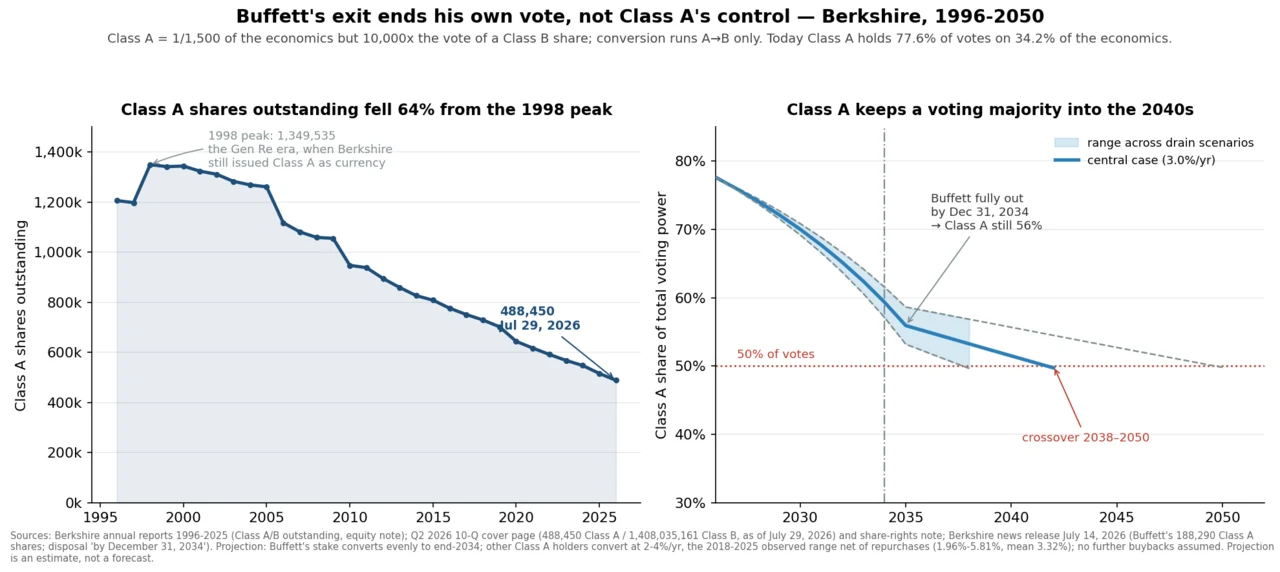
Class A Holds 78% of the Votes on 34% of the Money
Ordinary dual-class companies split economics and votes on a single ratio. Berkshire uses two. A Class B share carries 1/1,500 of the economic rights of a Class A share but only 1/10,000 of the voting rights.5 The gap between those ratios — a factor of 6.67 — is what founder control at Berkshire physically consists of.
Run it against the current share counts and the wedge is stark.
| As of July 29, 2026 | Shares outstanding | Share of votes | Share of economics |
|---|---|---|---|
| Class A | 488,4508 | 77.6% | 34.2% |
| Class B | 1,408,035,1618 | 22.4% | 65.8% |
Voting and economic shares computed from the share counts at the 1/10,000 and 1/1,500 ratios disclosed in the Q2 2026 10-Q.5
A third of the money elects three-quarters of the board. And because the Class A pool can only shrink while the Class B pool grows by 1,500 shares for every one that leaves, that wedge closes a little every year on its own — no decision required, no announcement made.
Buffett's Entire Exit Does Not Hand Control to Class B
The intuitive conclusion is that the largest planned share distribution in corporate history must break this structure. It does not, and the arithmetic is not close.
Convert all 188,290 of Buffett's Class A shares and they become 282,435,000 Class B shares. Class A falls to roughly 300,000 shares; Class B rises to about 1.69 billion. Class A's share of the vote goes from 77.6% to 64.0%. It remains a supermajority. To push Class A below half the vote you would need a further 114,011 Class A shares to convert after Buffett is finished — 38% of the entire remaining non-Buffett pool.
How long that takes depends on a rate we can actually measure. Because Berkshire discloses Class A repurchases separately in the equity note, the annual decline in the share count can be split into shares the company bought and shares that holders simply converted. Across 2018–2025 the conversion component ran between 2.0% and 5.8% of the outstanding pool a year, averaging 3.3%.9 Holding Buffett to his own deadline and letting everyone else convert at that historical pace produces this:
| Scenario (non-Buffett conversion rate) | Class A share of votes, end-2034 | Year Class A falls below 50% of votes |
|---|---|---|
| Slow, 2.0%/yr | 58.6% | 2050 |
| Central, 3.0%/yr | 55.9% | 2042 |
| Fast, 4.0%/yr | 53.2% | 2038 |
Author's projection, not a forecast: Buffett's stake converts evenly to December 31, 2034 per his stated goal;1 other Class A holders convert at the 2018–2025 observed range, whose 3.3% mean sits between the central and fast cases;9 no further repurchases assumed. The end-2034 column sits below the 64.0% quoted above because the projection lets every other Class A holder go on converting through those eight years too; the 64.0% isolates Buffett's exit on its own. Script and inputs in the site's work/scripts/.
So the honest headline is not that Class B takes over. It is that Berkshire's founder share class keeps a voting majority for roughly a decade and a half after the founder's shares are gone — and that the crossover, when it comes, will arrive with nobody in particular having caused it.
There Is Nobody Left to Inherit the Vote
The natural follow-up is: if Class A still controls 64% of the vote in 2035, who holds it? Berkshire's own answer, repeated in proxy after proxy, is that it does not know. Buffett is "the only person known to the Corporation to be the beneficial owner of more than 5% of the Corporation's Class A Stock."10 No institution has ever been disclosed as a Class A holder; BlackRock, Vanguard and State Street file against the Class B stock only.10
The two men who came closest are dead. David Gottesman, who held 2.7% of Class A as recently as the 2021 proxy, died in September 2022; Charlie Munger, at 0.7%, died in November 2023.10 The consequence shows up in a single comparison in the 2026 proxy: directors and executive officers as a group hold 38.6% of Class A, against Buffett's own 38.4%.3 Everyone else on the board, combined, rounds to two-tenths of a percentage point.
That means the roughly 300,000 Class A shares that will still command a voting majority in 2035 are, so far as any public filing discloses, dispersed among untraceable holders below the 5% reporting threshold. Control at Berkshire is not being transferred to a successor bloc. It is being atomized while the formal supermajority stays intact — which is a stranger outcome than either a clean handover or a clean collapse, and one that no filing anywhere describes as a plan.

Berkshire's Only Takeover Defense Has Been One Man's Vote
This matters because of what Berkshire does not have. There is no poison pill: no rights agreement appears anywhere in the company's filing history, and the bylaws contain no language matching "rights plan," "supermajority," "classified board" or "staggered."6 Directors are elected annually by plurality. There is one genuine minority protection — Article Fourth §2.E of the certificate requires a separate majority vote of Class B shares to approve any merger or reclassification that would increase another class's proportionate voting power11 — but that guards Class B against dilution, not Berkshire against a bidder.
The comparison that makes this concrete is with the other famous dual-class survivors. Ford's Class B sits in a family trust. The Hershey Trust holds its control block institutionally. The New York Times Class B is held through a family trust with transfer restrictions. In each case control persists across generations because it was locked into a structure — an entity that outlives its founder. Berkshire's control block is locked into a person, and it dissolves the way a person's estate does: one voluntary share at a time, into charity, permanently. The academic literature on dual-class sunsets is entirely about clauses written into charters at IPO; there is no body of work on a founder simply aging out and giving the control class away. Berkshire is about to be the case study.
Buffett anticipated the opposite risk. Every proxy since at least 2011 carries his voting agreement: should his combined voting power ever exceed 49.9%, he will vote the excess proportionately with other shareholders.3 The company built a ceiling against him having too much control. It built no floor.
The Buyback Is the Only Bid Sized for the Flow
Which brings us to the number that connects this to the story the market actually covered in August. Berkshire repurchased 8,598,193 Class B shares in the second quarter of 2026 — 1,458,312 in May at $476.01 and 7,139,881 in June at $487.98 — plus 478 Class A shares, for about $4.53 billion, after buying nothing at all in April and nothing whatsoever in 2025.212 That resumption was read everywhere as a valuation signal, and as a statement about what Greg Abel thinks Berkshire is worth. Fair enough. But look at it against the gift flow instead.
Buffett's remaining stake is 282,435,000 Class B-equivalents. Spread evenly over the eight and a half years to his deadline, placing it requires about 33.2 million Class B shares a year. Annualize the second quarter's repurchases and Berkshire is retiring 34.4 million a year — 104% of that flow. Annualize the fuller first half, which includes a January-through-April in which nothing was bought, and it is 54%.1213 The honest reading is a range rather than a coincidence: at June's pace the buyback absorbs Buffett's entire giving programme; at the half-year pace, about half of it.
There is a second-order effect that is not a matter of interpretation at all. Retiring Class B shares shrinks the Class B vote pool, which raises Class A's voting percentage. Every dollar Berkshire spends buying back the cheaper share class mechanically postpones the day the founder class loses its majority. Run the repurchase at the second quarter's pace indefinitely and the crossover never happens; run it at a tenth of that and 2042 becomes 2045. The buyback we have discussed elsewhere as a pressure gauge on the cash yield ↗ turns out to be, simultaneously and without anyone saying so, the control lever. Whether that is intended is unknowable and beside the point. The arithmetic does not require intent.
Three People in Their Seventies Have to Move $16 Billion a Year
The deadline is the weak link, and Buffett has said so. In November 2025 he wrote that his children "are all above normal retirement age, having reached 72, 70 and 67," that it "would be a mistake to wager that all three... will enjoy my exceptional luck in delayed aging," and that to improve the odds they can dispose of essentially his entire estate before alternate trustees replace them, "I need to step up the pace of lifetime gifts."14 The 2023 release describes the machinery: three children as trustees who "must act unanimously," administering a testamentary trust that "will be self-liquidating after a decade or so."15 The same three are the family Berkshire shareholders have been told to expect in the boardroom rather than the executive suite, an arrangement we looked at when Howard Buffett's non-executive chairmanship ↗ came into view. Note the hedge — a decade or so, not ten years. Even the plan does not commit to its own timetable.
The capacity problem is arithmetic. The four recipient foundations held about $3.87 billion between them in their most recent structured filings — the Susan Thompson Buffett Foundation $2.27 billion, NoVo $719 million, Sherwood $460 million and the Howard G. Buffett Foundation $420 million (FY2023; Form 990-PF data lags roughly two years).16 Buffett intends to route $138 billion through them in eight years. That is 35 times their combined current asset base, arriving at roughly $16.3 billion a year, against foundations whose grantmaking today runs in the low single-digit billions. Fortune, citing Inside Philanthropy, reports five-year average payout rates of 41% at the Susan Thompson Buffett Foundation, 59% at Howard G. Buffett and 87% at Sherwood — extraordinary multiples of the 5% minimum that federal law requires of a private foundation.1718 These are not endowments that sit on stock. They are spend-down machines, and they will need to scale five- to ten-fold to keep the schedule.
Nor does the law force the selling that the schedule implies, which is worth stating plainly because it cuts against the easy version of this argument. The federal rule sets a spending floor, not a selling one: a private foundation must distribute 5% of "the aggregate fair market value of all assets" not used directly for its exempt purpose, and a qualifying distribution is simply "any amount... paid to accomplish" a charitable purpose — nothing in the statute requires that amount to be cash.18 No law compels a single share to be sold. The evidence for selling is behavioural instead, and it is twenty years deep. The Gates Foundation Trust's Berkshire position fell from 87.1 million B shares at the end of 2012 to 17.0 million by the first quarter of 2026 — an 80% liquidation carried out while the annual gifts were still arriving.19 Recipients of Berkshire stock, historically, sell it.
None of this is a crisis, and the daily-volume math is undramatic: 33 million B shares a year is about 3% of BRK.B's average daily turnover.20 The point is narrower and more durable. Berkshire's ownership is on a published schedule for the first time, the schedule depends on the health and unanimity of three people in their seventies, and every year it slips pushes the voting arithmetic further out. The company will spend the 2030s as something it has never been: a business whose control class is a countdown rather than a constituency.
One clause in Berkshire's own governance guidelines has already been written for the ending. Directors are not eligible for re-election after their 80th birthday — except, the January 2026 revision specifies, that "any director who controls a 5% or greater voting interest in the Company will be eligible to be reelected after his or her 80th birthday."21 It is a rule with exactly one living subject, and on Buffett's own timetable it has eight years left before it applies to nobody at all.
References
-
Berkshire Hathaway news release, July 14, 2026 - berkshirehathaway.com — “My goal is to dispose of all of my Berkshire shares within about eight years… I have every hope that the three of them are able to carry out the disposal of my shares by December 31, 2034.” and “Mr. Buffett’s ownership of Berkshire now consists of 188,290 Class A shares and 1,162 Class B shares.” ↩↩
-
Berkshire Hathaway Q2 2026 Form 10-Q, Part II Item 2 (Issuer Purchases of Equity Securities) - berkshirehathaway.com — “413 Class A shares at an average price of $733,775.06; 7,139,881 Class B shares at an average price of $487.98” (June 2026 rows) ↩↩
-
Berkshire Hathaway 2026 Proxy Statement (DEF 14A), beneficial ownership as of March 4, 2026 - berkshirehathaway.com — “Warren E. Buffett … 196,317 Class A … 38.4% … 30.2% [aggregate voting power] … 13.7% [aggregate economic interest]”; directors and executive officers as a group 38.6% of Class A. The proxy's prose section rounds voting power to “approximately 30.0%”. ↩↩↩
-
Berkshire Hathaway news release, June 27, 2025 - berkshirehathaway.com — “When originally made, I owned 474,998 Berkshire A shares worth about $43 billion… During the following 19 years, I have neither bought nor sold any A or B shares… The five foundations have received Berkshire B shares that had a value when received of about $60 billion.” ↩
-
Berkshire Hathaway Q2 2026 Form 10-Q, common stock note - berkshirehathaway.com — “Each share of Class A common stock is convertible, at the option of the holder, into 1,500 shares of Class B common stock. Class B common stock is not convertible into Class A common stock… Each Class B common share possesses voting rights equal to one-ten-thousandth (1/10,000) of the voting rights of a Class A share.” ↩↩
-
Berkshire Hathaway Bylaws, as amended (Exhibit 3(ii)) - sec.gov ↩↩
-
Berkshire Hathaway 1998 Annual Report - berkshirehathaway.com — “General Re shareholders received at their election either 0.0035 shares of Berkshire Class A Common Stock or 0.105 shares of Berkshire Class B Common Stock for each share of General Re” ↩
-
Berkshire Hathaway Q2 2026 Form 10-Q, cover page - berkshirehathaway.com — “Class A — 488,450 shares; Class B — 1,408,035,161 shares” (as of July 29, 2026) ↩
-
Berkshire Hathaway annual reports 1996–2025, "Changes in issued and outstanding Berkshire common stock" note - berkshirehathaway.com ↩
-
Berkshire Hathaway 2021 Proxy Statement (DEF 14A) - sec.gov — “the only person known to the Corporation to be the beneficial owner of more than 5% of the Corporation’s Class A Stock”; Gottesman 17,202 Class A (2.7%), Munger 4,458 Class A (0.7%) ↩↩↩
-
Berkshire Hathaway Restated Certificate of Incorporation, Article Fourth §2.E - sec.gov ↩
-
Berkshire Hathaway Q1 2026 Form 10-Q, Part II Item 2 (and Q2 2026) - berkshirehathaway.com ↩↩
-
Berkshire Hathaway 2025 Annual Report - berkshirehathaway.com — “No Class A or Class B shares were repurchased in the fourth quarter of 2025”; no repurchases in 2025 ↩
-
Berkshire Hathaway news release, November 10, 2025 - berkshirehathaway.com — “My children are all above normal retirement age, having reached 72, 70 and 67… To improve the probability that they will dispose of what will essentially be my entire estate before alternate trustees replace them, I need to step up the pace of lifetime gifts.” ↩
-
Berkshire Hathaway news release, November 21, 2023 - berkshirehathaway.com — “In administering the testamentary trust, the three must act unanimously… The testamentary trust will be self-liquidating after a decade or so.” ↩
-
IRS Forms 990-PF (FY2023) via ProPublica Nonprofit Explorer - propublica.org ↩
-
Fortune, "Is Warren Buffett avoiding taxes by giving $140 billion to family foundations?", July 30, 2026, citing Inside Philanthropy - fortune.com ↩
-
26 U.S.C. §4942, "Taxes on failure to distribute income" - law.cornell.edu — “the minimum investment return for any private foundation for any taxable year is 5 percent of the excess of—(A) the aggregate fair market value of all assets of the foundation other than those which are used (or held for use) directly in carrying out the foundation’s exempt purpose” (§4942(e)(1)); qualifying distributions are “any amount… paid to accomplish one or more purposes described in section 170(c)(2)(B)” (§4942(g)(1)(A)) ↩↩
-
Bill & Melinda Gates Foundation Trust, Forms 13F, 2012–Q1 2026 - sec.gov ↩
-
BRK.B average daily trading volume - stockanalysis.com ↩
-
Berkshire Hathaway Corporate Governance Guidelines, revised January 2026 - berkshirehathaway.com — “Any director who controls a 5% or greater voting interest in the Company will be eligible to be reelected after his or her 80th birthday.” ↩