Tags: Share Buyback / Greg Abel / Warren Buffett
This fanpage is not officially affiliated with Berkshire Hathaway: Disclaimer
In June 2026 Berkshire Hathaway bought 413 of its own Class A shares at an average of $733,775.06 each, alongside 7,139,881 Class B shares at $487.98.1 That is $3.79 billion in a single month, and it came after a May in which the company spent $741 million at a price 2.5% lower. Five times the money, at a higher price, in the second month. Berkshire will never tell you what it thinks it is worth. But it just told you what it was willing to pay, twice, four weeks apart, and the two numbers do not describe a company buying a dip. They describe a company that decided a level was cheap and then leaned on it. What follows reconstructs every such statement Berkshire has made since 2011 — the revealed floor under management's own estimate of intrinsic value — and finds that the 21-month buyback drought which everyone read as Buffett-style patience ended without the stock ever getting cheap.

Every Repurchase Is a Valuation Statement Berkshire Never Otherwise Makes
Berkshire publishes no target price, no sum-of-the-parts, no "we believe intrinsic value is approximately." Its annual report contains exactly one sentence in which the company comments on the worth of its own shares, and it appears in the boilerplate describing the repurchase program: Berkshire may buy stock whenever the Chief Executive Officer, after consultation with the Chairman of the Board, "believes that the repurchase price is below Berkshire's intrinsic value, conservatively determined."2
One note on units before the numbers start. Berkshire discloses its repurchases in both share classes, and this piece quotes both, because a Class B share carries "dividend and distribution rights equal to one-fifteen-hundredth (1/1,500)" of a Class A share.2 The conversion is exact, which means the ratio at the centre of this article — price paid against book value per share — is identical whichever class you hold. A B shareholder can read every multiple below as their own.
That sentence is thin as prose and thick as evidence. Every share repurchased is a disclosed transaction at a disclosed price, and each one is an assertion under that clause: at this price, the stock is worth more than we paid. It sets a floor. Not the value itself, but a floor beneath it, and a floor that Berkshire's own filings force it to publish month by month.
The floor needs a denominator to be comparable across sixteen years, and Berkshire supplied that too. When Buffett announced the program in September 2011, he set the limit in book value: Berkshire would repurchase "at a price of up to 110% of book value." It lasted days. "We were in the market for only a few days — buying $67 million of stock — before the price advanced beyond our limit," he wrote that winter.3 Book value was the company's own chosen yardstick for its own stock for seven years, which makes it the honest unit for reading the record, whatever its defects. And it has plenty, which we come to.
The reasoning behind the limit was never subtle. "It's hard to go wrong when you're buying dollar bills for 80¢ or less," Buffett wrote in 2012.4 Take that literally and the arithmetic runs backwards: a purchase at 1.40× book claims an intrinsic value near 1.75× book — which, on the June 2026 balance sheet, would put Berkshire's worth around $611 a Class B share against the $489 it paid. Take it loosely and you still get the shape of the thing. The floor is disclosed. The ceiling has to be inferred from silence.
The Cap Berkshire Set, Broke, and Then Kept Anyway
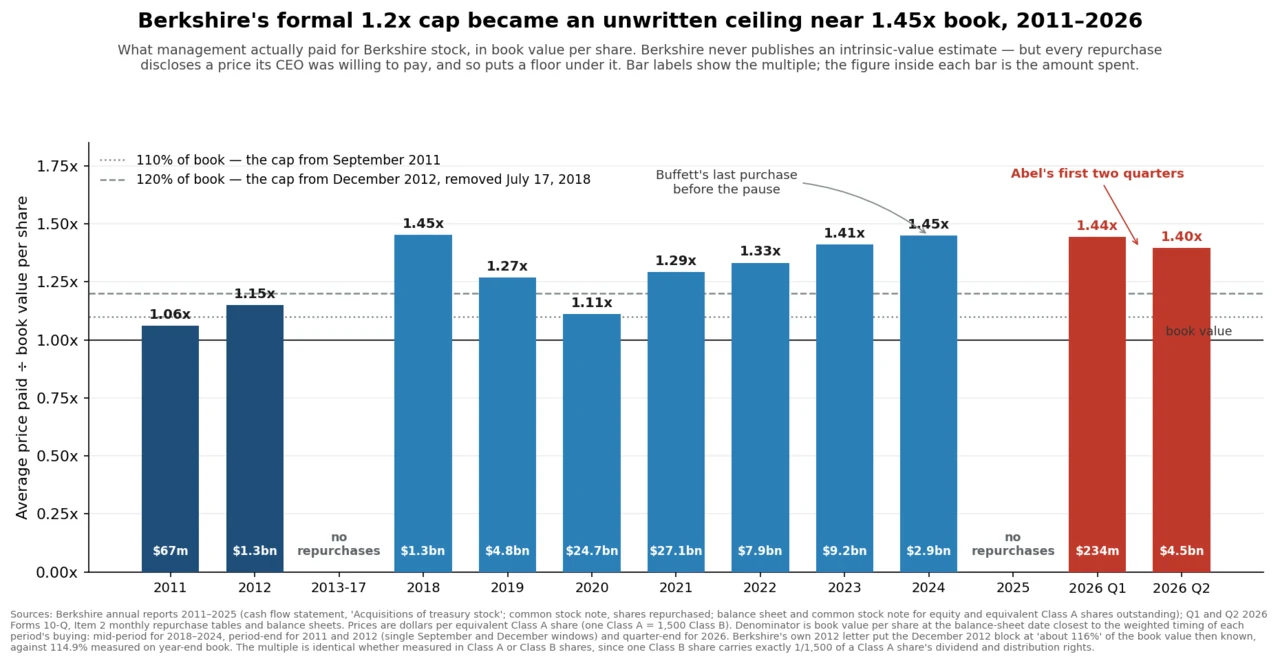
The formal history is three sentences long. September 2011: repurchases permitted at up to 110% of book. December 2012: the board raised the limit to 120%. July 17, 2018: the board threw the percentage away entirely, replacing it with the judgement of Buffett and Munger that the price sat below intrinsic value, conservatively determined.56
What makes the 2012 amendment worth pausing on is that Buffett explained it with something close to embarrassment. "We originally said we would not pay more than 110% of book value, but that proved unrealistic. Therefore, we increased the limit to 120% in December when a large block became available at about 116% of book value."4 The rule did not survive contact with a seller. Measured against year-end book, that year's buying comes out at 114.9%; Buffett, using the book value known to him at the time, called the block "about 116%." The gap between those two figures is the whole methodological problem of this exercise in miniature, and it is worth about one percentage point.
Then five years of nothing. From 2013 through 2017 Berkshire repurchased no stock at all, because the price never fell to the cap. The cap was doing precisely what a cap does: excluding the company from its own stock for half a decade.
The series below puts a number on each of those statements. Dollars spent come from the treasury-stock line of the cash flow statement,7 shares and equity from the balance sheets and common stock notes behind it.8
| Period | Spent | Equivalent A shares | Avg price paid per B / per A | Book value per share per B / per A | Price ÷ book |
|---|---|---|---|---|---|
| 2011 | $67m | 633 | $70.60 $105,903 | $66.57 $99,860 | 1.06× |
| 2012 | $1,296m | 9,879 | $87.46 $131,183 | $76.14 $114,214 | 1.15× |
| 2013–2017 | no repurchases | ||||
| 2018 | $1,346m | 4,370 | $205.35 $308,026 | $141.42 $212,127 | 1.45× |
| 2019 | $4,850m | 16,149 | $200.22 $300,329 | $157.97 $236,960 | 1.27× |
| 2020 | $24,706m | 80,998 | $203.35 $305,021 | $182.82 $274,224 | 1.11× |
| 2021 | $27,061m | 66,531 | $271.16 $406,745 | $209.88 $314,826 | 1.29× |
| 2022 | $7,854m | 17,696 | $295.89 $443,830 | $222.07 $333,107 | 1.33× |
| 2023 | $9,171m | 18,251 | $335.00 $502,501 | $237.66 $356,483 | 1.41× |
| 2024 | $2,918m | 4,787 | $406.38 $609,568 | $280.29 $420,440 | 1.45× |
| 2025 | no repurchases | ||||
| 2026 Q1 | $234m | 321 | $486.87 $730,310 | $337.15 $505,723 | 1.44× |
| 2026 Q2 | $4,528m | 6,210 | $486.08 $729,114 | $348.26 $522,396 | 1.40× |
Book value per share is Berkshire shareholders' equity divided by equivalent Class A shares outstanding, taken at the balance-sheet date closest to when that period's buying actually happened: mid-period for 2018–2024, period-end for 2011 and 2012 (a few days in September and a December block), quarter-end for 2026. Class B figures are the Class A figures divided by 1,500. Equity is taken as originally reported in each year, not as later restated — the long-duration-insurance-contracts standard adopted in 2023 restated December 2020 equity down and December 2022 equity up, which moves the 2020 multiple to 1.12× and leaves 2022 at 1.33×. Sources578.
The pattern after the cap came off is the interesting part. Berkshire did not wander. Across seven years of discretionary buying the annual multiple never once printed above 1.45×, and it hit that number exactly twice: in 2018, the first months of freedom, and in 2024, the last months before the drought. A formal cap of 1.20 was replaced by an unwritten one about a quarter higher, and then observed.
Buffett Retired Book Value in the Same Year He Stopped Capping It
There is an awkwardness in the ledger above that has to be met head-on, because Buffett himself raised it. In the 2018 letter, the same year the board deleted the 120% rule, he announced that Berkshire would stop reporting the annual change in book value per share at the top of the report. "The fact is that the annual change in Berkshire's book value … is a metric that has lost the relevance it once had."9
He gave three reasons, and the third is the one that matters here: Berkshire "will be a significant repurchaser of its shares, transactions that will take place at prices above book value but below our estimate of intrinsic value. The math of such purchases is simple: Each transaction makes per-share intrinsic value go up, while per-share book value goes down."9 Buybacks above book shrink book value per share. The denominator in this whole exercise is partly a product of the numerator.
So the chart above measures Berkshire in a unit its own chairman publicly retired. That is not a reason to abandon it; it is a reason to state the size of the distortion. Every dollar paid above book destroys book, and the sums are knowable: the 2021 buying at 1.29× consumed about $6.1 billion of book value, the 2020 buying about $2.5 billion, and the first half of 2026 about $1.4 billion, each measured against the same book value the table above uses for that period. The last of those sits against $747.9 billion of shareholders' equity, a rounding error of under two tenths of one percent.10 The 2020–21 numbers matter at the margin; 2026's does not.
The second of Buffett's three reasons cuts the other way, and cuts harder. Berkshire's marketable stocks are carried at market, but the operating companies — GEICO, BNSF, the utilities, See's, the whole manufacturing lattice — sit in book "at an amount far below their current value, a mismark that has grown in recent years."9 That mismark is why the revealed floor drifts upward over time even if management's discipline never changes. A machine whose best assets are frozen at historical cost gets structurally more expensive against book with every year of retained earnings, and 1.40× book in 2026 is not the same claim as 1.40× book would have been in 2012.
Twenty-One Months of Silence Set the Other Bound
Berkshire's last repurchase under Buffett was in May 2024: 100 Class A shares at an average of $626,685.61, and not one Class B.11 That is $417.79 in Class B terms. Against the book value the company reported six weeks later — $418,806 per Class A share, or $279.20 per Class B — it works out at 1.50× book, the richest single month in the record.12
Then it stopped. June 2024: nothing. All of 2025: nothing, a fact the 2025 Form 10-K records with three em-dashes in the fourth-quarter table.13 January and February 2026: nothing.14 Twenty-one consecutive months in which a company sitting on the largest liquid balance sheet in corporate history, with an explicit standing authorisation and no volume limit, bought none of the only asset it understands perfectly.

Read the way this article reads buying, not buying discloses the other bound. If a purchase at a given price asserts that intrinsic value exceeds it, then a refusal to purchase, month after month, with the money sitting right there, asserts something weaker but still real: that the asking price was not comfortably below it. Between the two you get a bracket. Buffett would pay 1.50× in May 2024 and would not pay whatever the market asked for the next twenty-one months.
What the market asked, we can get at without leaving Berkshire's own filings. The performance table on page 20 of the annual report gives the change in per-share market value each year: +25.5% in 2024 and +10.9% in 2025.15 Book value per share over the same two years rose 16.0% and 10.5%. So the multiple expanded about 8% during 2024 and moved four tenths of one percent during 2025. Nothing in those two calendar years brought Berkshire back to where Buffett had last been willing to write a cheque. The drought was not indecision. It was arithmetic that had not yet happened.
The Denominator Did the Work, Not the Price
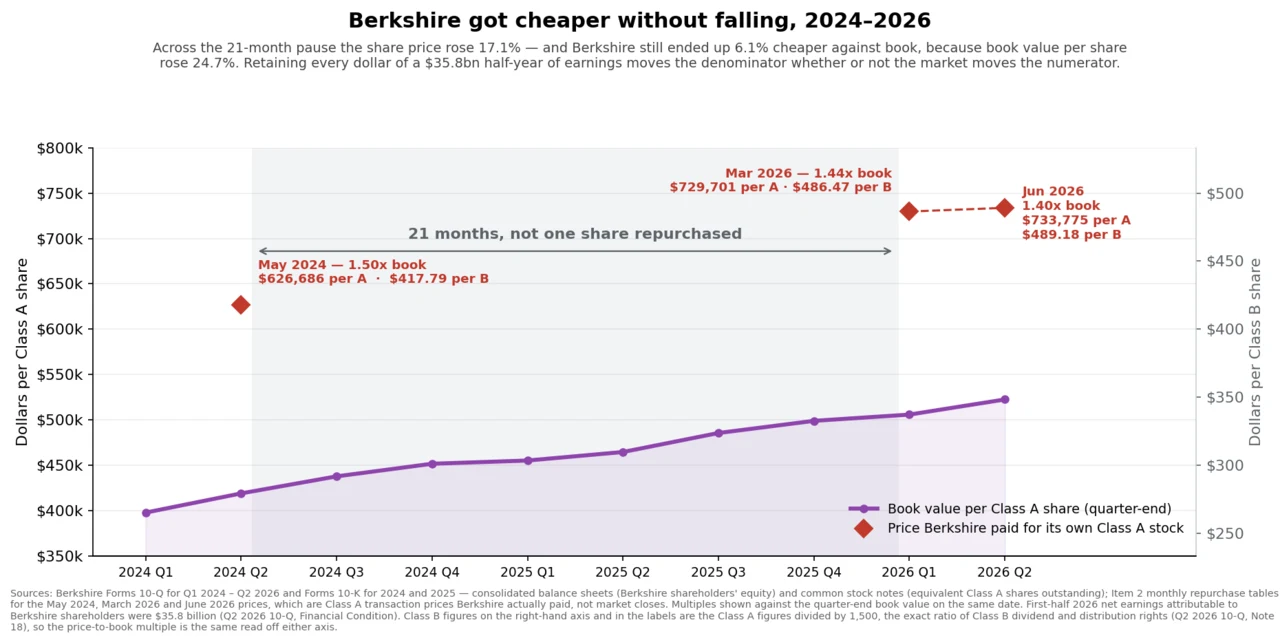
Here is the finding that inverts the standard telling. Between Buffett's last purchase and Abel's biggest one, Berkshire's share price went up 17.1%, from $626,685.61 in May 2024 to $733,775.06 in June 2026 — in the currency most readers of this site actually hold, from $417.79 to $489.18 a Class B share. Over the same eight quarters, book value rose 24.7%, from $418,806 to $522,396 per Class A share, or from $279.20 to $348.26 per Class B. The multiple therefore fell 6.1%, from 1.50× to 1.40×, without the stock ever going through a sustained decline.1111216
Berkshire got cheap the way a mortgage gets small: not because the number in front changed, but because the number underneath grew faster. And it grows faster by construction. Berkshire has not paid a dividend since 1967, so every dollar earned stays inside the denominator. First-half 2026 net earnings attributable to shareholders were $35.8 billion, and shareholders' equity rose $30.5 billion in six months.16 Book value per share has compounded at roughly 11.7% a year across the pause. A share price would have to run above that pace, indefinitely, just to keep the multiple still.
That is a peculiar and underappreciated property of a full-retention conglomerate: the buyback trigger is self-arming. Sit out long enough and the denominator walks up to meet the price. The counterpart of that mechanism is the one this archive has already traced from the other end, the Treasury-bill engine that made abstention comfortable while it paid five percent, and whose decay now forces deployment ↗. The cliff explains why Abel had to spend. The revealed floor explains what he was waiting to pay.
Abel Sized Up as the Price Went Up
The 2026 restart happened in three steps, and the steps are more interesting than the total.
| Month | Class A shares | Avg price, A | Class B shares | Avg price, B | Total spent | Price ÷ book |
|---|---|---|---|---|---|---|
| March 2026 | 33 | $729,701.17 | 431,462 | $486.92 | $234m | 1.44× |
| April 2026 | no repurchases | |||||
| May 2026 | 65 | $716,231.37 | 1,458,312 | $476.01 | $741m | 1.37× |
| June 2026 | 413 | $733,775.06 | 7,139,881 | $487.98 | $3,787m | 1.40× |
Multiples are the blended price per equivalent Class A share against book value per share at the end of the quarter containing the purchase ($505,723 per Class A share, or $337.15 per Class B, for March; $522,396 and $348.26 for May and June). Sources114.
A toe in the water in March at 1.44×. Nothing in April. Then $741 million in May at the cheapest multiple of the three, and $3.79 billion in June, five times as much money at a Class B price 2.5% higher.
Buffett has a line about this exact behaviour, and it is not a compliment. From the 2020 letter: "American CEOs have an embarrassing record of devoting more company funds to repurchases when prices have risen than when they have tanked. Our approach is exactly the reverse."17 On a literal reading of one quarter, Abel did the embarrassing thing.
The fairer reading is that he is running a different sensitivity, not a worse one. Buffett's rule is about price against value, and on that axis Abel's June purchases at 1.40× sat below every share Buffett bought in 2023 and 2024. Nothing in the June ramp took Berkshire above the unwritten ceiling; it took Berkshire deeper below it. What changed month to month was size, and size at Berkshire is now constrained by something other than conviction: a $359.2 billion cash and Treasury-bill position against a self-imposed floor of $30 billion, in a year that has already absorbed $9.4 billion for OxyChem in January and $6.8 billion for Taylor Morrison in July.16 A CEO with that much dry powder and a stock inside his range does not tiptoe for long. He builds a position, and building a position over four weeks means paying whatever those four weeks cost.
Which of those two readings is right is a question the November 10-Q settles. If Abel keeps buying as the multiple climbs back toward 1.45×, the line has moved and this is a cash-disposal valve wearing valuation clothes. If the buying thins as the multiple rises, the floor is real and Berkshire has simply changed hands without changing rules.
What Book Value Hides in Both Directions
The revealed floor is a measurement, and measurements have error bars. Four of them deserve naming.
The first is timing. A year's purchases are compared against a year's book, and the two are not the same shape. Berkshire's 2024 buying happened between January and May, so the annual figure of 1.45× is a blend; the last month of it, taken against the nearest reported balance sheet, was 1.50×. That year is also the thinnest reading in the series — 4,787 Class A shares and not a single Class B, against the 95.6 million Class B shares bought in 2020.8 Read the annual bars as a range, not a level.
The second is the mismark Buffett named: operating businesses carried at cost less depreciation flatter the multiple upward over time.9 The third runs opposite. Berkshire's balance sheet carried $90.2 billion of income taxes, principally deferred, at 30 June, much of it against unrealised gains on an equity portfolio it has no intention of selling, so book value is already stated after a tax bill that may never fall due.18 And book takes real hits when management concedes a mistake, such as the roughly $9.8 billion after-tax written off Precision Castparts in 2020, an impairment the business has since spent five years earning back ↗.19 Book value is conservative in some places and stale in others, and the two errors do not cancel on any schedule you can predict.
The fourth is that a repurchase is never only a valuation act. Retiring Class B shares mechanically lifts Class A's share of the vote, which makes the same Q2 table a governance document as well as a valuation one ↗. And a company under public pressure over an idle balance sheet has motives for buying its own stock that have nothing to do with what it is worth. The floor is what the purchase asserts, not proof the assertion is right.
Even allowing all four, the series holds its shape. Under a formal cap, Berkshire paid 1.06× and 1.15×. Uncapped, across $78 billion of buying in seven years, it never averaged above 1.45× in any year and never came back to the 1.11× it paid in the panic of 2020. Whatever intrinsic value is, management has behaved for eight years as though it sits somewhere north of one and a half times book, and as though the difference between 1.40× and 1.50× is worth waiting nearly two years for.
The Sentence That Lost Its Name
The clause authorising all of this has been rewritten four times, and its edits are a compressed history of who Berkshire is.
From 2011 it was a percentage, no person, just 110% of book and then 120%. From July 2018 it named two men: repurchases whenever Warren Buffett and Charles Munger "believe that the repurchase price is below Berkshire's intrinsic value, conservatively determined."6 After Munger's death in 2023 the annual report quietly dropped to one name, Buffett alone.20 And then, "in 2025," per a single sentence in the 2025 Form 10-K, the program was amended again, this time to name nobody at all, only an office: the Chief Executive Officer, after consultation with the Chairman of the Board.13 Berkshire filed no 8-K about it. The transfer of the only authority in the company that ever comments on Berkshire's own worth reached shareholders as a paragraph in an annual report, sitting between the dividend line and the stock performance graph.
There is something fitting in that. For sixty years the answer to "what is Berkshire worth?" was a man who declined to say. It is now an office that declines to say, and the only way to read its mind is the way it has always been: watch the money. Berkshire's stock changed hands around $743,500 in late August — about $496 a Class B share — a shade above where Abel was buying in June and a shade under 1.43× the book value he reported on 30 June.21 He is close enough to his own line that the next 10-Q will show whether it is a line at all.
References
-
Berkshire Hathaway Q2 2026 Form 10-Q — Item 2, Issuer Repurchases of Equity Securities - berkshirehathaway.com — “May … Class A common stock 65 … 716,231.37 … Class B common stock 1,458,312 … 476.01 … June … Class A common stock 413 … 733,775.06 … Class B common stock 7,139,881 … 487.98” ↩↩
-
Berkshire Hathaway Q2 2026 Form 10-Q — Common stock note - berkshirehathaway.com — “…any time that Berkshire’s Chief Executive Officer, after consultation with the Chairman of the Board, believes that the repurchase price is below Berkshire’s intrinsic value, conservatively determined.” ↩↩
-
Warren Buffett, 2011 Letter to Shareholders — "Share Repurchases" - berkshirehathaway.com — “Last September, we announced that Berkshire would repurchase its shares at a price of up to 110% of book value. We were in the market for only a few days – buying $67 million of stock – before the price advanced beyond our limit.” ↩
-
Warren Buffett, 2012 Letter to Shareholders - berkshirehathaway.com — “It’s hard to go wrong when you’re buying dollar bills for 80¢ or less … We originally said we would not pay more than 110% of book value, but that proved unrealistic. Therefore, we increased the limit to 120% in December when a large block became available at about 116% of book value.” ↩↩
-
Berkshire Hathaway 2012 Annual Report — Note 18, Common stock - berkshirehathaway.com — “In September 2011, Berkshire’s Board of Directors approved a common stock repurchase program under which Berkshire may repurchase its Class A and Class B shares at prices no higher than a 10% premium over the book value of the shares. In December 2012, Berkshire’s Board amended the repurchase program by raising the price limit to no higher than a 20% premium over book value.” ↩
-
Berkshire Hathaway 2018 Annual Report — Item 5, Common Stock Repurchase Program - berkshirehathaway.com — “On July 17, 2018, Berkshire’s Board of Directors authorized an amendment to the program, permitting Berkshire to repurchase shares any time that Warren Buffett … and Charles Munger … believe that the repurchase price is below Berkshire’s intrinsic value, conservatively determined.” ↩↩
-
Berkshire Hathaway annual reports 2011–2025 — Consolidated Statements of Cash Flows - berkshirehathaway.com — "Acquisitions of treasury stock" ($m): 2011 67; 2012 1,296; 2018 1,346; 2019 4,850; 2020 24,706; 2021 27,061; 2022 7,854; 2023 9,171; 2024 2,918; 2025 nil. ↩
-
Berkshire Hathaway annual reports 2010–2025 — Consolidated Balance Sheets and Common stock notes - berkshirehathaway.com — Berkshire shareholders' equity and equivalent Class A shares outstanding at each December 31 (the two inputs to book value per share), plus Class A and Class B treasury shares acquired each year: 2018, 1,217 A and 4,729,147 B; 2020, 17,255 A and 95,614,062 B; 2024, 4,787 A and none. ↩↩
-
Warren Buffett, 2018 Letter to Shareholders - berkshirehathaway.com — “The fact is that the annual change in Berkshire’s book value … is a metric that has lost the relevance it once had … accounting rules require our collection of operating companies to be included in book value at an amount far below their current value, a mismark that has grown in recent years … Each transaction makes per-share intrinsic value go up, while per-share book value goes down.” ↩↩↩↩
-
Berkshire Hathaway annual reports 2020–2021 and Q2 2026 Form 10-Q — derived - berkshirehathaway.com — Book value consumed = equivalent Class A shares repurchased × (average price paid − book value per share): 2020, 80,998 × ($305,021 − $274,224) = $2.49bn; 2021, 66,531 × ($406,745 − $314,826) = $6.12bn; first half 2026, $1.36bn against $747,910m of Berkshire shareholders' equity, or 0.18%. ↩
-
Berkshire Hathaway Q2 2024 Form 10-Q — Item 2, Issuer Repurchases - sec.gov — “May … Class A common stock 100 … $626,685.61 … Class B common stock — … June … Class A common stock — … Class B common stock —” ↩↩
-
Berkshire Hathaway Q2 2024 Form 10-Q — Consolidated Balance Sheet and Common stock note - sec.gov — Berkshire Hathaway shareholders' equity $601,697m; “there were 1,436,696 shares outstanding as of June 30, 2024” on an equivalent Class A basis, giving $418,806 per Class A share. ↩↩
-
Berkshire Hathaway 2025 Annual Report — Item 5, Common Stock Repurchase Program - berkshirehathaway.com — “In 2025, Berkshire’s common stock repurchase program was amended to permit Berkshire to repurchase its Class A and Class B common stock at any time that Berkshire’s Chief Executive Officer, after consultation with the Chairman of the Board, believes that the repurchase price is below Berkshire’s intrinsic value, conservatively determined. Prior to the amendment, the program permitted Warren Buffett … No Class A or Class B shares were repurchased in the fourth quarter of 2025.” ↩↩
-
Berkshire Hathaway Q1 2026 Form 10-Q — Item 2 and Consolidated Balance Sheet - berkshirehathaway.com — January and February show no shares purchased; “March … Class A common stock 33 … 729,701.17 … Class B common stock 431,462 … 486.92”; Berkshire shareholders' equity $727,181m and 1,437,903 equivalent Class A shares outstanding at March 31, 2026. ↩
-
Berkshire Hathaway 2025 Annual Report — "Berkshire's Performance vs. the S&P 500", p.20 - berkshirehathaway.com — annual percentage change in per-share market value of Berkshire: “2024 … 25.5 … 2025 … 10.9” ↩
-
Berkshire Hathaway Q2 2026 Form 10-Q — Management's Discussion, Financial Condition - berkshirehathaway.com — “Berkshire’s shareholders’ equity at June 30, 2026 was $747.9 billion, an increase of $30.5 billion since December 31, 2025. Net earnings attributable to Berkshire shareholders were $35.8 billion for the first six months of 2026 … Berkshire acquired $4.8 billion of treasury stock in the first six months of 2026, most of which was in the second quarter … investments in cash, cash equivalents and U.S. Treasury Bills (net of payables for unsettled purchases) of $359.2 billion … On January 2, 2026, Berkshire acquired OxyChem for approximately $9.4 billion. Additionally, Berkshire acquired Taylor Morrison Home Corporation on July 24, 2026, for aggregate cash consideration of approximately $6.8 billion.” ↩↩↩
-
Warren Buffett, 2020 Letter to Shareholders - berkshirehathaway.com — “In no way do we think that Berkshire shares should be repurchased at simply any price. I emphasize that point because American CEOs have an embarrassing record of devoting more company funds to repurchases when prices have risen than when they have tanked. Our approach is exactly the reverse.” ↩
-
Berkshire Hathaway Q2 2026 Form 10-Q — Consolidated Balance Sheet - berkshirehathaway.com — “Income taxes, principally deferred 90,176” ($m, at June 30, 2026; $86,955m at December 31, 2025). ↩
-
Berkshire Hathaway 2020 Annual Report — Management's Discussion - berkshirehathaway.com — “Approximately $9.8 billion of the charges in 2020 were attributable to impairments of goodwill and identifiable intangible assets recorded in connection with Berkshire’s acquisition of Precision Castparts in 2016.” (after-tax) ↩
-
Berkshire Hathaway 2024 Annual Report — Common stock note - berkshirehathaway.com — “Berkshire’s common stock repurchase program, as amended, permits Berkshire to repurchase shares any time that Warren Buffett, Berkshire’s Chairman of the Board and Chief Executive Officer, believes that the repurchase price is below Berkshire’s intrinsic value, conservatively determined.” ↩
-
Berkshire Hathaway Class A (BRK.A) share price - cnbc.com — last close $743,500 as of August 21, 2026; exchange price data, not a company disclosure. ↩