Tags: Cash / Interest Rates / Share Buyback
This fanpage is not officially affiliated with Berkshire Hathaway: Disclaimer
For three glorious years, Berkshire Hathaway's mountain of cash stopped being a punchline and started being a business. The same $300-billion-plus hoard that commentators once scolded as "idle" quietly became one of the largest earners in the entire conglomerate — a bond engine wired directly to the Federal Reserve. But engines wired to the Fed run in both directions, and the meter has already started ticking backward: insurance investment income fell in 2025, and fell again in the first quarter of 2026.12 This is the story of the reinvestment cliff — how big the drop can get, why Berkshire has almost nowhere to hide from it, and why a shrinking bond engine may be the most bullish signal the company sends.

The engine nobody built on purpose
Warren Buffett did not set out to build a bond fund. For most of Berkshire's history the insurance investment book was a place to hold great businesses — Coca-Cola, American Express, Apple — with a slug of cash on the side for safety and opportunism. As recently as 2021, the interest earned on that cash was a rounding error: insurance "interest and other investment income" was just $589 million for the entire year, dwarfed by roughly $5 billion of stock dividends.3 Cash yielded nothing because the Fed had pinned short rates to the floor, and Buffett said so plainly, warning in his 2020 letter that "bonds are not the place to be these days" with the 10-year Treasury yielding 0.93%.8
Then the Fed hiked, fast. And here the accident of Berkshire's balance sheet became a windfall. By 2024, that same interest line had reached $11.55 billion — a nearly twenty-fold jump in three years — while dividend income barely moved.3 Buffett described the mechanism himself in the 2024 letter with characteristic understatement: Berkshire "was aided by a predictable large gain in investment income as Treasury Bill yields improved and we substantially increased our holdings of these highly-liquid short-term securities."4 Two things happened at once — the pile got bigger, and each dollar in it earned more. The result was an earnings stream that, on a pre-tax basis, rivals BNSF.
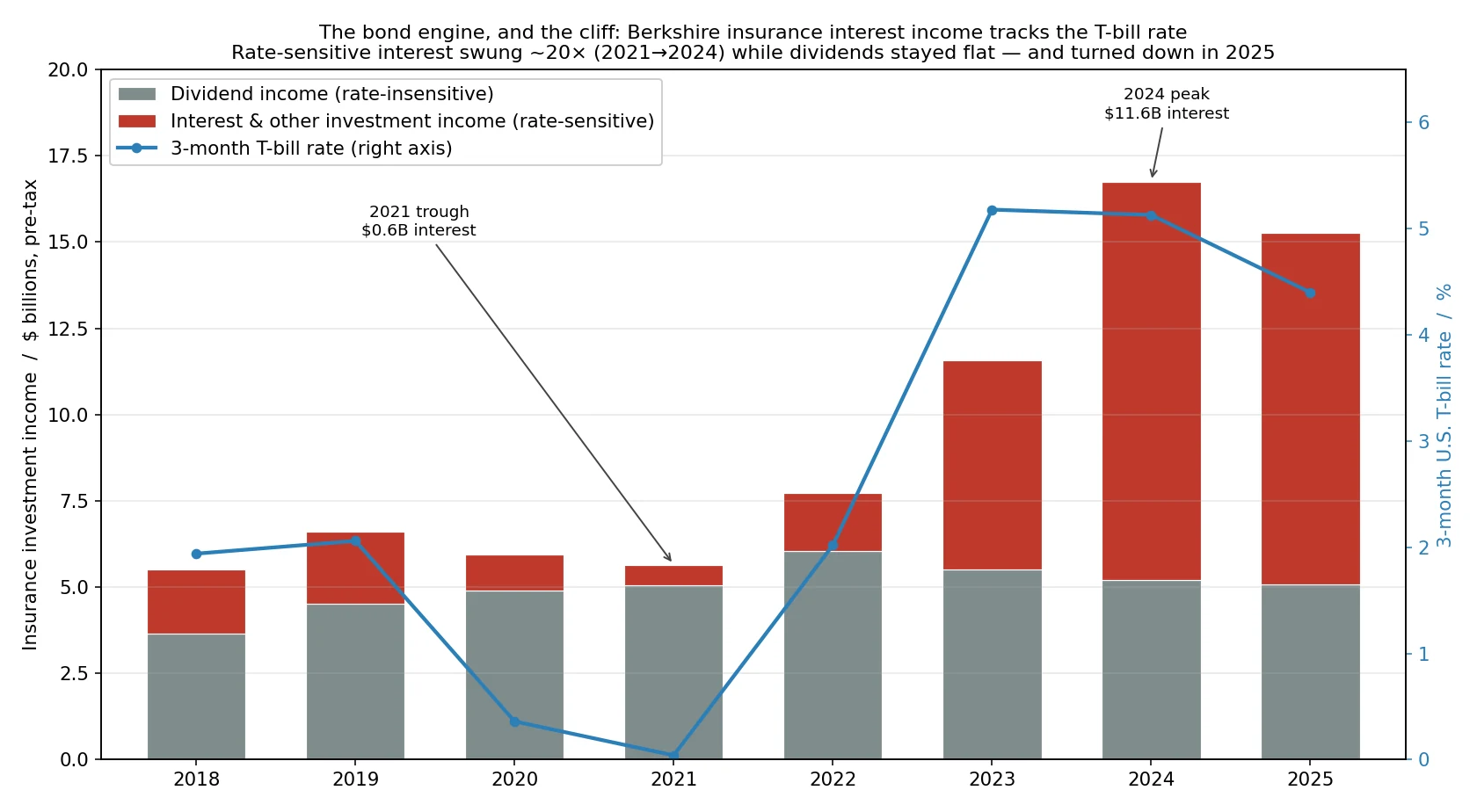
The chart above is the whole thesis in one picture. The grey blocks — dividends — barely breathe. The red blocks — interest — move in near-lockstep with the blue line, the 3-month Treasury-bill rate. When the rate went to zero, interest income went to nothing. When the rate went to 5%, interest income went to $11.6 billion. This is not a portfolio that happens to be sensitive to rates. This is a portfolio that is a rate.
The cliff already has a first step
Most discussions of "what happens when the Fed cuts" are speculation. Berkshire's is not, because the decline has already started showing up in the filings. In its 2025 annual report, the company reported that after-tax earnings from insurance investment income "declined $1.2 billion (8.5%) in 2025 versus 2024, reflecting lower interest income, attributable to lower interest rates."1 The first-quarter 2026 10-Q carried the same message: insurance investment income "declined $214 million (7.4%) in 2026 versus 2025."2 The interest line that peaked at $11.55 billion in 2024 slipped to $10.18 billion in 2025, and the quarterly run-rate is now pointing down.3
You can watch it even more cleanly in a number Berkshire tucks into its cash-flow statement: "discount accretion on investments, principally U.S. Treasury Bills" — essentially the raw interest the bill pile throws off. It went from $1.13 billion in 2022 to $5.51 billion in 2023 to $11.35 billion in 2024 to $11.96 billion in 2025, and then the first quarter of 2026 came in at $3.07 billion, below the $3.13 billion of the year-earlier quarter.7 The engine is still enormous. It is also, for the first time in this cycle, running in reverse.
None of this required a forecast. We are not in the business of predicting the Fed — plenty of people who are paid to do that have been humbled by 2022 through 2026. The point is narrower and more durable: whichever way the front end moves, Berkshire's investment income now moves with it, and it has started moving down.
Why Berkshire has almost nowhere to hide
A pension fund frightened of falling rates can lock in today's yields by buying ten- or thirty-year bonds. Berkshire has deliberately chosen not to. Of the $528.96 billion insurance investment book at year-end 2025, only $17.5 billion sat in fixed-maturity securities of any tenor; $294.1 billion was in stocks and $212.65 billion in cash and U.S. Treasury bills.5 At the parent level the T-bill position is larger still: $339.26 billion of Treasury bills plus $51.5 billion of cash at March 31, 2026, up from $321.43 billion of bills at year-end.6 Treasury bills, by definition, mature in a year or less — most of Berkshire's mature in a matter of weeks. There is essentially no duration in the book to cushion a rate decline. When bills roll off, they get reinvested at whatever the new, lower rate happens to be. That is reinvestment risk in its purest form, and Berkshire has arranged its affairs to have as much of it as possible.
Why would Buffett and now Greg Abel court that risk instead of locking in 5% for a decade? Because the ultra-short posture is not a yield bet — it is an optionality bet. Cash that matures next month can be redeployed next month into a falling market, a distressed seller, or an elephant-sized acquisition. Ten-year bonds cannot. The cost of keeping that option open is precisely the reinvestment risk we are describing. Berkshire pays it on purpose.
That trade-off sets up the forward question every shareholder should be asking: if the pile stays near $340 billion, how much does the income swing as rates move?
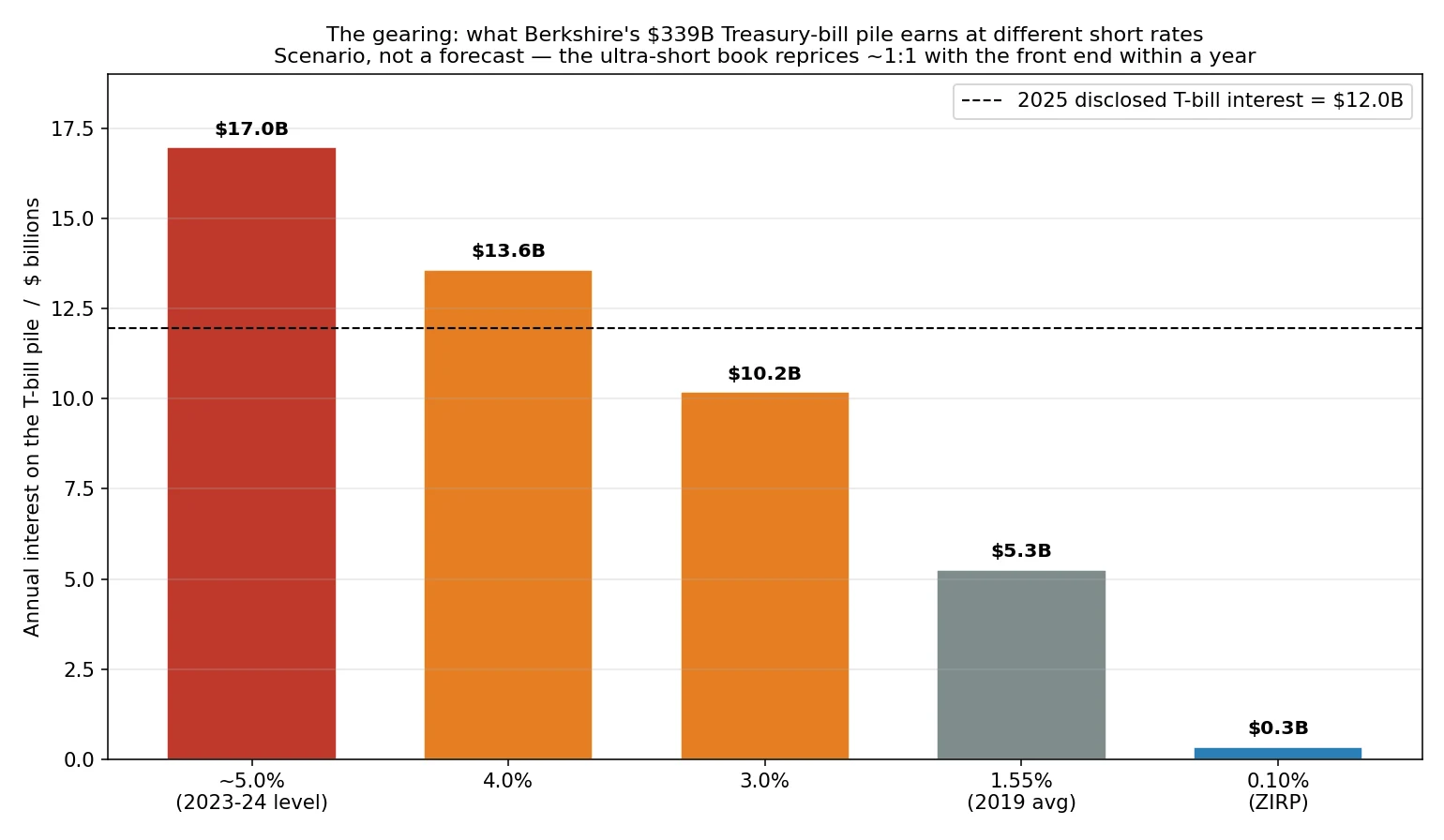
The arithmetic is unforgiving in its simplicity. At a 5% short rate the current pile earns about $17 billion a year; at 3% it earns roughly $10 billion; and in a return to the zero-rate world of 2021, it earns essentially nothing — about $300 million.15 The gap between the top and bottom bars, some $16 billion of pre-tax income, is not a tail scenario. Berkshire lived at both ends of that range within the last five years. This is what it means to say the bond engine is geared: the same asset that added $11 billion of income on the way up can subtract most of it on the way down, and the balance sheet is built so that it will.
What if Berkshire can't roll well?
There is a subtler worry buried inside the reinvestment story, and it is worth naming. It is not only that yields fall; it is where the money can go when hundreds of billions of dollars come due all at once. A small investor rolling a maturing CD faces one decision. Berkshire rolling $340 billion faces a structural one. The T-bill market is deep enough to absorb it — that is precisely why Buffett parks there — but T-bills are also the asset whose yield falls first and furthest when the Fed eases. The "safe" place to roll is, by construction, the place with the most reinvestment risk.
The alternative destinations are worse fits than they look. Longer Treasuries would lock in a yield but surrender the optionality Berkshire prizes and expose the book to price losses if rates back up. Credit would reach for yield in exactly the way Buffett has spent decades mocking. And equities — Berkshire's true preferred home for capital — have been expensive by the company's own revealed behavior: Berkshire has been a net seller of stocks for three straight years, and its own equity portfolio of roughly $297.8 billion is concentrated with nearly two-thirds in a handful of names.14 So the reinvestment question is not merely "at what yield?" but "into what?" — and for now the honest answer is that a very large share of the money has nowhere better to go than back into the very bills whose yield is receding. That is the cliff's second, quieter step: not just a lower rate, but a shortage of good alternatives at the moment the cash comes free.
The pressure gauge
Here is where the gloomy framing inverts into something more interesting. A falling bond-engine yield is bad for reported investment income. But for a company whose entire identity is capital allocation, a low yield on cash is not a threat — it is a signal. When Treasury bills pay 5%, Berkshire is, in Buffett's phrase, paid to wait; there is little penalty for holding cash and every reason to be patient. When bills pay nothing, the opportunity cost of that same cash becomes enormous, and the pressure to deploy it into businesses and stocks becomes almost mechanical.
The historical record makes the relationship almost embarrassingly clean.
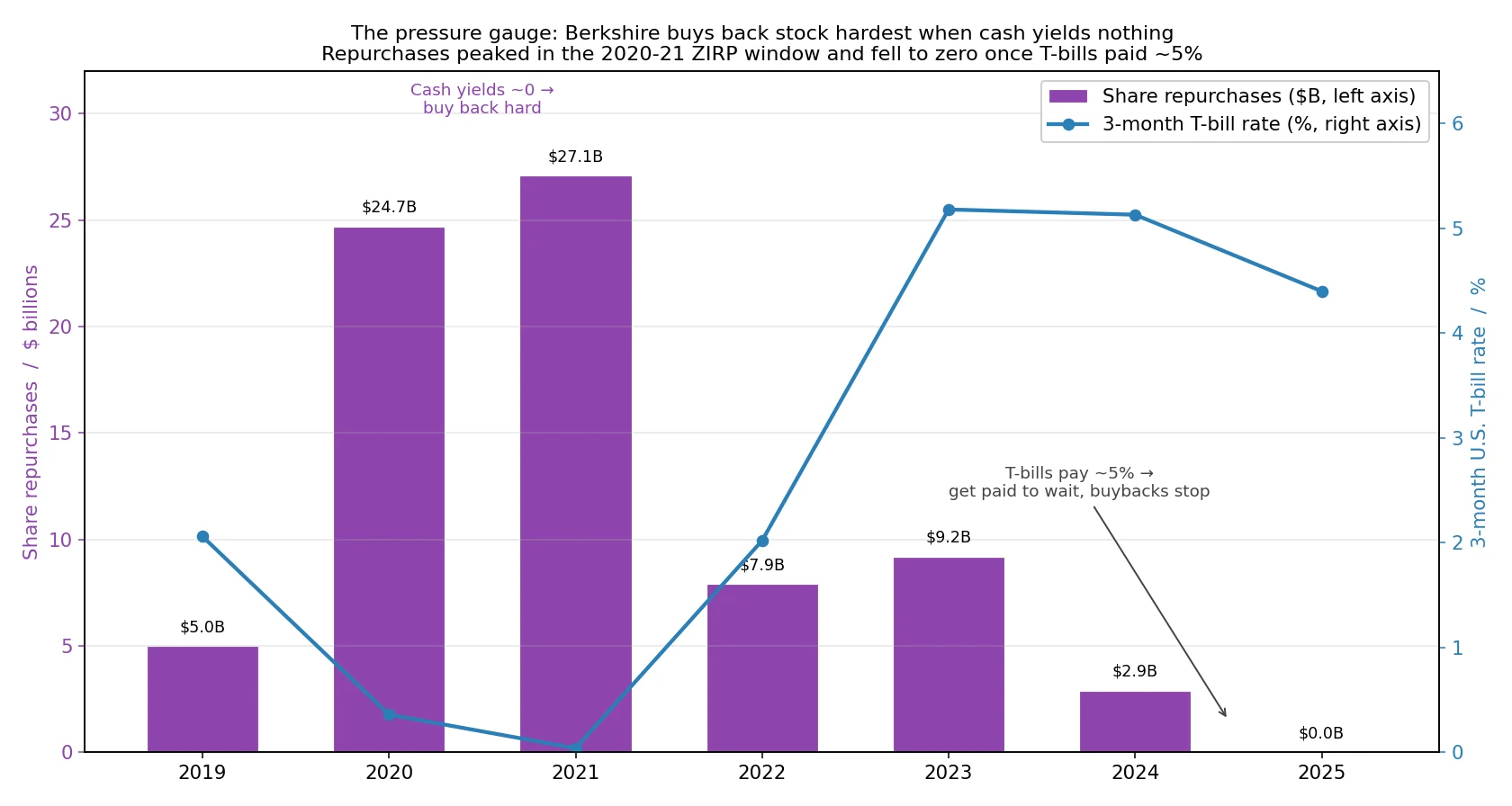
Look at when Berkshire bought back the most of its own stock. In 2020 and 2021 — the zero-rate years, when the bond engine earned nothing — the company repurchased a combined $51.8 billion of shares, including a then-record $24.7 billion in 2020 and $27.1 billion in 2021.10 Then rates climbed, the bond engine roared, and buybacks fell off a cliff of their own: $7.9 billion in 2022, $9.2 billion in 2023, $2.9 billion in 2024, and zero in 2025.11 The pattern is not a coincidence. When cash was free, holding it was painful and Berkshire spent it; when cash paid 5%, holding it was profitable and Berkshire hoarded it. The bond engine's yield and the deployment rate move in opposite directions, like the two ends of a see-saw.
This is why the reinvestment cliff, properly understood, is not a bear case. It is the mechanism that ends the cash-hoarding phase. Buffett himself has always described these cash-heavy stretches as temporary discomforts: in the 2021 letter, sitting on $144 billion of cash and equivalents including $120 billion of Treasury bills, he wrote that such positions "are never pleasant; they are also never permanent."9 The permanence ends when rates fall — because that is exactly when the opportunity cost of $340 billion becomes too large to ignore.
Abel inherits the trigger
The timing hands Greg Abel an unusually clean inheritance. He takes over a balance sheet whose bond engine is just beginning to cool, which means the pressure gauge is just beginning to build. In his first shareholder letter, attached to the 2025 annual report, Abel framed the cash exactly as this piece would: Berkshire's cash and Treasury holdings, he wrote, now exceed $370 billion and constitute "our dry powder... a strategic asset to be deployed at the right time."12 He was careful to rebut the idea that a big cash pile signals retreat, promising Berkshire "will always aim for ownership of productive businesses over U.S. Treasuries."12 And he has started to act on it — 2025 brought the announced acquisitions of OxyChem and Bell Laboratories, Abel's first material deployments of the hoard.13
The reinvestment cliff, in other words, is not something Abel has to defend against. It is the tailwind at his back. Every basis point the Fed cuts makes the $340 billion less comfortable to hold and the case for buying whole businesses — or Berkshire's own shares below intrinsic value — a little more compelling. The bond engine's decline is the starting gun for the capital-allocation phase that defines an Abel-era Berkshire. It is worth remembering that the last time Berkshire deployed at scale into a downturn, it did so from a similar position of strength: the same discipline that built a record float, chronicled in our look at Berkshire's two-speed float machine ↗, is what funds the dry powder now.
How shareholders should size it
The practical takeaway is a matter of arithmetic and expectations. Investment income of roughly $20 billion-plus at the consolidated level was never a permanent step-up in Berkshire's earning power; it was a cyclical peak, borrowed from an unusually high short rate. A shareholder modeling Berkshire's normalized earnings should treat the bond-engine contribution as rate-geared, not baseline — a line that swells in a higher-for-longer world and shrinks meaningfully if the Fed eases, with the gearing table above as the rough guide. Pretending the 2024 peak is the new floor is the same mistake, in reverse, that commentators made when they called the cash "idle."
This is the companion truth to a point we made in The Silent De-Levering ↗: as Berkshire's equity-selection and leverage moats have narrowed, the float-and-cash side of the machine has done more of the work. The bond engine is the most visible expression of that shift — and also the most cyclical. Understanding how the float itself is generated, which we walked through in Calculating Berkshire Hathaway's Float ↗, is the other half of the picture: float supplies the raw material, and short rates set the price the market currently pays Berkshire to hold it.
So watch the interest line, not the headlines. When it falls, do not read it as Berkshire faltering. Read it as the meter that tells you the opportunity cost of $340 billion is rising — and that somewhere in Omaha, the pressure to finally spend it is climbing with every cut. The reinvestment cliff giveth back what the rate cycle gave; what Berkshire does on the way down is the part worth watching.
References
-
Berkshire Hathaway 2025 Annual Report — Management's Discussion (Insurance—Investment Income) - berkshirehathaway.com — “After-tax earnings from insurance investment income declined $1.2 billion (8.5%) in 2025 versus 2024, reflecting lower interest income, attributable to lower interest rates, and dividend income.” ↩↩
-
Berkshire Hathaway Q1 2026 Form 10-Q — Insurance Investment Income - berkshirehathaway.com — “…earnings from insurance investment income in the first quarter declined $214 million (7.4%) in 2026 versus 2025…” ↩↩
-
Berkshire Hathaway 2025, 2022 and 2020 Annual Reports — Insurance—Investment Income summary tables - berkshirehathaway.com — Insurance interest & other investment income by year ($M): 2020 1,059; 2021 589; 2022 1,685; 2023 6,081; 2024 11,550; 2025 10,175. Dividend income held near $5–6B throughout. ↩↩↩
-
Warren Buffett, 2024 Letter to Shareholders - berkshirehathaway.com — “We were aided by a predictable large gain in investment income as Treasury Bill yields improved and we substantially increased our holdings of these highly-liquid short-term securities.” ↩
-
Berkshire Hathaway 2025 Annual Report — summary of cash and investments held in insurance businesses - berkshirehathaway.com — “Cash, cash equivalents and U.S. Treasury Bills $212,651 … Equity securities 294,144 … Fixed maturity securities 17,466 … $528,963” (Dec 31, 2025, $M). ↩
-
Berkshire Hathaway Q1 2026 Form 10-Q — Consolidated Balance Sheet - berkshirehathaway.com — Short-term investments in U.S. Treasury Bills $339,261M and cash and cash equivalents $51,478M at March 31, 2026 (vs. $321,434M T-bills at Dec 31, 2025). ↩
-
Berkshire Hathaway 2025 Annual Report & Q1 2026 10-Q — Consolidated Statements of Cash Flows - berkshirehathaway.com — “Discount accretion on investments, principally U.S. Treasury Bills”: 2022 $1,132M; 2023 $5,510M; 2024 $11,349M; 2025 $11,964M; Q1 2026 $3,068M vs. $3,129M in Q1 2025. ↩
-
Warren Buffett, 2020 Letter to Shareholders - berkshirehathaway.com — “And bonds are not the place to be these days … the yield was 0.93% at yearend … Fixed-income investors worldwide … face a bleak future.” ↩
-
Warren Buffett, 2021 Letter to Shareholders - berkshirehathaway.com — “$144 billion of cash and cash equivalents … $120 billion is held in U.S. Treasury bills … These periods are never pleasant; they are also never permanent.” ↩
-
Warren Buffett, 2019–2021 Letters to Shareholders (repurchase sections) - berkshirehathaway.com — 2019 repurchases $5.0B (~1%); 2020 $24.7B (“spending $24.7 billion in the process”); 2020–2021 combined $51.7B. ↩
-
Berkshire Hathaway Annual Reports 2022–2025, share-repurchase disclosures - berkshirehathaway.com — Share repurchases ($B): 2022 7.9; 2023 9.2; 2024 2.9; 2025 0.0 — “There were no share repurchases in 2025.” ↩
-
Greg Abel, 2025 Letter to Shareholders - berkshirehathaway.com — “Our cash and U.S. Treasury holdings now exceed $370 billion … it also constitutes our dry powder … a strategic asset to be deployed at the right time … We will always aim for ownership of productive businesses over U.S. Treasuries.” ↩↩
-
Greg Abel, 2025 Letter to Shareholders (Capital Discipline) - berkshirehathaway.com — “…Berkshire announcing the acquisition of two very different businesses: OxyChem and Bell Laboratories.” ↩
-
Berkshire Hathaway 2025 Annual Report — equity portfolio concentration - berkshirehathaway.com — Equity securities portfolio of $297.8 billion with roughly two-thirds concentrated in a small number of issuers; Berkshire a net seller of equities for three consecutive years through 2025. ↩
-
Author's calculation. Annual interest = T-bill pile ($339.26B, March 31 2026) × assumed short rate; scenarios at 5.0% ($17.0B), 4.0% ($13.6B), 3.0% ($10.2B), 1.55% ($5.3B), 0.10% ($0.3B). Illustrative gearing, not a forecast of rates or of Berkshire's future bill balance. ↩