Tags: Warren Buffett / History / Bonds
This fanpage is not officially affiliated with Berkshire Hathaway: Disclaimer
In 1989, when Buffett announced Berkshire's billion-dollar purchase of Coca-Cola stock, he described it as an extreme example of putting his money where his mouth was. Two years later he inverted the line. "On August 18 of last year, when I was elected Interim Chairman of Salomon Inc, it was a different story: I put my mouth where our money was."1 That is the most honest sentence anyone has written about the Salomon affair, and it contains the part of the story that never gets told. The rescue is remembered as a parable about reputation — the ruthless quote, the contrite testimony, the firm pulled back from the edge. What Berkshire's own filings record is something less flattering and more useful: a ten-year position earning a contractual 9% while Berkshire itself, in the best decade of its life, compounded book value at 26.3% a year. The gap between those two numbers is worth about $5.5 billion, and Buffett predicted it in writing two years before the scandal.

Buffett Bought a Bond and Described It as a Friendship
The instrument came first, and it was not an equity bet. Under letter agreements dated September 27 and 28, 1987, Berkshire bought $700 million of Salomon Inc Series A Cumulative Convertible Preferred — 700,000 shares with a $1,000 redemption value each, paying $90 a year, convertible after three years into common at $38 a share, and redeemable in five equal annual instalments beginning October 31, 1995.2 Buffett filed it exactly where it belonged. "From most standpoints," he wrote that year, "this commitment fits into the medium-term fixed-income securities category. In addition, we have an interesting conversion possibility."3
The reasoning he gave for the purchase was not about investment banking, which he conceded he could not forecast. It was about a person. "What we do have a strong feeling about is the ability and integrity of John Gutfreund, CEO of Salomon Inc. Charlie and I like, admire and trust John."4 Buffett had known Gutfreund since 1976, when the Salomon chief personally underwrote the convertible preferred that kept GEICO out of liquidation — the deal that eventually made Berkshire what it is ↗. Four years after the Salomon purchase, Buffett would replace him.
Salomon was the first and largest of a quartet of negotiated preferreds Berkshire assembled in the late 1980s, all built to the same design: a fat coupon, mandatory redemption, a conversion option, and unrestricted voting rights on a fully-converted basis, which Buffett noted was "far from standard in corporate finance."5
| Issue | Size | Coupon | Conversion price | Bought |
|---|---|---|---|---|
| Salomon Inc | $700M | 9% | $38 | Sept 1987 |
| The Gillette Company | $600M | 8¾% | $50 | July 1989 |
| USAir Group | $358M | 9¼% | $60 | 1989 |
| Champion International | $300M | 9¼% | $38 | Late 1989 |
Terms as stated in Berkshire's 1987 and 1989 shareholder letters.36 Gillette converted into 12 million common shares on April 1, 1991; the USAir preferred ↗ became Buffett's most-quoted mistake; Gillette ↗ became Duracell.
He Wrote the Verdict on This Position Two Years Before the Scandal
The most remarkable document in the whole affair is not the testimony. It is a passage in the 1989 letter, written while Gutfreund was still a friend and Paul Mozer was still an obscure government-bond trader, in which Buffett describes precisely what would happen and grades it in advance:
"Under almost any conditions, we expect these preferreds to return us our money plus dividends. If that is all we get, though, the result will be disappointing, because we will have given up flexibility and consequently will have missed some significant opportunities that are bound to present themselves during the decade."6
He was explicit about the mechanism, too: "The only way Berkshire can achieve satisfactory results from its four preferred issues is to have the common stocks of the investee companies do well."6 And a year later, correcting press coverage that valued the preferreds as though they were just the conversion option: "most of the value of our convertible preferreds is derived from their fixed-income characteristics."7
Read those three sentences together and the Salomon position has already been scored. Berkshire would get its money back plus dividends. Salomon's common would not do well. The result, in Buffett's own word, would be disappointing. Everything that follows — the scandal, the ten months in New York, the settlement, the takeover — changes the story enormously and the arithmetic hardly at all.
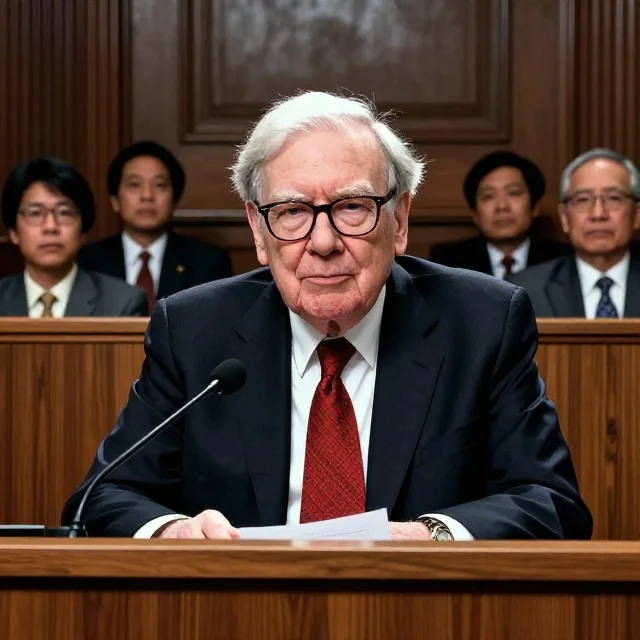
The Rescue Was Real, and It Was Not an Investment Decision
In August 1991 Salomon disclosed that it had submitted false and unauthorized bids in Treasury auctions to get around the rule capping any single bidder at 35% of an issue, bidding in customers' names, without their authorization, to take down more of an auction than the firm was entitled to.8 The May 1991 two-year note was the notorious one; by most reconstructions Salomon ended up controlling the great bulk of the issue.9 On August 18 the Treasury barred the firm from bidding, Gutfreund resigned, and Buffett — a director since 1987 — was elected interim chairman. Over the following hours he negotiated the ban down to a partial one: Salomon could bid for its own account, but not for customers.8
He stayed ten months, stepping down in June 1992.10 On September 4, 1991, he sat in front of a House subcommittee and delivered the sentence that outlived every other fact in this story: "Lose money for the firm, and I will be understanding; lose a shred of reputation for the firm, and I will be ruthless."11 In May 1992 Salomon settled with the SEC and the Justice Department for $290 million, of which up to $100 million was set aside for private claims.12
Buffett's own accounting of the episode, in the 1992 letter, is characteristically brief and entirely about people rather than money. Salomon ranked second among 311 companies in Fortune's survey of reputation improvement; Salomon Brothers posted record pre-tax earnings, 34% above its previous high; and without Deryck Maughan, Bob Denham, Don Howard and John Macfarlane, "the firm very probably would not have survived." Ron Olson of Munger, Tolles & Olson handled five separate authorities at once — the SEC, the New York Fed, the Treasury, the U.S. Attorney for the Southern District of New York, and the Antitrust Division.10 The section is titled "The Salomon Interlude," which tells you how Buffett filed it. Not a chapter. An interruption.
The Dividend Was Safe Until Salomon's Own Losses Ate Half of It
Berkshire's filings say something at this point that the retellings do not. For years Berkshire carried a line on the face of its income statement reading "Income from investment in Salomon Inc": a single position important enough to get its own revenue line. It ran at exactly $63.0 million in 1991, 1992 and 1993, nine percent of $700 million, paid like clockwork straight through the worst governance crisis in the firm's history.13
Then in 1994 it fell to $30.1 million.
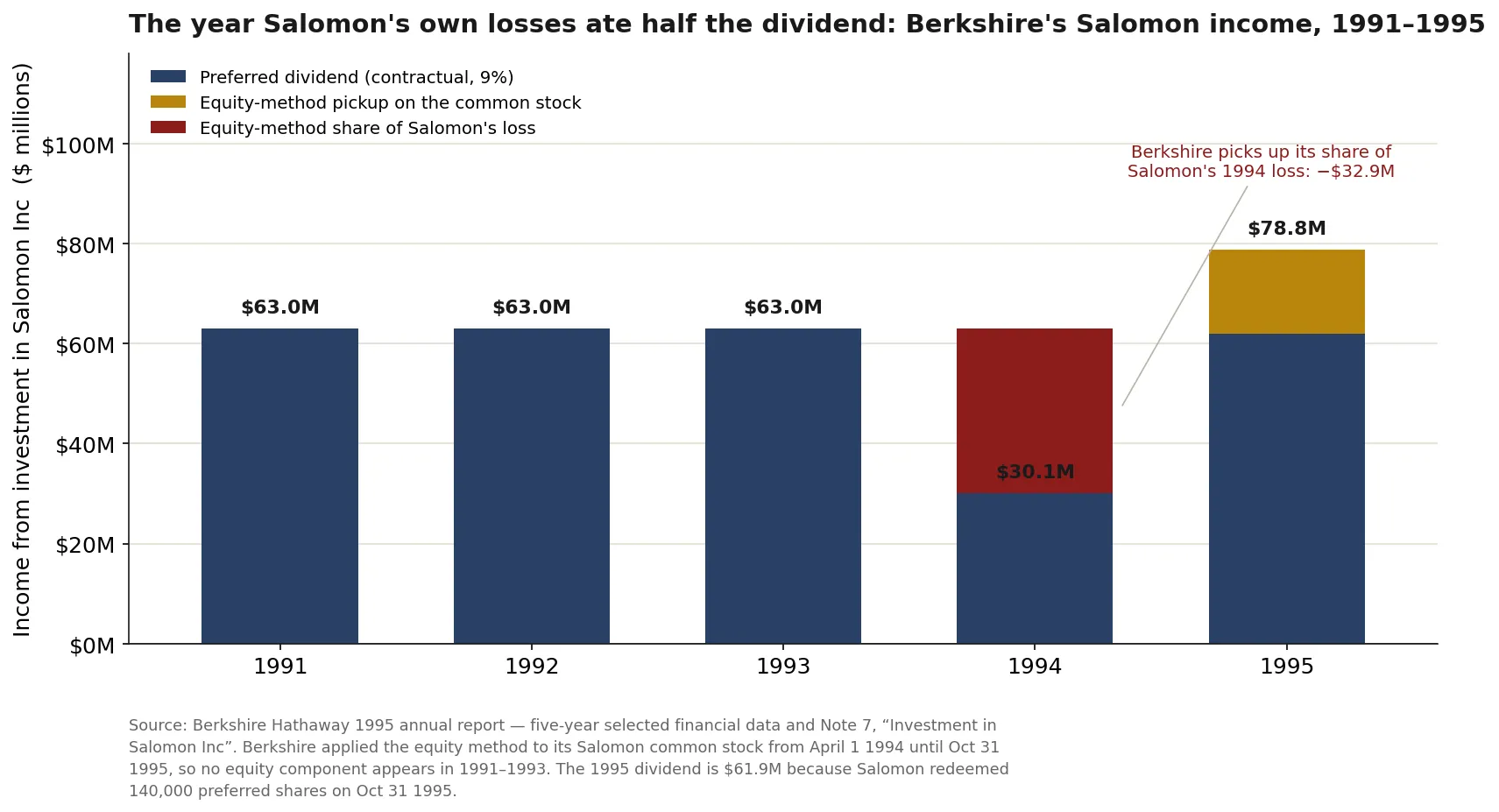
The cause was not a missed dividend. Berkshire had also been buying Salomon common, and from April 1, 1994 its holdings crossed roughly 20% of total voting rights, which forced it onto the equity method — meaning Berkshire had to book its proportional share of Salomon's results. Salomon lost money in 1994, and Berkshire picked up −$32.9 million of it, against $63.0 million of dividends. In 1995 the equity pickup turned positive at $16.9 million and the reported line jumped to $78.8 million, while the dividend itself slipped to $61.9 million because Salomon had redeemed the first 140,000 preferred shares on October 31.13
The coupon, in other words, was doing its job perfectly. The business behind it was not.
Berkshire Also Bought the Common — and Was Underwater on It
The equity-method footnote gives up a fact that no retelling of the Salomon story mentions: Berkshire's common-stock position in Salomon was a loser. At December 31, 1995, Berkshire's 6,633,600 Salomon common shares had cost $324.4 million and were worth $234.7 million — a 28% loss on a position taken in the company Buffett had personally rescued. The preferred, meanwhile, was carried at $588.0 million against $560.0 million of cost. Total: $884.4 million of cost, $822.7 million of value, eight years in.14
Then Berkshire did something quietly revealing. On December 2, 1996 it issued $500 million principal amount of 1% Senior Exchangeable Notes, taking in net proceeds of $447.1 million. Each $1,000 note was exchangeable, at the holder's option, into 17.65 shares of Salomon common.15 Strip the mechanics away and Berkshire had borrowed at one percent against its Salomon common — handing the upside on those shares to noteholders in exchange for cash it could deploy elsewhere. It is not the behaviour of an investor who thinks the stock is cheap. When the takeover came, that decision cost $298.4 million in a contingent-value charge.16
The Exit Was a Takeover, Not a Vindication
Berkshire did not sell Salomon. Salomon was bought. In November 1997 Travelers Group completed its acquisition, and Berkshire's subsidiaries exchanged their Salomon common and preferred for Travelers stock worth approximately $1.8 billion. Berkshire booked a realized gain of $677.9 million pre-tax — $427.3 million after tax — and that figure was already net of the $298.4 million charge on the Exchange Notes.16
That is a perfectly respectable outcome. A $1,024.4 million cost basis returned about $1.8 billion in securities plus roughly a decade of 9% coupons, with $140 million a year of principal coming back from October 1995 onward. Nobody lost money. The Salomon name itself did not survive long: absorbed into Travelers, then Citigroup, then retired.
Respectable, however, is the whole problem.
The Coupon Was Safe, and Safety Was Expensive
Berkshire earned 9% on $700 million for a decade. Set that against what the same money did inside Berkshire itself over the ten years from 1988 through 1997 — a period when per-share book value compounded at 26.3% a year and the S&P 500, dividends included, returned 18.1%.17
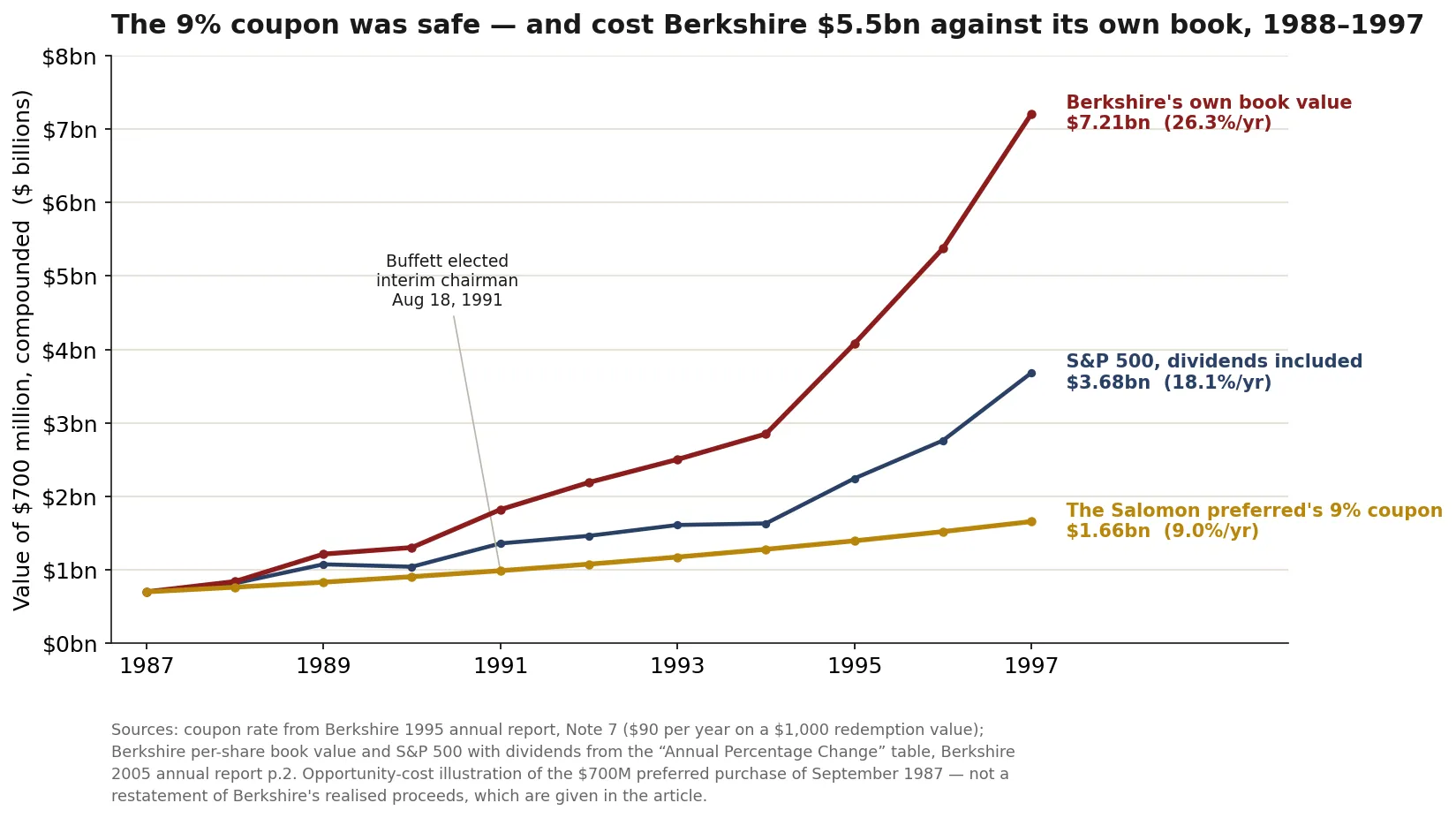
Compounded at the coupon rate, $700 million becomes $1.66 billion. Compounded at Berkshire's own book-value rate, it becomes $7.21 billion. The gap is roughly $5.5 billion — more than three times Berkshire's entire realized proceeds from the position, and roughly equal to Berkshire's whole shareholders' equity at the end of 1990.21 Even against the index, the coupon lost by about $2 billion.
Two honest caveats. This is an opportunity-cost illustration, not a claim about a foregone trade: book-value growth is not shareholder return, and Berkshire could not have bought $700 million of itself at book in 1987. And the counterfactual is unfair in the way all counterfactuals are — nobody in September 1987 knew that the following decade would be the best ten-year stretch in Berkshire's history, least of all in the weeks before Black Monday. But the direction is not in doubt, and Buffett named it himself in 1989. Giving up flexibility for a coupon meant "we will have missed some significant opportunities that are bound to present themselves during the decade."6 They presented themselves. Berkshire was holding a bond.
What the position did earn, and what has compounded ever since, was the doctrine. The reputation line from the 1991 testimony became the governing rule of Berkshire's crisis pricing, and it is visible in every distress deal since: when Berkshire was asked for capital in 2008 and again in 2011, the terms were written by the side that had learned what a damaged franchise costs.
Berkshire Now Sits on the Other Side of the Auction
The final irony is one of scale. The market Mozer rigged was the market for U.S. government debt, and at the end of fiscal 1991 the entire federal debt outstanding was $3.67 trillion. As of July 30, 2026 it stands at $39.84 trillion, of which $32.04 trillion is held by the public — nearly eleven times the pile that a single trader on a single desk was able to corner.18
Berkshire is no longer a bystander at those auctions. At March 31, 2026 it held $339.3 billion of U.S. Treasury bills, and it bought $189.6 billion of bills and fixed-maturity securities during that quarter alone — some 270 times the Salomon position, in ninety days.19 Berkshire's bill portfolio today is worth about 9% of every dollar of federal debt that existed in the year Salomon cheated to get a few hundred million more of it.20 The company whose chairman once had to fly to New York to restore the integrity of the Treasury auction is now one of its largest non-sovereign customers — and it is once again earning a safe, fixed, unexciting yield on an enormous pile of money it has not yet found a better use for, which is precisely the trade whose mechanics we examined ↗ earlier this month.
There is a version of the Salomon story in which Buffett is the hero who saved a firm, and it is true. There is a second version, kept in the notes to the financial statements, in which a great capital allocator parked a fortune in a 9% instrument for ten years and watched from inside the building while his own company tripled that rate. He knew. He filed the verdict in 1989, before there was anything to be a hero about: the result will be disappointing.
References
-
Buffett 1991 Shareholder Letter - berkshirehathaway.com — “On August 18 of last year, when I was elected Interim Chairman of Salomon Inc, it was a different story: I put my mouth where our money was.” ↩
-
Berkshire Hathaway 1995 Annual Report, Note 7 “Investment in Salomon Inc” - sec.gov — “The Preferred Shares have a redemption value of $1,000 per share and are entitled to receive quarterly dividends at the annual rate of $90 per share.… Annually on each October 31, Salomon Inc will redeem, at cost, 140,000 of the Preferred Shares…” ↩
-
Buffett 1987 Shareholder Letter - berkshirehathaway.com — “By far our largest — and most publicized — investment in 1987 was a $700 million purchase of Salomon Inc 9% preferred stock.… From most standpoints, this commitment fits into the medium-term fixed-income securities category.” ↩
-
Buffett 1987 Shareholder Letter - berkshirehathaway.com — “What we do have a strong feeling about is the ability and integrity of John Gutfreund, CEO of Salomon Inc. Charlie and I like, admire and trust John.” ↩
-
Buffett 1989 Shareholder Letter - berkshirehathaway.com ↩
-
Buffett 1989 Shareholder Letter - berkshirehathaway.com — “Under almost any conditions, we expect these preferreds to return us our money plus dividends. If that is all we get, though, the result will be disappointing, because we will have given up flexibility and consequently will have missed some significant opportunities that are bound to present themselves during the decade.” ↩↩↩
-
Buffett 1990 Shareholder Letter - berkshirehathaway.com — “The point you should keep in mind is that most of the value of our convertible preferreds is derived from their fixed-income characteristics.” ↩
-
“Salvaging Salomon Brothers” - time.com ↩↩
-
Bradford D. Jordan and Susan D. Jordan, “Salomon Brothers and the May 1991 Treasury auction: Analysis of a market corner,” Journal of Banking & Finance 20(1), 1996, pp.25–40 - ideas.repec.org ↩
-
Buffett 1992 Shareholder Letter, “The Salomon Interlude” - berkshirehathaway.com — “Last June, I stepped down as Interim Chairman of Salomon Inc after ten months in the job.… It is no exaggeration to say that without the combined efforts of Salomon executives Deryck Maughan, Bob Denham, Don Howard, and John Macfarlane, the firm very probably would not have survived.” ↩↩
-
“The moment America met Warren Buffett” - finance.yahoo.com — “Lose money for the firm, and I will be understanding; lose a shred of reputation for the firm, and I will be ruthless” (House subcommittee testimony, September 4, 1991) ↩
-
“Salomon fined $290 million for trading violations”, May 20, 1992 - upi.com ↩
-
Berkshire Hathaway 1995 Annual Report — five-year selected financial data and Note 7 - sec.gov — “Dividends $61.9 / $63.0 / $63.0; Equity in net income (loss) of Salomon attributable to common stock holdings 16.9 / (32.9) / —” (1995/1994/1993) ↩↩
-
Berkshire Hathaway 1995 Annual Report, Note 7 - sec.gov — “Common Stock … Cost 324.4 … Fair Value 234.7 … Carrying Value 234.7” (December 31, 1995) ↩
-
Berkshire Hathaway 1996 Annual Report, Note 9 - sec.gov — “On December 2, 1996, Berkshire received net proceeds of $447.1 million from the issuance of $500 million principal amount of 1% Senior Exchangeable Notes, due December 2, 2001… convertible at the option of the holder into 17.65 shares of Salomon Inc common stock.” ↩
-
Berkshire Hathaway 1997 Annual Report, Note 5 - sec.gov — “The value of the Travelers shares received was approximately $1.8 billion. Realized investment gains for 1997 include $677.9 million with respect to the transaction. The gain is net of a charge of $298.4 million for the contingent value associated with Berkshire's Exchange Notes.” ↩↩
-
Berkshire Hathaway 2005 Annual Report, p.2, “Annual Percentage Change” table - berkshirehathaway.com ↩
-
U.S. Treasury Fiscal Data — Debt to the Penny and Historical Debt Outstanding - fiscaldata.treasury.gov — “1991-09-30: $3,665,303,351,697.03”; “2026-07-30: total public debt outstanding $39,841,114,561,022.68; debt held by the public $32,035,731,397,438.63” ↩↩
-
Berkshire Hathaway Q1 2026 Form 10-Q - sec.gov — “Short-term investments in U.S. Treasury Bills 339,261”; “Purchases of U.S. Treasury Bills and fixed maturity securities (189,625)” ↩↩
-
Derived: $339.261B of Treasury bills at March 31, 2026 divided by $3,665.303B of federal debt outstanding at September 30, 1991 = 9.3%. Inputs from 18 and 19. ↩
-
Buffett 1990 Shareholder Letter - berkshirehathaway.com — “we were able to close 1990 with net worth up by $362 million, or 7.3%” — implying shareholders' equity of about $5.32 billion at year-end 1990. ↩