Tags: GEICO / Earnings / Risk
This fanpage is not officially affiliated with Berkshire Hathaway: Disclaimer
Berkshire's second-quarter report says GEICO's premiums written went up. They rose $121 million, or 1.1%, and the filing explains why in a single clause: "an increase in commercial auto business, partially offset by lower average premiums per policy for private passenger auto insurance."1 Translated out of accounting politeness, that clause says the average American who insures a car with GEICO is now paying less than they were a year ago. It is the second consecutive quarter Berkshire has printed that sentence.2 For four years the story of GEICO has been a company raising prices to catch loss costs that kept running ahead of it. This is the quarter the direction flipped, and the headline insurance number Berkshire reported is arranged — entirely legitimately — so that you cannot see it.
The Sentence Hiding Inside a Premium Increase
The distinction matters because it changes what kind of problem GEICO has. When we looked at the rate trap in June ↗, the mechanism was regulatory: claim severity moves in weeks, but a rate filing in a prior-approval state takes six to eighteen months, so GEICO's price is structurally late to its own costs. That is a story about a company with its hands tied.
A price cut is a story about a company with its hands free. Nobody made GEICO lower the average premium on a private passenger auto policy. Berkshire's own disclosures show the pivot cleanly: average premium per auto policy rose 10.5% in 2022, 16.8% in 2023 and 7.8% in 2024,34 and Berkshire told shareholders in the 2025 annual report that average earned premiums per policy increased again that year.5 Then, in both quarters of 2026, the same line reverses.
That reversal happened while every cost line moved the wrong way. In the first half of 2026, bodily-injury claim frequency rose 5% to 7% and bodily-injury severity rose 10% to 12%; property-damage and collision frequency rose 3% to 5%.1 GEICO's loss ratio reached 76.6% in the second quarter, up 4.8 points, and its combined ratio hit 91.2%, up 7.7 points from 83.5% a year earlier.1 Pre-tax underwriting earnings fell to $994 million from $1,821 million — a 45.4% decline in a quarter with no catastrophes in it at all.
The shape of that decline is worth stating precisely, because it did not begin this year and it is not a tidy quarter-by-quarter slide. GEICO's combined ratio averaged 81.7% across the first half of 2025 and 87.5% across the second — the erosion was well under way before 2026 opened, and the second half of 2025 was in fact worse than the 87.3% GEICO went on to print in the first quarter of 2026.15 What 2026 added was not the deterioration. It was the discount.
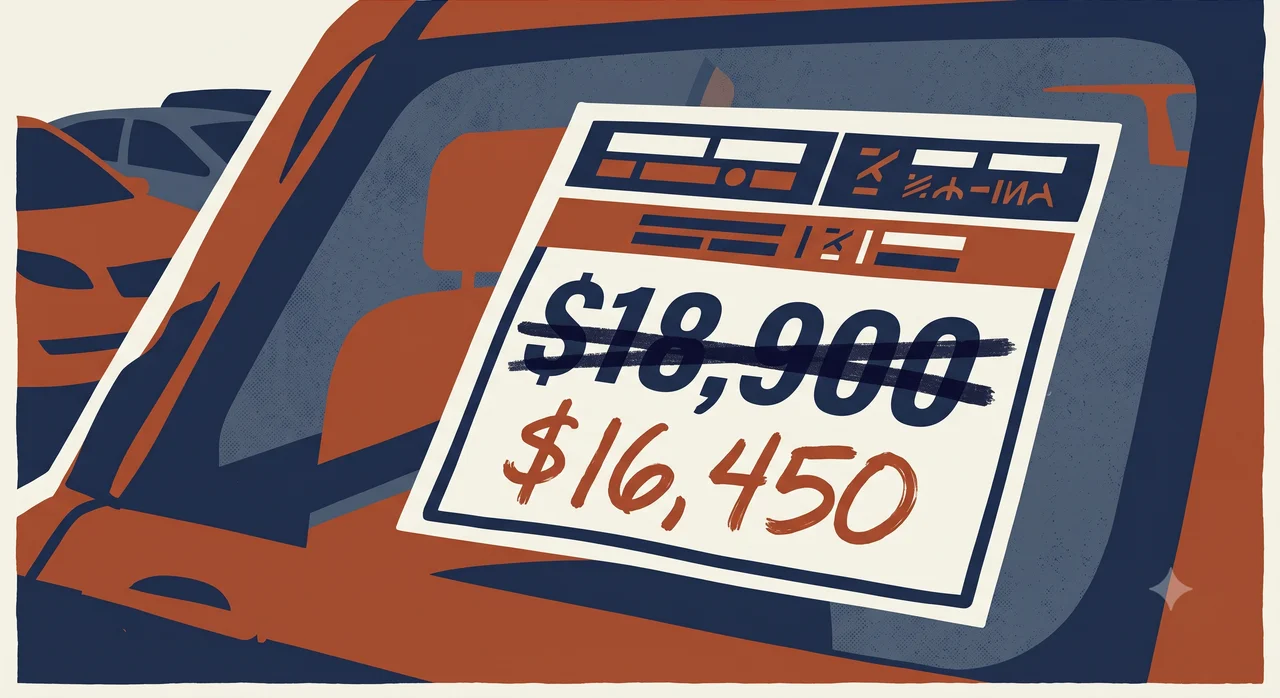
Cutting Price Into Rising Costs Reverses Four Years of Doctrine
There is a defensible reading of this, and it deserves stating before the critical one. GEICO spent 2022 and 2023 pricing for survival and paid for it in customers: voluntary auto policies-in-force fell 8.9% in 2022, and policies-in-force fell a further 9.8% in 2023.3 Berkshire was explicit about the cause, writing that "reductions in advertising expenditures in 2022 and 2023 contributed to reductions of policies-in-force."4 A company that has just shed a fifth of its book, rebuilt its margin, and watched a competitor take the customers it let go might reasonably decide that 2026 is the year to buy them back. Underwriting profit is a fine thing, but an auto insurer with no policies has no float, and float ↗ is the reason Berkshire owns an auto insurer in the first place.
The difficulty is the timing. The moment GEICO chose to start discounting is the moment its own loss costs re-accelerated. Bodily-injury severity running at 10% to 12% is not a used-car problem that a cheaper auction market will fix; it is medical and legal inflation, and it does not respond to advertising. GEICO is cutting price into the one cost line it cannot influence.
GEICO Now Spends More Per Dollar of Premium Than in Its Crisis Year
The other half of the combined ratio is where the discounting actually shows up on the income statement. When both ratios bent together in the first quarter ↗, the open question was whether the acquisition-cost surge was a one-quarter push or a standing commitment. It is a standing commitment. GEICO's underwriting expenses rose 27.3% in the second quarter and 28.3% across the first half, which Berkshire attributes to "increases in commissions and advertising expenses."1 The expense ratio reached 14.0% for the half — against 9.7% in both 2023 and 2024.46
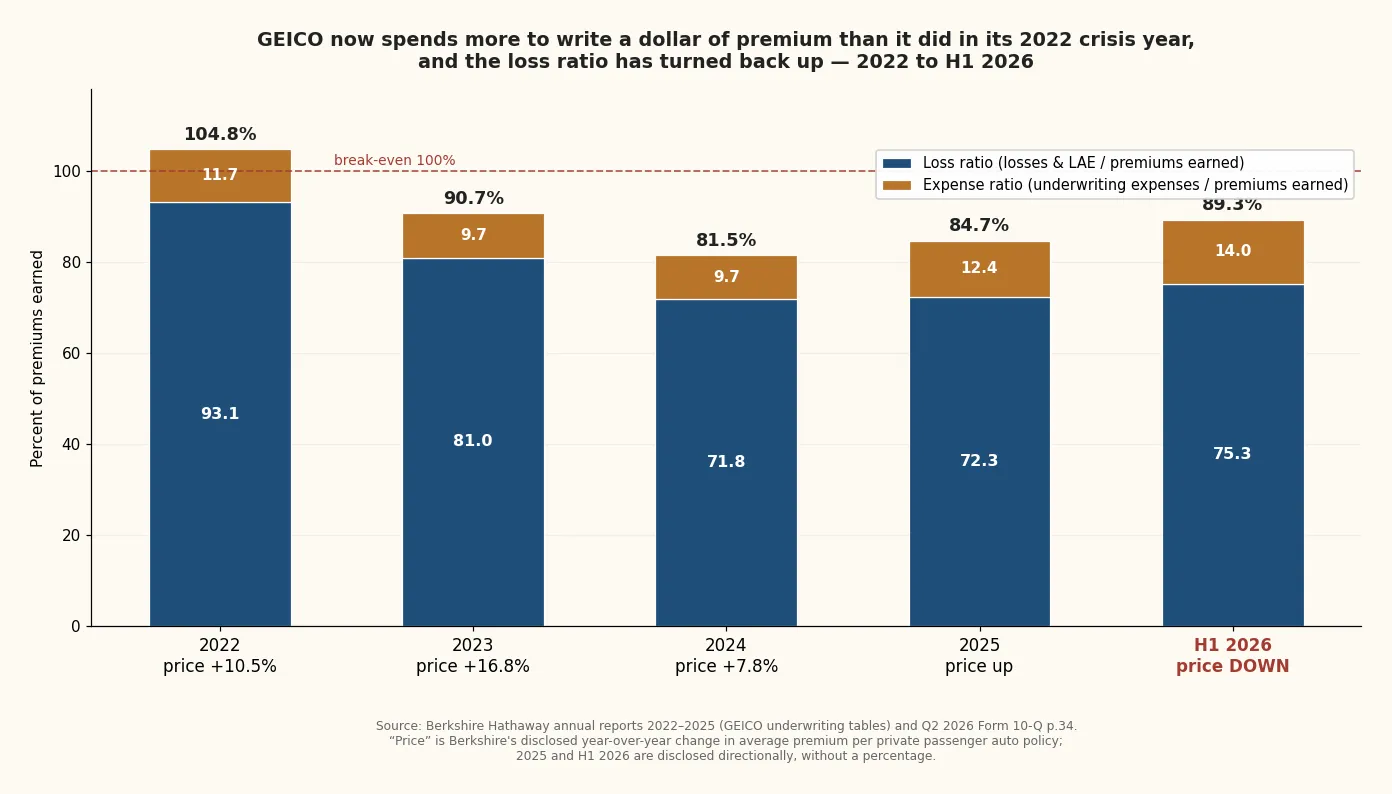
The comparison that should stop a shareholder is with 2022. That was GEICO's disaster year — a combined ratio of 104.8% and a pre-tax underwriting loss of $1,880 million.7 Even then, GEICO spent only 11.7 cents of each premium dollar on underwriting expenses. In the first half of 2026 it is spending 14.0 cents. GEICO has never, in this cycle, paid so much to put a policy on the books.
It is also running ahead of schedule in the wrong direction. In November 2025, S&P Global Market Intelligence projected that GEICO's advertising spend "could conceivably come close to $1.9 billion" for that year, and cited consensus forecasts putting GEICO's expense ratio at 14.5 by the fourth quarter of 2026.8 GEICO printed 14.6% in the second quarter of 2026 — two quarters early.
Everyone Is Discounting, but Only GEICO Is Discounting From Behind
The tempting frame is that GEICO started a price war. It did not. The soft market is industry-wide, and the evidence is in competitors' own filings. Progressive told the SEC that "average written premium per policy decreased 2% in both personal auto and personal property products," adding that it "took minimal personal auto rate decreases on a countrywide basis over the previous 12 months."9 Allstate's auto policies-in-force grew 2.8% while its auto net written premium grew 0.4% — arithmetic that only works if the average premium is falling there too.10 American Property Casualty insurers filed an average approved private passenger auto rate change of +3.7% in 2025, down from +9.7% in 2024, according to AM Best.11
So GEICO is not starting a fight. It is matching one. What separates it from the others is not the discount but the condition of the business absorbing the discount.
| Q2 2026, US personal auto | Combined ratio | Change vs Q2 2025 | Policy growth | Average premium per policy |
|---|---|---|---|---|
| GEICO (direct)1 | 91.2% | +7.7 pts | not disclosed | Falling |
| Progressive, direct auto9 | 89.2% | +1.7 pts | Direct auto +10% | −2% |
| Progressive, agency auto9 | 86.4% | +2.0 pts | Agency auto +8% | −2% |
| Allstate, auto (recorded)10 | 83.3% | −2.7 pts | PIF +2.8% | Falling |
| Allstate, auto (underlying)10 | 87.6% | −0.2 pts | — | — |
The fairest comparison is Progressive's direct book, which sells the same way GEICO does. It ran a 89.2% combined ratio in the quarter, against GEICO's 91.2% — and it got there having deteriorated 1.7 points, where GEICO deteriorated 7.7. On the loss ratio alone, Progressive's direct business moved 1.3 points; GEICO's moved 4.8.19 Progressive is cutting price from a position of margin, and being paid for it in volume — personal auto policies in force up 9% year over year, with the company noting "steady year-over-year growth in both premiums and policies in force despite increased competition in the marketplace."9 Progressive has also now passed State Farm to become the largest US private passenger auto insurer by direct written premium.12
None of this is comfortable for the discounter with the worst combined ratio at the table. GEICO's 91.2% is worse than every Progressive channel, including the direct book that is its closest structural twin.
Berkshire's Reported Insurance Profit Came From the Weather
The consolidated number is where all of this stops being visible. Berkshire's total pre-tax insurance underwriting earnings for the first half of 2026 were $4,445 million, against $4,256 million a year earlier — a 4.4% increase, in a half-year when the company's largest insurance business earned 39.7% less.1 Two things closed that gap, and neither is underwriting.
The first is weather. Berkshire recorded no significant catastrophe events at all in the first half of 2026 — none exceeding its $150 million threshold — against $1.1 billion of current-accident-year losses from the Southern California wildfires in the first half of 2025.1 This was not luck confined to Omaha: Aon put global insured catastrophe losses at roughly $47 billion for the half, against roughly $100 billion a year earlier.13
The second is reserves. Berkshire reduced its estimate of what it owes on prior accident years by $1.5 billion in the first half of 2026, against $240 million in the same period of 2025.1 Those releases flow straight through losses incurred and land in underwriting profit.
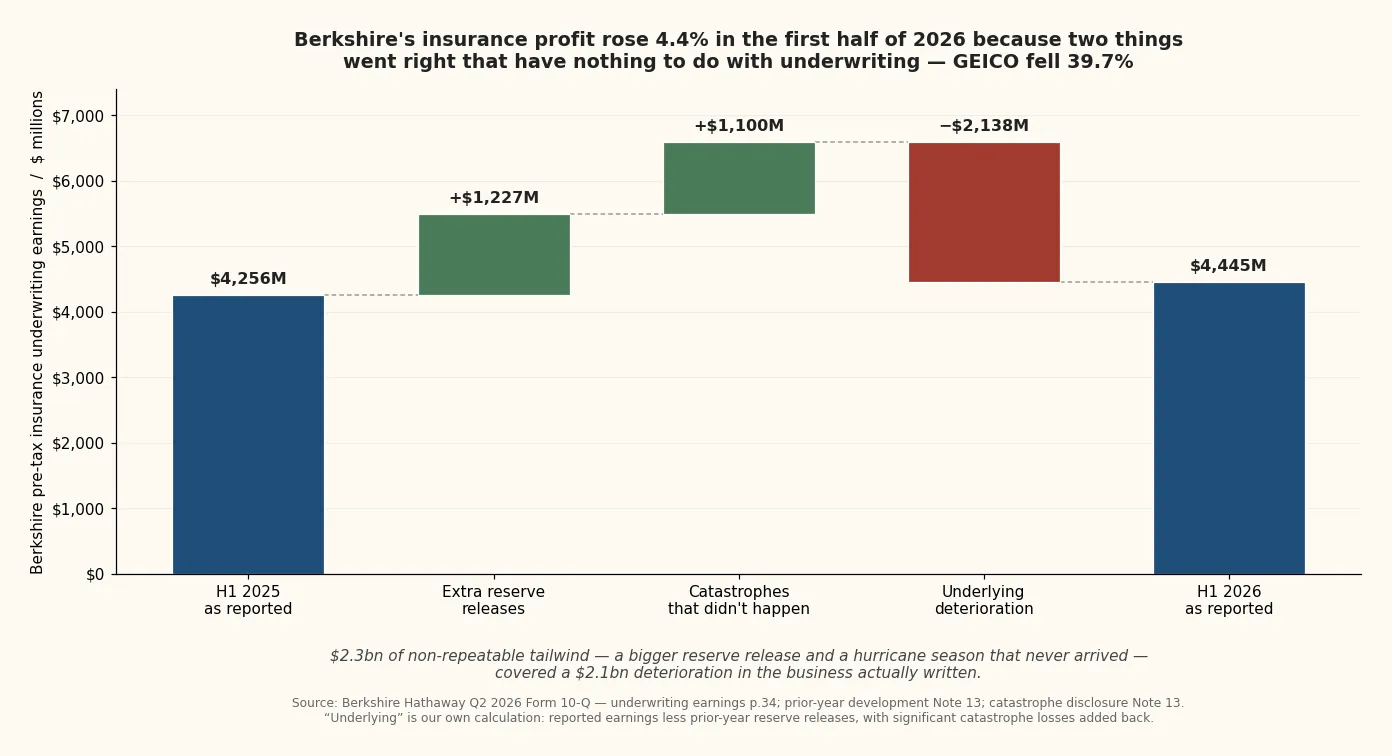
Put the two together and the reported increase inverts. Strip out the prior-year releases and add back the catastrophes that did occur, and the underlying result goes from roughly $5,116 million in the first half of 2025 to roughly $2,978 million in 2026 — a decline of about 42%.14 Berkshire's insurance operation reported a 4.4% gain on $2.3 billion of tailwind that will not repeat and does not recur by choice.
Two caveats belong on our own arithmetic, since Berkshire publishes no such measure. Berkshire discloses only that no significant catastrophe occurred in 2026 — none above its $150 million-per-event threshold — so the add-back for 2026 is zero where the true number is small but positive, which biases the comparison toward a steeper fall. And the totals carry run-off charges from retroactive reinsurance and periodic-payment annuities that have nothing to do with cars, and that happened to move about $179 million in 2026's favour.14 Neither adjustment reverses the direction; both are worth knowing before quoting the number.
This is also not an accusation. Every figure above is disclosed, in the filing, by Berkshire. Reserve releases are the honest consequence of earlier conservatism, and a quiet hurricane season is a genuine economic good. But a shareholder reading "underwriting earnings rose" and stopping there has read the weather report, not the business.
The Releases Came From Businesses GEICO Is Not In
The most telling detail is where those releases did not come from. Berkshire states that the change in GEICO's prior-year reserve estimates in the first half of 2026 was "relatively insignificant."1 The $1.5 billion came from the primary insurance group and the reinsurance businesses — and it came specifically from "lower-than-expected property losses," on the property books those units are deliberately shrinking.1
That matters because GEICO has leaned on its own reserve releases before, and they have been lumpy enough to move a year's result on their own:
| GEICO, favorable prior-year reserve development | Amount |
|---|---|
| 20224 | $653M |
| 20234 | $1,500M |
| 20246 | $550M |
| 20256 | $957M |
| H1 20261 | Not disclosed; change vs H1 2025 "relatively insignificant" |
That last row needs reading carefully, because it is the one place the filing invites a mistake. Berkshire does not say GEICO released nothing in the first half of 2026. It says the change in GEICO's prior-year development against the same period of 2025 was relatively insignificant.1 The level is undisclosed. What that does establish is more useful than a level would be: whatever cushion GEICO booked this year, it booked a comparable one last year. So the 7.7-point deterioration in the combined ratio is like-for-like — not an artefact of a reserve release that appeared or vanished — and there was no catastrophe in the quarter to blame either. GEICO's 91.2% is what the business currently produces, and it is the worst since 2022.
Berkshire Stopped Publishing the Number That Would Settle This
The obvious question is whether the discount is working — whether GEICO is buying policies fast enough to justify buying them at all. Berkshire used to answer it. The 2023 annual report gave the policies-in-force change (−9.8%) alongside the average premium change (+16.8%); the 2024 report did the same (−0.5% and +7.8%).34
The 2025 annual report does not. It says premiums written rose 5.3% "primarily attributable to an increase in policies-in-force over the past year" and leaves it there — no percentage for the policy count, none for the average premium.5 The quarterly filings continue the pattern, describing the direction of price per policy without ever sizing it.12
Berkshire is under no obligation to disclose a metric it has disclosed before, and this is a company that has folded subsidiary reporting into aggregates for decades. But the disclosure went dark in the year the trade got interesting, and its absence means shareholders cannot presently verify whether GEICO is winning the customers it is discounting for. The one figure that would settle whether this is a strategy or a slide is the one that stopped being printed.
Jack Byrne Made the Opposite Trade, and It Saved the Company
Fifty years ago GEICO faced a worse version of this decision, and answered it the other way. In 1976, with the company weeks from liquidation, Jack Byrne raised rates 35% in New York, non-renewed roughly 40% of policies, and pulled out of all but seven states and the District of Columbia ↗. Operation Bootstrap was a deliberate trade of policy count for price, executed at the point of maximum temptation to do the reverse. It worked, and Buffett bought the stock on the strength of the man willing to make it.
Berkshire's stated doctrine has not changed since. The same second-quarter filing that records GEICO's discount also carries the standing instruction to underwriting managers "to decline writing insurance business when the premiums are deemed inadequate to the risks underwritten, without regard to the impact on premium volume."1 In the reinsurance group, that instruction is visibly being followed: property volumes are down, premiums written ex-Tokio Marine fell 5.6% in the quarter, and the unit is shrinking into a soft market on purpose.1 Two businesses under one roof are reading the same market and doing opposite things. The one with the price cut is the one with the deteriorating loss ratio, and the one exercising restraint is the one whose margins are fine.
That may still be the right call. GEICO's 2022–2023 experiment in discipline cost it nearly a fifth of its customers and handed Progressive a lead it has not surrendered, and there is a real argument that the franchise is worth more than a year of margin. What is no longer arguable is the price. GEICO is paying 14 cents of every premium dollar to acquire business, charging less for it than last year, and absorbing bodily-injury severity in double digits while it does so.
The test arrives with the third quarter, and it is narrow enough to be worth writing down. If the discount is working, policies-in-force growth should be visible enough that Berkshire resumes quantifying it, and the loss ratio should stop climbing near 76%. If the third quarter brings another rise in the loss ratio, another jump in acquisition costs, and another year of silence on the policy count, then GEICO will not have been buying growth. It will have been paying full price for a smaller share of a softer market — and the next hurricane season will not be there to cover it.
References
-
Berkshire Hathaway Q2 2026 Form 10-Q - berkshirehathaway.com — “…reflecting an increase in commercial auto business, partially offset by lower average premiums per policy for private passenger auto insurance.” (p.34) ↩↩↩↩↩↩↩↩↩↩↩↩↩↩
-
Berkshire Hathaway Q1 2026 Form 10-Q - berkshirehathaway.com — “Premiums written increased $168 million (1.5%) in the first quarter of 2026… partially offset by lower average premiums per policy for private passenger auto insurance.” (p.30) ↩↩
-
Berkshire Hathaway 2023 Annual Report - berkshirehathaway.com — “…higher average premiums per auto policy (16.8%) due to rate increases, partially offset by a 9.8% decrease in policies-in-force”; and “Voluntary auto policies-in-force declined 8.9% in 2022 … while average premiums per auto policy increased 10.5%” (GEICO underwriting discussion) ↩↩↩
-
Berkshire Hathaway 2024 Annual Report - berkshirehathaway.com — “Reductions in advertising expenditures in 2022 and 2023 contributed to reductions of policies-in-force.” (GEICO underwriting discussion) ↩↩↩↩
-
Berkshire Hathaway 2025 Annual Report - berkshirehathaway.com — “Premiums written increased $2.3 billion (5.3%) in 2025… primarily attributable to an increase in policies-in-force over the past year.” ↩↩
-
Berkshire Hathaway 2025 Annual Report, GEICO reserve development - berkshirehathaway.com — “…reductions in the ultimate loss estimates for prior accident years’ claims of $957 million in 2025 compared to $550 million in 2024.” ↩
-
Berkshire Hathaway 2022 Annual Report - berkshirehathaway.com ↩
-
Carrier Management, on S&P Global Market Intelligence's GEICO expense-ratio forecast - carriermanagement.com — “GEICO's expense ratio could rise to 14.5 by fourth-quarter 2026, the S&P GMI report says, citing consensus forecasts collected by Visible Alpha.” Both this and the $1.9bn advertising figure are November 2025 projections, not reported results. ↩
-
Progressive Corporation Q2 2026 Form 10-Q - sec.gov — “…average written premium per policy decreased 2% in both personal auto and personal property products…” ↩↩↩
-
Allstate Q2 2026 results - prnewswire.com ↩
-
AM Best via Insurance Journal, average approved auto rate changes - insurancejournal.com ↩
-
Carrier Management, Progressive passes State Farm - carriermanagement.com — “Progressive's U.S. private auto insurance direct written premiums for the 12 months ended March 31 totaled about $70.2 billion, roughly $1.5 billion more than the $68.7 billion tallied for State Farm.” State Farm remains the larger insurer across all lines. ↩
-
Aon H1 2026 Global Catastrophe Report via Artemis - artemis.bm — “insured losses from catastrophe events across the globe in the first half of 2026 are estimated to have reached $47 billion… significantly down on last year's $100 billion.” ↩
-
Berkshire Hathaway Q2 2026 Form 10-Q - berkshirehathaway.com — author's calculation from the filing's own figures; Berkshire publishes no "underlying underwriting" measure. Run-off drags were $710M in H1 2026 (retroactive reinsurance $426M, periodic payment annuity $284M) against $889M in H1 2025. ↩↩
-
Berkshire Hathaway 2025 Annual Report and Q2 2026 Form 10-Q - berkshirehathaway.com — author's calculation: GEICO's second-half 2025 combined ratio derived by subtracting the disclosed first-half 2025 figures from the full-year 2025 totals. ↩