Tags: Justin Brands / Acme Brick / Warren Buffett
This fanpage is not officially affiliated with Berkshire Hathaway: Disclaimer
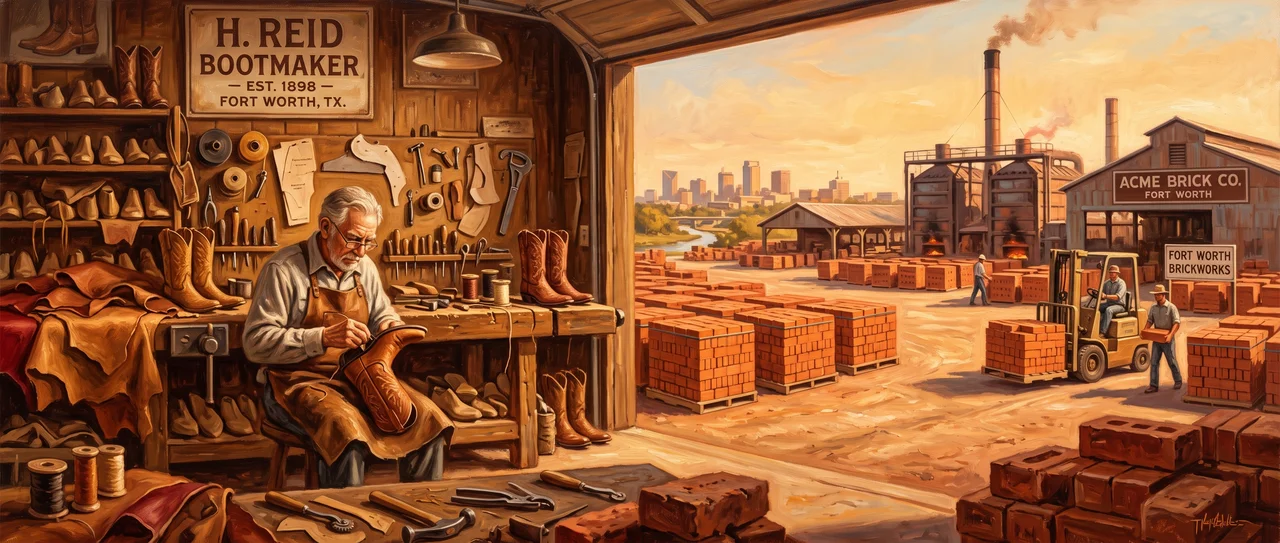
On May 4, 2000, an unsolicited fax arrived at Kiewit Plaza from a stranger named Mark Jones, asking if Berkshire Hathaway would join a buyout group to purchase an unnamed Texas corporation.1 Warren Buffett replied with his customary rule: Berkshire almost never partners with buyout syndicates, but if Jones provided the details and Berkshire completed a deal alone, he would receive a finder's fee.2 The mystery target was Justin Industries, an eccentric Fort Worth conglomerate traded on NASDAQ under the ticker JSTN.3 Within weeks, Buffett flew to Texas to sit with chairman John Roach and eighty-three-year-old John Justin Jr., who was battling severe health problems and searching for a permanent home for his life's work.4 On June 20, 2000, Berkshire announced a tender offer of $22.00 per share, writing a $570 million all-cash check for an enterprise that manufactured two products with zero connection to each other: clay face bricks and handcrafted western boots.5 Wall Street immediately concluded Berkshire had bought a premier brick company and would quietly spin off or shutter the distressed footwear unit; instead, Justin Brands became the clearest demonstration in Omaha's history that Berkshire's greatest operational advantage is the disciplined refusal to manufacture corporate synergy.↗
The May Fax and the Cash Tender Offer
When the Justin Industries acquisition closed on August 1, 2000, financial analysts treated the cowboy boots as an awkward historical appendix.6 Justin Industries owned Acme Brick Company, which produced over one billion face bricks annually across twenty-two plants, representing roughly 11.7% of total American output and commanding a 75% brand-recognition share across Texas.7 In contrast, the boot business had endured five consecutive years of industry contraction, shuttered two historic manufacturing plants in 1999, and booked a painful operating loss during an botched enterprise software overhaul.8
To standard corporate buyers, a conglomerate spanning kilns in Denton and boot benches in El Paso was an operational absurdity crying out for rationalization. In traditional corporate takeovers, investment bankers promise cost reductions through consolidated back offices, unified supply chains, cross-marketing initiatives, and shared executive suites. Such combinations routinely destroy value by forcing unrelated businesses to report through intermediate layers of management who understand neither customer base.
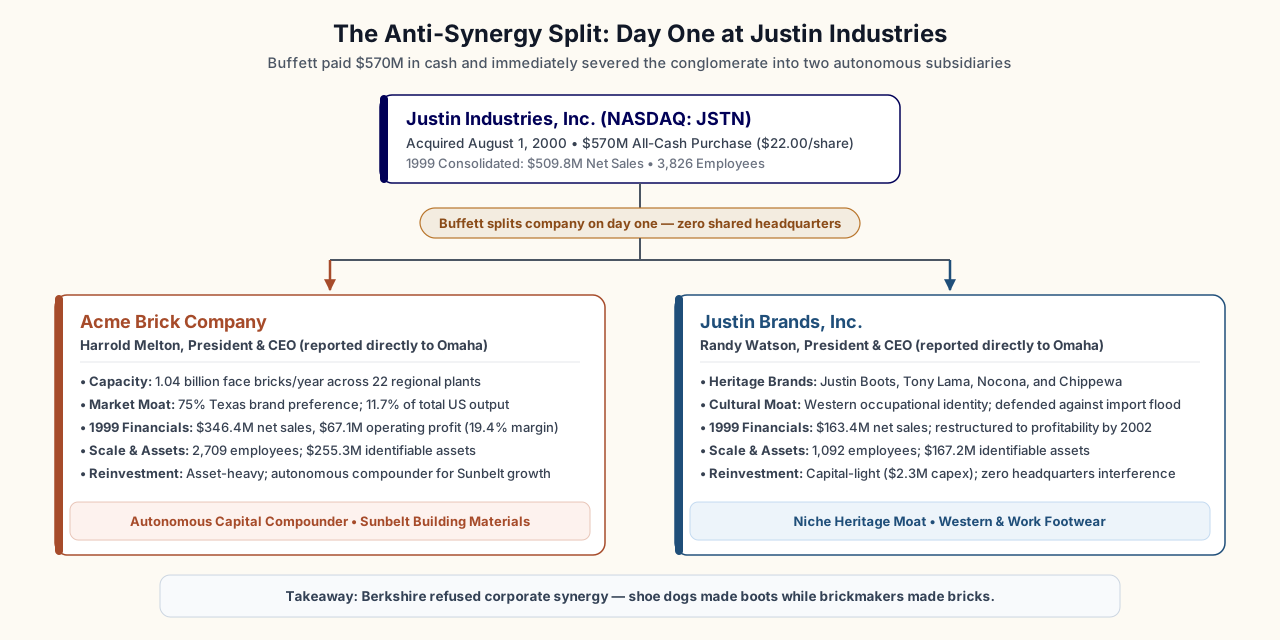
Buffett approached Fort Worth with an entirely opposite framework. He recognized that John Justin Jr. had built two extraordinary franchises that happened to sit beneath a single corporate umbrella purely due to estate-tax planning thirty-two years earlier.9 Instead of forcing the two divisions into a unified corporate structure, Buffett split Justin Industries on day one.10 Harrold Melton remained president of Acme Brick, reporting directly to Omaha. Randy Watson, a seasoned boot salesman who had joined Justin in 1993 and had just been named head of footwear, took full operational command of Justin Brands.11
Neither executive was asked to attend headquarters strategy meetings, nor did either report to an intermediary division president. Buffett provided the capital, promised never to sell the companies, and left each executive completely alone. In his 2000 letter to shareholders, Buffett praised John Justin Jr. as "a class act" who had groomed two managers capable of running their companies with total autonomy.12 It was an acquisition method that echoed the purchase of Fechheimer Brothers fourteen years earlier, where personal trust and localized autonomy substituted for legalistic oversight.↗
The Accidental Conglomerate: How Bricks and Boots Collided
The corporate pairing that landed on Buffett's desk in 2000 was the result of a medical scare three decades earlier. The boot company traced its heritage to 1879, when Herman Joseph Justin borrowed $35 to set up a boot-repair bench in Spanish Fort, Texas, serving cattle drovers traveling north along the Chisholm Trail.13 After H.J. died in 1908, his sons moved the enterprise to Nocona and later Fort Worth, but the business struggled during the mid-century as mechanization shrank the working cowboy population.14
The founder's grandson, John Justin Jr., took control of the family firm in 1950 after buying out his relatives.15 Justin Jr. was an instinctive merchandiser with an acute sense of western identity, even though he did not ride a horse until he was thirty-seven years old.16 When he attended a Cheyenne rodeo in 1954 and noticed that calf-ropers struggled with high-heeled riding boots during foot races, he adapted the low-heeled footwear worn by Texas A&M ROTC cadets to create the "Roper" boot.17 The Roper became an immediate commercial phenomenon, transforming western footwear from functional work gear into casual American lifestyle fashion. Justin Jr. followed with custom-tooled boots featuring collegiate mascots, starting with Texas Christian University's horned frog and expanding across the Southwest Conference.18 Between 1950 and the late 1960s, annual footwear sales surged from $1 million toward $10 million.19
In 1968, a severe bout of appendicitis forced Justin Jr. to confront his estate exposure.20 His net worth was entirely concentrated in illiquid shares of a private footwear partnership. To secure liquidity and establish a public market value, he agreed to merge Justin Boot Company into First Worth Corporation, a publicly traded investment vehicle that owned Acme Brick.21
The partnership soured almost immediately. Justin Jr. discovered that First Worth's executive promoters prioritized short-term accounting tricks over operating substance.22 Furious at what he viewed as deceptive balance-sheet management, he threatened litigation to unwind the merger. Confronted by an outraged western icon who owned a major equity block, First Worth's management capitulated and surrendered executive control to Justin Jr. in 1969.23
Though he admitted knowing nothing about clay kilns, Justin Jr. applied simple manufacturing discipline to Acme. During the 1970 housing recession, when competitors shuttered production lines, Justin Jr. studied Acme's historical shipment archives dating back to 1891 and observed that residential construction invariably snapped back.24 He ordered Acme's plants to produce at full capacity and build inventory on open fields, betting that storage costs were lower than the friction of shutting and relighting kilns.25 When the Texas housing market rebounded, Acme held the only available brick supply in the Southwest, locking in a dominant market share that it never relinquished.
By 1985, Justin Industries had grown into an attractive mid-cap compounder, prompting hostile takeover bids from industrial corporate raiders who planned to split the boots from the bricks.26 Justin Jr. defeated the raids by acquiring rival bootmaker Tony Lama Company in 1990, absorbing its corporate liabilities as a balance-sheet shield and rallying Fort Worth civic allies to buy shares.27 Having added Nocona Boot Company in 1981 and Chippewa Shoe in 1984, Justin Industries entered the late 1990s as the undisputed leader of American western footwear and regional brickmaking.28
The 1999 Autopsy: Getting a Footwear Empire for Free
The financial anatomy of the 2000 transaction reveals why Buffett moved with such speed when Mark Jones's fax crossed his desk. Justin Industries was filed under the brick manufacturing SIC code, obscuring the distinct economics of its two constituent businesses.29 A forensic look at Justin Industries' final Form 10-K for the fiscal year ended December 31, 1999, demonstrates that Berkshire purchased Acme Brick at a reasonable standalone multiple and received the footwear empire as a zero-cost call option.30
| Segment | 1999 Net Sales | 1999 Operating Profit (Loss) | Identifiable Assets | 1999 Capex | Full-Time Headcount |
|---|---|---|---|---|---|
| Acme Building Brands | $346.4M31 | $67.1M32 | $255.3M33 | $51.2M34 | 2,70935 |
| Justin Brands (Footwear) | $163.4M36 | ($16.3M)37 | $167.2M38 | $2.3M39 | 1,09240 |
| Corporate / Eliminations | — | ($5.9M)41 | $10.8M42 | $0.2M43 | 2544 |
| Consolidated Total | $509.8M45 | $45.0M46 | $433.3M47 | $53.6M48 | 3,82649 |
In 1999, Acme Building Brands generated $67.1 million in operating profit on $346.4 million in net revenue, delivering a 19.4% operating margin in an unglamorous building-materials sector.50 Acme was self-funding, asset-rich, and threw off substantial free cash flow. If an acquirer valued Acme Brick at a modest multiple of eight to nine times operating earnings, Acme alone was worth between $535 million and $600 million.51
Berkshire paid $570 million in cash for the entire enterprise.52 On consolidated pre-tax income of $43.7 million, the sticker price appeared to be roughly 13.0 times trailing earnings.53 However, the consolidated figure was severely depressed by Footwear's reported operating loss of $16.3 million.54 Crucially, that footwear loss was not an operational cash drain: it included a one-time inventory write-down of $7.0 million and plant-restructuring charges of $5.5 million incurred to clear out obsolete inventory and shut uncompetitive facilities.55
Backing out the $12.5 million in non-recurring charges, Justin Brands had generated approximately breakeven operating results during the absolute trough of its cycle, while requiring just $2.3 million in capital expenditures across the entire year.56 Buffett effectively bought Acme Brick at approximately 8.5 times operating earnings and acquired $163.4 million in boot revenue, $167.2 million in identifiable assets, and four peerless consumer trademarks for net zero capital outlay.
Randy Watson's Midnight Rescue and the Factory Closures
The reason Justin Brands arrived at Berkshire at an optical trough was an operational catastrophe that unfolded in late 1998. Seeking to streamline procurement, manufacturing, and order fulfillment across four disparate boot brands, corporate management had greenlit an enterprise software overhaul.57 The software migration went live immediately prior to the 1998 Christmas shopping season, and the entire system instantly seized up.58
Warehouses could neither locate inventory nor fulfill shipments to western retailers. Delivery delays stretched from days into months, destroying approximately $15 million in footwear revenue across late 1998 and early 1999.59 With customer orders canceled and retail shelves left bare, western specialty dealers began sourcing boots from aggressive competitors like Ariat and Lucchese.60 Justin Industries was threatened with structural brand impairment.
In the middle of the breakdown, John Justin Jr. turned to Randy Watson. Watson had spent his life in the western apparel trade, starting as a wholesale sales representative before rising to manage Justin Boot.61 Recognizing that the company was bleeding cash and carrying bloated overhead from the Tony Lama and Nocona mergers, Watson executed a painful restructuring in 1999.62
Watson made the difficult decision to shut down Justin's historic plant in Fort Worth and the original Nocona factory, laying off roughly 280 production workers and consolidating all domestic manufacturing into larger, modern facilities in El Paso, Texas, and Cassville and Carthage, Missouri.63 He took a $7 million inventory write-down to liquidate overlapping styles, stopped his own brands from competing on identical price points, and introduced entry-level lines to protect retail volume.64
By the time Buffett met Watson in Fort Worth in June 2000, the painful surgical work had already been completed. The shipping backlogs were resolved, overhead was lowered, and the boot business was positioned to harvest profits on minimal capital. When Buffett asked Watson how he planned to run the business under Berkshire, Watson answered that he simply needed Omaha to leave him alone so his team could sell boots. Buffett agreed without reservation.
Why Dexter Collapsed While Justin Endured
To understand why Buffett was willing to own Justin Brands in 2000, one must contrast it with the ghost that haunted Berkshire's balance sheet throughout that exact period: Dexter Shoe Company. Buffett's purchase of Dexter in 1993 had quickly deteriorated into the worst capital-allocation mistake of his career.↗
| Company | Acquired | Consideration | Transaction Cost | Economic Fate |
|---|---|---|---|---|
| H.H. Brown Shoe | 199165 | Cash66 | ~$100M (Est.)67 | Stable niche profit; anchor of BH Shoe Holdings.68 |
| Dexter Shoe | 199369 | 25,203 Class A Shares70 | $433M at close / >$18B current value71 | Competitive moat destroyed by foreign imports; written to zero.72 |
| Justin Brands | 200073 | Cash (part of $570M check)74 | Imputed ~$0 for footwear assets75 | High ROIC cash compounder; restored profit by 2002.76 |
| Brooks Sports | 200677 | Cash (via Russell Corp buyout)78 | ~$1.15B for Russell Corp group79 | Spun out as direct sub; over $1B in performance running sales.80 |
In 1993, Buffett purchased Dexter Shoe for 25,203 Class A shares, then valued at $433 million.81 Dexter produced high-quality, generic casual shoes and dress footwear in Maine. Buffett believed Dexter possessed a durable moat grounded in skilled domestic craftsmanship and loyal wholesale relationships.82
He was completely wrong. Within three years of the purchase, low-cost footwear manufacturing in China and Southeast Asia flooded the American market. Dexter's wholesale customers deserted the brand for foreign products that cost a third of Maine production expenses. Dexter's earnings evaporated, culminating in a complete shutdown of its domestic plants and a total write-down of its carrying value.83 Because Buffett had surrendered 1.6% of Berkshire's equity to buy the company—shares worth over $18 billion at today's valuation—the Dexter transaction became an enduring wound in Berkshire lore.84↗
Why did Justin Brands survive the exact import tsunami that drowned Dexter? The answer lay in the nature of the western moat. Dexter made undifferentiated casual loafers; a consumer shopping for boat shoes cares about styling and price, not whether the leather was stitched in New England. Justin, Tony Lama, and Nocona made cultural artifacts.
A working cowboy, a rodeo rider, or a Texas oilfield worker does not buy western boots as interchangeable footwear. The boots are an emblem of occupational identity, durability, and regional pride. While generic casual footwear migrated overseas, the premium western segment sustained pricing power. Furthermore, Chippewa held a fortified position in rugged industrial work boots, where safety ratings and brand reputation insulate manufacturers from commodity price competition.85
Equally important was capital intensity: while Dexter required persistent capital reinvestment to chase disappearing volume, Justin Brands operated as a capital-light brand licenser and specialty fabricator. When foreign production became inevitable for entry-level price tiers, Watson blended imported uppers with domestic premium benchcraft in El Paso, preserving the brand's authentic heritage while defending margins.86
The Turnaround and the Greenwich Consolidation
The operational proof of Buffett's thesis arrived almost immediately. In 2001, Berkshire's aggregate shoe group recorded a pre-tax loss of $46.2 million, as catastrophic liquidations at Dexter dragged the entire segment into the red.87 Yet in his annual review, Buffett noted that profits at both H.H. Brown and Justin Brands had been completely obscured by Dexter's collapse.88
Just twelve months later, the picture shifted dramatically. In his 2002 shareholder letter, Buffett reported that Berkshire's shoe earnings had staged a $70 million upward swing, generating $24 million in pre-tax profit.89 Buffett singled out Randy Watson for praise, noting that Justin Brands had dramatically expanded margins while simultaneously reducing invested capital.90 Without central corporate management or consultants, Watson had trimmed working capital, collected receivables, and converted inventory into cash.
          2001 Pre-Tax Shoe Loss:  -$46.2M (Swamped by Dexter write-downs)
                                         │
                         +$70M Operational Swing
                                         ▼
          2002 Pre-Tax Shoe Profit: +$24.0M (Justin expands margins, cuts capital)
Watson continued running Justin Brands out of Fort Worth for the next decade and a half. Between 2008 and 2012, while the Great Recession battered consumer discretionary retail, Justin Brands grew annual revenues at an average rate exceeding 10% per year.91 Watson expanded the company's retail partnerships with farm-and-ranch chains like Cavender's, Tractor Supply, and Boot Barn, while deepening Justin's sponsorship of the Professional Rodeo Cowboys Association.92 In 2013, Ernst & Young recognized Watson as an Entrepreneur of the Year for strategic leadership.93
Eventually, the quiet logic of Berkshire's apparel holdings led to an unheralded structural change. In 2021, Berkshire consolidated its various footwear operations—H.H. Brown, Justin Brands, Tony Lama, Chippewa, BØRN, and Carolina—under a single reporting umbrella designated as BH Shoe Holdings Group, based in Greenwich, Connecticut.94 The consolidation was administrative rather than operational: Justin Brands retained its operational center and cultural identity in Texas, but its back-office reporting and global sourcing were aligned alongside H.H. Brown under longtime Berkshire footwear executive Jim Issler.95 By 2025, BH Shoe Holdings employed 1,137 workers worldwide, while its sister company Acme Brick employed 1,733, continuing to compound side by side a quarter-century after Buffett bought them together.96
Omaha Still Buys Boots on Friday Morning
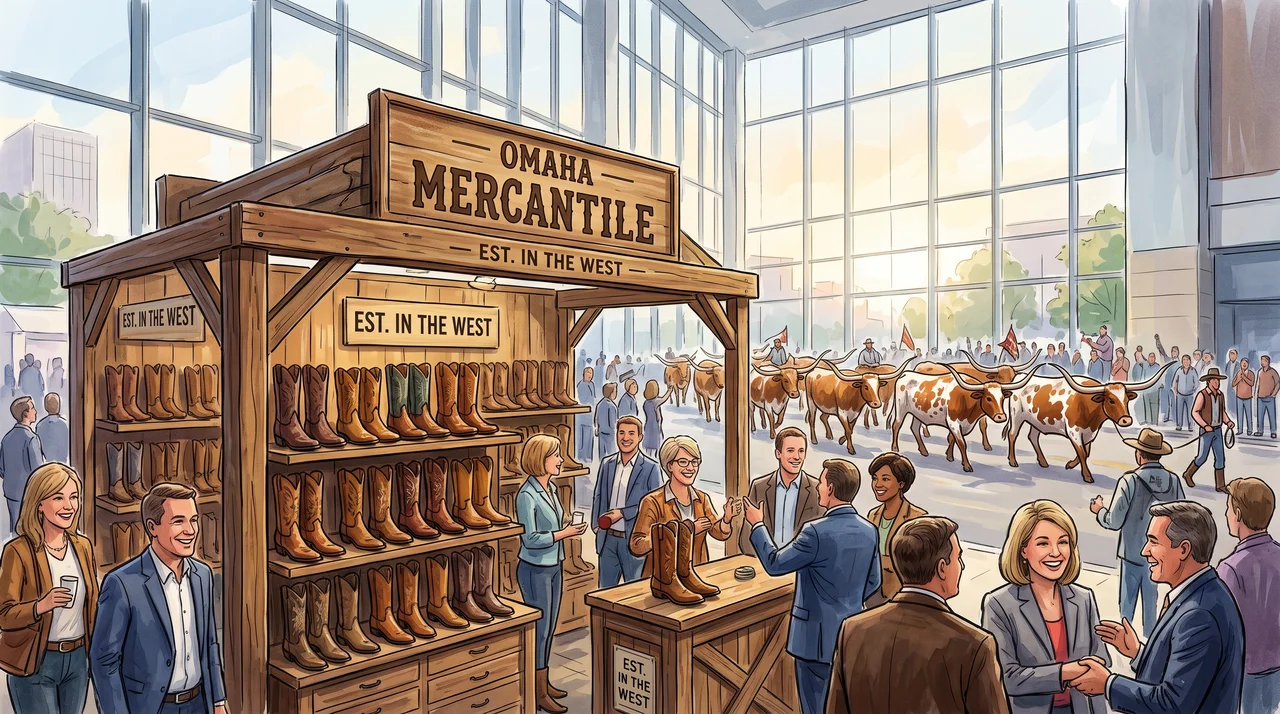
For Berkshire Hathaway shareholders, Justin Brands is celebrated not through SEC segment breakdowns, but on the concrete floor of the CHI Health Center in Omaha every spring.97
Beginning in the early 2000s, Justin Brands established an expansive pop-up store inside the shareholder exhibit hall, situated alongside Fruit of the Loom, See's Candies, and Borsheims.98 Every Friday and Saturday of annual meeting weekend, thousands of shareholders line up to purchase handcrafted western boots at shareholder discounts. At the 2014 meeting, Buffett joked with the arena that Berkshire had expanded its transport empire beyond planes, trains, and automobiles when Justin Boots brought two full-sized Texas Longhorn steers to parade outside the arena at sunrise.99
That enduring spectacle captures the paradox of Berkshire Hathaway. An orthodox private equity sponsor buying Justin Industries in 2000 would have dissected the balance sheet, stripped headquarter overhead, fired redundant staff, and sold the footwear business to a financial buyer to pay down acquisition debt. In doing so, they would have incurred millions in advisory fees and severed the generational relationships that sustained the brand.
Buffett understood that the two businesses needed nothing from each other except the freedom to operate independently. Acme Brick required vast amounts of capital to automate kilns, acquire shale reserves, and expand concrete block distribution across the Sunbelt; Justin Brands required almost no capital, relying instead on brand equity, dealer loyalty, and cultural authenticity. By providing a permanent balance sheet without operational interference, Berkshire allowed both companies to thrive. A quarter of a century after a stranger's fax landed in Omaha, the boots that came with the bricks remain an enduring testament to the power of corporate anti-synergy.
References
-
Warren Buffett, 2000 Shareholder Letter - berkshirehathaway.com — “On May 4th, I received a fax from Mark Jones, a stranger to me, proposing that Berkshire join a group to acquire an unnamed company.” (p. 5) ↩
-
Warren Buffett, 2000 Shareholder Letter - berkshirehathaway.com — “with rare exceptions we don't invest with others, but would happily pay him a commission if he sent details and we later made a purchase.” (p. 5) ↩
-
Justin Industries, Inc. Form 10-K for Fiscal Year Ended December 31, 1999 - sec.gov ↩
-
Warren Buffett, 2000 Shareholder Letter - berkshirehathaway.com — “I then went to Fort Worth to meet John Roach, chairman of the company and John Justin, who had built the business and was its major shareholder.” (p. 5) ↩
-
Warren Buffett, 2000 Shareholder Letter - berkshirehathaway.com — “Soon after, we bought Justin for $570 million in cash.” (p. 5) ↩
-
Berkshire Hathaway Inc. 2000 Annual Report - sec.gov (Note 2, Significant Business Acquisitions, p. 37) ↩
-
Warren Buffett, 2000 Shareholder Letter - berkshirehathaway.com — “produces more than one billion bricks per year at its 22 plants, about 11.7% of the industry's national output... When Texans are asked to name a brand of brick, 75% respond Acme...” (p. 5) ↩
-
Justin Industries, Inc. Form 10-K for Fiscal Year Ended December 31, 1999 - sec.gov (Item 7, Management's Discussion and Analysis) ↩
-
Lawrence A. Cunningham, Berkshire Beyond Buffett: The Enduring Value of Values - books.google.com — Columbia University Press, 2014, pp. 96-99. ↩
-
Lawrence A. Cunningham, Berkshire Beyond Buffett: The Enduring Value of Values - books.google.com — p. 98 — “Upon acquisition, Berkshire split Acme and Justin into separate operations, each a standalone subsidiary.” ↩
-
Ronald Chan, Behind the Berkshire Hathaway Curtain: Lessons from Warren Buffett's Top Business Leaders - books.google.com — John Wiley & Sons, 2010, pp. 25-32. ↩
-
Warren Buffett, 2000 Shareholder Letter - berkshirehathaway.com — “John was a class act — as a citizen, businessman and human being. Fortunately, he had groomed two outstanding managers, Harrold Melton at Acme and Randy Watson at Justin Boot, each of whom runs his company autonomously.” (p. 5) ↩
-
Irvin Farman, Standard of the West: The Justin Story - books.google.com — Texas Christian University Press, 1996, pp. 15-28. ↩
-
Irvin Farman, Standard of the West: The Justin Story - books.google.com — pp. 88-102. ↩
-
Lawrence A. Cunningham, Berkshire Beyond Buffett - books.google.com — p. 96. ↩
-
Irvin Farman, Standard of the West: The Justin Story - books.google.com — p. 138. ↩
-
Irvin Farman, Standard of the West: The Justin Story - books.google.com — pp. 153-154. ↩
-
Irvin Farman, Standard of the West: The Justin Story - books.google.com — p. 155. ↩
-
International Directory of Company Histories, Vol. 19: Justin Industries, Inc. - fundinguniverse.com — St. James Press, 1998. ↩
-
Irvin Farman, Standard of the West: The Justin Story - books.google.com — pp. 172-173. ↩
-
Edwin E. Lehr, Colossus in Clay: Acme Brick Company - books.google.com — Walsworth Publishing, 1998, pp. 185-192. ↩
-
Irvin Farman, Standard of the West: The Justin Story - books.google.com — pp. 177-183. ↩
-
Lawrence A. Cunningham, Berkshire Beyond Buffett - books.google.com — p. 97. ↩
-
Edwin E. Lehr, Colossus in Clay: Acme Brick Company - books.google.com — pp. 201-205. ↩
-
Lawrence A. Cunningham, Berkshire Beyond Buffett - books.google.com — p. 97. ↩
-
Irvin Farman, Standard of the West: The Justin Story - books.google.com — pp. 210-225. ↩
-
Irvin Farman, Standard of the West: The Justin Story - books.google.com — pp. 226-235. ↩
-
International Directory of Company Histories, Vol. 19: Justin Industries, Inc. - fundinguniverse.com — St. James Press, 1998. ↩
-
Justin Industries Form 10-K, Item 1 - sec.gov ↩
-
Justin Industries 1999 Form 10-K, Note 14 (Industry Segments) - sec.gov ↩
-
Justin Industries 1999 Form 10-K - sec.gov — “Net sales: Building Materials $346,377” (Note 14, in thousands) ↩
-
Justin Industries 1999 Form 10-K - sec.gov — “Operating profit: Building Materials $67,107” (Note 14, in thousands) ↩
-
Justin Industries 1999 Form 10-K - sec.gov — “Identifiable assets: Building Materials $255,320” (Note 14, in thousands) ↩
-
Justin Industries 1999 Form 10-K - sec.gov — “Expenditures for long-lived assets: Building Materials $51,169” (Note 14, in thousands) ↩
-
Justin Industries 1999 Form 10-K - sec.gov — “Building Materials Total [employees]: 2,709” (Item 1, p. 7) ↩
-
Justin Industries 1999 Form 10-K - sec.gov — “Net sales: Footwear $163,434” (Note 14, in thousands) ↩
-
Justin Industries 1999 Form 10-K - sec.gov — “Operating profit (loss): Footwear $(16,258)” (Note 14, in thousands) ↩
-
Justin Industries 1999 Form 10-K - sec.gov — “Identifiable assets: Footwear $167,154” (Note 14, in thousands) ↩
-
Justin Industries 1999 Form 10-K - sec.gov — “Expenditures for long-lived assets: Footwear $2,308” (Note 14, in thousands) ↩
-
Justin Industries 1999 Form 10-K - sec.gov — “Footwear Total [employees]: 1,092” (Item 1, p. 7) ↩
-
Justin Industries 1999 Form 10-K, Note 14 - sec.gov ↩
-
Justin Industries 1999 Form 10-K, Note 14 - sec.gov ↩
-
Justin Industries 1999 Form 10-K, Note 14 - sec.gov ↩
-
Justin Industries 1999 Form 10-K, Item 1 - sec.gov ↩
-
Justin Industries 1999 Form 10-K, Note 14 - sec.gov ↩
-
Justin Industries 1999 Form 10-K, Note 14 - sec.gov ↩
-
Justin Industries 1999 Form 10-K, Note 14 - sec.gov ↩
-
Justin Industries 1999 Form 10-K, Note 14 - sec.gov ↩
-
Justin Industries 1999 Form 10-K, Item 1 - sec.gov ↩
-
Justin Industries 1999 Form 10-K, Item 7 - sec.gov ↩
-
Derived: $67.1M operating profit × 8 = $536.8M; $67.1M × 9 = $603.9M, based on Justin Industries 1999 Form 10-K - sec.gov ↩
-
Warren Buffett, 2000 Shareholder Letter - berkshirehathaway.com (p. 5) ↩
-
Justin Industries 1999 Form 10-K, Consolidated Statements of Earnings - sec.gov (Pre-tax income $43,736 thousand; $570M / $43.736M = 13.03x) ↩
-
Justin Industries 1999 Form 10-K, Note 14 - sec.gov ↩
-
Justin Industries 1999 Form 10-K - sec.gov — “Footwear's operating loss in 1999 includes a special inventory write-down of $7 million and a restructuring charge of $5.5 million.” (Note 14, footnote 1) ↩
-
Derived: $(16.258M) loss + $12.5M one-offs = $(3.758M) normalized operating loss, against $2.308M capex, based on Justin Industries 1999 Form 10-K - sec.gov ↩
-
Ronald Chan, Behind the Berkshire Hathaway Curtain - books.google.com — pp. 27-28. ↩
-
Ronald Chan, Behind the Berkshire Hathaway Curtain - books.google.com — p. 27. ↩
-
Justin Industries 1999 Form 10-K - sec.gov — “computer problems that impacted Justin Brands' revenues by an estimated $10 million and $5 million, respectively.” (Item 7, p. 17) ↩
-
Ronald Chan, Behind the Berkshire Hathaway Curtain - books.google.com — p. 28. ↩
-
Martha Deller, “Top CEO, Strategic Management, Randy Watson of Justin Boots,” Fort Worth Business Press (cited in Cunningham, Berkshire Beyond Buffett, p. 268) - books.google.com ↩
-
Ronald Chan, Behind the Berkshire Hathaway Curtain - books.google.com — pp. 28-29. ↩
-
Justin Industries 1999 Form 10-K, Item 1 - sec.gov (Footwear plant closures and headcount) ↩
-
Justin Industries 1999 Form 10-K, Item 7 - sec.gov ↩
-
Warren Buffett, 1991 Shareholder Letter - berkshirehathaway.com ↩
-
Warren Buffett, 1991 Shareholder Letter - berkshirehathaway.com ↩
-
Warren Buffett, 1991 Shareholder Letter - berkshirehathaway.com — Estimated purchase price based on 1991 acquisition disclosures. ↩
-
Berkshire Hathaway Inc. 2021 Annual Report - berkshirehathaway.com (Item 1, p. K-18) ↩
-
Warren Buffett, 1993 Shareholder Letter - berkshirehathaway.com ↩
-
Warren Buffett, 1993 Shareholder Letter - berkshirehathaway.com — “25,203 shares when we acquired Dexter Shoe” ↩
-
Derived from share count in Warren Buffett, 1993 Shareholder Letter - berkshirehathaway.com — 25,203 Class A shares × ~$730,000 Class A share price in 2026 = ~$18.4 billion. ↩
-
Warren Buffett, 2007 Shareholder Letter - berkshirehathaway.com (p. 8) ↩
-
Warren Buffett, 2000 Shareholder Letter - berkshirehathaway.com (p. 5) ↩
-
Warren Buffett, 2000 Shareholder Letter - berkshirehathaway.com (p. 5) ↩
-
Derived: based on Acme Brick standalone valuation vs $570M total purchase price in Warren Buffett, 2000 Shareholder Letter - berkshirehathaway.com ↩
-
Warren Buffett, 2002 Shareholder Letter - berkshirehathaway.com (p. 11) ↩
-
Warren Buffett, 2006 Shareholder Letter - berkshirehathaway.com ↩
-
Warren Buffett, 2006 Shareholder Letter - berkshirehathaway.com ↩
-
Berkshire Hathaway Inc. 2006 Annual Report - berkshirehathaway.com ↩
-
Berkshire Hathaway Inc. 2023 Annual Report - berkshirehathaway.com ↩
-
Warren Buffett, 2007 Shareholder Letter - berkshirehathaway.com — “I bought in 1993 for $433 million in Berkshire stock (25,203 shares of A)” (p. 8) ↩
-
Warren Buffett, 1993 Shareholder Letter - berkshirehathaway.com ↩
-
Warren Buffett, 2001 Shareholder Letter - berkshirehathaway.com — “Dexter, prior to our purchase – and indeed for a few years after – prospered despite low-cost foreign competition that was brutal. I concluded that Dexter could continue to cope with that problem, and I was wrong.” (p. 6) ↩
-
Warren Buffett, 2007 Shareholder Letter - berkshirehathaway.com — “In essence, I gave away 1.6% of a wonderful business – one now valued at $220 billion – to buy a worthless business. To date, Dexter is the worst deal that I've made.” (p. 8) ↩
-
Ronald Chan, Behind the Berkshire Hathaway Curtain - books.google.com — pp. 30-31. ↩
-
Warren Buffett, 2001 Shareholder Letter - berkshirehathaway.com — “Our shoe operations (included in ‘other businesses’) lost $46.2 million pre-tax, with profits at H.H. Brown and Justin swamped by losses at Dexter.” (p. 6) ↩
-
Warren Buffett, 2001 Shareholder Letter - berkshirehathaway.com (p. 6) ↩
-
Warren Buffett, 2002 Shareholder Letter - berkshirehathaway.com — “we earned $24 million in shoes last year, an upward swing of $70 million from 2001.” (p. 11) ↩
-
Warren Buffett, 2002 Shareholder Letter - berkshirehathaway.com — “Randy Watson at Justin also contributed to this improvement, increasing margins significantly while trimming invested capital.” (p. 11) ↩
-
Martha Deller, “Top CEO, Strategic Management, Randy Watson of Justin Boots,” Fort Worth Business Press (cited in Cunningham, Berkshire Beyond Buffett) - books.google.com — “sales growth exceeded 10 percent in every year from 2008 to 2012.” ↩
-
Ronald Chan, Behind the Berkshire Hathaway Curtain - books.google.com — pp. 29-30. ↩
-
Martha Deller, Fort Worth Business Press (cited in Cunningham, Berkshire Beyond Buffett, p. 268) - books.google.com ↩
-
Berkshire Hathaway Inc. 2021 Annual Report - berkshirehathaway.com — “The BH Shoe Holdings Group, headquartered in Greenwich, Connecticut, manufactures and distributes work, rugged outdoor and casual shoes and western-style footwear under a number of brand names, including Justin, Tony Lama, Chippewa...” (p. K-18) ↩
-
Berkshire Hathaway Inc. 2021 Annual Report - berkshirehathaway.com (p. K-18) ↩
-
Berkshire Hathaway Inc. 2025 Annual Report - berkshirehathaway.com — “Acme . . . . 1,733”; “H. H. Brown Shoe Group . . . . 1,137” (p. A-6) ↩
-
Daniel Pecaut and Corey Wrenn, University of Berkshire Hathaway - books.google.com — Pecaut & Company, 2017, p. 112. ↩
-
Daniel Pecaut and Corey Wrenn, University of Berkshire Hathaway - books.google.com — p. 112. ↩
-
Daniel Pecaut and Corey Wrenn, University of Berkshire Hathaway - books.google.com — p. 182 — “Buffett joked that they expanded transportation beyond planes, trains and automobiles as Justin Boots brought two big steers and Wells Fargo brought a stagecoach to parade down to The CenturyLink Center at 6:30 a.m.” ↩