Tags: BNSF / Greg Abel / Warren Buffett
This fanpage is not officially affiliated with Berkshire Hathaway: Disclaimer
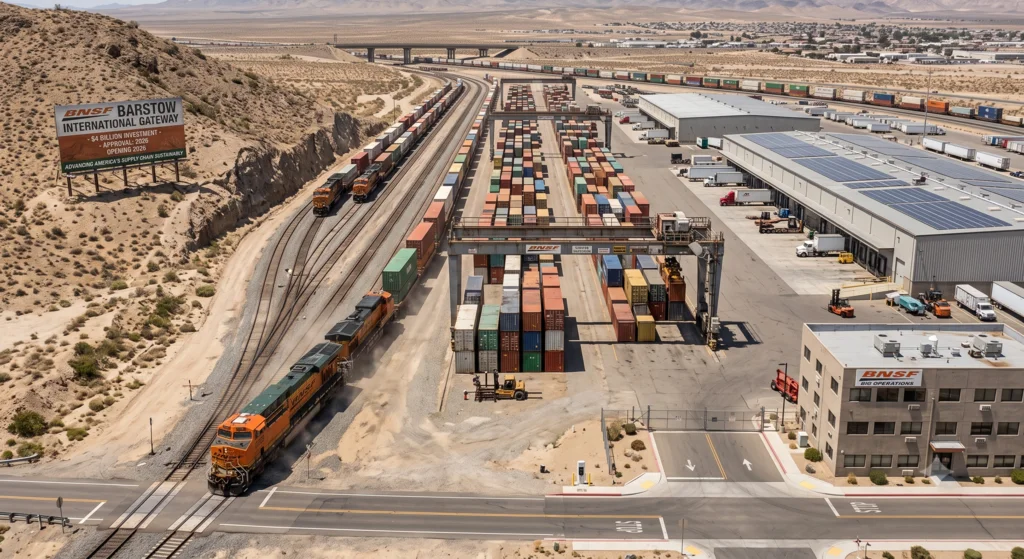
On June 17, 2026, the city council of Barstow, California — population roughly 25,000, a High Desert railroad town most Americans know only as a gas stop on the way to Las Vegas — approved the largest privately funded rail project in the country. Berkshire Hathaway's BNSF Railway will spend $4 billion to build the Barstow International Gateway, a 4,500-acre integrated inland port on the west side of town.1 The timing is not an accident. One state to the east, Union Pacific and Norfolk Southern are trying to merge into the first single-line transcontinental railroad in American history — an $85 billion deal that would leave BNSF as the odd railroad out. BNSF's answer to that threat is instructive, because it is not a counter-merger. It is a hole in the ground and a very large check.
Introduction
There are two ways for a railroad to get bigger. You can buy another railroad, or you can build more railroad. The first way makes headlines, mints banker fees, and — if the regulators ever bless it — reshapes the competitive map overnight. The second way is slow, unglamorous, and shows up on the balance sheet as depreciation. Wall Street loves the first. Warren Buffett and Greg Abel have spent fifteen years quietly proving they prefer the second.
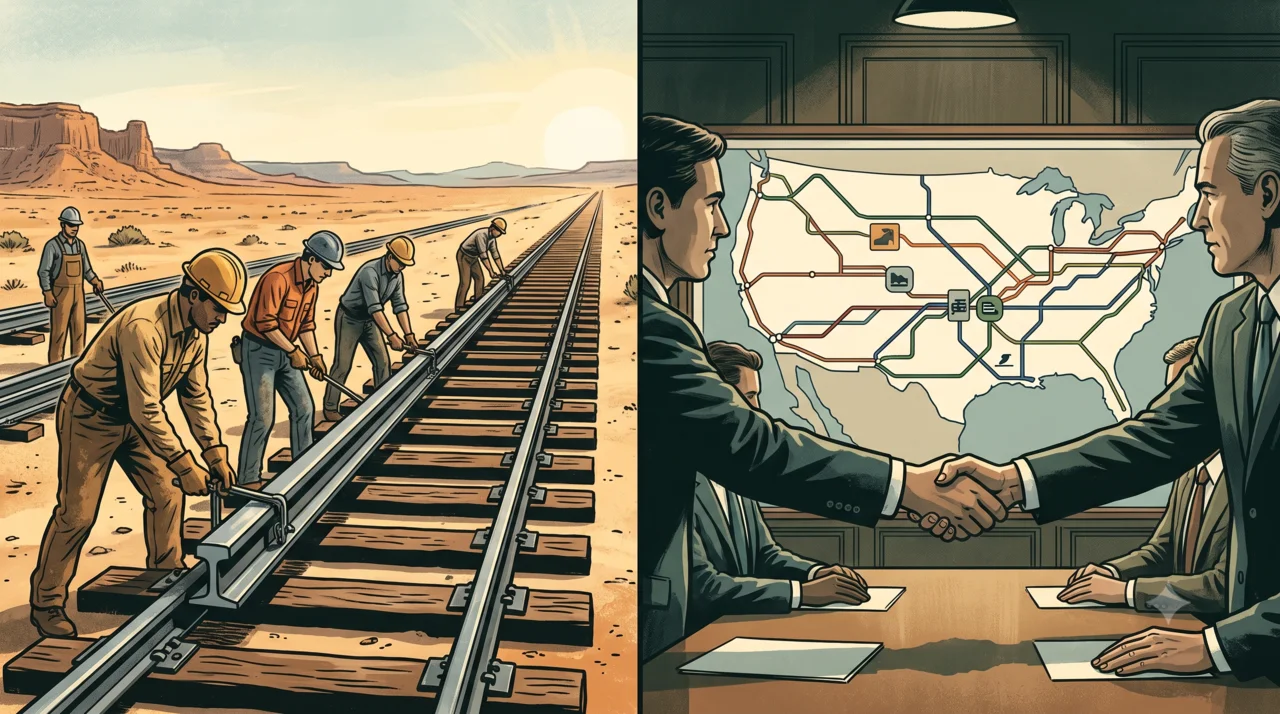
The Union Pacific–Norfolk Southern merger, announced in July 2025, is the most consequential rail combination since Buffett bought BNSF outright in 2010. It would create a single operator spanning "over 50,000 route miles across 43 states from the East Coast to the West Coast, linking approximately 100 ports."2 For a shipper in Chicago sending a container to a port in Georgia, one railroad instead of two handoffs is a genuinely better product. And it puts BNSF, which today reaches the East only by interlining with an eastern partner, on the wrong side of a structural advantage.
Berkshire could, in theory, respond in kind — go buy CSX, the obvious eastern dance partner, and build its own coast-to-coast machine. It has the cash. What it does not have is the inclination. And that refusal, stated plainly in the 2025 annual report, is the key that unlocks the whole Barstow story.
The merger BNSF won't answer with a merger
Berkshire's position is not a matter of speculation. In his 2025 shareholder letter, in the BNSF section, the company put it in writing: "Berkshire has been clear that it is not interested in acquiring one of the other Class I railroads, since the current economics would not work in our shareholders' favor."3 BNSF's entire posture toward the UP–NS deal, the letter continued, is to "ensure BNSF can continue to offer customers a compelling value proposition, including full and competitive access to Eastern rail markets."
Read that twice. In the middle of the largest consolidation wave since the 1990s, the best-capitalized railroad owner on the continent — sitting on a corporate cash hoard near $340 billion — is telling you it will not play the merger game, because at today's prices the arithmetic doesn't work for its owners. That is the Buffett capital-allocation discipline applied to the one industry where empire-building is most tempting.
It is also good tactics, because BNSF thinks the UP–NS deal is bad for its customers and has said so loudly. BNSF is a founding member of the "Stop the Rail Merger Coalition," an unusually broad tent that includes rival CPKC, the American Chemistry Council, the American Farm Bureau Federation, and the Teamsters — groups that agree on almost nothing except that a coast-to-coast monopolist would "reduce competition [and] drive up costs for American manufacturers, farmers and consumers."4 BNSF's chief marketing officer, Tom Williams, framed the customer view bluntly: shippers "are not advocating for this," and the merger would eliminate "half of the options, and all of the lanes associated with them" on transcontinental routes.5
Meanwhile, the merger is not close to done. The regulatory clock is long and the outcome uncertain, and that contrast — years of doubt versus concrete now — is the entire point.
| Date | Milestone in the UP–NS review |
|---|---|
| Jul 29, 2025 | Merger announced; NS valued at ~$85B, "America's first transcontinental railroad"2 |
| Dec 19, 2025 | Initial application filed with the Surface Transportation Board |
| Jan 16, 2026 | STB unanimously rejects the application as incomplete6 |
| Apr 30, 2026 | UP/NS file a revised application |
| May 28–29, 2026 | STB accepts the revised filing but holds proceedings in abeyance, calling several aspects "unclear or underdeveloped"7 |
| 2027 (est.) | Earliest realistic decision; the companies target an early-to-mid-2027 close |
The Board threw the first version out as incomplete in January 2026, accepted a rewritten version in May but immediately parked it pending more information, and the merged railroad — if it is ever approved — will not turn a wheel as a single system until 2027 at the earliest.67 Barstow, by contrast, breaks ground this winter.
What Barstow actually is
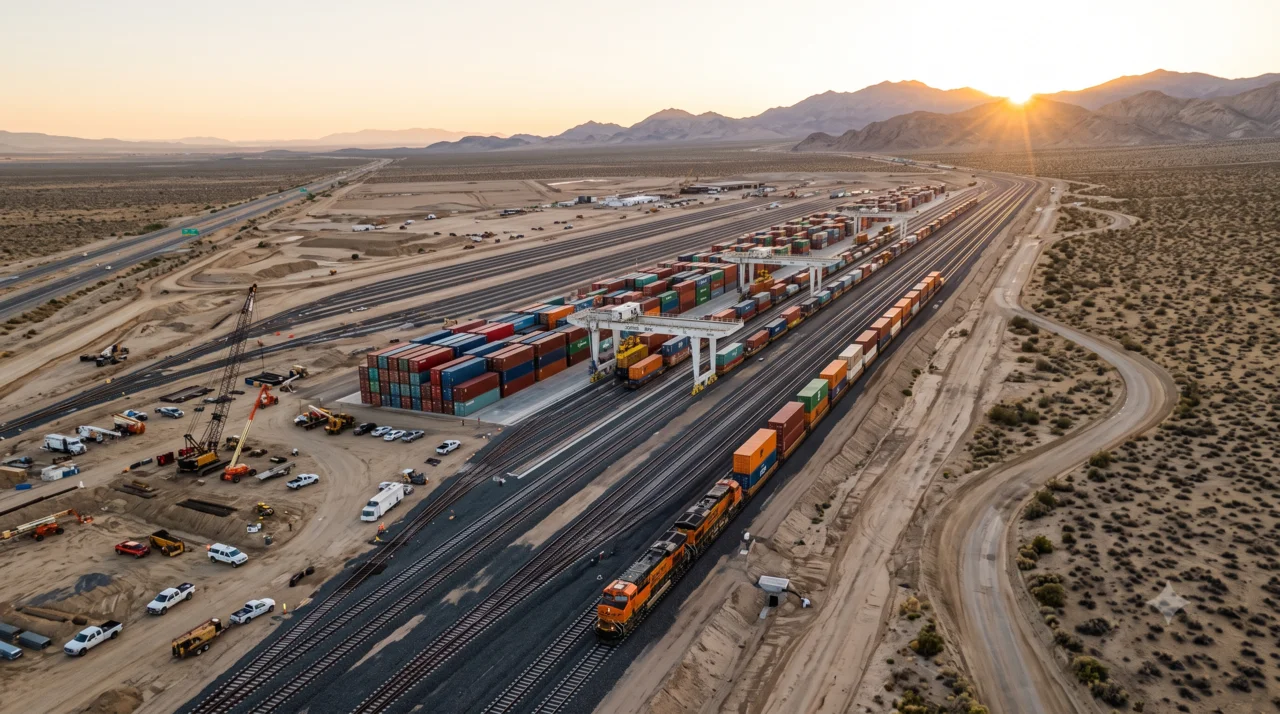
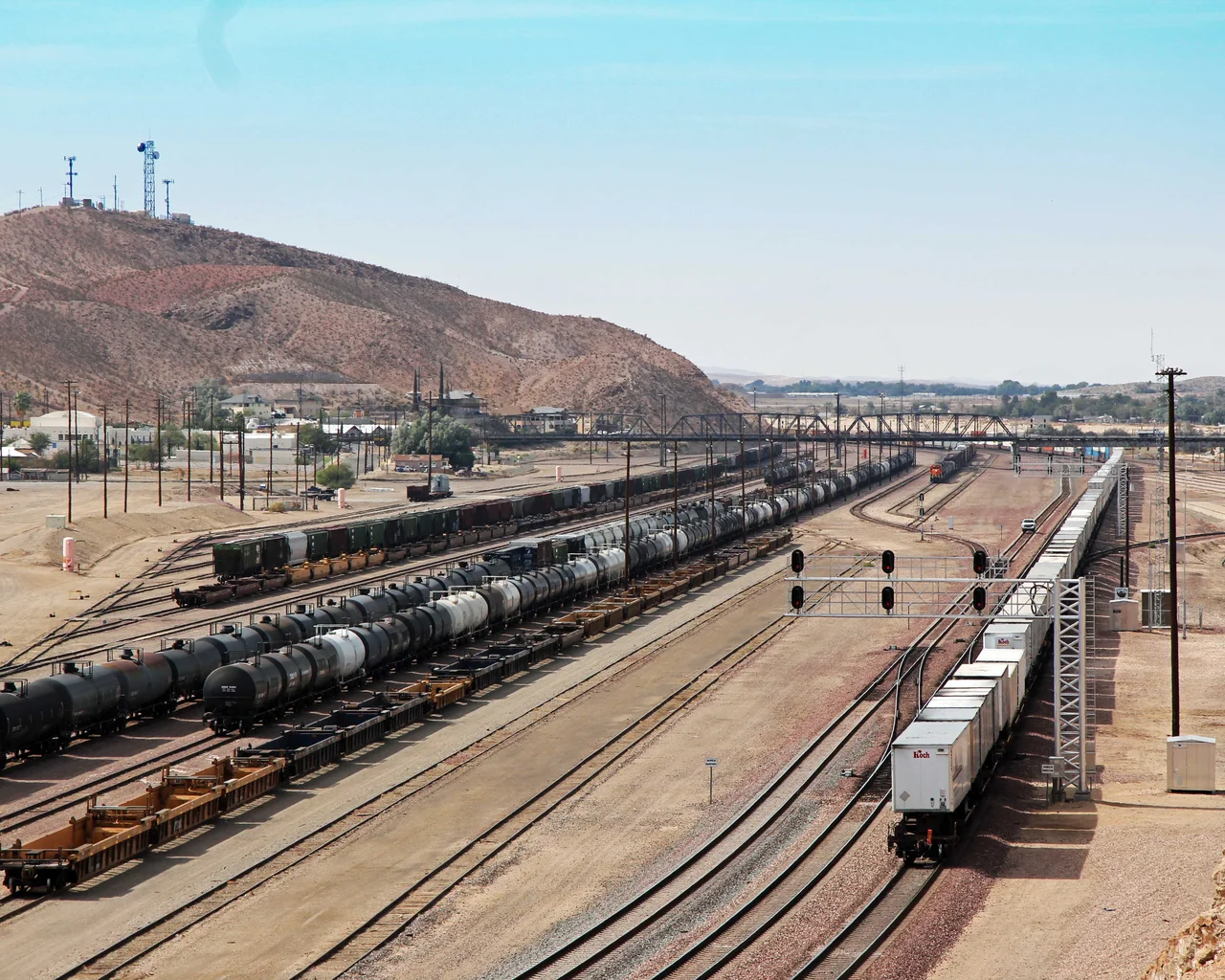
An "inland port" sounds like a contradiction — Barstow is 130 miles from the ocean. That distance is the whole idea. Today, a container landing at the Ports of Los Angeles and Long Beach is often unpacked, sorted, and reloaded onto trains within a few congested miles of the docks, in the most expensive and space-starved real estate in American logistics. The Barstow International Gateway moves that work inland. Containers will roll off the ships, travel the Alameda Corridor and BNSF's mainline out to the High Desert, and there be transloaded from international boxes into domestic ones and built into eastbound trains — using zero-emission cranes, hostlers, and forklifts on a 4,500-acre site with room to breathe.1
It is, BNSF says, the first integrated facility of its kind built by a Class I railroad, and California's governor certified it under the state's SB 149 infrastructure-permitting law to speed it along.1 The project is not new — BNSF first announced it in October 2022. What is new is the price tag and the approval. The 2022 announcement carried a $1.5 billion estimate; the version the council approved in June 2026 costs $4 billion.8 Same footprint, same jobs promise — nearly triple the cost. Even the concrete got more expensive. That escalation is itself a small argument for building sooner rather than later.
Barstow is also not alone. Two weeks after the council vote, BNSF broke ground on Camp Howze Industrial Rail Park near Gainesville, Texas — 489 acres of master-planned industrial space on a BNSF Certified Site, with rail service targeted for 2027.9 The railroad is expanding its physical plant on two fronts at once, in the same quarter its principal competitor is filing merger paperwork.
The reinvestment machine
Here is the number that reframes the entire debate. Since Berkshire acquired BNSF for $34.5 billion in equity value in 2010, the railroad has plowed roughly $58 billion of capital expenditure back into its own tracks, bridges, terminals, and locomotives through 2025 — about $62 billion counting the 2026 plan.1011 That is 1.7 times the purchase price, reinvested into the physical railroad, and it is why the $85 billion merger and the $4 billion project belong on the same chart as the steady grind of annual capex.
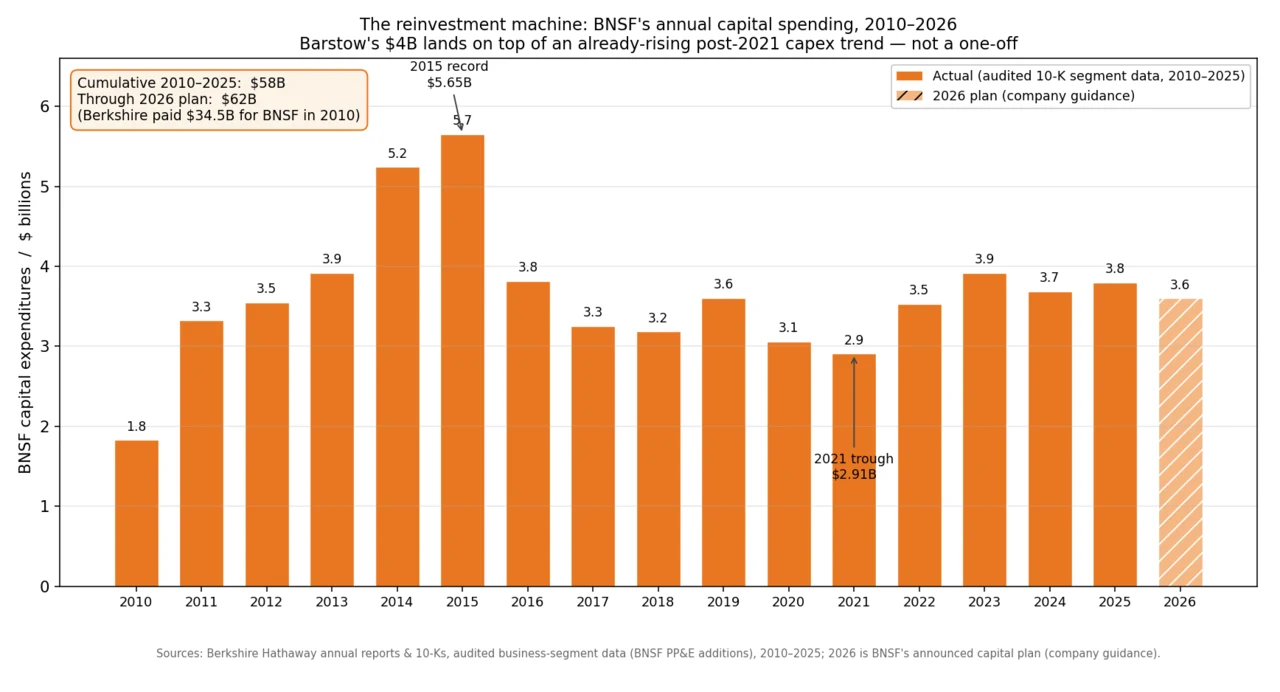
The shape tells the story. BNSF's capital spending spiked to a record $5.65 billion in 2015 — the year Buffett wrote that when people talk about "America's crumbling infrastructure, rest assured that they're not talking about Berkshire."12 It fell to a $2.91 billion trough in the pandemic year of 2021, then climbed steadily back toward $3.6–3.9 billion. Barstow's $4 billion is not a wild departure; it lands on top of an already-rising trend. This railroad spends this kind of money every year, whether or not there is a merger to worry about.
None of it is new behavior. In the 2014 letter, Buffett described BNSF's response to service congestion in almost exactly today's terms — capital, not consolidation. BNSF's spending, he wrote, "far exceeded the outlays made by Union Pacific, our principal competitor," and the railroad would spend $6 billion in 2015, "about 26% of estimated revenues," against Union Pacific's projected 16–17% — outlays "of that magnitude" being "largely unheard of among railroads."13 Barstow is that same instinct, eleven years on. When BNSF feels competitive pressure, it does not reach for a merger agreement. It reaches for a checkbook and a construction crew.
Grow by concrete, not by combination
Put the four numbers side by side and the thesis draws itself.
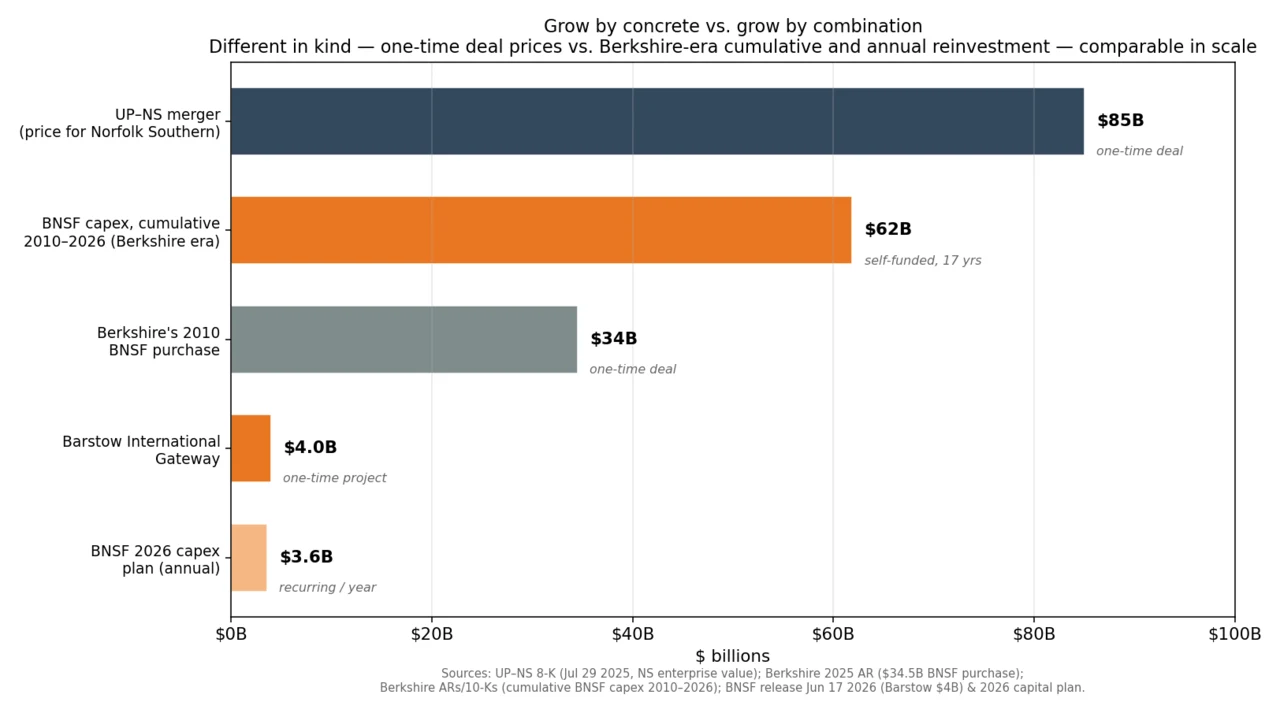
These figures are different in kind, and honesty requires saying so: the $85 billion and the $34.5 billion are one-time acquisition prices, while the $62 billion is seventeen years of cumulative reinvestment and the $3.6 billion is a single year. But that is exactly what makes the comparison bite. Union Pacific must borrow, issue stock, and bet the company on one transformational transaction to add $85 billion of scale. BNSF adds capacity the boring way — a few billion dollars a year of owner-funded concrete, no shareholder vote, no antitrust review, no integration risk — and over a decade and a half it quietly compounds into merger-scale money.
| Grow by combination (UP–NS) | Grow by concrete (BNSF) | |
|---|---|---|
| Vehicle | $85B acquisition of Norfolk Southern2 | $4B Barstow build + ~$3.6B/yr capex1 |
| Financing | Cash + stock; new leverage | Internally funded from BNSF cash flow |
| Time to effect | Years; earliest close 20277 | Ground broken winter 2026–27 |
| Regulatory risk | STB review, still in abeyance7 | Local approval secured; state-fast-tracked1 |
| What it buys | A single-line coast-to-coast network | Throughput, fluidity, port-gateway capacity |
The merger buys reach. The concrete buys resilience. Reach is worth more in a press release; resilience is worth more in a supply-chain crisis. Which brings us to what all this means beyond Berkshire's ledger.
What it means for America
Buffett has always framed BNSF as more than an investment. When Berkshire announced the acquisition on November 3, 2009 — the depth of the financial crisis, when almost no one was writing $34 billion checks — he called it exactly that: "Most important of all, however, it's an all-in wager on the economic future of the United States," he said. "I love these bets."14 A railroad is the ultimate long-duration vote of confidence in a country; you do not lay steel across a continent unless you expect there to be freight, and factories, and consumers, for the next hundred years.
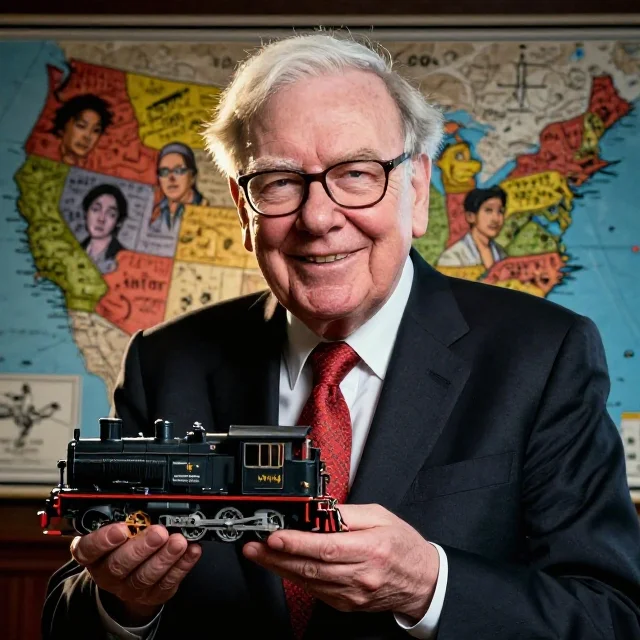
Barstow is that wager renewed for the 2020s. The Ports of Los Angeles and Long Beach together move nearly 20 million containers a year — roughly 40% of the nation's containerized imports — and Americans learned in 2021 exactly what happens when that gateway seizes up.15 At the peak of the congestion crisis in January 2022, 109 container ships sat anchored off Southern California, some waiting more than three weeks for a berth, while store shelves thinned out across the country.16 An inland port at Barstow is precisely the kind of capacity that keeps the 2021 nightmare from recurring: it takes the transloading pressure off the coast, speeds boxes toward the interior, and — BNSF projects — eliminates hundreds of millions of truck miles from Southern California's freeways over its life.1
It is also, unfashionably, a jobs-and-infrastructure story of the sort Washington spends billions trying to manufacture. BNSF's economic-impact study projects roughly 5,400 permanent jobs in Barstow itself over the facility's first twenty years, some $2.9 billion in total economic output for a town that badly needs it; broader regional estimates run higher.17 This is nation-building financed entirely by a private company's retained earnings. Buffett's "American Tailwind" essay in the 2018 letter — the one where he reminded shareholders that "we are lucky — gloriously lucky — to have that force at our back"18 — was really an argument that betting on America has been the single best trade of the last century. Barstow is Berkshire putting $4 billion where that thesis is.
What it means for Berkshire
For shareholders, the reassuring part of this story is how unexciting it is. Abel's first full year running the company has produced no ego-driven mega-merger in rails, no bet-the-conglomerate transaction — just the methodical deployment of owner cash into durable, high-return plant. That is precisely the temperament Buffett spent sixty years modeling, and its survival into the Abel era is worth more to a long-term holder than any single project.
The financials show why BNSF can self-fund this without breaking a sweat. In 2025 the railroad earned $7.2 billion pre-tax on $23.4 billion of revenue, improved its operating ratio to 65.5%, and paid $4.4 billion up to Berkshire — and it still had ample cash flow to keep the reinvestment machine running.19 Early 2026 extended the momentum, with first-quarter net earnings up more than 13% year over year.20 A business throwing off that kind of cash can build a Barstow roughly every year out of pocket if it chooses.
| BNSF | 2023 | 2024 | 2025 |
|---|---|---|---|
| Revenue ($M) | 23,474 | 23,355 | 23,350 |
| Pre-tax earnings ($M) | 6,614 | 6,648 | 7,175 |
| Operating ratio | — | 68.0% | 65.5% |
| Dividends to Berkshire ($M) | ~$4,100 five-year average; $4,400 in 202519 | ||
Berkshire's owners should keep one honest caveat in view. Buffett flagged it himself in the 2023 letter: BNSF "spends more on capital expenditures than any of the five other major North American railroads," yet "its profit margins have slipped relative to all five since our purchase."21 Outspending peers has not, so far, translated into out-earning them — a reminder that concrete is a bet, not a guarantee, and that the margin gap is the metric to watch as Barstow comes online. The optimistic read, and the one Abel is playing for, is that BNSF's patient, service-first, capacity-rich strategy compounds precisely when a consolidating competitor is distracted by the multi-year grind of integrating a coast-to-coast merger. If the UP–NS deal closes, BNSF will spend years absorbing customers who value having a competitive alternative; if it collapses under regulatory weight, BNSF will have spent that same time getting physically bigger and more fluid. Concrete looks like the better hedge either way.
Conclusion
Two railroads, two philosophies, on display in the same summer. Union Pacific is betting that the fastest way to get bigger is to combine — to buy the network it cannot build in time. BNSF, backed by an owner who has spent his life preferring durable assets to clever deals, is betting that the surest way to get bigger is to build the network no one can buy. One path runs through the Surface Transportation Board and years of uncertainty. The other runs through a city council in the High Desert and a construction crew arriving this winter. Merger synergies are a forecast; poured concrete is a fact. In Barstow, Berkshire just chose the fact — a $4 billion renewal of Buffett's oldest and favorite wager, that it still pays to bet on America. For a fuller tour of that instinct, see our companion pieces on Berkshire's $21-billion-a-year building habit ↗, the unbuildable railroad ↗, Abel's AI bet at BNSF ↗, and BNSF on the tariff front line ↗.
References
-
Barstow International Gateway Approved by the Barstow City Council - bnsf.com — “This $4 billion private investment strengthens the entire supply chain” (Katie Farmer, June 17 2026) ↩↩↩↩
-
Union Pacific and Norfolk Southern to Create America's First Transcontinental Railroad - norfolksouthern.com — “over 50,000 route miles across 43 states…linking approximately 100 ports” ↩
-
Berkshire Hathaway 2025 Annual Report (Chairman's Letter, BNSF) - berkshirehathaway.com — “Berkshire has been clear that it is not interested in acquiring one of the other Class I railroads, since the current economics would not work in our shareholders' favor.” ↩
-
Stop the Rail Merger Coalition Launches to Oppose the Union Pacific–Norfolk Southern Merger - bnsf.com ↩
-
BNSF on UP-NS merger: "Don't ruin a good thing" - freightwaves.com — “Our customers are not advocating for this.” ↩
-
STB Rejects Union Pacific–Norfolk Southern Merger Application as Incomplete - stb.gov ↩
-
STB Accepts Revised UP–NS Application, Holds Proceedings in Abeyance - stb.gov ↩
-
BNSF to Build New Integrated Rail Facility in Barstow (original announcement) - bnsf.com — original 2022 estimate $1.5 billion, same 4,500-acre footprint ↩
-
Camp Howze Industrial Rail Park Groundbreaking - streamrealty.com — 489 acres, BNSF Certified Site, service targeted Q2 2027 ↩
-
Berkshire Hathaway 2025 Annual Report - berkshirehathaway.com — BNSF acquired 2010 for $34.5 billion equity value ↩
-
Berkshire Hathaway annual reports & 10-Ks, 2010–2025 (audited business-segment capital-expenditure data) - berkshirehathaway.com — cumulative BNSF capex ≈ $58.3B (2010–2025), ≈ $62B including BNSF's announced 2026 plan ↩
-
Buffett 2015 Shareholder Letter - berkshirehathaway.com — “When you hear talk about America's crumbling infrastructure, rest assured that they're not talking about Berkshire.” ↩
-
Buffett 2014 Shareholder Letter - berkshirehathaway.com — BNSF's capex “far exceeded the outlays made by Union Pacific”; $6B in 2015, ~26% of revenue, “largely unheard of among railroads” ↩
-
Berkshire Hathaway to Acquire Burlington Northern Santa Fe (press release, Nov 3 2009) - berkshirehathaway.com — “Most important of all, however, it's an all-in wager on the economic future of the United States,” said Mr. Buffett. “I love these bets.” ↩
-
Port of Los Angeles / Port of Long Beach container statistics, 2025 - portoflosangeles.org — LA 10.24M TEU, Long Beach 9.88M TEU; combined ~20M, ~40% of U.S. containerized imports ↩
-
4 charts show the effects of West Coast port congestion - supplychaindive.com — 109 vessels waiting Jan 9 2022; 20+ day berth waits ↩
-
Barstow International Gateway Approved by the Barstow City Council - businesswire.com — BNSF economic-impact study: ~5,400 direct jobs, $938M earnings, $2.9B output over 20 years ↩
-
Buffett 2018 Shareholder Letter ("The American Tailwind") - berkshirehathaway.com — “We are lucky – gloriously lucky – to have that force at our back.” ↩
-
Berkshire Hathaway 2025 Annual Report (BNSF segment) - berkshirehathaway.com — 2025 revenue $23,350M, operating ratio 65.5%, pre-tax $7,175M; $4.4B dividended to Berkshire (5-yr avg ~$4.1B) ↩
-
Berkshire Hathaway Q1 2026 10-Q - berkshirehathaway.com — BNSF Q1 2026 net earnings $1,377M vs $1,214M (+13.4% YoY) ↩
-
Buffett 2023 Shareholder Letter - berkshirehathaway.com — BNSF “spends more on capital expenditures than any of the five other major North American railroads,” yet “its profit margins have slipped relative to all five since our purchase.” ↩