Tags: GEICO / Earnings / Risk
This fanpage is not officially affiliated with Berkshire Hathaway: Disclaimer
The Manheim Used Vehicle Value Index turned up in late 2025 for the first time since the 2021-22 surge that cost GEICO $1.9 billion in underwriting losses. The same mechanism is at work again — used-vehicle values rising, total-loss settlements climbing, and rate filings that cannot adjust fast enough to keep premiums in line. But the scale is different, and the bigger half of the loss-ratio story is something the used-car index cannot forecast at all.

Introduction
Every quarter, auto insurance analysts read GEICO's loss ratio the way a rearview mirror reads the road — here is what just happened. The Manheim Used Vehicle Value Index reads the same road through the windshield. The relationship between the two is the subject of this piece, and it is simpler than it sounds: when wholesale used-vehicle values rise, GEICO's loss ratio follows roughly twelve months behind, because the premiums GEICO collects today were filed with state regulators six to eighteen months ago, based on vehicle values that no longer apply.
Nobody builds this chart. Auto insurance analysis focuses on combined ratios, policies-in-force, and expense ratios — not wholesale auction prices. But the Manheim index is public, updated monthly, and free to access. GEICO's loss ratio is in every Berkshire annual report. Pairing the two takes five minutes of data entry and produces a lead indicator that has called the last two turns in GEICO's underwriting cycle.
The chart below is the proprietary artifact — the kind of thing an AI Overview will not synthesize from public filings alone, because it requires pulling a wholesale-auction index from Cox Automotive and overlaying it on segment data buried in Berkshire's annual reports.
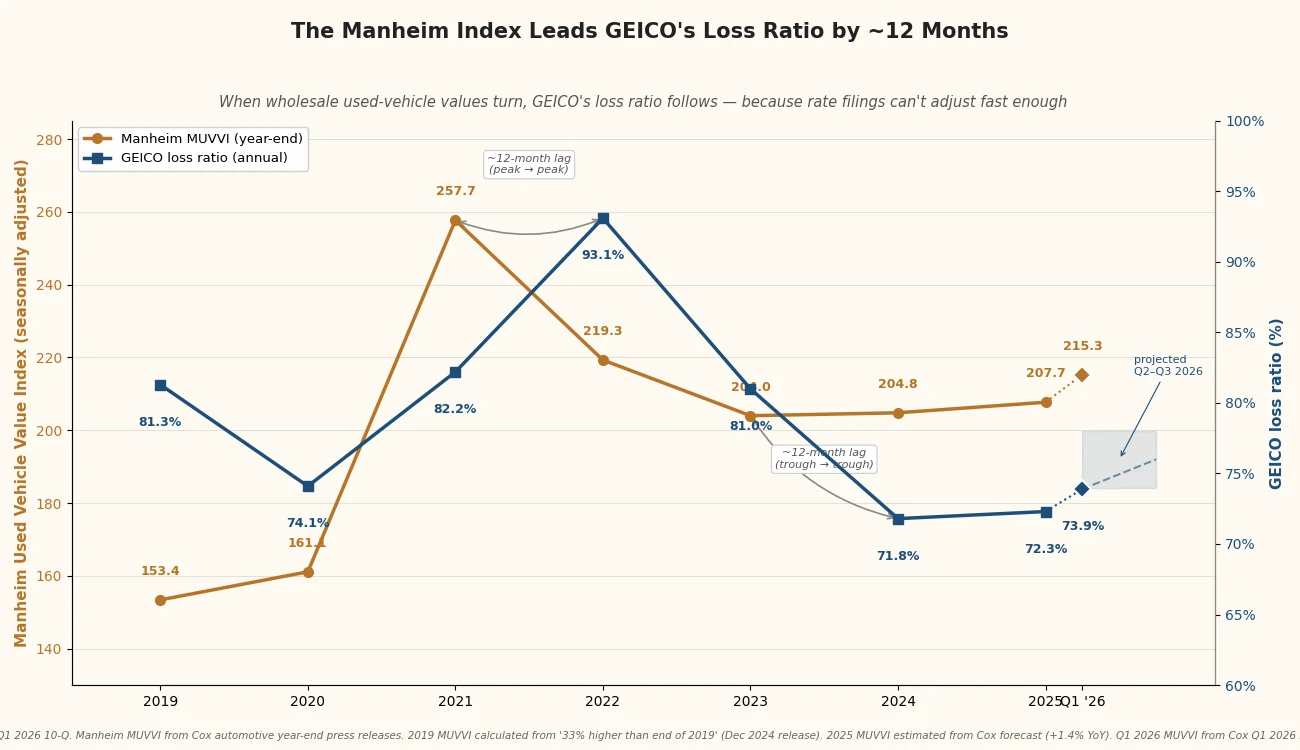
The honest caveat, which the chart makes visible and which this article will not paper over: five data points is an anecdote, not a regression. The 2021-22 cycle is distorted by COVID frequency effects, reserve strengthening, and a once-in-a-generation supply shock. The Manheim index maps to physical-damage and total-loss severity — roughly half the loss ratio. The other half, bodily-injury severity, is driven by medical costs and litigation trends that have nothing to do with wholesale vehicle auctions. What follows is an argument that the mechanism is real, that the chart is the tool, and that the 2026 signal is live — not a prediction that the loss ratio will hit 93% again.
The Chart: A Lead Indicator Hiding in Plain Sight
The Manheim Used Vehicle Value Index (MUVVI) measures wholesale used-vehicle prices at auction, adjusted for mix, mileage, and seasonality, rebased to January 1997 = 100 1. It is the premier benchmark for used-vehicle pricing in the United States. When the index rises, the cost of total-loss settlements rises with it — because insurers pay policyholders the market value of a destroyed or stolen vehicle, and that value is set at auction.
GEICO's loss ratio — losses and loss adjustment expenses divided by premiums earned — is the single most watched metric in Berkshire's insurance segment. The table below pairs the two, year by year, and the pattern is visible without statistics:
| Year | MUVVI (year-end) | MUVVI YoY | GEICO loss ratio | GEICO pre-tax ($M) |
|---|---|---|---|---|
| 2019 | ~153.4 | — | 81.3% | $1,506 |
| 2020 | 161.1 | +5.0% | 74.1% | $3,428 |
| 2021 | 257.7 | +59.9% | 82.2% | $1,259 |
| 2022 | 219.3 | -14.9% | 93.1% | ($1,880) |
| 2023 | 204.0 | -7.0% | 81.0% | $3,635 |
| 2024 | 204.8 | +0.4% | 71.8% | $7,813 |
| 2025 | ~207.7 | +1.4% | 72.3% | $6,824 |
| Q1 2026 | 215.3 | +6.2% | 73.9% | $1,416 |
Sources: Manheim MUVVI from Cox automotive year-end press releases 12310; GEICO loss ratios from BRK annual reports 2019-2025 and Q1 2026 10-Q 56. 2019 MUVVI calculated from "33% higher than end of 2019" (Dec 2024 release); 2025 MUVVI estimated from Cox forecast (+1.4% YoY).
The MUVVI peaked at 257.7 at the end of 2021 — a 59.9% year-over-year surge driven by the COVID-era chip shortage, rental fleet sell-offs, and stimulus-fueled demand 3. GEICO's loss ratio peaked one year later: 93.1% in 2022, producing a $1.9 billion underwriting loss 6. The MUVVI troughed at 204.0 at the end of 2023. GEICO's loss ratio troughed one year later: 71.8% in 2024, the best result in a decade 6.
Peak to peak, trough to trough. The index leads; the loss ratio follows. The question is why — and the answer is not that GEICO's management is slow. It is that the law will not let them be fast.
The Rate-Trap Mechanism
Auto insurance in the United States is priced at the speed of regulation, not the speed of markets. The mechanism has three distinct lags, and conflating them into a single "twelve-month delay" hides more than it reveals.
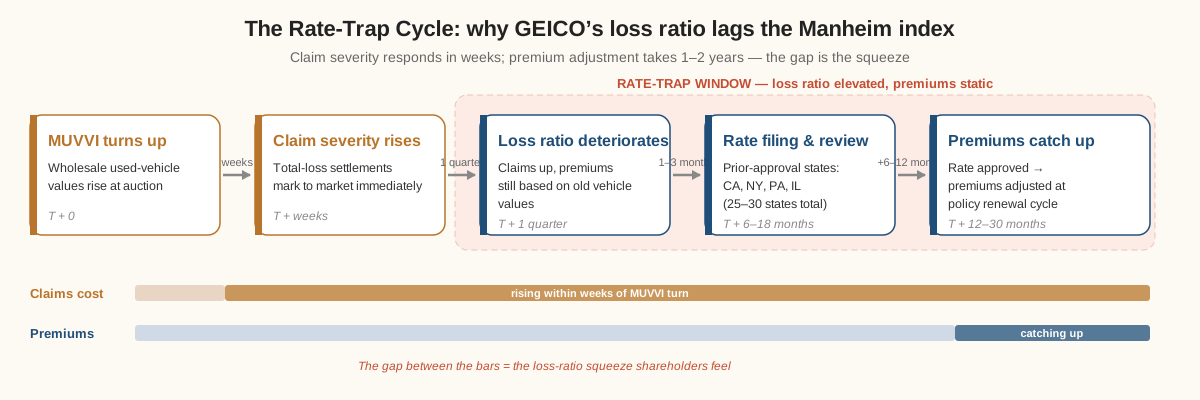
The first lag is claim severity — and it is fast. When wholesale vehicle values rise, total-loss settlements adjust within weeks. Claims adjusters mark to market immediately; a totaled 2019 Honda Accord pays out more because the Accord is worth more at auction. This hits the loss ratio within the same quarter the MUVVI turns 1.
The second lag is regulatory rate-filing — and it is slow. Approximately 25 to 30 states use a prior-approval system for personal auto insurance, meaning insurers must submit proposed rate changes to the state insurance department and wait for explicit approval before implementation 7. California, New York, Pennsylvania, and Illinois — all major GEICO markets — are prior-approval states. In these jurisdictions, the lag from filing to approved implementation runs six to eighteen months. California's Proposition 103, which mandates exhaustive commissioner review of actuarial justifications, is notorious for stretching comprehensive rate adjustments past twelve months 7. In file-and-use states like Texas and Florida, implementation can be immediate, but these are the exception, not the rule.
The third lag is the policy renewal cycle — and it compounds the second. Even after a rate increase is approved, it only reaches policyholders as their policies renew. A six-month policy filed in January, approved in July, takes effect at the next renewal — which might be another six months away. The result is that a MUVVI turn in Q1 2026 may not be fully priced into GEICO's premiums until late 2027.
The gap between the first lag (weeks) and the combined second-plus-third lag (12 to 30 months) is the rate trap. During that window, GEICO is paying claims at new-vehicle-value prices while collecting premiums at old-vehicle-value prices. The loss ratio rises. It keeps rising until the rate filings catch up. Then it normalizes — and the cycle waits for the next MUVVI turn.
2021 Was a Hurricane; 2026 Is a Squall
The 2021 MUVVI surge was a once-in-a-generation supply shock. Used-vehicle values rose 59.9% in a single year — the product of semiconductor shortages that halted new-car production, rental fleets that sold off inventory during COVID lockdowns, and stimulus-fueled consumer demand. The index went from 161.1 to 257.7 in twelve months. Nothing like it had happened in the history of the Manheim series 3.
The 2026 turn is different. The MUVVI stands at 215.3 as of Q1 2026, up 6.2% year over year 1. That is a normalization bounce, not a supply shock. Cox Automotive's own forecast, published in January 2026, calls for the index to rise approximately 2% by year-end — consistent with long-term averages — and notes that values are expected to "peak as tax refund season concludes" 2. The mid-June 2026 reading of 213.9, up only 2.6% year over year, suggests the spring bounce may already be fading 4.
This matters for the loss-ratio forecast. A 59.9% MUVVI surge produced a 93.1% loss ratio and a $1.9 billion underwriting loss. A 6.2% MUVVI rise is a different animal — it might push the loss ratio from 72% toward 75-78%, not toward 93%. The chart's forward projection band, shown as the shaded area extending from Q1 2026, reflects this: a drift upward, not a cliff.
But "different animal" does not mean "nothing." The rate-trap mechanism operates regardless of magnitude. Even a modest MUVVI rise produces a squeeze during the filing window — premiums static, claim costs rising, loss ratio drifting up. The difference is whether the squeeze is uncomfortable (loss ratio in the mid-70s) or catastrophic (loss ratio in the 90s). The 2026 signal points to uncomfortable.
What MUVVI Cannot Explain
The Manheim index maps to one channel of claim severity: physical damage and total-loss settlements. It does not map to bodily-injury severity, which is the larger half of the loss-ratio story. This was already visible in Q1 2026, as the Twin Squeeze piece documented ↗.
GEICO's Q1 2026 loss ratio rose 4.9 percentage points, from 69.0% to 73.9% 5. The breakdown tells two stories:
- Bodily-injury severity: +12 to 14% year over year — driven by medical cost inflation and rising attorney representation rates. This is courtroom math, not auction math. MUVVI has nothing to say about it.
- Property-damage and collision severity: +2 to 4% year over year — this is the channel MUVVI explains. Rising vehicle values push up repair costs and total-loss payouts. The +2-4% range is consistent with the +6.2% MUVVI reading, adjusted for the lag.
The bodily-injury line is the bigger mover. If BI severity stays at +12-14%, GEICO's loss ratio has a problem that no amount of rate filing can solve quickly — because BI severity is driven by medical costs, litigation funding, and social inflation, none of which respond to vehicle auction prices. The Manheim index is a lead indicator for half the loss ratio, not the whole thing. Treating it as the master key would be the kind of overreach that makes a chart say more than the data supports.
The honest framing: MUVVI is one channel of severity pressure, and it is the channel that is currently turning up. The other channel — BI severity — is a separate, larger wildcard that this chart cannot forecast.
Why Nobody Escapes (But Progressive Grows Anyway)
A natural question: if rate-filing lag traps GEICO, does Progressive's telematics program let it escape? The answer is no — and understanding why is the key to the competitive picture.
Progressive's Snapshot, running for over fifteen years, tracks driving behavior — hard braking, mileage, time of day — and adjusts individual risk scores accordingly ↗. GEICO's DriveEasy, launched around 2019, does something similar but with seven years less data depth. The initial thesis — that Progressive reprices in "near-real-time" while GEICO cannot — turns out to be wrong in the way that matters.
Telematics adjusts the risk-score mix — how individual driving behavior maps to expected claim frequency. It does not adjust the base rate, which embeds vehicle-value assumptions and severity expectations. The base rate still requires state regulatory approval. When used-vehicle values rise and total-loss settlements climb, Progressive's base rate is just as stale as GEICO's. Snapshot does not let Progressive reprice severity in real time; it lets Progressive reprice frequency 7.
What telematics does give Progressive is better risk selection. Fifteen years of driving data means Progressive can segment policyholders more precisely — identifying which drivers to write and which to let go. During the rate-trap window, when both insurers face the same severity squeeze, Progressive's selection advantage lets it grow policies in force while GEICO is constrained. Q1 2026 shows the result: Progressive grew personal-lines PIF +9% year over year; GEICO grew +2% 8. Progressive overtook State Farm as the largest U.S. auto insurer in May 2026 9. Progressive's net premiums written rose 6.5%; GEICO's rose 1.5%.
Progressive's combined ratio in Q1 2026 was 86.4% — essentially tied with GEICO's 87.3% ↗. Neither insurer escaped the severity environment. But Progressive spent 7 percentage points more per premium dollar on expenses (20.5% vs GEICO's 13.4%) and converted that spend into four-times-faster policy growth. The rate trap squeezes both; the data advantage lets one grow through it.
Nancy Pierce, GEICO's new CEO, has chosen retention as her opening priority — "The best way for us to grow is to retain every one of our customers" ↗. It is the cheaper path: keeping an existing customer costs less than winning one from Progressive. But it is also a tell about where the competitive pressure sits. When the rate trap raises premiums at renewal, retention is the defense; growth is the casualty.

The Honest Uncertainty
The bear case for this thesis has four legs, and each one is legitimate.
First, the MUVVI may already be plateauing. The Q1 2026 reading of 215.3 was the spring peak; May dropped to 212.6 and mid-June to 213.9. Cox Automotive's own forecast calls for roughly 2% year-end growth — normal seasonal depreciation, not a renewed surge 2. If the index fades back below 210 through the second half of 2026, the rate-trap squeeze is mild and short-lived.
Second, Q1 2025 was an unusually easy comparison. GEICO's Q1 2025 loss ratio of 69.0% was exceptional — well below the 72.3% full-year 2025 figure and the 71.8% full-year 2024 figure. Some of the Q1 2026 deterioration to 73.9% is mean reversion toward a normal range, not MUVVI-driven severity pressure. The loss ratio might have risen to 73-74% even if vehicle values had been flat.
Third, GEICO has been taking rate action. Greg Abel said at the May 2 annual meeting that GEICO spent the last several years "aligning price to risk," and the 2024-2025 loss ratio improvement from 81.0% to 71.8% to 72.3% reflects rate increases that have now earned through ↗. Some of the 2026 rate filings may already reflect late-2025 MUVVI assumptions — meaning the trap window could be shorter than the 2021-22 cycle, when the MUVVI move was so fast that filings could not keep up.
Fourth, bodily-injury severity is the variable that dwarfs the MUVVI signal. If BI severity stays at +12-14%, the loss ratio has a problem regardless of what vehicle values do. If BI severity eases — because medical inflation moderates, or litigation funding tightens — the loss ratio could improve even as MUVVI rises. The Manheim index is silent on this question.
The forward projection band in the chart — a shaded zone from Q1 2026 suggesting the loss ratio may drift toward 74-78% — is deliberately wide. It is a directional signal from a mechanism, not a quantitative forecast from a model. The mechanism says "up." The magnitude says "moderately." The wildcard says "but check BI severity too."
Conclusion
GEICO's loss ratio will always be rate-trapped to some degree. That is the structural consequence of operating in a regulated pricing environment where claim costs respond to markets in weeks but premiums respond to regulators in months. The Manheim Used Vehicle Value Index is the tool that makes the trap visible — a lead indicator for the physical-damage channel of severity, sitting in public view at Cox Automotive, that nobody in the auto insurance analyst community bothers to chart against GEICO's segment data.
The 2026 signal is live. The MUVVI has turned up, GEICO's Q1 loss ratio is already responding, and the rate-trap window is open. But the scale is a fraction of 2021 — a squall, not a hurricane — and the bigger driver of GEICO's loss ratio, bodily-injury severity, is a variable the Manheim index cannot forecast. Shareholders watching GEICO should keep three numbers in view: the MUVVI reading (is it still rising or plateauing?), the quarterly loss ratio (is it drifting toward 75-78% or stabilizing?), and the BI severity trend (is the +12-14% easing or persisting?).
The chart says the squeeze is real. The data says it is modest. The wildcard says the bigger story is in the courtroom, not the auction lane. Buffett built GEICO on the cost moat ↗. Pierce's first test as CEO is whether that moat is wide enough to absorb a rate-trap squeeze without sacrificing the growth Abel's scorecard demands.
References
-
Manheim Used Vehicle Value Index Increases Through Q1 2026 - coxautoinc.com ↩↩↩
-
Manheim Index: Used-Vehicle Values Stabilized in 2024 - coxautoinc.com ↩↩
-
Manheim Index: Used-Vehicle Values Fall Further in 2023 - coxautoinc.com ↩↩
-
Manheim Used Vehicle Value Index Mid-June 2026 Trends - coxautoinc.com ↩
-
Berkshire Hathaway Q1 2026 10-Q (filed May 2, 2026) - sec.gov ↩
-
Berkshire Hathaway Annual Reports 2019-2025 - berkshirehathaway.com ↩↩
-
NAIC: Auto Insurance Rate Regulation - naic.org ↩↩↩
-
Progressive Q1 2026 Income Up Nearly 10% - carriermanagement.com ↩
-
Progressive Passes State Farm as Largest US Auto Insurer - repairerdrivennews.com ↩
-
Wholesale Used-Vehicle Prices Increase in December - coxautoinc.com ↩