Tags: FlightSafety / Warren Buffett / History
This fanpage is not officially affiliated with Berkshire Hathaway: Disclaimer
Berkshire is now old enough that anniversaries arrive on a schedule. Some years it is a marquee deal — GEICO's half-century, See's at fifty. This year the candle belongs to a company most shareholders would struggle to place on a map: FlightSafety International, the aviation-training business Warren Buffett bought at the end of 1996 and then, with disarming efficiency, stopped talking about. Thirty years on, FlightSafety is the quiet proof of a Buffett principle he spent the following decade explaining out loud — that the durable way to own the sky was never the airline. It was the toll booth every pilot has to pass through, twice a year, forever.
The Man Who Fell Out of the Sky
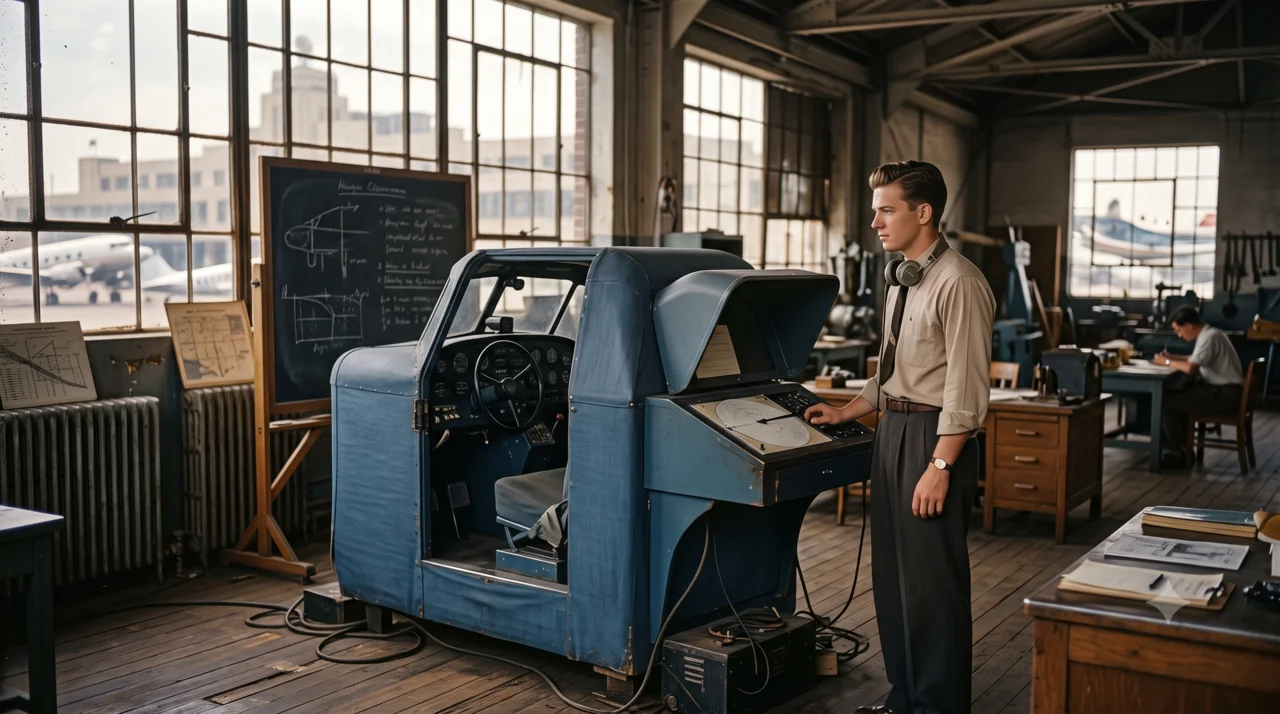
The company exists because a parachute didn't open. In 1939, a young flight instructor named Albert Lee Ueltschi was demonstrating snap rolls to a federal aviation inspector in an open-cockpit biplane when his seat came unhinged; he went over the side, pulled the ripcord, and the chute failed. He survived — and walked away convinced there had to be a safer way to teach people to fly than by nearly killing them.4
Ueltschi was already the kind of person Buffett collects. Kentucky-born, he had put himself through flying lessons on the profits of a teenage hamburger stand, then talked his way into Pan American World Airways, where he spent two decades as Juan Trippe's personal pilot.4 In 1951, still drawing his Pan Am salary, he mortgaged his house, rented a single Link trainer at LaGuardia's Marine Air Terminal, and hung out a shingle: FlightSafety. In Buffett's telling, he "invested $10,000 to start the company."2 He financed the early years by persuading corporate customers — Alcoa, Coca-Cola, Eastman Kodak — to prepay five years of training in advance, which is a fair definition of a business the market wants.4
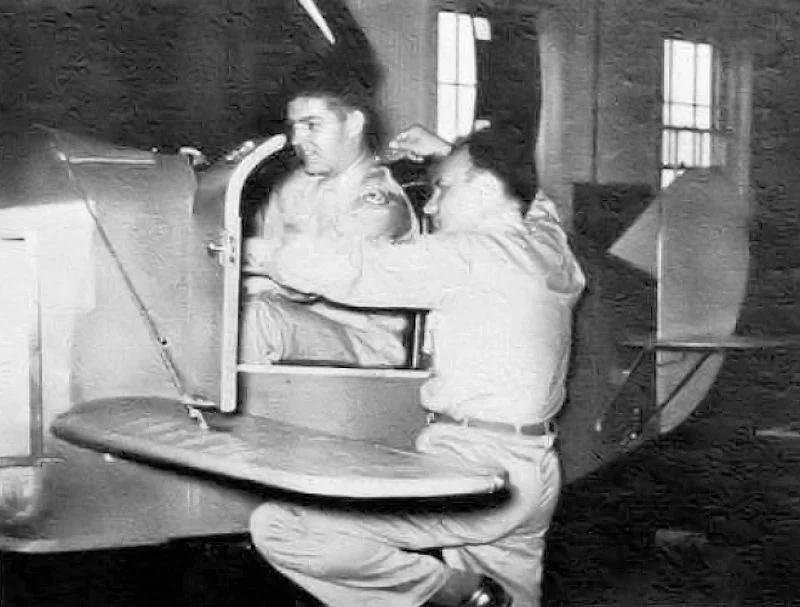
By the time Buffett came calling, Ueltschi had spent forty-five years building the thing manufacturers eventually decided not to build themselves. Learjet, Cessna, Gulfstream, Dassault and the rest found it cheaper to outsource pilot training to FlightSafety than to run their own schools — and each outsourcing decision widened the moat by one more aircraft type. That is the business Buffett bought.
A Lunch and a Handshake
The deal that brought FlightSafety into Berkshire began the way the best of them do — with someone deciding they would rather sell to Buffett than to a stranger. Worried about a takeover of his large personal stake, Ueltschi let it be known he was looking for a permanent home; a shareholder of both companies passed word to Berkshire's counsel, Buffett called, and the two men settled it over a hamburger lunch in New York. The definitive merger agreement was signed October 14, 1996, and the deal closed December 23 of that year: roughly $1.5 billion, about $769 million of it in cash and the rest in Berkshire stock, for a company that had booked $363.7 million of revenue that year.1 It was, as we've written before, one of the deals that marked ↗ the year Berkshire stopped being just an insurance company.
What Buffett had actually bought was harder to see than a candy company or a furniture store. FlightSafety sells nothing you can hold. It sells the difference between a crew that has practised an engine failure on approach a hundred times in a box and a crew that hasn't. Buffett's own framing was blunt: "Going to any other flight-training provider than the best is like taking the low bid on a surgical procedure."9 A durable competitive advantage, in other words, that grows straight out of the customer's fear.
The Capital Wall
The moat has a moat: money. A full-motion flight simulator is one of the most capital-hungry objects in commercial life. In 1999, with the company operating 222 of them, Buffett laid out the arithmetic that makes FlightSafety both wonderful and merely good at the same time:
"A single flight simulator can cost as much as $15 million — and we have 222. Only one person at a time, furthermore, can be trained in a simulator, which means that the capital investment per dollar of revenue at FSI is exceptionally high."5
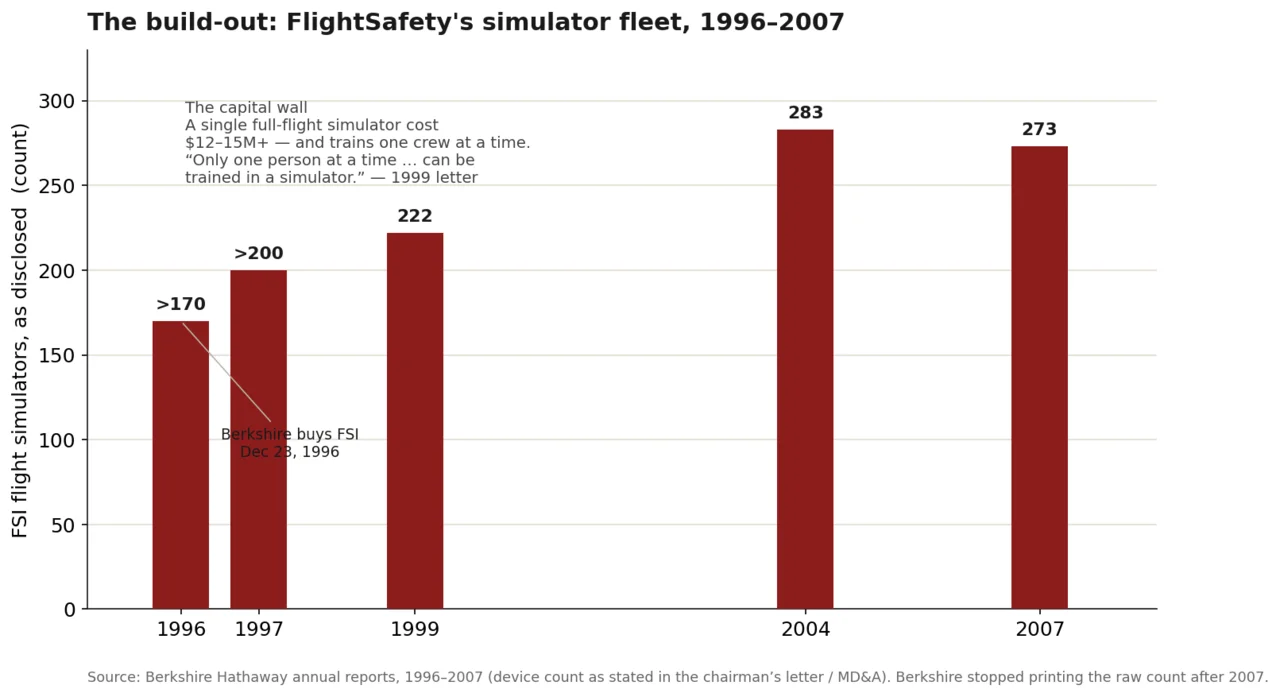
The device count is a clean proxy for the whole business, and Berkshire disclosed it plainly for about a decade before folding it away. It marched from more than 170 at acquisition to 283 by 2004, then eased back to 273 by 2007 as older boxes were retired and re-tooled for new airframes.6
Each of those boxes had to be bought, and then bought again as Boeing and Airbus and Gulfstream kept rolling out new models the old simulators couldn't replicate. By 2004 Buffett reckoned the business needed $3.50 of capital investment for every $1 of annual revenue — a ratio that would make a railroad blush.7 The result is a company that spends heavily every single year just to stand still. Between 1999 and 2002, FlightSafety's outlay on simulators and other fixed assets ran two to three times its annual depreciation charge.
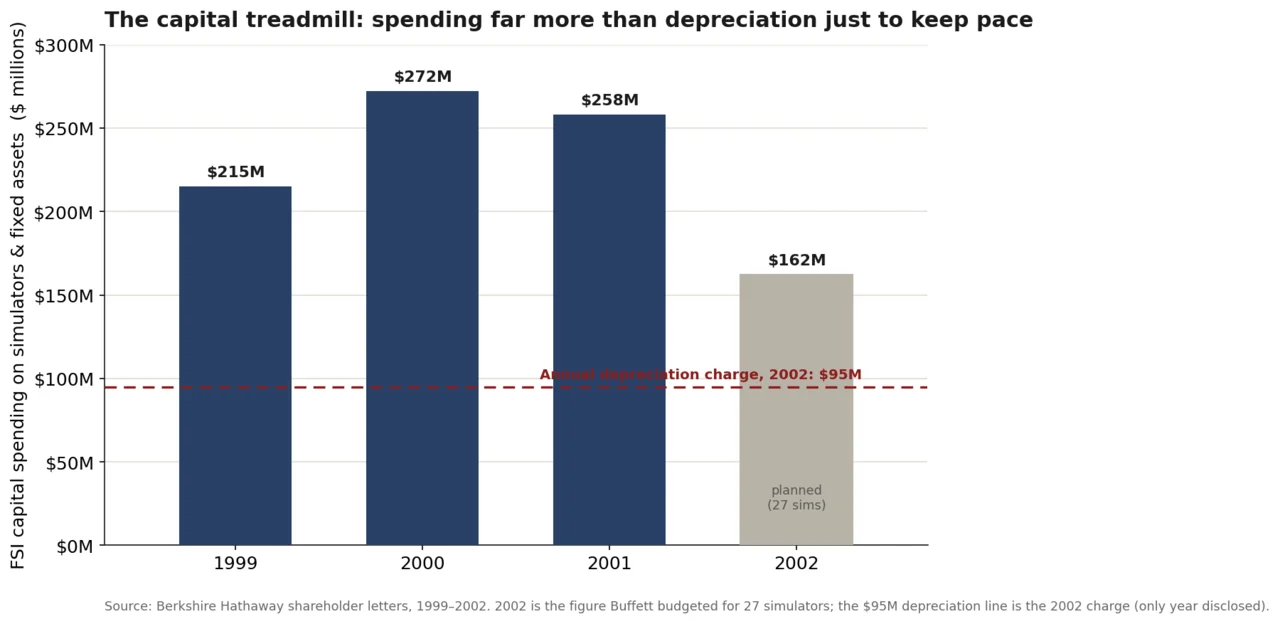
Buffett used FlightSafety as his standing rebuke to anyone who mistakes cash flow for profit. "Those who believe that EBITDA is in any way equivalent to true earnings are welcome to pick up the tab," he wrote in 2001, and again, a year earlier: "Anyone who thinks that the annual charges for depreciation don't reflect a real cost … should get an internship at a simulator company."8 The simulators are the moat and the millstone in one object — which is precisely why no one has bothered to attack the position head-on.
The Toll Bridge Holds: September 2001
Here is where the thesis earns its keep. When aviation is hit, the airlines take the blow to the chin. FlightSafety takes it somewhere padded — because a large share of its demand isn't discretionary at all. A working pilot who wants to keep flying legally must requalify on a recurring cycle no recession suspends. In the United States, the FAA's proficiency-check rule requires a check for turbojet and multi-crew pilots within the preceding 12 months; in Europe, EASA operators run proficiency checks in a full-flight simulator every six.16 Those checks happen whether flight departments are hiring or firing.
September 11th was the first live test under Berkshire ownership, and the split was exactly what the thesis predicts. In the 2001 letter Buffett reported:
"After September 11th, training for commercial airlines fell, and today it remains depressed. However, training for business and general aviation, our main activity, is at near-normal levels and should continue to grow."10
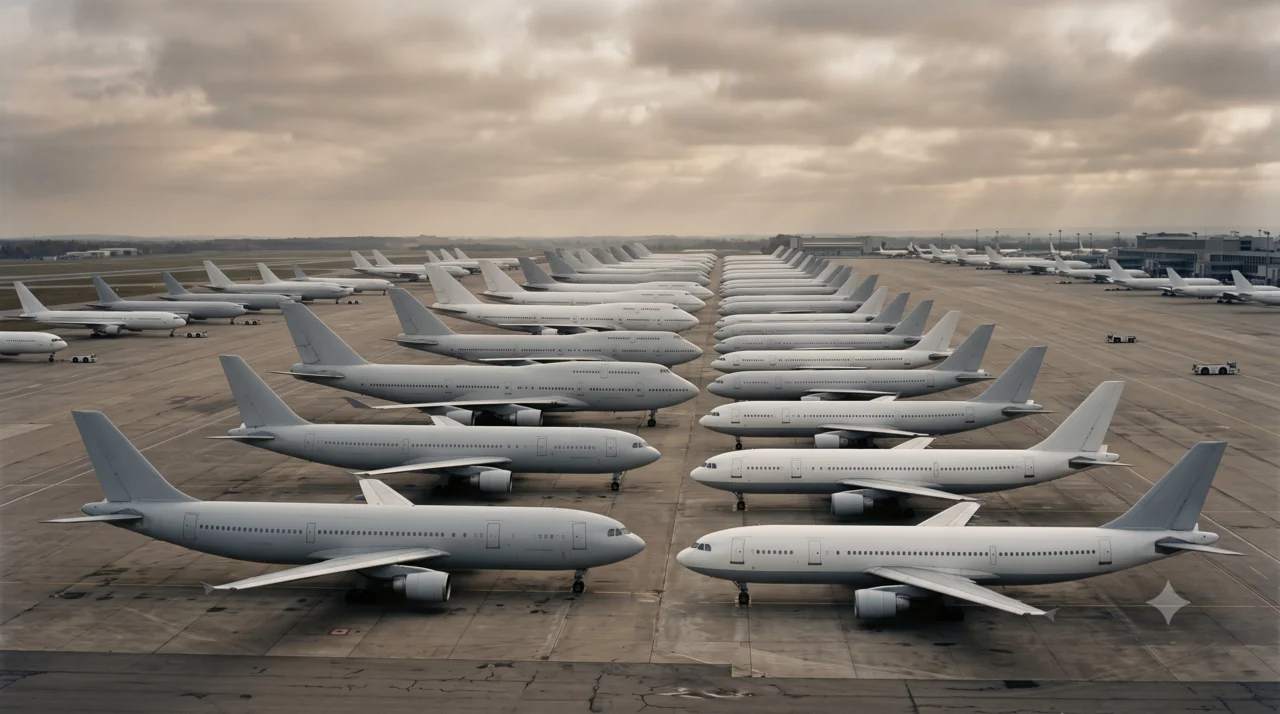
The commercial-airline side — the part exposed to the airlines' own collapse — fell and stayed down. FlightSafety's core, business and general aviation, barely flinched. It was not perfectly insulated: the corporate-aviation slowdown that trailed the 2001 recession did trim training earnings in 2002 and 2003, and only a one-time $60 million gain from selling FlightSafety's half of a simulator-manufacturing joint venture to Boeing kept the segment's reported profit rising that year.11 But "trimmed" is a very different word from what was happening two rungs up the food chain, where Berkshire itself had already learned the airline lesson the hard way — the ↗ 1989 USAir preferred that Buffett spent years regretting.
The Gruesome Comparison
By 2007 Buffett had owned FlightSafety long enough to grade it, and he did so in one of his most quoted passages — the taxonomy of "the great, the good, and the gruesome." FlightSafety landed squarely in the middle, and the numbers he showed his own work with are worth keeping:
| FlightSafety, as Buffett scored it | 1996 | 2007 |
|---|---|---|
| Pre-tax operating earnings | $111M | $270M |
| Net investment in fixed assets | $570M | $1,079M |
| Cumulative depreciation, 1996–2007 | $923M | |
| Cumulative capital expenditure, 1996–2007 | $1,635M | |
| Earnings gain on ~$509M of incremental investment | +$159M9 | |
A gain of $159 million in annual earnings for half a billion dollars of extra capital is, in Buffett's words, "a good, but far from See's-like, return." FlightSafety is "an excellent but not extraordinary business" — it has to put up more to earn more, the fate of most honest companies. Then came the pivot that makes the whole thirty-year story cohere: "Now let's move to the gruesome. The worst sort of business is one that grows rapidly, requires significant capital to engender the growth, and then earns little or no money. Think airlines."9
That is the entire shareholder case in two words. Berkshire has been burned by airlines twice — the USAir preferred in 1989 and the big-four equity stakes it built and then dumped at a loss in 2020. The company that trains the pilots asked for a lot of capital and gave back a steady, unspectacular, utterly reliable return through every cycle. The airlines asked for even more and periodically vaporised it.
Grounded, Then Airborne: 2020
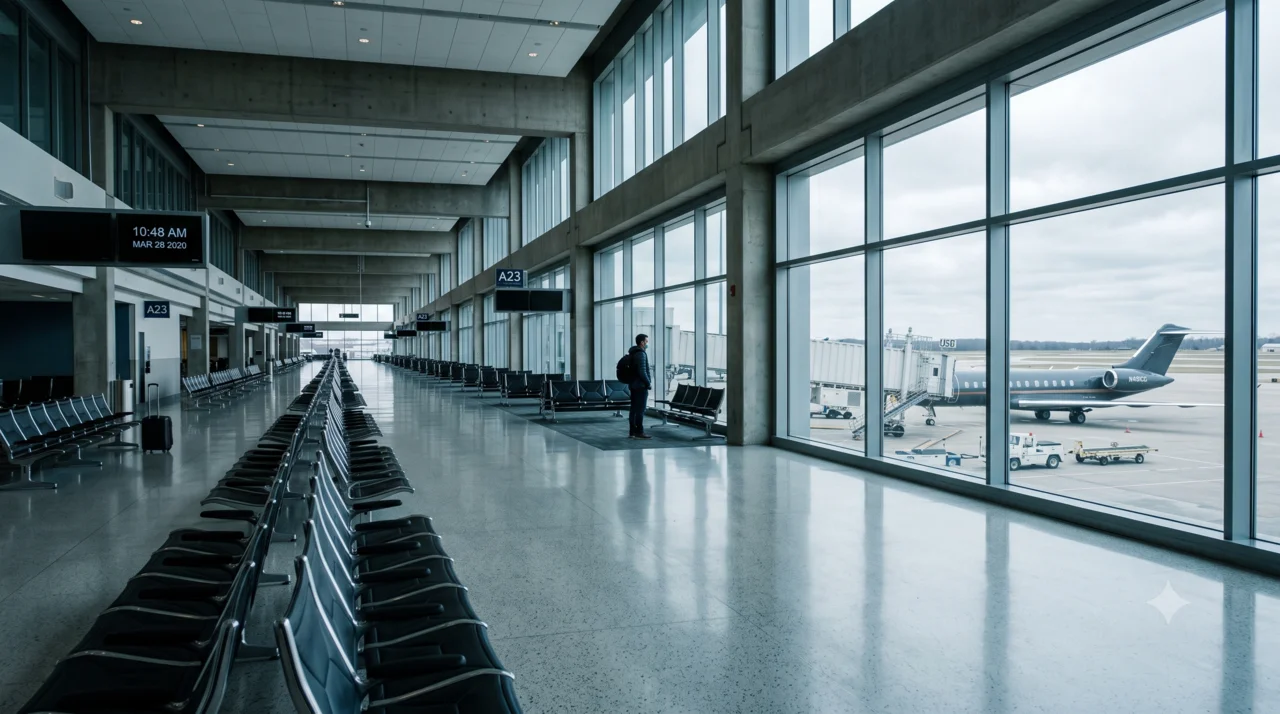
If 9/11 was the first test, COVID was the harder one — a shock that grounded business aviation too, not just the airlines. FlightSafety felt it. In 2020, revenue across Berkshire's combined aviation-services businesses fell $816 million, or 13.5%; NetJets flight hours dropped 27%, and, in the number that matters most for our story, FlightSafety's commercial and corporate simulator training hours declined 30% from 2019.12 The moat blunts a downturn; it does not repeal one.
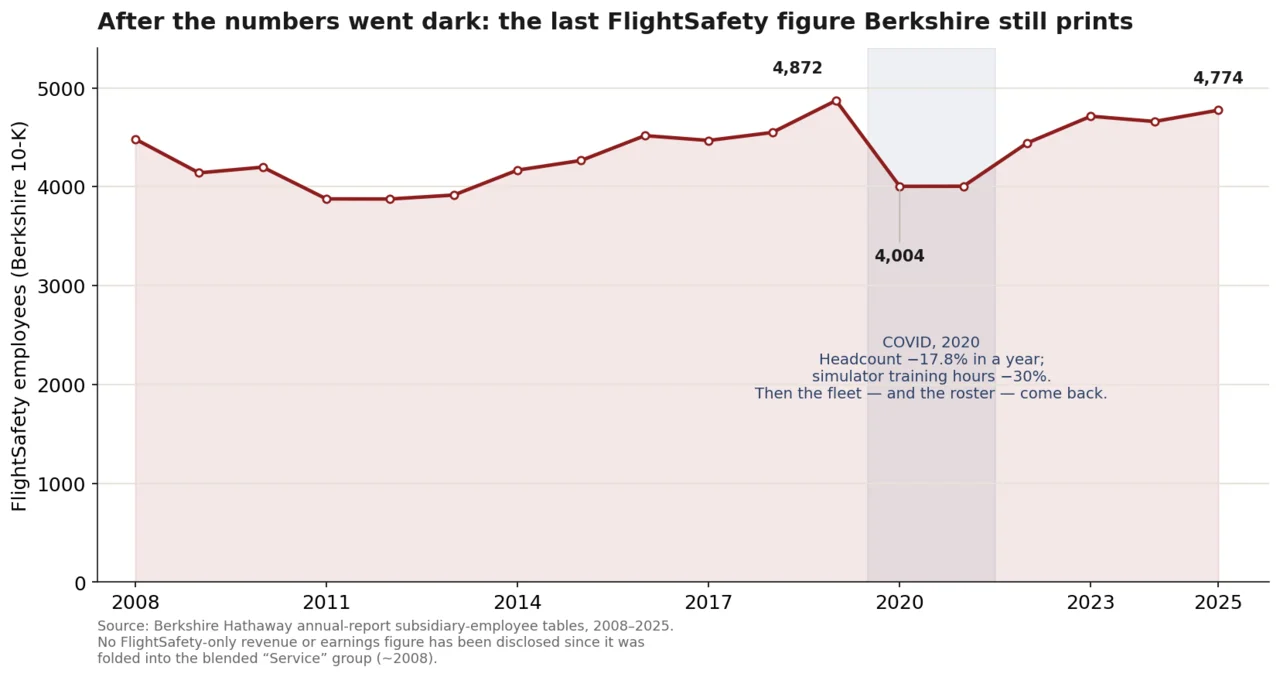
The recovery is the tell. By 2008 Berkshire had stopped reporting FlightSafety's revenue and earnings entirely, blending it into a "Service" group alongside a dozen other businesses. The one FlightSafety-specific number it still prints is a headcount, buried in the subsidiary-employee table at the back of each 10-K — and that number traces the COVID round-trip with almost clinical precision. The roster fell from 4,872 in 2019 to 4,004 in 2020, a 17.8% cut in a single year, then climbed steadily back to a record 4,774 by 2025.13
The reason the roster came back is the same reason the toll bridge holds. A leisure trip cancelled in a pandemic is gone forever. A recurrent proficiency check merely deferred is a check you still owe — and once the fleet flew again, the training bill came due all at once.
The Company That Vanished Into a Footnote
For a shareholder, the strangest thing about FlightSafety at thirty is how little Berkshire will tell you about it. For its first years under Buffett it was a named segment, "Flight Services," reported alongside NetJets. Since roughly 2008 it has been folded into the anonymous "Service" bucket, and no FlightSafety-only revenue or profit figure has appeared since. The employee count is the last quantitative trace — exactly the pattern we mapped on ↗ the fortieth-anniversary Fechheimer piece, where a once-disclosed compounder shrank to a single headcount line.
| Shock | What hit FlightSafety | The floor that held |
|---|---|---|
| September 11th (2001–03) | Commercial-airline training "fell and remains depressed"; corporate-aviation slowdown trimmed earnings10 | Business/general aviation — the core — stayed at "near-normal levels"; recovered by ~2005 |
| COVID-19 (2020) | Simulator training hours −30%; headcount −17.8%; aviation-services revenue −$816M12 | Mandated recurrent checks can't be deferred; record headcount restored by 2025 |
The disappearance is a backhanded compliment. Berkshire stops breaking out a business when it is neither broken nor big enough to move the needle on a $1-trillion enterprise — a comfortable, cash-generative, low-drama corner that runs itself. FlightSafety in 2007 estimated it trained about 58% of U.S. corporate pilots.14 A company with that kind of share, still growing, that no longer merits its own line item, is the very picture of a Berkshire subsidiary doing its job.
Why the Trainer Outlasts the Airline
Thirty years in, the moat is arguably wider than the day Buffett bought it. The industry's defining problem is a pilot shortage: Boeing's 2025 outlook projects the world will need 660,000 new commercial pilots over the next twenty years, every one of whom must be trained and then re-checked for a career.15 That is demand with a regulatory floor under it and a demographic tailwind behind it.
The capital wall still keeps the field small. Full-flight simulators today run $10–20 million apiece, and the business is effectively a duopoly: FlightSafety in business, regional and military aircraft, and Canada's CAE — which posted about $2.7 billion in civil-aviation revenue in its 2025 fiscal year and paid $1.05 billion in 2021 to buy L3Harris's military-training arm — dominating the commercial-airline side.17 FlightSafety, for its part, now operates more than 320 simulators across a global network and marks its own 75th anniversary in 2026, having outlived the founder who fell out of the sky in 1939; Ueltschi ran the company past his ninetieth birthday, handed the controls to Bruce Whitman in 2003,18 and died in 2012 at 95.3
None of this makes FlightSafety the flashiest thing Berkshire owns. Buffett graded it honestly: good, not great; a business that must feed the capital furnace to grow. But held up against the alternative — the airlines that "requires significant capital … and then earns little or no money" — it is exactly the asset a long-term owner wants when the cycle turns. You do not want to own the fleet that gets grounded. You want to own the bridge every returning pilot has to cross to fly it again.
Conclusion
Berkshire's calendar of anniversaries is really a catalogue of decisions that keep paying off, and 2026 belongs to FlightSafety — a company that came in on a handshake over hamburgers, absorbed two blows that flattened the airlines, and quietly compounded its way out of the annual report altogether. The lesson Buffett drew from it in 2007 is the one worth carrying into the next thirty years: in aviation, the durable profits have never been in the flying. They're in the training that makes the flying survivable — a toll every pilot pays, in good years and bad, for as long as there are airplanes to fall out of.
References
-
Berkshire Hathaway 1996 & 1997 Annual Reports - berkshirehathaway.com — “aggregate consideration of approximately $1.5 billion was paid to FlightSafety shareholders consisting of $769 million in cash”; FSI full-year 1996 revenue $363.7 million ↩
-
Buffett 2001 Shareholder Letter - berkshirehathaway.com — “since 1951, when he invested $10,000 to start the company” ↩
-
Albert Lee Ueltschi - en.wikipedia.org ↩
-
Lawrence Cunningham, Berkshire Beyond Buffett - cup.columbia.edu — Ueltschi biography, Pan Am / Juan Trippe, prepaid-training financing ↩↩↩
-
Buffett 1999 Shareholder Letter - berkshirehathaway.com — “A single flight simulator can cost as much as $15 million — and we have 222. Only one person at a time, furthermore, can be trained in a simulator” ↩
-
Berkshire Hathaway Annual Reports, 1996–2007 - berkshirehathaway.com — disclosed simulator counts: 170 (1996), 200+ (1997), 222 (1999), 283 (2004), 273 (2007) ↩
-
Buffett 2004 Shareholder Letter - berkshirehathaway.com — “as much as $3.50 of capital investment is required to produce $1 of annual revenue” ↩
-
Buffett 1999–2001 Shareholder Letters - berkshirehathaway.com — annual simulator capex $215M (1999), $272M (2000), $258M (2001); 2002 plan $162M for 27 simulators vs. $95M depreciation charge ↩
-
Buffett 2007 Shareholder Letter - berkshirehathaway.com — “capital expenditures have totaled $1.635 billion … Pre-tax operating earnings in 2007 were $270 million, a gain of $159 million since 1996 … Now let's move to the gruesome … Think airlines.” ↩↩
-
Buffett 2001 Shareholder Letter - berkshirehathaway.com — “After September 11th, training for commercial airlines fell, and today it remains depressed. However, training for business and general aviation, our main activity, is at near-normal levels” ↩
-
Buffett 2002 Shareholder Letter - berkshirehathaway.com — $60 million pre-tax gain on sale of the 50% FlightSafety Boeing interest; without it, training earnings would have fallen with the business-aviation slowdown ↩
-
Berkshire Hathaway 2020 Annual Report - berkshirehathaway.com — “NetJets experienced a decline in flight hours of 27% and FlightSafety's commercial and corporate simulator training hours declined 30% from 2019”; combined aviation-services revenue −$816M (−13.5%) ↩
-
Berkshire Hathaway Annual Reports, 2008–2025 - berkshirehathaway.com — FlightSafety employee counts, subsidiary-employee tables (4,872 in 2019; 4,004 in 2020; 4,774 in 2025) ↩
-
Buffett 2007 Shareholder Letter - berkshirehathaway.com — “we estimate that we train about 58% of U.S. corporate pilots” ↩
-
Boeing 2025 Pilot and Technician Outlook - boeing.com — “660,000 new commercial pilots” needed 2025–2044 ↩
-
14 CFR § 61.58 (FAA) and EASA Part-FCL proficiency-check rules - ecfr.gov — PIC proficiency check within preceding 12 months (FAA); operator proficiency checks every 6 months (EASA) ↩
-
CAE Fourth-Quarter and Full-Year Fiscal 2025 Results; L3Harris military-training acquisition - cae.com — civil-aviation revenue ~$2.7B FY2025; $1.05 billion acquisition of L3Harris Technologies' Military Training business (2021) ↩
-
FlightSafety International — Company History - flightsafety.com — 320+ simulators; 75th anniversary (2026); Ueltschi succession to Bruce Whitman (2003) ↩