Tags: BHRG / Float / Risk
This fanpage is not officially affiliated with Berkshire Hathaway: Disclaimer
In the reinsurance business, the surest sign that a company has lost its discipline is a press release bragging about growth. On June 1, 2026, property-catastrophe prices fell 15 to 20 percent in Florida — the steepest mid-year decline in over a decade — while the capital chasing those risks climbed to an all-time high. Berkshire's response was to write less. That is not a retreat. It is the same reflex that, twenty years earlier, made Berkshire write the largest catastrophe book in its history. The reflex has a measurable signature, and understanding it explains why the company can walk away from a soft market and still watch its float climb to a record $176.9 billion.

Introduction
Most reinsurers behave like moths. When catastrophe prices are high — after a Katrina, a Hurricane Ian, a year that frightens capital out of the market — premiums are attractive but capital is scarce, so the moths cannot get to the flame. When prices are low, capital is abundant and everyone crowds in, writing more business precisely when each dollar of premium buys the least protection. The industry's volume, in aggregate, tends to be highest when pricing is worst.
Berkshire is the moth flying the other way. It expands its catastrophe book when prices peak and shrinks it when capital floods in. Ajit Jain spent fifteen years — from 1996 to 2011 — keeping Berkshire almost entirely out of property catastrophe reinsurance because, in his words, prices "have not been attractive."12 Then, when the hard markets came, Berkshire stepped in as the catastrophe-capital-of-last-resort. This is contrarian capital supply, and unlike most things said about Berkshire's "discipline," it is something you can put a number on.
What follows is three charts' worth of that number, and the reason the 2026 pullback in catastrophe writing tells you almost nothing about the health of Berkshire's insurance machine — because the premium engine and the float engine run at two different speeds.
The Discipline Signature
For the years Berkshire reported its catastrophe book as a separate line — roughly 2000 through 2014 — the relationship between what it wrote and what the market charged is almost embarrassingly tight. Berkshire Hathaway Reinsurance Group's catastrophe and individual-risk premiums earned ran $321 million in the soft pre-9/11 market of 2000, surged to $2.2 billion at the post-Katrina 2006 peak, then collapsed to $623 million by 2010 as capacity flooded back and prices softened.1011 Plotted against the Guy Carpenter Global Property-Catastrophe Rate-on-Line Index — the industry's standard gauge of reinsurance price levels — the two move together with a correlation of +0.71 on year-over-year changes. In 11 of those 14 years, Berkshire's catastrophe writing rose or fell in the same direction as the price of risk.
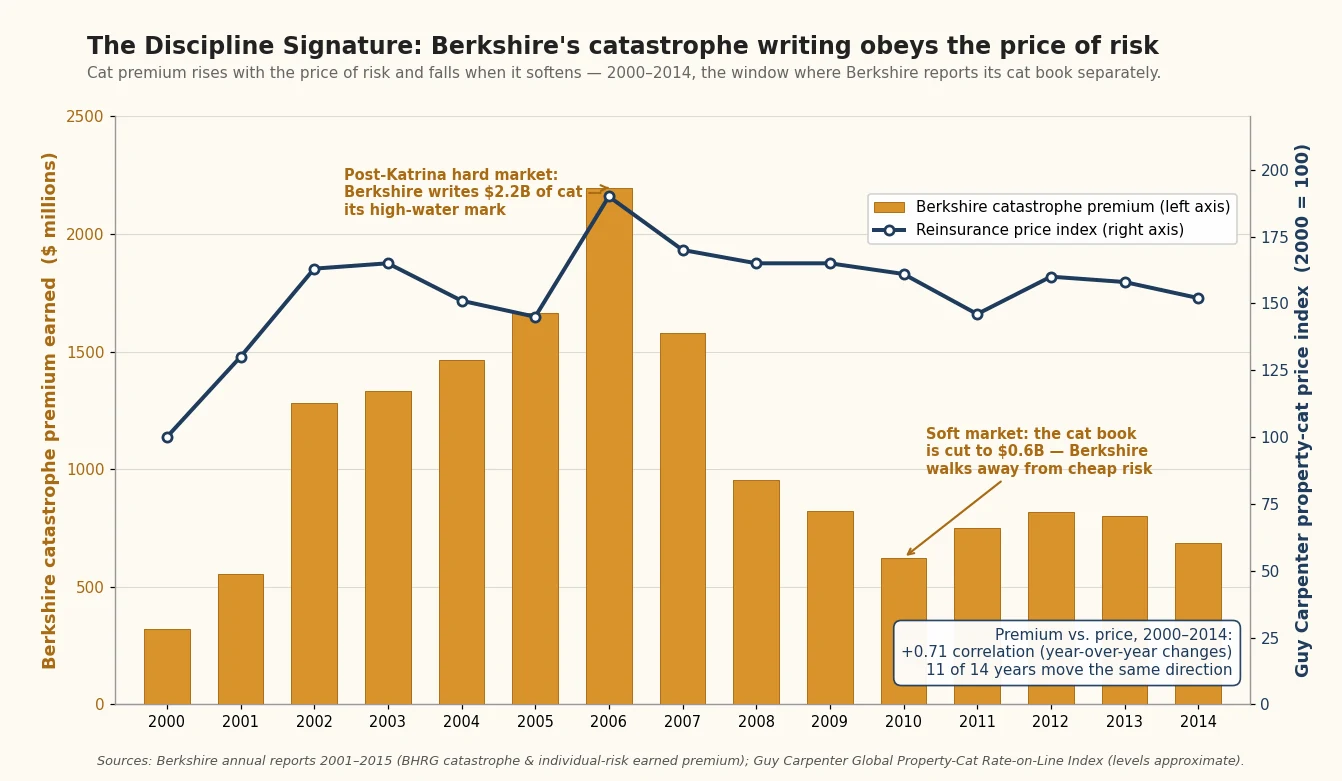
A correlation that high is not how a normal insurer behaves. Most carriers are judged on premium growth, market share, and policy count, all of which push management to write more in soft markets to defend their position. Berkshire is judged on underwriting profit, which pushes the opposite way. The three years where the signature breaks down — 2008 through 2010 — are themselves revealing: Berkshire shrank its catastrophe book more than the modest price decline alone would justify, in part because it was conserving capital for the $26 billion BNSF acquisition it would close in 2010. Even the deviations are disciplined.
The honest caveat is that Berkshire stopped breaking out its catastrophe line after 2014, folding it into a combined total that later absorbed the 2017 merger with General Re and the 2022 acquisition of TransRe. So the cleanest proof of the pattern lives in the years where the data is clean. But the behavior the chart documents is not a historical artifact. It is a constant — and the best evidence is what Berkshire is doing right now.
What 2006 Teaches About 2026
Rewind to the winter of 2005–06. Hurricanes Katrina, Rita, and Wilma had just inflicted the worst catastrophe-loss year the industry had ever seen. Reinsurers were reeling, capital had fled, and U.S. catastrophe rates spiked — the Guy Carpenter index jumped roughly a third globally and far more in the United States.10 This was the moment most of the market was least able to write business. It was the precise moment Berkshire wrote the most catastrophe cover in its history, because National Indemnity's balance sheet could absorb a once-in-a-generation loss that would have bankrupted a thinly capitalized competitor. Buffett long described this as Berkshire's structural edge in catastrophe reinsurance — the willingness and the capacity to absorb a single loss that would make a lesser-capitalized rival flinch.
Now run the film in 2026. The 2022–2024 hard market — driven by Hurricane Ian and a repricing of climate risk — sent the Guy Carpenter index up 27.5 percent at the January 2023 renewal alone and to a multi-year peak by 2024.14 Then it turned. Prices fell 6.6 percent at January 2025, 12 percent at January 2026, and a further leg down at mid-year, leaving the global index roughly 16 percent below where it started the year.35 In Florida — the epicenter of U.S. catastrophe risk — Guy Carpenter pegged June 1 renewals down 15 to 20 percent across many layers, with rival broker Howden putting some loss-free programs down as much as 25 percent.415 After the most profitable cat years in a generation, capital is sprinting back toward the flame.
Berkshire's move is the 2006 reflex inverted. With prices softening, it is writing less. Its first-quarter property-casualty reinsurance premiums written slipped 2.3 percent year-over-year, to $5.992 billion, with the 10-Q attributing the decline plainly to "volume reductions in property business" caused by "increased competition and lower rates."2 We covered the mechanics of that quarterly rotation — and the offsetting Tokio Marine quota-share — in ↗. The point here is bigger than one quarter: it is that the behavior is identical to 2006, only the sign has flipped.
When Capital Steps In, Berkshire Steps Out
The cleanest way to see the 2026 discipline is not to watch the price of risk but to watch the supply of capital — and the purest gauge of that supply is the catastrophe-bond market, the pension-fund and hedge-fund money that buys catastrophe risk directly. It has exploded. Cat-bond issuance hit a record $25.6 billion in 2025, the first year ever to clear $20 billion, taking the outstanding market past $61 billion.67 Alternative reinsurance capital reached roughly $136 billion, and total reinsurer capital climbed to a record of about $785 billion.58 Even Florida — long considered too dangerous for many reinsurers — drew $3.2 billion of new catastrophe bonds in the first months of 2026 alone.9
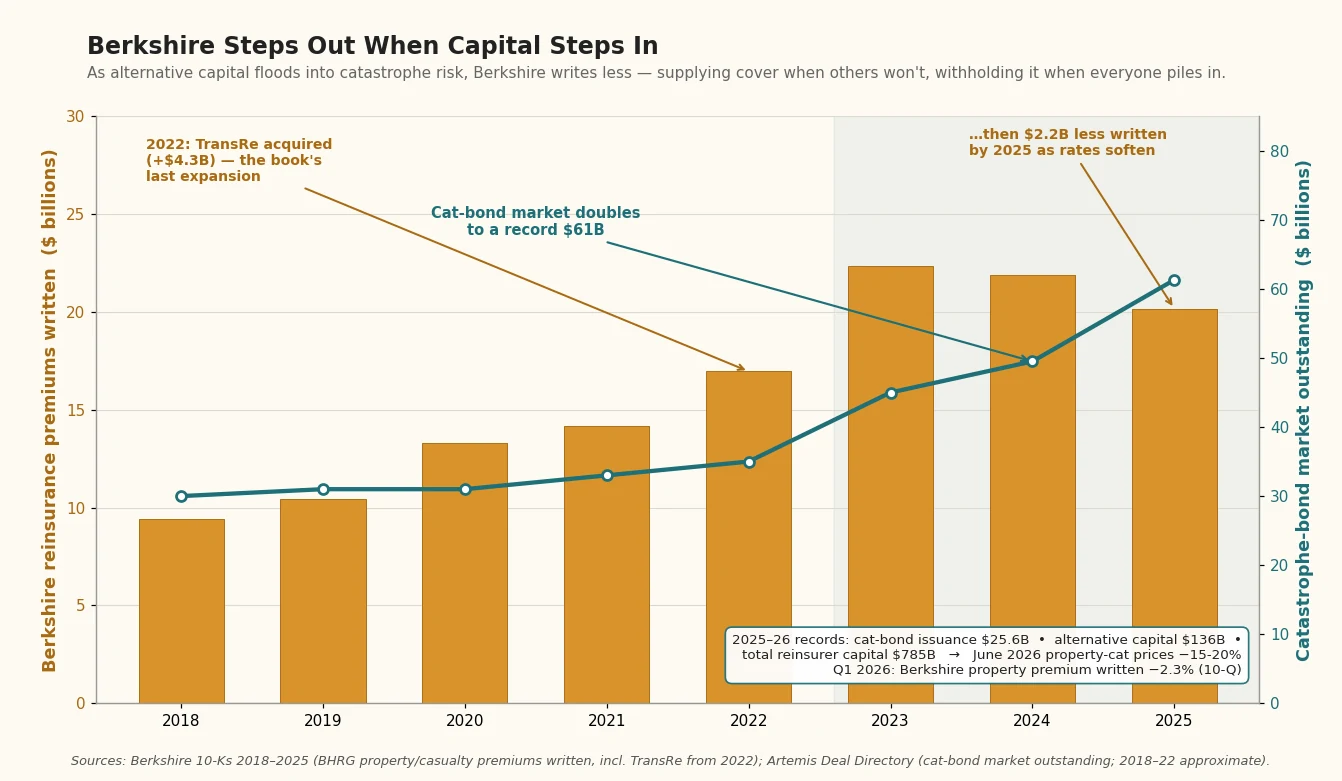
Against that tide, Berkshire's property-casualty reinsurance book has turned down. Premiums written rose every year through 2023 — but that 2023 peak of $22.4 billion was inflated by the first full year of the TransRe acquisition, not by organic pricing.1 Strip out the deal noise and the trajectory since is unmistakable: written premiums fell to $21.9 billion in 2024 and $20.2 billion in 2025, even with TransRe still in the figures, and the first quarter of 2026 extended the slide.12 The chart shows the scissor cleanly — alternative capital roughly doubling into catastrophe risk while Berkshire's pen lifts off the page. It is the behavior of a supplier that sells umbrellas when it is raining and refuses to discount them when the sun comes out.
This is where Berkshire's structure becomes a weapon. A publicly traded reinsurer that shrinks its top line for three years running invites activist pressure, analyst downgrades, and a sliding share price. Berkshire answers to none of that. It can let its catastrophe book wither for as long as prices stay inadequate, exactly as Jain did for the fifteen years chronicled in ↗, and wait for the next dislocation to deploy.
Why a Shrinking Book Is Good News

For a long-term shareholder, the most reassuring sentence in Berkshire's 2025 annual report is not a growth number. It is a warning. "As long as these phases of the cycle endure," wrote Greg Abel of the soft property market, "we expect to write less reinsurance premium."1 The line carries extra weight because of who wrote it: the 2025 report, published in February 2026, was Abel's first shareholder letter as chief executive, and he used his debut to reaffirm the discipline rather than announce a growth push. Buffett's own 2024 letter had put the same doctrine in blunter terms: "We must never write inadequately-priced policies in order to stay in the game. That policy is corporate suicide."16 The handoff from Buffett to Abel changed the signature on the letter, not the underwriting religion.
The reason discipline matters so much is the economics of float. Float is the pool of policyholder money an insurer holds between collecting premiums and paying claims, and Berkshire invests it as if it were its own — the mechanics are laid out in ↗. Float is only valuable if it is cheap. An insurer that writes unprofitable business to grow its float is paying interest on its borrowed money in the form of underwriting losses; an insurer that holds the line keeps its float at or below zero cost. Berkshire's overall property-casualty combined ratio has averaged about 92 percent over the past twenty years and 87.1 percent in 2025, meaning it has generally been paid to hold its float rather than paying to hold it.1 As our companion piece ↗ documented, the cost of that float reached its most negative reading in Buffett's published history in recent years — the float-side moat is at its widest precisely as the equity-selection moat has narrowed.
So when Berkshire writes $2.2 billion less catastrophe premium because prices are inadequate, it is not giving up earnings — it is declining to import an underwriting loss. The premium it walks away from is the premium most likely to blow a hole in the combined ratio when the next big storm lands. Doing nothing, as Buffett has said for decades, is sometimes the highest-value activity in reinsurance.
| Year | Reinsurance price phase | RoL index3 | Berkshire cat premium10 | What Berkshire did |
|---|---|---|---|---|
| 2000 | Soft (pre-9/11) | 100 | $321M | Stays small |
| 2002 | Hardening (post-9/11) | 163 | $1,283M | Expands |
| 2006 | Hard (post-Katrina) | 190 | $2,196M | Writes its high-water mark |
| 2010 | Softening | 161 | $623M | Walks away |
| 2014 | Soft | 152 | $688M | "Rates inadequate" |
| 2026 | Softening fast | ~154 (mid-year) | Property book shrinking2 | Writes less |
Berkshire's catastrophe and individual-risk premiums earned against the Guy Carpenter price index. The cat line is reported separately only through 2014; 2026 reflects the property-volume decline disclosed in the Q1 10-Q.
The Two-Speed Float

Here is the part that confuses the headlines. Berkshire is shrinking its most price-sensitive book in a soft market — and its total insurance float just hit an all-time record of $176.9 billion, up from $171 billion a year earlier and just $46 billion two decades ago.12 How does float reach a record while the catastrophe engine idles?
Because they are different engines, running at different speeds. The catastrophe-pricing cycle whipsaws — hard after Katrina, soft for a decade, hard again through 2024, soft now. Float ignores it.
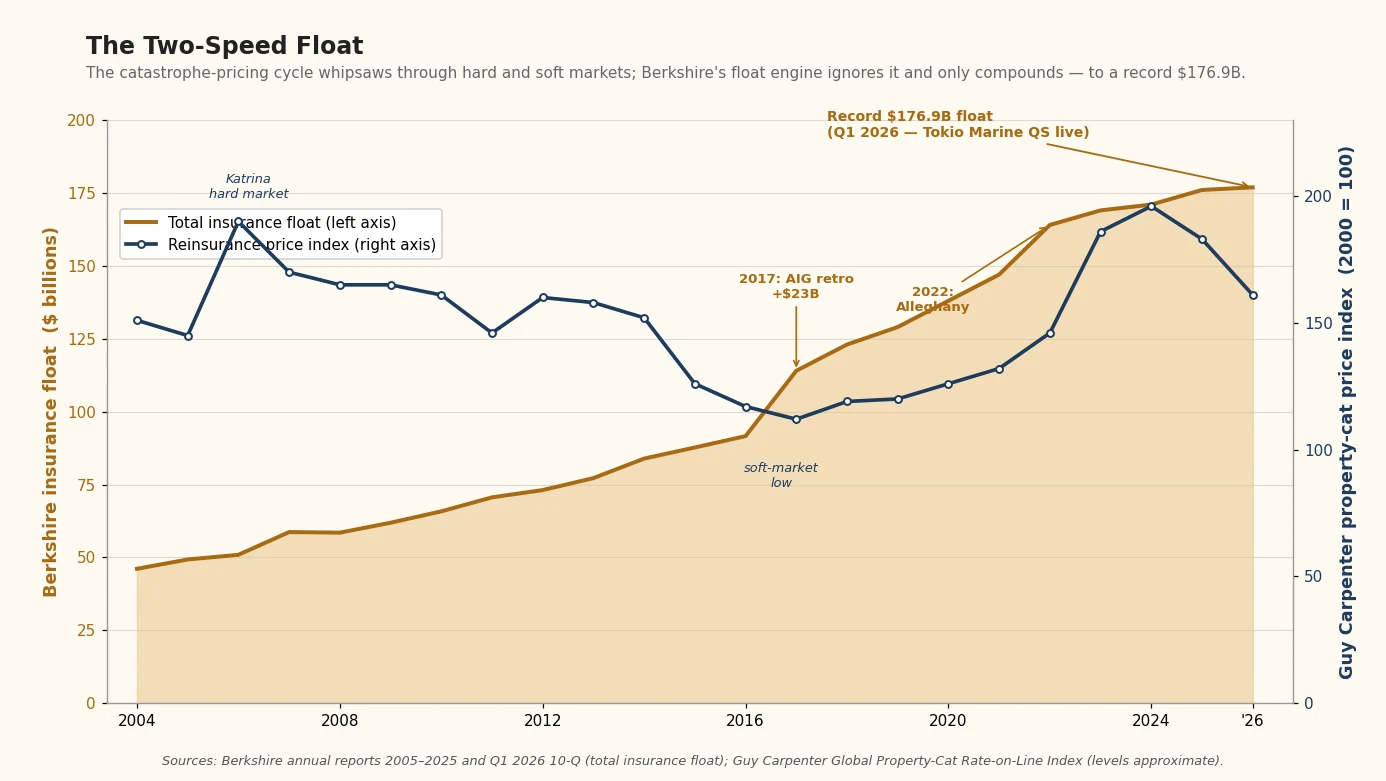
The chart above tells the story. Across more than twenty years, while the navy price line lurches from the Katrina peak down to the 2017 soft-market low and back up to the 2024 hard-market crest, the amber float line just compounds — through every phase, in every direction the cycle turns. The reason is diversification of source. GEICO's float grows with auto-policy count, indifferent to reinsurance pricing. Structured, one-off deals — the 2017 AIG retroactive cover helped drive a roughly $22 billion jump in float in a single year13 — arrive on their own schedule. The 2022 Alleghany acquisition brought another book. And the newest engine, the ten-year whole-account quota-share with Tokio Marine that went live April 1, 2026, was deliberately switched on as the catastrophe market softened, replacing cyclical cat premium with structural, relationship-driven flow.2 We covered that deal's origins in ↗.
This is the two-speed machine. One speed — the catastrophe book — is fast, cyclical, and deliberately throttled up and down with the price of risk. The other — total float — is slow, structural, and only compounds. Confusing the two is the single most common error in reading Berkshire's insurance results. A shrinking catastrophe book is the first engine doing its job. A record float is the second engine doing its.
| The 2026 soft market, by the numbers | Figure | Source |
|---|---|---|
| Global property-cat price, Jan 1 2026 | −12% | 3 |
| Florida property-cat price, June 1 2026 | −15% to −20% | 4 |
| Cat-bond issuance, 2025 (record) | $25.6B | 6 |
| Cat-bond market outstanding | ~$61B | 6 |
| Alternative reinsurance capital | ~$136B | 8 |
| Total reinsurer capital (record) | ~$785B | 5 |
| Berkshire P/C reinsurance written, Q1 2026 | $5,992M (−2.3%) | 2 |
| Berkshire total float, Q1 2026 (record) | $176.9B | 2 |
The Risk in Discipline
It would be too neat to end there, so here is the honest other side. Discipline is not free, and this cycle carries a genuine risk that 2006 did not.
The capital crowding into catastrophe risk today is stickier than the capital that fled after Katrina. Multi-year catastrophe bonds, sidecars backed by pension funds, and collateralized retrocession do not panic and withdraw after a single bad storm the way traditional reinsurer capital once did. That means the soft phase could last longer than the historical median, and a reinsurer that sits it out could cede relationships, talent, and market relevance for years before the next hard market rewards its patience. Berkshire is betting that its balance sheet lets it wait indefinitely — but "indefinitely" is a long time to watch competitors write the business you trained your underwriters to write.
There is also a reading-the-tape risk for shareholders. The next major catastrophe quarter — and there will be one — will spike Berkshire's combined ratio and produce headlines about an underwriting "miss." It will be neither a miss nor a discipline failure. It will be the same thing the soft prices are: the cycle. The first-quarter 2026 combined ratio of 87 percent looked brilliant largely because no significant catastrophe struck, just as a future bad quarter will look alarming largely because one did. Single quarters are weather; the discipline is climate. The same caution that made Berkshire the buyer of last resort after Katrina — see how the pattern began in the 1976 rescue chronicled in ↗ — is the caution that makes it a non-buyer today.
Conclusion
Strip away the quarterly noise and Berkshire's reinsurance posture in 2026 is the most coherent thing in its results. Prices are falling at the fastest rate in over a decade because a record wall of capital is chasing catastrophe risk. Berkshire, which exists to be paid adequately for taking that risk, is declining to chase — writing less, holding its combined ratio, and refusing to import the underwriting losses that the marginal soft-market policy would deliver. It is doing in 2026 exactly what it did in reverse in 2006, and the +0.71 signature in the data says it has been doing some version of this for a quarter-century.
Meanwhile the float — the actual prize, the permanent capital that funds everything from Apple shares to BNSF locomotives — compounds to a record on engines that the catastrophe cycle never touches. The premium engine is supposed to throttle up and down. The float engine is supposed to only climb. In the first half of 2026, both did precisely their jobs. That is not a machine in trouble. That is a machine running at two speeds, exactly as designed.
References
-
Berkshire Hathaway 2025 Annual Report - berkshirehathaway.com ↩↩↩↩↩
-
Berkshire Hathaway Q1 2026 Form 10-Q — BHRG property/casualty segment (premiums written $5,992M vs $6,135M; "increased competition and lower rates"); total float $176.9B (line 1756). ↩↩↩↩
-
Property catastrophe rates fall 12% globally at Jan 1 renewals: Guy Carpenter - artemis.bm ↩
-
Florida renewal risk-adjusted pricing down 15% to 20% across many layers: Guy Carpenter - artemis.bm ↩
-
Property reinsurance softening accelerates at mid-year amid capital growth: Guy Carpenter - artemis.bm ↩↩
-
Catastrophe bond issuance breaks Q4 and full-year records, market grows 24% - artemis.bm ↩
-
Record cat bond issuance of $17.7bn in 2024 takes outstanding market near $50bn - artemis.bm ↩
-
Alternative reinsurance capital hit new $115bn high at end of 2024: Aon - artemis.bm ↩
-
Florida cat bonds hit $3.2bn in 2026 YTD, pricing lower than last year: Guy Carpenter - artemis.bm ↩
-
Berkshire Hathaway annual reports 2001–2015 — Berkshire Hathaway Reinsurance Group "Catastrophe and individual risk" earned-premium line (reported separately through 2014). ↩↩
-
Berkshire Hathaway 2010 Annual Report - berkshirehathaway.com ↩
-
Buffett's Prince of Risk: Ajit Jain Q&A Transcript - kingswell.io ↩
-
Berkshire Hathaway 2017 Annual Report - berkshirehathaway.com ↩
-
Guy Carpenter Global Property-Catastrophe Rate-on-Line Index, 2000–2023 (+27.5%) - guycarp.com ↩
-
Property-cat rates fall up to 25% as reinsurance capital hits record high - insurancebusinessmag.com ↩
-
Berkshire Hathaway 2024 Annual Report - berkshirehathaway.com ↩