Tags: BHE / Earnings / Greg Abel
This fanpage is not officially affiliated with Berkshire Hathaway: Disclaimer
Berkshire Hathaway Energy's headline first-quarter 2026 result was a rounding error. Net earnings inched up roughly 1.3% — the kind of number that gets a single bullet in a Q1 recap and disappears. Underneath, the picture was anything but quiet. Three sub-segments moved violently in opposite directions: U.S. regulated utilities fell 16.1% after-tax, the natural gas pipelines business surged 24.2%, and the international and Other Energy group dropped 26.5% on a Northern Powergrid tariff reset that has been quietly grinding through results since the second quarter of 20251. BHE is not the company most shareholders think it is, and Q1 was the quarter where that became visible.
Introduction
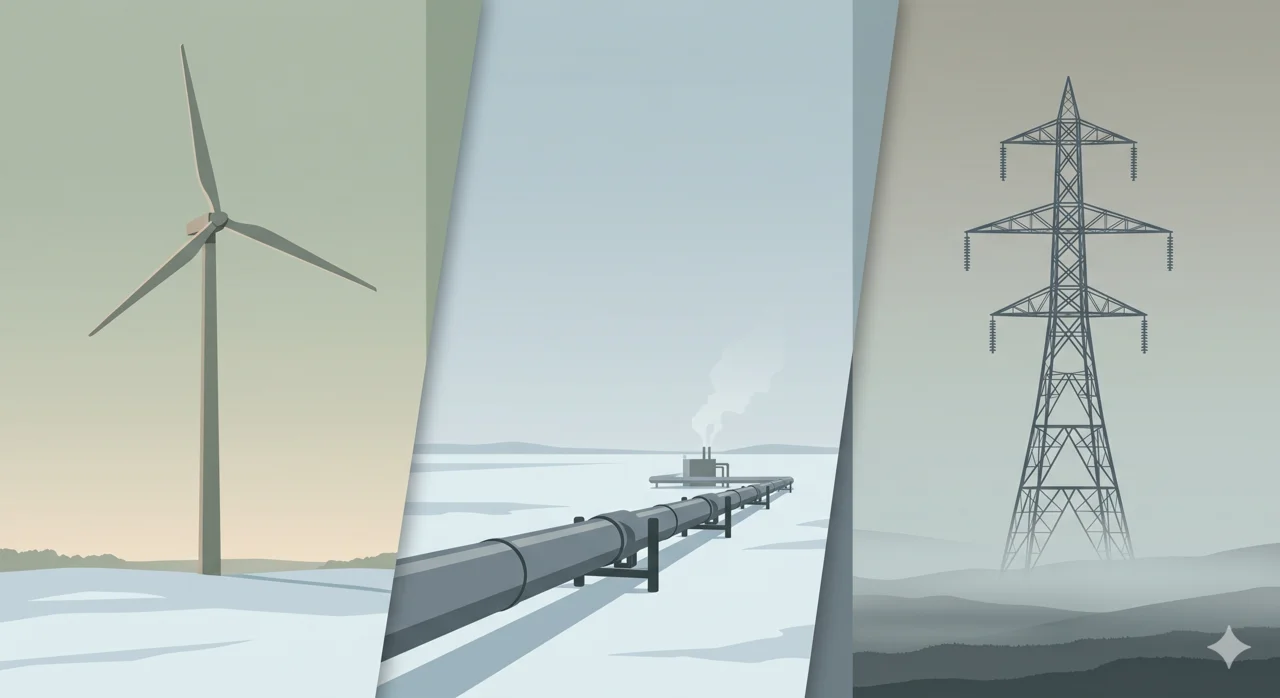
Berkshire Hathaway Energy is, in practice, three businesses sharing a holding company. PacifiCorp, MidAmerican Energy, and NV Energy form the U.S. regulated-utility leg: roughly $2.10 billion of net earnings in 20252, a rate base that grows with capex, and the kind of regulatory churn that has turned PacifiCorp's wildfire exposure into a multi-year drag ↗. The natural gas pipeline group — Northern Natural Gas, Kern River, BHE GT&S, and a half-share of Iroquois Gas Transmission — is the second leg: $1.15 billion of 2025 net earnings2, a 20,900-mile interstate footprint with 21.6 Bcf/day of design capacity2, and revenue patterns that swing with weather and LNG export demand. The third leg, Other Energy, gathers Northern Powergrid in the United Kingdom, AltaLink in Alberta, BHE Renewables, and a residential real-estate brokerage: $1.18 billion of 2025 net earnings2, with the U.K. piece on a five-year regulatory price control that links allowed revenue to a U.K. inflation index.
In 2025, the three legs leaned one direction. U.S. utilities posted a 6.9% gain in net earnings; pipelines fell 6.6%; Other Energy fell 11.9%2. In Q1 2026 they leaned the other direction. The whiplash is partly weather, partly U.K. regulatory mechanics, partly the natural lag between a rate-case filing and its earnings impact. Some of it will reverse. Some of it is structural. The job of this piece is to separate the two — and to ask what Greg Abel, the man who ran BHE before he ran the conglomerate, is doing about it.
Pipelines: A Cold January Pays for the Quarter
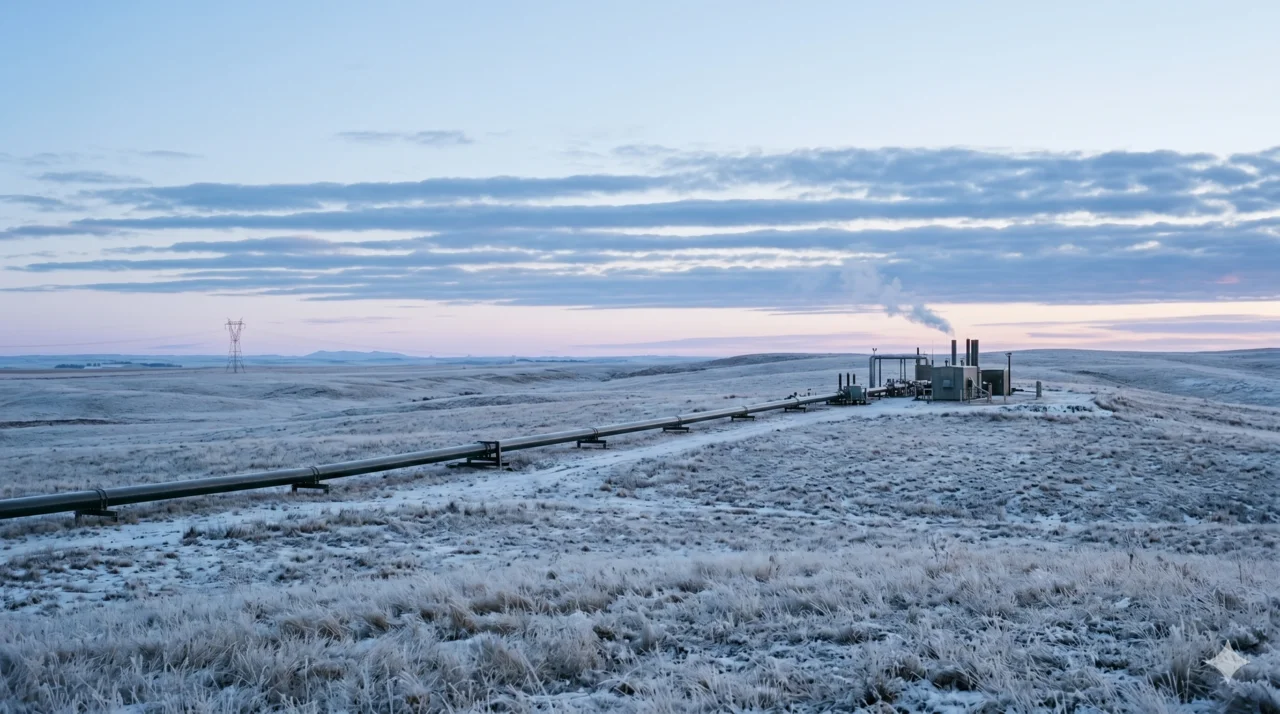
The pipeline group's $606 million in after-tax earnings, against $488 million a year earlier1, is the cleanest of the three sub-segment moves to explain. Two drivers stand out, and a third is worth flagging.
The first is weather. The week ending January 30, 2026 logged the largest natural gas storage withdrawal ever recorded in the EIA weekly report — 360 Bcf, 89% above the five-year average3. Henry Hub spot prices reached $9.03/MMBtu on January 28, with intraday peaks above $30/MMBtu reported earlier in the week4. National natural gas demand averaged 165.6 Bcf/day across a seven-day window — an all-time record3. Northern Natural Gas, BHE's largest pipeline at roughly 14,100 miles2 running from west Texas to the Upper Peninsula of Michigan, has a documented seasonal pattern in which "the highest demand typically occurs during the months of November through March"2. Winter Storm Fern arrived precisely in the meaty middle of that window. Nominations spiked. Storage withdrawals were rapid and remunerative. Those revenues do not recur in Q2.
The second driver is regulatory. Northern Natural Gas filed a Section 4 rate case on July 1, 2025 (FERC docket RP25-989). On February 23, 2026, the company filed a motion for interim settlement rates, effective February 1 and billable from March 15. The settlement is worth reading carefully: the interim settlement rates are lower than the commission-approved rates currently in effect5 — a multi-party compromise on the way to a final outcome, not a windfall. What the rate case does deliver is rate stability and recovery of higher operating costs into the rate base, which converts inflation into ROIC over the regulatory cycle. It is the bedrock of every pipeline operator's business model, and it works exactly when the press loses interest.
The third factor is LNG. March 2026 LNG exports averaged 17.9 Bcf/day, the second-highest monthly figure on record6; the EIA's 2026 STEO projects 17.0 Bcf/day for the full year against 15.1 Bcf/day in 2025, a 13% YoY step-up driven primarily by Plaquemines LNG and continued ramp at existing terminals6. Cove Point LNG in Lusby, Maryland — 75% owned by BHE GT&S after a $3.3 billion limited-partnership-interest purchase in September 20232 — captured netbacks on elevated U.S.-to-Europe spreads through the cold-weather quarter.
To check the framing against peers, the table below lines BHE's pipeline result up against the two natural-gas-pipeline pure-plays that reported the same quarter.
| Company | Q1 2026 metric | YoY change | Source |
|---|---|---|---|
| BHE pipelines (after-tax net earnings) | $606M | +24.2% | 1 |
| Williams Companies (adjusted EBITDA) | $2.25B | +13% | 7 |
| Kinder Morgan (adjusted EBITDA) | not disclosed line-item | +18% | 8 |
The peer comparison says two things. First, the cold-weather-and-LNG tailwind was a sector event, not a BHE event — Williams +13% and Kinder Morgan +18% confirm it. Second, BHE's outperformance against both peers suggests the rate-case overlay was additive. Kinder Morgan's CEO told the Q1 call he expects U.S. gas demand to reach 150 Bcf/day by 2031, a 27% step-up over current levels driven by data-center power and LNG8. If that projection is even directionally right, BHE's pipeline group is precisely where Berkshire wants to be.

How BHE Built a Pipeline Empire, One Forced Sale at a Time
The pipeline footprint did not appear in 2026. It was assembled, opportunistically, across three discrete moments when sellers had no leverage.
In July 2002, MidAmerican Energy Holdings paid $928 million in cash plus $950 million in assumed debt — about $1.88 billion in enterprise value — to acquire Northern Natural Gas from Dynegy9. Dynegy itself had bought the asset from the post-bankruptcy Enron just months earlier for $1.5 billion9. MidAmerican walked into the boardroom of a company in distress, paid $600 million less than the previous owner had, and acquired what is today the largest interstate natural gas pipeline in the United States by mileage. Buffett described the deal in the 2002 letter as the kind of opportunity that materializes precisely when no other buyer can act.
The same year, MidAmerican closed on Kern River Gas Transmission. Williams Companies announced the sale on March 7, 2002, at $450 million cash plus $510 million assumed debt — $960 million enterprise value10. Williams was reducing its debt-to-capital ratio from 71% to 57% under credit pressure10; MidAmerican was the willing buyer. Kern River runs 1,400 miles from the Wyoming Rockies to California and Nevada gas markets2. It is the single most important pipeline serving Las Vegas and southern Nevada power generation today.
The third move, eighteen years later, was the November 2020 acquisition of Dominion Energy's Gas Transmission and Storage business: $4.0 billion in equity plus approximately $5.7 billion in assumed debt, $9.7 billion enterprise value2. Dominion was repositioning around regulated electricity; Berkshire was the cash counterparty. The deal added what became BHE GT&S — roughly 5,400 miles in the eastern United States, seventeen underground storage fields, and the original 25% stake in Cove Point LNG2.
The 2020 deal is also the cleanest illustration of why FTC review matters. The original Dominion package included Questar Pipeline, a 2,200-mile system primarily serving central Utah. The FTC blocked BHE from holding Questar in July 2021 on competitive grounds: Kern River already served Utah, and the combination would have given BHE a regional monopoly11. Questar was unwound, sold to Southwest Gas Holdings as MountainWest, and then later moved on again12. The pipeline group BHE actually owns is therefore smaller than the headline 2020 deal implied, and the strategic constraint is real — Berkshire has effectively reached the U.S. pipeline-acquisition ceiling that horizontal antitrust permits.
The pattern across all three deals is consistent. BHE bought when the seller could not wait — Enron's collapse spilling Northern Natural through Dynegy, Williams's credit crunch flushing Kern River, Dominion's strategic pivot dropping a $9.7 billion package onto the market. None of these were auctions. All of them were buyers'-leverage situations. It is the same playbook BHE used to acquire the original MidAmerican Energy stake in 1999 and Northern Powergrid in 1999–2000 — patience capital, deployed when patience was the scarce input.
U.S. Utilities: PacifiCorp's Drag, Iowa's Quiet Outperformance
The utility leg fell from $428 million to $359 million after-tax in Q1 2026, a 16.1% decline1. The reflexive read is "PacifiCorp wildfires, again," and that is partly correct — but it understates how much the sub-segment is actually doing.
PacifiCorp's wildfire reserves now total roughly $2.9 billion against approximately $50 billion in outstanding claims, with the April 8, 2026 Oregon Court of Appeals decision pausing the most aggressive class-action vehicle ↗. That story is its own piece. What is not its own piece, and is hiding underneath, is MidAmerican Energy. MEC's electric customer-volume growth in 2025 was 9.6%, against PacifiCorp at +1.3% and NV Energy at −2.2%2. Iowa is in the early innings of a data-center and industrial-electrification load surge that no other Berkshire utility is matching, and MEC has the wind generation and transmission position to absorb it without rate-case turbulence. BHE owns roughly 13,642 MW of wind capacity, much of it in Iowa, with Iowa wind covering nearly 90% of MEC's retail electric customer demand on average2 ↗.
NV Energy is the third leg. The Public Utilities Commission of Nevada approved Nevada Power's 2025 general rate case on September 17, 2025, against an initial $215.7 million annual revenue request, with a first-in-the-nation residential demand charge effective April 1, 20261314. The demand charge is controversial — consumer groups have already filed legal challenges — but the underlying rate-case outcome is a Q2 2026 tailwind that will partly offset the PacifiCorp drag in subsequent quarters.
For the full year 2025, the U.S. utilities leg posted $2.10 billion in net earnings, up from $1.96 billion in 2024 and $906 million in 20232. The 2023 figure was crushed by $1.7 billion in PacifiCorp wildfire accruals; 2024 saw $346 million in further accruals; 2025 saw $100 million2. Strip the wildfire noise out and the underlying utility margin is growing meaningfully — call it 8% to 9% per year — but you would not see that from the headline number. The Q1 2026 −16.1% is partly the same effect running in reverse: a year-ago quarter that benefited from one set of wildfire dynamics, against a current quarter where the wildfire reserve is being drawn down rather than added to.
Northern Powergrid: When the Inflation Gift Goes in Reverse
The Other Energy leg fell 26.5% to $255 million after-tax, against $347 million in Q1 20251. The 10-Q text is precise about the cause: lower distribution revenues at Northern Powergrid "due to lower tariffs from inflation adjustments beginning in the second quarter of 2025"1. Translating from filing-language to economics requires understanding RIIO-ED2.
Ofgem's RIIO-ED2 price control is the U.K. five-year regulatory framework for electricity distribution network operators, running from April 1, 2023 through March 31, 202815. Allowed revenue is indexed annually to CPIH — the Consumer Price Index including owner-occupier housing costs — replacing the older RPI mechanism. The RAV (Regulatory Asset Value) on which DNOs earn a return is also CPIH-indexed. In a high-inflation environment, the formula is generous: when CPIH ran above 6% in 2022 and 2023, NPG's permitted revenue rose mechanically. In a normalizing-inflation environment, the formula gives the gift back: CPIH dropped meaningfully through 2024 and into 2025, and the annual tariff revision effective from the second quarter of 2025 cut allowed revenue accordingly.
This is not regulatory hostility. It is the inflation index doing exactly what it is designed to do. Ofgem's RIIO-ED2 annual report covering 2024–2025 confirms that the network-cost outturn was within the framework16. Northern Powergrid did appeal aspects of the original RIIO-ED2 final determination to the Competition and Markets Authority back in 2023, arguing for higher allowances to fund electrification capex; the CMA found for Ofgem on most points and ordered redetermination on a narrower issue17. Northern Powergrid's interim accounts for the half-year ended June 30, 2025 confirm the impact: profit after tax of £85.0 million, down £10.0 million from H1 2024, attributed to "lower gross margins and higher operating expenses"18.
The point is structural. Northern Powergrid is approximately 4 million U.K. electricity customers across Yorkshire and Northeast England, served by roughly 10,000 square miles of network2. Its earnings track CPIH up and CPIH down. The Q1 2026 result is the second consecutive quarter of mean-reversion working against the operator after several years of working in its favor. There is no reason to expect the trajectory to reverse before the next RIIO price control begins in 2028, unless U.K. inflation re-accelerates. For BHE, that means roughly a quarter of Other Energy's earnings are running against a structural headwind that the press will not pick up because it lives inside a Cardiff regulatory document.
What Abel Is Doing About It
The three-legs read makes more sense once Greg Abel's prior role is recalled. Abel ran BHE from 2008 through 2018, oversaw the $9.7 billion Dominion gas transmission acquisition in 2020 from his perch as Vice Chairman of Non-Insurance Operations, and now sits as Berkshire's CEO with BHE among the structural challenges he inherited ↗. He knows the rotation intimately. The signals from the 2025 annual letter and the Q1 2026 capital-allocation pattern suggest a deliberate response.
The 2025 letter paragraph on BHE is short, careful, and revealing: "BHE is rebalancing as the team positions it to move forward. In 2025, BHE produced $8.4 billion in net cash flows from operating activities, consistent with its five-year average... Our willingness to invest capital depends on the continued functioning of the regulatory compact through which utilities earn a reasonable return on invested capital. Near-term opportunities are significant, and BHE will pursue them selectively."2 Selectively is the operative word. BHE plus BNSF have planned roughly $15 billion in capex for 2026, with $12.4 billion remaining at the end of Q11 — an aggressive number, but not the unlimited-capex posture of prior cycles. The framing pulls back hard from PacifiCorp's wildfire-vulnerable territory and toward what works: pipelines and renewables.
The debt picture supports the reading. BHE subsidiaries issued $4.6 billion of term debt in Q1 2026 at a 5.8% weighted-average rate, with maturities running 2029 through 20561. That is more capacity than was issued in all of 2025 ($4.3 billion at 6.2%2) — and at a noticeably lower funding cost. BHE's aggregate borrowings stood at $59.3 billion at the end of 2025, up about $2.9 billion year-over-year2. The capital structure is becoming more debt-funded, but at rates that are normalizing as the Federal Reserve's cuts work through. None of the proceeds appear earmarked for new utility-rate-base growth in PacifiCorp territory; the natural-gas pipeline maintenance-and-expansion need, plus continued renewables build, gets the lion's share. Cumulative renewables investment through 2025 reached $38.0 billion, with twenty-two coal units retired since 20072. That is structural commitment, not optics. The last leg of the rotation — the renewables piece, partially hidden inside Other Energy — is the part Abel is least likely to slow down.
Conclusion
Q1 2026 is a single quarter, and any analysis built on a single quarter's segment data is one quarter from being embarrassed. The 2025 full-year picture leaned the other way: utilities up, pipelines down, Other Energy down. The Q1 2026 picture leans this way: utilities down, pipelines up, Other Energy down. Some of that whiplash is genuinely cyclical — Winter Storm Fern, the 2025 wildfire-accrual drawdown — and some of it is structural — RIIO-ED2 working its CPIH mechanics, MEC's data-center load growth, the antitrust ceiling on U.S. pipeline acquisitions.
But the deeper read is this: the headline +1.3% on BHE net earnings is doing more work than it appears to be doing. It averages a regulated-utility business that is partly stuck (PacifiCorp), partly compounding (MEC), and partly waiting on a rate case (NV Energy); a pipeline business that is the cleanest beneficiary of U.S. industrial electrification and LNG export growth; and an international piece tethered to a U.K. inflation index. BHE today is the most diversified part of Berkshire's regulated-infrastructure book — more so than BNSF, which is the cleaner single-business comparison ↗. The cost of that diversification is harder analysis. The benefit is exactly what the +1.3% number proves: when one leg drops 26%, another absorbs the shock. The rotation is not an aberration. It is the model.
References
-
Berkshire Hathaway Q1 2026 Form 10-Q - berkshirehathaway.com ↩↩↩↩↩↩↩
-
Berkshire Hathaway 2025 Annual Report (10-K) - berkshirehathaway.com ↩↩↩↩↩↩↩↩↩↩↩↩↩↩↩↩↩↩↩↩
-
Largest weekly natural gas storage withdrawal on record - eia.gov ↩↩
-
EIA Press Release on January 2026 natural gas demand - eia.gov ↩
-
Northern Natural Gas Motion for Interim Settlement Rates, FERC RP25-989 - northernnaturalgas.com ↩↩
-
Williams Companies Q1 2026 Earnings Recap - williams.com ↩
-
Kinder Morgan Q1 2026 Earnings Call Transcript - investing.com ↩
-
Dynegy sells Northern Natural to MidAmerican for $1.9B - money.cnn.com ↩↩
-
Williams sells Kern River to MidAmerican for $960M - naturalgasintel.com ↩↩
-
FTC Statement on BHE termination of Questar Pipeline acquisition - ftc.gov ↩
-
Southwest Gas Holdings to acquire Questar Pipeline - swgasholdings.com ↩
-
Nevada Power 2025 General Rate Case - nvenergy.com ↩
-
PUCN approves NV Energy rate hike - nevadacurrent.com ↩
-
Ofgem RIIO-ED2 Electricity Distribution Price Control 2023-2028 - ofgem.gov.uk ↩
-
Ofgem RIIO-2 Electricity Distribution Annual Report 2024-2025 - ofgem.gov.uk ↩
-
Northern Powergrid appeals RIIO-ED2 decision - utilityweek.co.uk ↩
-
Northern Powergrid Holdings interim financial statements - northernpowergrid.com ↩