Tags: BHE / Greg Abel / Innovation
This fanpage is not officially affiliated with Berkshire Hathaway: Disclaimer
During the first two days of June 2026, Berkshire Hathaway did something it almost never does: it bought a large slug of a megacap technology stock at a rich price. The $10 billion private placement into Alphabet1 was the headline. But while the analysts argued about whether Warren Buffett's successors had finally capitulated to the AI trade, a quieter fact sat unremarked in a regulatory docket two states away. Berkshire's own electric utility was already on the other side of the same buildout — not as a shareholder of Google, but as the company selling Google its electricity. Berkshire is financing the chips and supplying the power. Only one of those two bets is durable, and the durable one is the one nobody is pricing.
Introduction
Conglomerates are supposed to make this kind of double exposure visible. Berkshire's almost perversely hides it. The Alphabet stake shows up in a 13F, gets a CNBC chyron, and moves the stock. Berkshire Hathaway Energy — wholly owned since October 2024, never separately traded, marked on the balance sheet at historical cost — gets none of that. Its data-center business is buried inside integrated-resource-plan filings at the Public Utilities Commission of Nevada and a single capital-expenditure line in a 10-K. The result is that the market spent early June debating Berkshire's most fragile AI bet while ignoring its sturdiest one.
This piece is about the sturdy one. The question it asks is narrow and, for shareholders, overdue: what is BHE actually worth now that the AI power boom has arrived in its service territories — and why does Berkshire's own last mark on the business, struck at roughly book value, look like a relic of a fear that has already started to lift? We have written before about the wildfire liability that produced that mark ↗ and about the quarter-by-quarter rotation inside the segment ↗. What follows is the valuation case those pieces set up.
Two bets on one buildout

Consider the two instruments side by side, because they could not be more different in character. The Alphabet position is an equity stake bought at roughly twenty times earnings into a capital-expenditure arms race. Alphabet has committed something on the order of $185 billion of capex for 2026 and raised some $85 billion of fresh capital to fund it2 — the $10 billion Berkshire check was one tranche of that raise. If the AI build pays off, Berkshire owns a sliver of the winner. If hyperscaler returns on all that silicon disappoint — and the history of capital-spending booms from railroads to fiber to shale says a great many of them do — Berkshire owns a sliver of a richly valued stock at the wrong moment. It is, in the most Buffettian sense, a casino chip: a bet on a narrative whose payoff depends on other people's discipline.
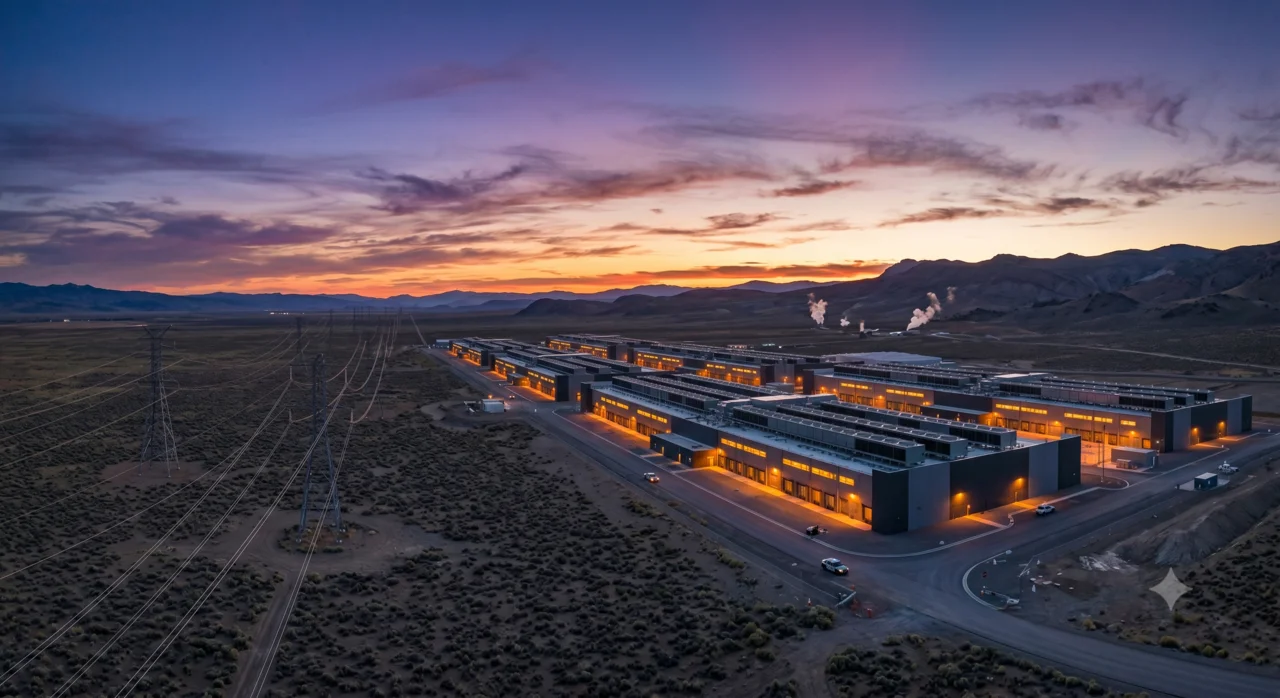
The power business is the opposite animal. In June 2024 Google and NV Energy — a BHE subsidiary — jointly filed a "Clean Transition Tariff" with Nevada regulators to supply Google's data centers with 115 megawatts of enhanced geothermal power from Fervo Energy, and the commission approved it in 20253. A separate long-term agreement routes up to 150 megawatts of Ormat geothermal capacity to the same customer4. These are not narrative bets. They are regulated, commission-blessed obligations to deliver electrons, on which NV Energy earns an allowed return on the rate base it builds to serve them. Google's chips may or may not earn their keep. Google's power bill will be paid either way — and if the data center runs at all, it runs on someone's regulated grid.
That asymmetry is the whole thesis. The shareholder who would rather own the toll road than the casino chip should be far more interested in the line item Berkshire hides than the one it disclosed.
The mark that time forgot
Here is the awkward part. Because BHE is wholly owned and never trades, the only "prices" it ever receives are the rare occasions Berkshire buys out a minority holder. There have been exactly two in recent memory, and together they tell a story of collapse.
| Transaction | Date | Stake | Price | Implied BHE equity | ≈ × book |
|---|---|---|---|---|---|
| Greg Abel sells his 1% personal stake to Berkshire | Aug 2022 | ~1% (740,961 sh) | $870M5 | ~$87 billion | ~1.7× |
| Walter Scott estate buyout | Sep 30, 2024 | ~8% (4.42M sh) | $650/sh6 | ~$49 billion | ~1.0× |
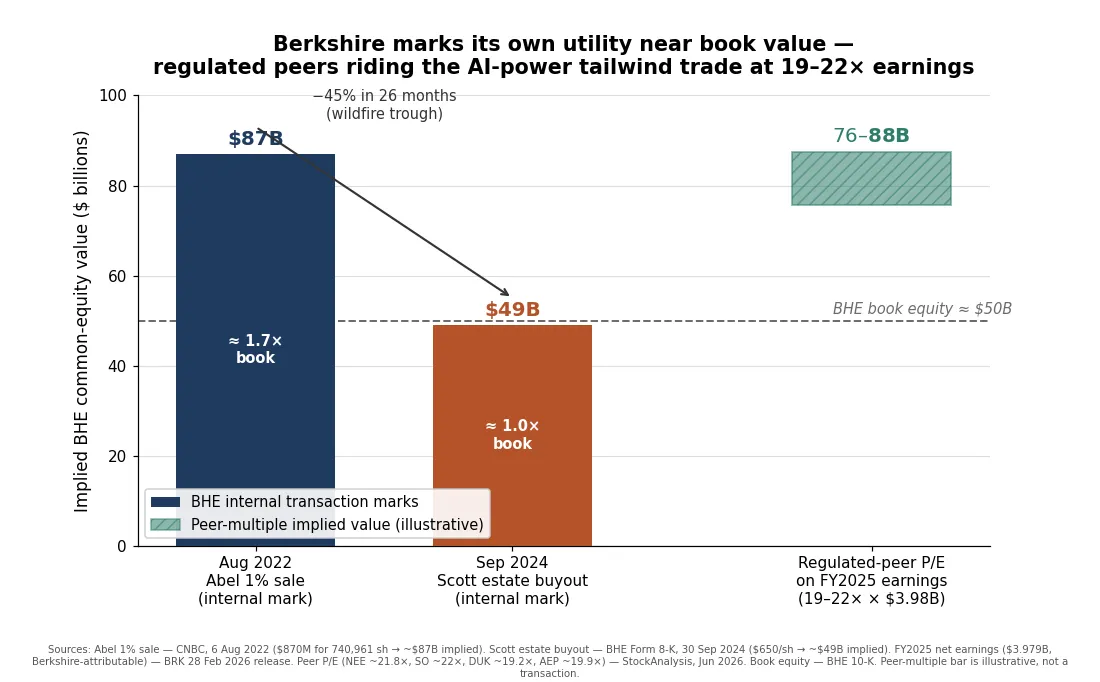
In twenty-six months, Berkshire's own implied valuation of its utility fell forty-five percent, from roughly $87 billion to roughly $49 billion, even though BHE's book equity sat flat at about $50 billion the entire time. The 2024 mark, in other words, valued one of the largest regulated utility platforms in America at approximately book value — the price you assign a business you expect to earn its cost of capital and not a dollar more.
There was a reason. The Scott estate sale closed at the absolute nadir of the PacifiCorp wildfire panic, with plaintiff demands stacking into the tens of billions and a real question hanging over BHE's credit. Berkshire, as the single natural buyer purchasing from an illiquid estate, set a price that embedded every ounce of that fear. It was a fair price for the moment. The problem is that the moment has passed, and the mark has not moved — because nothing forces it to.
What peers fetch for the same tailwind
Set BHE's stranded $49 billion mark against what public regulated utilities now command for precisely the demand story unfolding in NV Energy's territory. NextEra trades near 21.8 times earnings, Southern around 22 times, American Electric Power and Duke in the 19s15. The AI-power thesis has re-rated the whole regulated group, and the sector is consolidating around it — in May 2026 NextEra agreed to buy Dominion for $67 billion in stock to assemble the largest regulated electric utility on earth17.
Apply that 19-to-22-times band to BHE's FY2025 net earnings of $3.98 billion8 and you get an implied equity value of roughly $76 to $88 billion — the upper end landing almost exactly back at Abel's 2022 mark. That is the teal band on the chart above, and it is doing the central work of this article: on today's earnings, valued the way the market values its listed peers, BHE is worth something close to double Berkshire's last internal mark, before crediting a single megawatt of the data-center pipeline still to come.
One honest caveat belongs here, and it is the reason the band is labeled "illustrative." BHE is not its peers, and not only because of wildfire. It is regulated, which means — and this is the most misunderstood point in the entire AI-utility story — it cannot capture the merchant upside that has made the independent power producers the market's darlings. Vistra, Constellation, and Talen sell power to hyperscalers at negotiated, often premium, market prices, and trade at the rich multiples that merchant pricing earns16. NV Energy does not. It recovers its data-center load through a regulated tariff and earns its allowed return — call it nine to ten percent — on the rate base it adds. The data-center boom does not spike BHE's margins; it enlarges the base on which BHE compounds a steady, regulated return. The correct comparison is therefore the regulated names, not the merchants, and the re-rating logic is "bigger rate base for longer," not "windfall pricing." That is a slower, surer machine — exactly the kind Berkshire prefers to own.
The pipeline nobody is pricing
How big is the base about to get? NV Energy's 2026 integrated resource plan is the closest thing to a public ledger, and the numbers are startling for a utility whose entire system peak is about 8,500 megawatts. The utility reports having already executed roughly 6 gigawatts of agreements to interconnect large loads, against data-center interest inquiries totaling some 22 gigawatts9 — more than two and a half times the size of the entire grid it operates today. Even a fraction of that converting to steel and substations represents a multi-year rate-base expansion concentrated in one of the fastest-growing data-center corridors in the country, the Reno–Storey County industrial belt.
This is not confined to Nevada. MidAmerican Energy in Iowa is racing to serve Microsoft's West Des Moines campuses and has won approval for an 800-megawatt solar project and a new gas plant to keep pace with load18. Across the whole platform, BHE has earmarked $33.3 billion of capital expenditure for 2026 through 2028 — roughly $15.8 billion of it regulated transmission and distribution — with MidAmerican's three-year budget up 65 percent and NV Energy's up 17 percent10. (The 10-K describes that $15.8 billion as regulated wires spending; the attribution to AI demand is mine, but the geography of the increase makes the connection hard to miss.) Every dollar of that prudently-incurred capital becomes rate base, and rate base is the only engine a regulated utility has. This is the same "shovelmaker" posture we flagged in Berkshire's response to the index's chip mania ↗ and in the capex pivot toward AI-driven wires we noted in the long-run returns piece ↗: when everyone else is panning for gold, Berkshire would rather sell the picks — or in this case, the power.
There is a near-term risk worth naming, because it cuts against the thesis. Interconnection queues are long, and some customers are impatient. At the Tahoe-Reno Industrial Center, one developer is pursuing 350 megawatts of on-site generation precisely because NV Energy cannot serve it for at least two years, and Alphabet's own $4.75 billion acquisition of Intersect Power in March 2026 signals that hyperscalers are increasingly willing to self-supply rather than wait. If enough load bypasses the regulated utility, the rate-base math softens. The toll road only collects if the traffic uses the road.
The anchor that won't lift
Which brings us back to wildfire, the reason the mark is stuck and the discount persists. Through the first quarter of 2026, BHE's cumulative estimated probable wildfire loss stood at about $2.9 billion, of which roughly $2.3 billion had been paid and $577 million remained as unpaid accrual11. Against that sits a wall of plaintiff demands — about $46 billion disclosed in August 2024, since swelling past $55 billion12. It is essential to read those big numbers correctly: they are gross damages claimed in complaints, not BHE's expected liability or its reserve. The roughly fifty-billion-dollar gap between the two is not an accounting hole; it is a philosophical disagreement, now headed for the courts, about what PacifiCorp actually owes.
And the courts have begun to lean Berkshire's way. In April 2026 the Oregon Court of Appeals reversed and remanded the foundational James class-action verdict, finding that a single erroneous jury instruction had let jurors apply causation evidence uniformly across four geographically distinct fires — a ruling that jeopardizes more than a billion dollars of existing verdicts and pauses a long line of scheduled trials13. In February, PacifiCorp had separately settled all known federal claims across six fires for $575 million14. The tail is not gone — plaintiffs have petitioned the Oregon Supreme Court, and a thousand individual trials still loom — but the worst-case distribution is visibly narrowing from where it stood when Berkshire set the $49 billion mark.
Here is the structural wrinkle a careful shareholder should sit with: the wildfire risk lives almost entirely at PacifiCorp, in the Pacific Northwest, while the data-center upside lives at NV Energy and MidAmerican, in Nevada and Iowa. They are different subsidiaries with different regulators. A single consolidated mark on "BHE" blends a discount that belongs to one set of assets with an opportunity that belongs to another. Anyone buying the AI re-rating is also, unavoidably, buying the Oregon tail — and anyone fixating on the Oregon tail is ignoring two utilities sitting in front of the largest load-growth wave in their history.
What it's worth
So where does that leave the number? Take FY2025 earnings of $3.98 billion — themselves the product of a genuine recovery, up from $2.33 billion in 2023 and $3.73 billion in 2024 as wildfire accruals faded78 — apply a regulated-peer multiple, and the honest range lands between book value and roughly $88 billion depending entirely on how one weights the Oregon tail. The $49 billion mark is the wildfire-trough floor. The $76-to-$88 billion band is what the business fetches if it is valued like NextEra or Southern. The truth, today, sits somewhere in between and is drifting upward as the appellate ruling holds and the data-center base compounds.
The maddening part for shareholders is that they will never see the needle move on a screen. BHE is opaque by construction; Berkshire carries it at cost, re-marks it only when it transacts, and has no minority holders left to transact with. That opacity is itself a discount — value you own but cannot point to. The compensation is that the underlying machine is about as good as regulated infrastructure gets: a swelling rate base, an allowed return, and the single largest hyperscaler in the world as a captive, commission-bound customer in Nevada.
Buffett spent decades teaching that the best businesses are toll bridges. In June 2026 Berkshire bought a casino chip on Alphabet and, in the same breath, deepened its toll on Alphabet's electricity. If the chip disappoints, the toll keeps collecting. That is the whole reason to prefer the part of this story that does not come with a chyron.
Conclusion
The market read Berkshire's June correctly as an AI bet and then looked at entirely the wrong half of it. The Alphabet equity stake is the fragile, narrative-dependent piece — defensible, perhaps even shrewd, but a chip on someone else's discipline. The durable piece is the utility quietly contracting to power the same machines, earning a regulated return on a rate base set to grow for a decade. Berkshire's last internal mark values that utility at book, struck in a wildfire panic that the courts are now unwinding. Valued the way its listed peers are valued, BHE is plausibly worth close to double that mark before a single megawatt of the 22-gigawatt Nevada pipeline is built. Shareholders cannot force the re-rating onto a screen. But they can at least know which half of June's AI bet they should actually want to own.
References
-
Berkshire Hathaway invests $10 billion in Alphabet via private placement - cnbc.com ↩
-
Google secures nearly $32bn in debt following major data center capex commitment - datacenterdynamics.com ↩
-
Google, Fervo, NV Energy win Nevada approval for clean transition tariff - utilitydive.com ↩
-
Ormat signs geothermal PPA with NV Energy to serve Google's Nevada data centers - briefglance.com ↩
-
Berkshire CEO-designate Abel sells stake in energy company he led for $870 million - cnbc.com ↩
-
Berkshire Hathaway Energy Form 8-K (Walter Scott estate share repurchase, Sept 30 2024) - sec.gov ↩
-
Berkshire Hathaway Inc. 2024 Form 10-K (BHE segment earnings) - sec.gov ↩
-
Berkshire Hathaway fourth-quarter and full-year 2025 earnings release - berkshirehathaway.com ↩↩
-
NV Energy's new long-term plan highlights massive power demand tied to data centers - mynews4.com ↩
-
Berkshire Hathaway Energy utilities see gain in capex spending - industrialinfo.com ↩
-
Berkshire Hathaway Q1 2026 Form 10-Q (PacifiCorp wildfire loss accrual) - berkshirehathaway.com ↩
-
Wildfire claims against PacifiCorp surge to $46B on Oregon mass complaints - spglobal.com ↩
-
Oregon Court of Appeals reverses PacifiCorp wildfire class-action verdict - carriermanagement.com ↩
-
PacifiCorp agrees to pay $575M to settle claims for damage caused by six wildfires - justice.gov ↩
-
NextEra Energy (NEE) valuation statistics - stockanalysis.com ↩
-
Constellation Energy vs. Vistra: merchant-power valuation comparison - tikr.com ↩
-
NextEra to acquire Dominion Energy in $67 billion data-center-driven deal - cnbc.com ↩
-
Energy, water use under close watch as data centers expand in Iowa - businessrecord.com ↩