Tags: Comments / Greg Abel
This fanpage is not officially affiliated with Berkshire Hathaway: Disclaimer
This week, a company that lost roughly $4.9 billion last year is going to ask the public for about $75 billion. SpaceX is expected to price its IPO on June 11 at $135 a share — a $1.77 trillion valuation, the largest stock-market debut in history.1 What makes the moment more than a Musk spectacle is the plumbing underneath it: the day SpaceX starts trading, index funds tracking the Nasdaq-100 and the Russell will be obliged to buy it, profitless or not, because the rule-makers rewrote the entry criteria to let them. The S&P 500 just refused to play along. That split — and what it reveals about what an index fund actually is in 2026 — is the best argument we have seen in a while for why Berkshire Hathaway is not the thing most people think they are comparing it to.
Introduction
For a generation, the advice given to ordinary savers has been beautifully simple: buy a low-cost S&P 500 index fund and stop fiddling. Warren Buffett himself has preached it for decades, and we have made the case for it on this very site ↗. The advice was sound because the index it pointed at was, broadly, the American economy: five hundred businesses, no single one large enough to sink the ship.
That index has quietly changed shape. It is now, to a degree without modern precedent, a leveraged wager on a dozen semiconductor and artificial-intelligence companies — and the people who write index rules are busy lowering the drawbridge for the next wave of them. None of this is an argument that the index is bad or that anyone should sell it. It is an argument that the index has become a particular kind of bet, and that Berkshire is a structurally different machine — one built to do several things a passive fund cannot. The interesting part is that Berkshire is not even hiding from the AI boom; it is in the race, just by a different door. Let us walk through what the index has become, what is about to be bolted onto it, and where a conglomerate quietly diverges.
The Index You Think You Own
Start with the concentration. The ten largest stocks in the S&P 500 now account for roughly 41% of the entire index, against about 27% at the dot-com peak in 2000 and around 19% as recently as 2015.2 The top twenty names alone make up more than half of it.3 The engine under that concentration is silicon: semiconductors have grown to about 18% of the S&P 500 — more than double their weight at the 2000 tech-bubble top — and they accounted for roughly 70% of the index's market-value gains in the first months of 2026.4
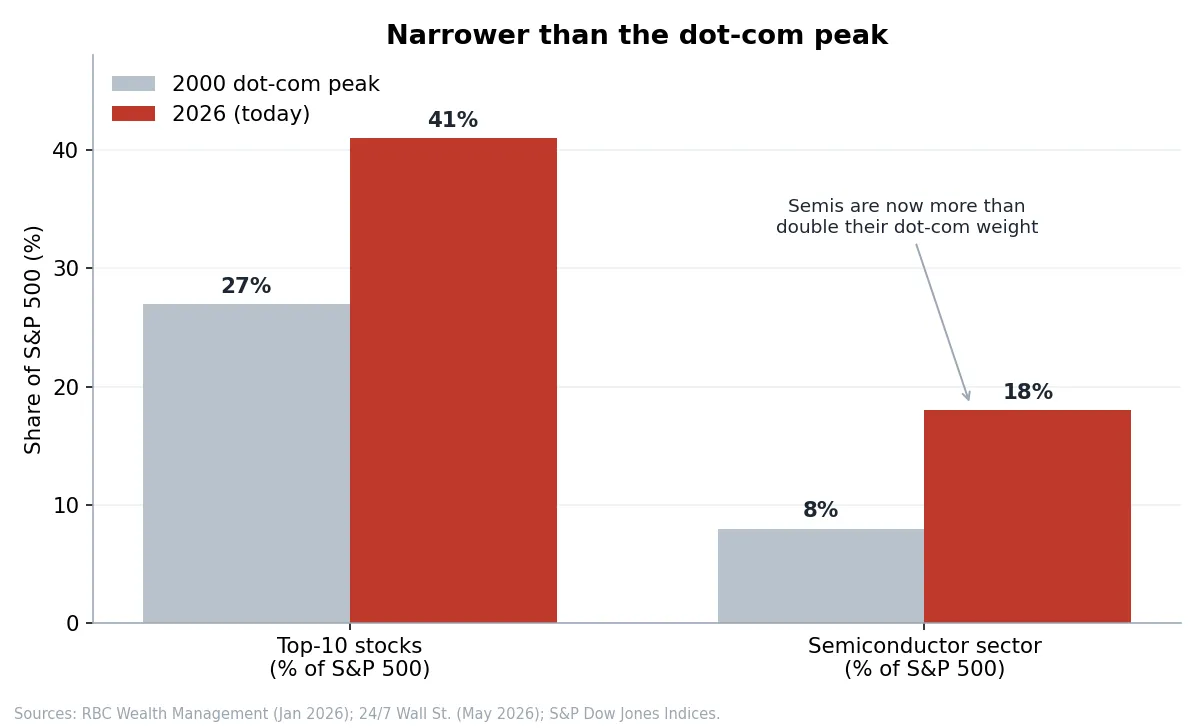
Drill into a single year and the narrowness is stark. Of the S&P 500's total return in 2025, Nvidia alone supplied 15.5% — one stock, one-sixth of the index's entire gain. Alphabet added another 13.5%, Microsoft 7.4%, and Broadcom 7.2%; the seven largest names together delivered more than half the year's return while making up roughly a quarter of the index's weight.5 The cap-weighted S&P 500 has beaten its own equal-weighted version by something like 32 percentage points over 2023–2025, the widest three-year gap since the late-1990s mania.6 In plain English: when you buy "the market," more than forty cents of every dollar now flows into ten companies, and the index's fate is increasingly hostage to whether a handful of chipmakers keep beating expectations.
| 2025 S&P 500 total return | Share contributed |
|---|---|
| Nvidia | 15.5%5 |
| Alphabet | 13.5%5 |
| Microsoft | 7.4%5 |
| Broadcom | 7.2%5 |
| Top 7 names combined | ~52%2 |
This is not, on its own, a crime. Today's giants are genuinely profitable in a way Cisco and Lucent were not in 1999. But concentration is concentration, and a portfolio that holds five hundred names yet derives half its movement from seven of them is not diversified in any meaningful sense. It is a chip bet wearing a five-hundred-stock costume.
The Forced Buyer
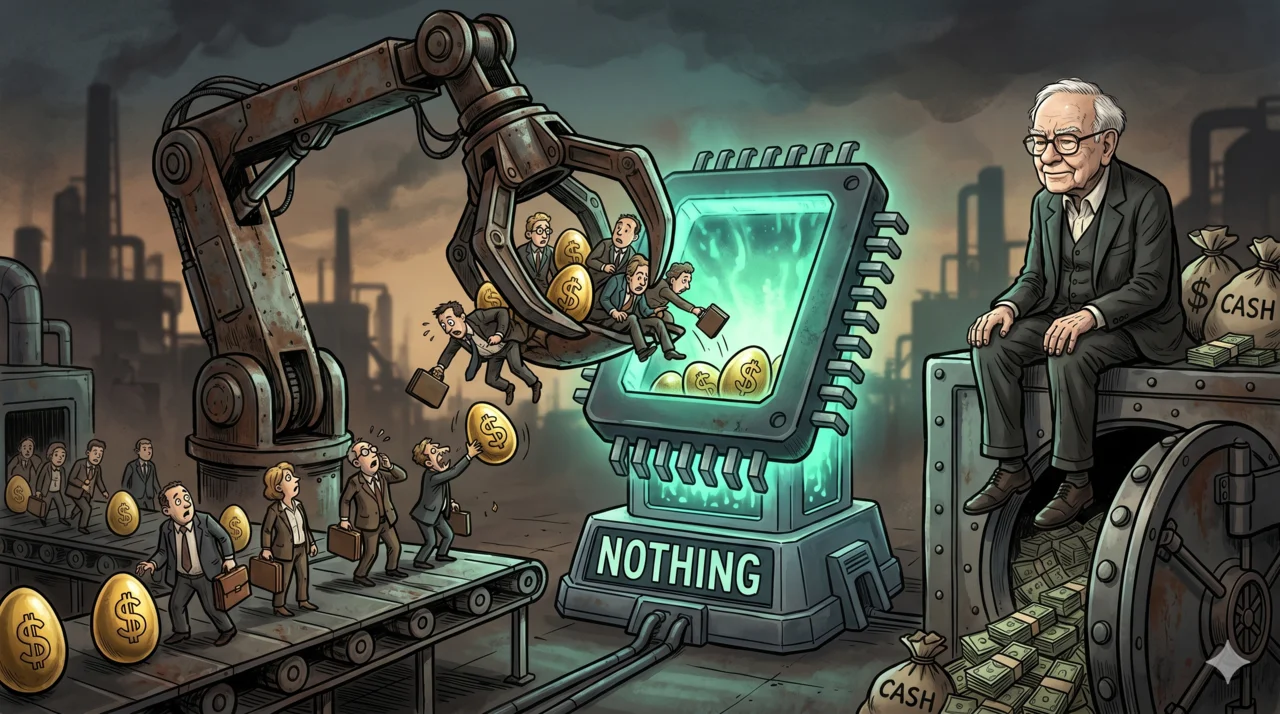
Here is where the plumbing turns the screw. When a stock joins a cap-weighted index, every fund tracking that index must buy it, at whatever price the market sets on inclusion day, with no regard to whether it is cheap. The buying is mechanical and price-blind, and it lands on the same savers — the ones whose 401(k) money sits in default index and target-date funds — who never chose any of it.
In 2026 the index-makers diverged on how easy that should be. The Nasdaq-100 adopted a "Fast Entry" rule, effective May 1, that admits a giant new listing after just fifteen trading days, with no profitability test and the old minimum-float requirement waived.7 FTSE Russell went further on speed, ushering qualifying mega-IPOs into its US indexes after only five trading days.8 S&P Dow Jones Indices, by contrast, ran a consultation and on June 4 declined to bend, keeping its profitability screen, its twelve-month seasoning period, and its float floor intact — concluding that "exceptions … should not be granted solely based on market capitalization."9 The practical upshot: a loss-making SpaceX can be force-fed into Nasdaq-100 and Russell funds within days of listing, while S&P 500 holders are walled off until it actually earns money. OpenAI (last valued privately at about $852 billion, targeting a September debut) and Anthropic (which filed confidentially on June 1 near a $965 billion valuation) are queued up behind it.1011
That the forced buyer overpays is not a hunch; it is documented. A 2026 study of the five-day fast-track rule found that fast-entry IPOs beat comparable peers by more than five percentage points heading into inclusion, that roughly half of that pop reverses within two weeks, and that issuers raise about 6.2% more capital precisely because they know guaranteed index demand is coming.12 We have seen the live version. When Tesla joined the S&P 500 in December 2020, passive funds were forced to absorb something like $75 billion of stock, and it jumped about 12% on the announcement.13 When Coinbase was added in May 2025, it popped roughly 24% — then fell about 46% from that peak, leaving index funds holding a high-cost basis they had no choice but to establish.14 Multiply that mechanism across the $10.1 trillion sitting in American 401(k) plans — where target-date funds are the automatic default in the large majority of plans, and more than half of those assets are passively run — and you have a very large, very patient pool of price-insensitive money waiting to be pointed at the next trillion-dollar listing.15
Where the Froth Isn't
The reflexive response — "stocks are just expensive, brace for low returns" — misreads the picture. The expense is concentrated. The Magnificent Seven trade around 29–31 times forward earnings; the other 493 sit near 20 times, only a modest premium to their long-run average.16 Look at it by sector and the same truth appears: Information Technology around 32 times forward earnings and Consumer Discretionary near 29, against a whole-index multiple of roughly 21 — while Financials sit near 15 and Energy near 14, the only sector trading below its own ten-year average.16
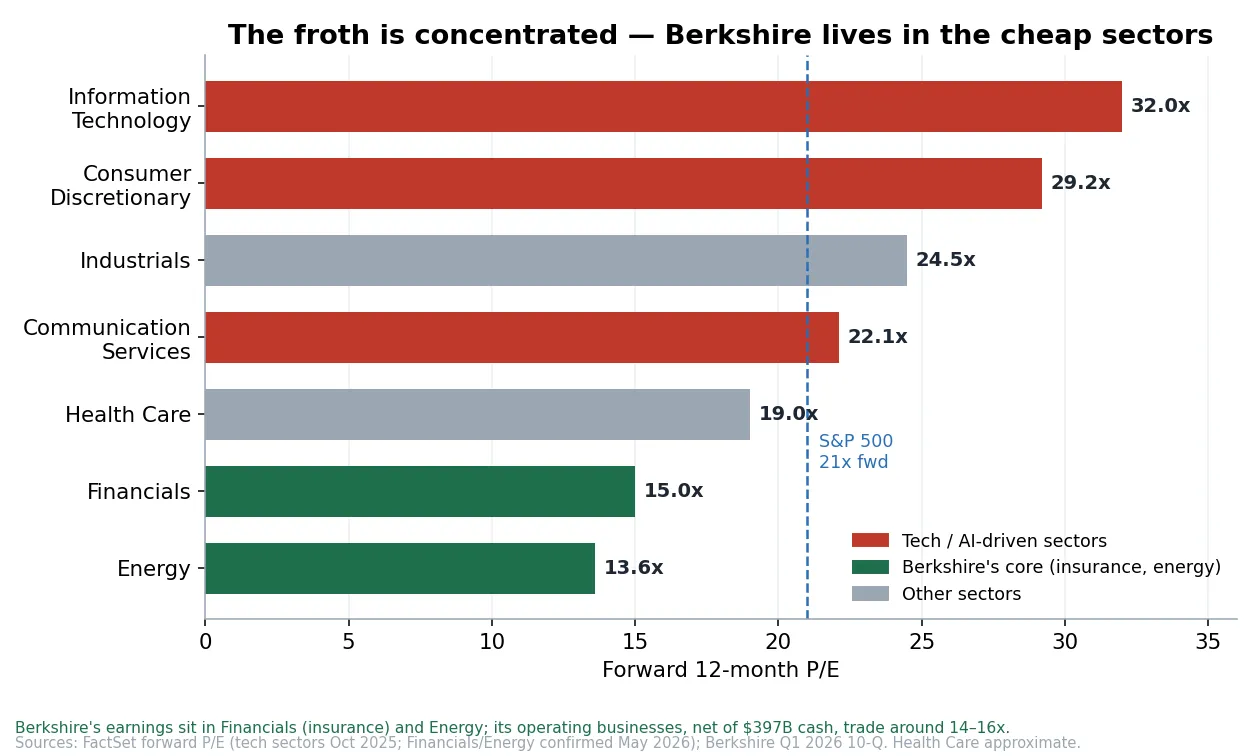
Notice where those cheap sectors are. They are exactly the neighborhoods where Berkshire's earnings live. Of Berkshire's roughly $44.5 billion in 2025 operating earnings, close to 44% came from insurance, around 31% from manufacturing, service and retailing, about 12% from BNSF, and roughly 9% from Berkshire Hathaway Energy — and essentially none from a technology operating business.17 Strip out its $397 billion cash hoard and Berkshire's operating businesses change hands for something like 14–16 times earnings, comfortably below the index multiple.1718 When you buy the S&P 500 today you are paying a tech premium whether you want one or not; when you buy Berkshire you are buying railroads, utilities, insurers and a brick maker at the cheap end of the market — plus a stock portfolio whose two largest holdings happen to be tech.
A Machine an Index Can't Be
The deepest difference is not what Berkshire owns; it is what it can do. An index fund is a rule. It is fully invested at all times, it holds every constituent at market weight, and it cannot exercise judgment — that is the whole point, and in calm markets it is a virtue. But it means there are levers a conglomerate has that a passive fund structurally lacks.
| Lever | S&P 500 index fund | Berkshire Hathaway |
|---|---|---|
| Buy back its own shares when cheap | Impossible — always 100% invested | Restarted March 2026 at ~1.45× book19 |
| Hold cash as optionality | No — cash is tracking error | ~$397B in cash and Treasuries18 |
| Use insurance float as leverage | No such mechanism | ~$176B float, near-zero cost17 |
| Reallocate capital across businesses | No — weights set by price | ~80 subsidiaries feeding one allocator |
The buyback lever is the one worth dwelling on, because it inverts the usual worry. Berkshire is having a weak year — the stock trails a red-hot S&P 500 by the widest margin of 2026 so far.20 For an index fund, a drawdown is simply loss. For Berkshire, a cheaper share price plus a mountain of cash is the trigger for the buyback machine: Greg Abel restarted repurchases in March 2026, after a 21-month pause, when the stock fell to about 1.45 times book value.19 An index fund cannot buy itself back when it is cheap. A conglomerate can turn its own bad year into per-share value for the holders who stay. Add the float — roughly $176 billion of insurance money invested at a famously negative cost, the lever academics credit for much of Berkshire's historic edge21 — and the $397 billion of Treasuries earning interest while it waits for a dislocation, and you have a vehicle that does several useful things the index is forbidden, by its own design, from attempting.
Berkshire Is in the AI Race, Too
The honest objection is that Berkshire is not abstaining from the boom — and it isn't. It is in the AI race; it simply entered through a different door. Inside its own businesses, artificial intelligence shows up as productivity in assets it already owns at cost. At BNSF, Abel has staked the railroad's future on software rather than the cost-cutting scalpel its rivals used; in the first quarter of 2026 the railroad moved more freight with 260 fewer locomotives, a story we told in our look at the algorithm and the railroad ↗.22 That is AI exposure bought at no bubble premium.
Then there is the equity book. Abel tripled Berkshire's Alphabet stake and has built it toward $26–30 billion, which together with the legacy Apple position puts close to 30% of the stock portfolio in two AI-adjacent megacaps.23 We are not going to pretend that is risk-free — Alphabet is pouring capital into AI infrastructure on the same intertwined terms as everyone else, and whether it compounds through a genuine shake-out is an open question. But the distinction holds: this is one chosen, priced bet on a probable survivor, made by a person who decided it was cheap, not the entire bubble bought at market weight because a rule demanded it. The difference between Berkshire and the index here is not the sector. It is whether a human or a formula is doing the buying.
The Honest Ledger
A piece that only flattered Berkshire would be propaganda, so here is the other column. Berkshire is no magic hedge. In 2020, when the recovery was led by exactly the digital businesses it did not own, it returned about 2.4% against the S&P 500's 18.4% — a year the defensive thesis simply failed.24 Its legendary outperformance is also front-loaded: the ~20% annual compounding is the sixty-year number, and over the last two decades Berkshire and the index have run roughly neck-and-neck.25 Much of the historic "alpha," the academic work argues, came from cheap insurance leverage rather than pure stock-picking sorcery.21 Its equity sleeve is drifting toward the index's tech tilt via Apple and Alphabet. And — the subtlest point — Berkshire is itself the tenth-largest member of the S&P 500, about 1.5% of it, so anyone who owns the index already owns a slice of Berkshire.26 This was never a case for separation. It is a case about degree and mechanism: how concentrated your exposure is, and whether a person or a rule decides what you buy.
Conclusion
We have seen this movie. In December 1999, with Berkshire down 23% on the year while the Nasdaq melted up, Barron's ran a cover asking "What's Wrong, Warren?" and pronounced him past his prime.27 Over the following three years the Nasdaq fell about 78%, the S&P 500 dropped through 2000–2002, and Berkshire's book value rose while the index sank — Cisco, briefly the world's most valuable company, would not see its 2000 high again for twenty-five years.2728 Buffett was not wrong; he was early, which in a mania looks identical to wrong right up until it doesn't.
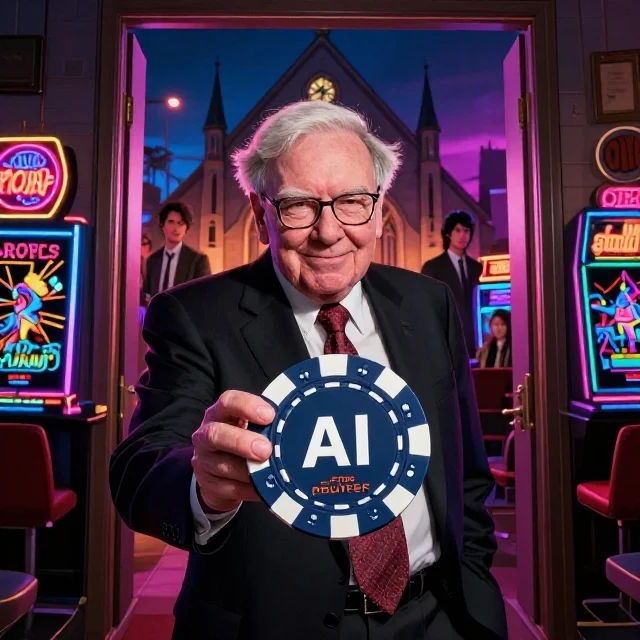
The rhyme is hard to miss. The Buffett indicator — total market value to GDP — sits at a record high, the Shiller multiple in territory matched only by 1929 and 2000 — valuation ground we mapped in our 38-year look at gold, Berkshire and the S&P 500 ↗ — and the man himself, at the May 2026 annual meeting, described markets as "a church with a casino attached" and warned that "we've never had people in a more gambling mood than now."2930 He is, characteristically, holding cash and buying his own stock. None of this is advice about what belongs in anyone's retirement account — that is a decision for each holder and is emphatically not ours to give. It is an observation about structure. The index has quietly become a price-blind, rule-driven bet on the most crowded trade in the world, and the rule-makers are widening the on-ramp. Berkshire is the large-cap built the other way: judgment instead of a formula, cash instead of full investment, the cheap end of the market instead of the dear, and the rare ability to buy itself when everyone else is selling. In a market this narrow, knowing which machine you actually own has rarely mattered more.
References
-
SpaceX reveals its share price and record valuation ahead of IPO - fortune.com ↩
-
The "Great Narrowing": S&P 500 Concentration - rbcwealthmanagement.com ↩
-
Nvidia and 19 Other Stocks Now Make Up 50% of the S&P 500 - fool.com ↩
-
Semiconductor Exposure in S&P 500 Hits 18% — More Than Double the Tech Bubble Peak - 247wallst.com ↩
-
Defying Bubble Fears, Nvidia Drove the S&P 500 Higher in 2025 (data: S&P Dow Jones Indices) - statista.com ↩
-
The S&P 500 Equal Weight vs. Market Cap Weight Debate - benzinga.com ↩
-
Nasdaq-100 Index Methodology Update: Why Now, and What It Means - nasdaq.com ↩
-
FTSE Russell introduces IPO Fast Entry enhancements for Russell US Indexes - lseg.com ↩
-
S&P Dow Jones Indices Consultation on Treatment of MegaCap Companies — Results - press.spglobal.com ↩
-
Five things to know about OpenAI's potentially record-breaking IPO plans - finance.yahoo.com ↩
-
Anthropic files to go public - techcrunch.com ↩
-
Murray & Sammon, "Primary Capital Market Transactions and Index Funds," Review of Asset Pricing Studies - academic.oup.com ↩
-
S&P's decision to add Tesla in one shot demonstrates the power of passive investing - cnbc.com ↩
-
News Flash: You Are the Exit Liquidity for the SpaceX IPO - fool.com ↩
-
Highest Forward 12-Month P/E Ratio for the S&P 500 in More Than 5 Years (sector and S&P 493 valuations) - insight.factset.com ↩↩
-
Berkshire Hathaway Inc. News Release, February 28, 2026 (2025 operating earnings; insurance float) - berkshirehathaway.com ↩↩
-
Berkshire Hathaway reports record cash pile in Greg Abel's first quarter as CEO - cnn.com ↩
-
Berkshire Hathaway Just Resumed Stock Buybacks After a Long Pause - fool.com ↩
-
Berkshire trails red-hot S&P 500 by biggest margin so far this year - cnbc.com ↩
-
Frazzini, Kabiller & Pedersen, "Buffett's Alpha," Financial Analysts Journal - aqr.com ↩↩
-
BNSF Logs Revenue, Income Growth in Q1 2026 - progressiverailroading.com ↩
-
Greg Abel Just Plowed $10 Billion Into This AI Stock - fool.com ↩
-
Why Warren Buffett's Berkshire Hathaway Lagged the S&P 500 - fool.com ↩
-
Berkshire Hathaway is a Counter-Cyclical Asset (annual returns vs. S&P 500) - blog.umd.edu ↩
-
S&P 500 Companies by Weight - us500.com ↩
-
"What's Wrong, Warren?" (Barron's, December 1999) and the aftermath - brianlangis.wordpress.com ↩↩
-
Cisco's stock closes at record for first time since dot-com peak in 2000 - cnbc.com ↩
-
Buffett Valuation Indicator, April 2026 - advisorperspectives.com ↩
-
Warren Buffett: markets are like a church with a casino attached - fortune.com ↩