Tags: BNSF / Greg Abel / Innovation
This fanpage is not officially affiliated with Berkshire Hathaway: Disclaimer
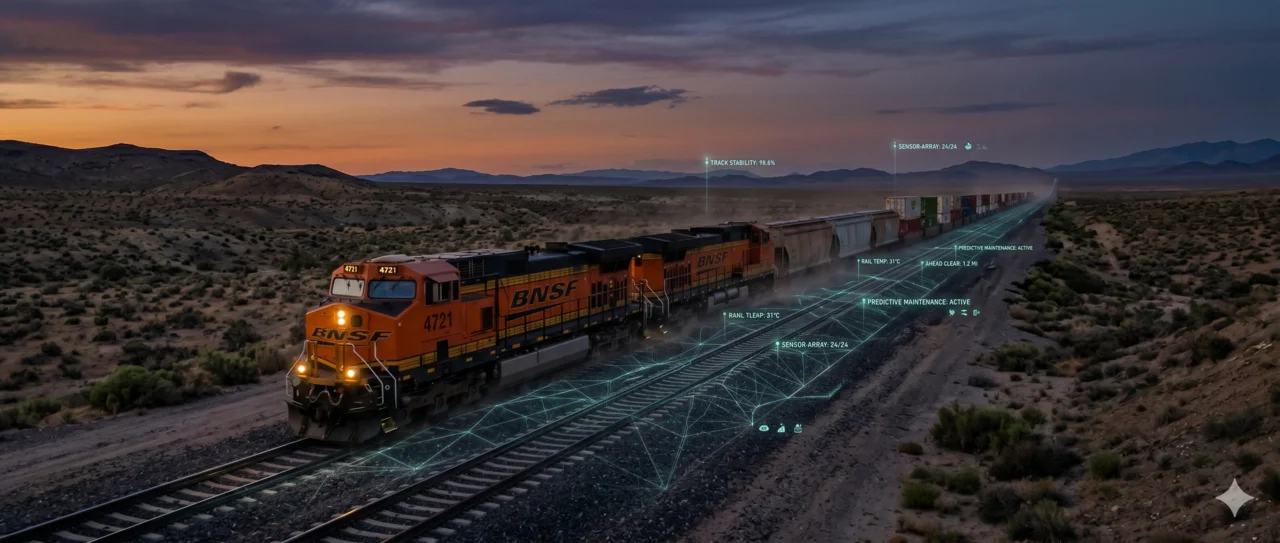
On May 2, 2026, in front of a thinner-than-usual crowd in Omaha, Greg Abel did something Warren Buffett rarely did from that stage: he graded the railroad and gave it a poor mark. BNSF, Abel said, ranked fifth out of six North American Class I railroads on operating efficiency in 2024, climbing to fourth in the first quarter of 2026. The gap to the industry's best "remains too wide," and closing it would require "a fundamental step change in how we approach our railroad operations."1 What he did not say — but what the rest of the meeting made clear — is that the step change he has in mind is not the cost-cutting scalpel that reshaped every other Class I over the last decade. It is software.
Introduction
This is a piece about that bet, and about the awkward fact sitting underneath it. The previous generation of railroad efficiency came from Precision Scheduled Railroading — Hunter Harrison's discipline of fixed schedules, fewer locomotives, closed hump yards, and thinner crews. Berkshire's railroad was famously the lone Class I holdout from PSR ↗, eating a roughly 5.7-percentage-point operating-ratio gap to Union Pacific in exchange for service quality and network slack. The economics of that gap — and why patient capital tolerated it — is a story we have told. This is the sequel: the moment Abel stops tolerating the gap and names the tool he intends to close it with.
The tool is artificial intelligence, broadly defined — machine vision, predictive algorithms, network simulation. It is a genuinely different lever from PSR, and a politically cleaner one: software does not show up at a union rally. But as a January 2026 admission by one of BNSF's own engineering directors revealed, an AI railroad raises a question PSR never had to answer. When you build a machine that can see every defect on the network, you also have to decide which defects you want it to report. BNSF, it turns out, has already started deciding.
The Bet: Software, Not the Scalpel
Start with the arithmetic Abel keeps repeating, because it explains the urgency. In the 2025 annual letter and again in Omaha, he attached a price to the operating-ratio gap: each one-percentage-point improvement in operating margin throws off roughly $230 million of incremental operating cash flow for Berkshire's owners.12 BNSF's 2025 operating ratio was 65.5% against Union Pacific's 59.8%; at $230 million a point, the spread is something on the order of $1.3 billion a year in cash flow that the railroad is not earning relative to its closest peer.3 Abel told shareholders he "would be disappointed if we do not deliver a substantial improvement over the next few years." For a man who inherited the margin gap as one of three structural problems ↗ on day one, the letter's tone reads less like a defense of the status quo than a notice of intent.
What makes this Abel's bet rather than a continuation of Buffett's is the chosen mechanism. He could have ordered BNSF to adopt PSR — fire the slack out of the system, close yards, run the operating ratio down by brute discipline the way CSX and Norfolk Southern did after activists forced the issue. He did not. Instead, Abel framed Berkshire's whole approach to AI as cautious and value-first: a "narrow" artificial intelligence kept on a human leash, deployed only where it is "additive" to a business, with a builder's rather than a buyer's posture toward the technology.4 He grounded the philosophy in GEICO, where building proprietary systems gave Berkshire better command of its own data than buying software off the shelf ever did. Applied to BNSF, that means the railroad is supposed to close the Union Pacific gap by getting smarter, not leaner — by squeezing more throughput out of the network it already runs rather than cutting the network down to size.
There is a defensible logic to choosing code over the scalpel. PSR's efficiency came with documented costs: it concentrated the industry's labor disputes, drew the Federal Railroad Administration's scrutiny on crew sizes and yard safety, and stripped out the redundancy that lets a network recover when a Polar Vortex closes a mainline. BNSF is also the largest Class I by route miles, with the heaviest intermodal and bulk mix — the hardest network on which to impose rigid scheduling. Software promises the margin without the cultural rupture. Whether it can actually deliver is the open question of the Abel era.
What an AI Railroad Actually Does
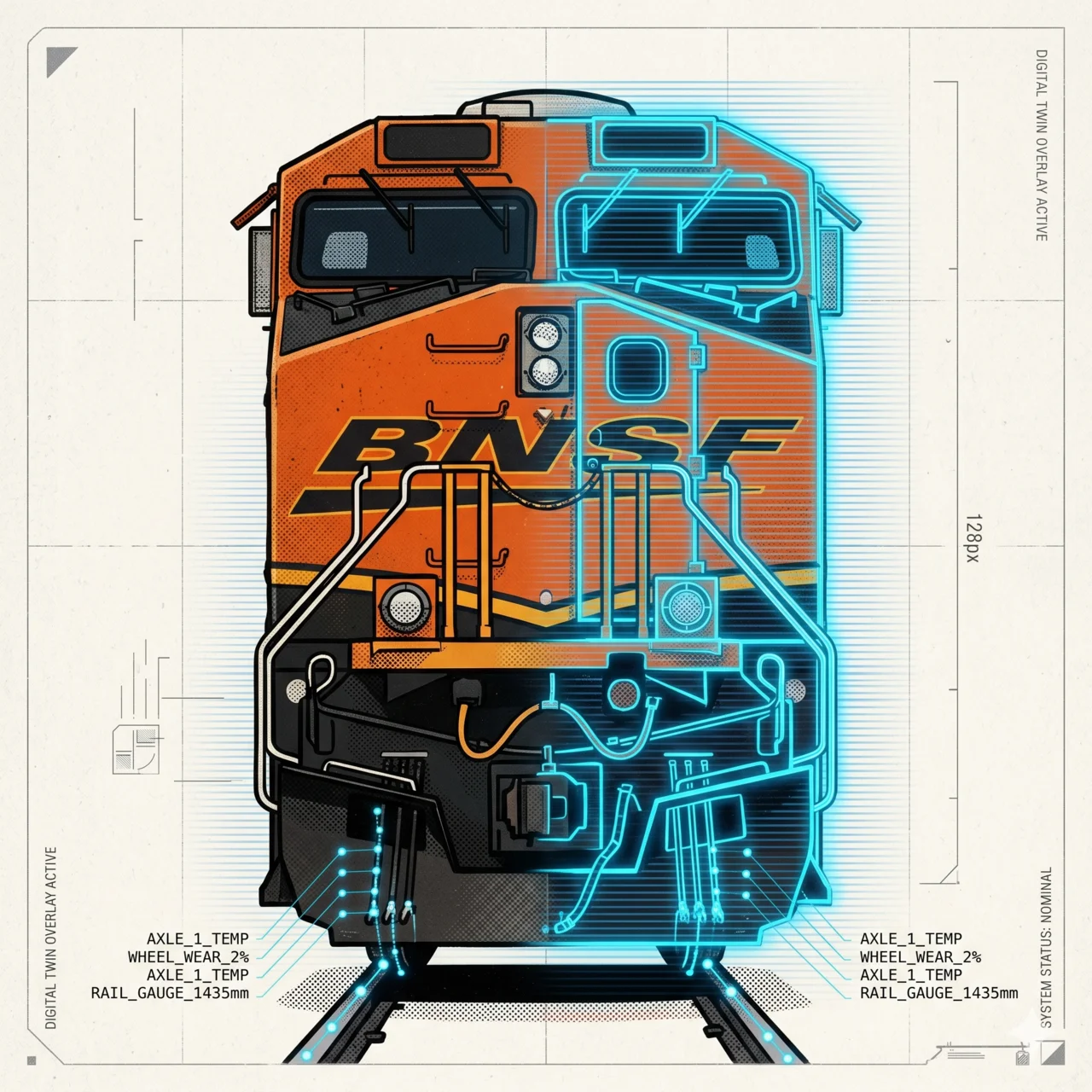
Strip away the annual-meeting abstraction and BNSF's AI program is surprisingly concrete — and further along than the "we're exploring it" framing suggests. The railroad has been quietly wiring sensors and algorithms into the physical plant for several years.
| Program | What it does | Documented 2025 result |
|---|---|---|
| ODIN | Track-geometry sensors mounted under in-service locomotives, measuring gauge, alignment, and surface every foot as trains run | 150,000+ miles of track measured; 30+ equipped units, expanding toward 60+ by 20275 |
| THOR | High-speed optical cameras plus machine-vision algorithms that photograph and scan rail for visual defects at up to 70 mph | 3 units imaged 165,000 miles and flagged 1,900 defects, all addressed before failure5 |
| Wayside detection | AI sifts thermal and acoustic readings from trackside detectors for predictive maintenance | 35M+ readings and 2M+ images processed daily; 1.5M+ wheels monitored in motion6 |
| Automated Yard Check | Drones plus algorithms locate containers in intermodal yards | +20% inventory accuracy vs. manual checks6 |
| Load-plan optimization | AI places containers and trailers on railcars to cut moves | Alliance, TX hub: 30+ min faster loading per train; ~500k more annual lifts projected network-wide6 |
| Predictive ETA | Machine learning forecasts terminal dwell and delivery windows | +20% ETA accuracy on tested intermodal trains6 |
| Digital twins | Computational models simulate the network before trains physically run it | Tied to a 13% reduction in terminal dwell — about three fewer hours per car7 |
The payoff shows up in the first-quarter numbers, and it is the single best piece of evidence for Abel's thesis. In Q1 2026, BNSF moved 2.2% more volume than a year earlier while using 260 fewer locomotives to do it, and reported its operating ratio at 65.6%, a 2.3-point improvement that lifted the railroad from fifth to fourth in the Class I rankings.78 Revenue rose 5% to $5.97 billion and net income climbed 13% to $1.4 billion.8 BNSF CEO Katie Farmer described the digital-twin work as the chance "to model how we run the railroad before we actually run the railroad," and credited the inspection systems with a 33% year-over-year drop in track-caused equipment incidents in 2025 — a record.57 On the surface, the bet is already paying: fewer assets, more freight, better safety statistics.
The Class I Scoreboard
Abel's "fifth of six" admission invites a question the company would rather not dwell on: lagging on what, exactly? Operating ratio is the headline gap, but the more telling lag is in the technology itself. Assembled side by side, the Class I railroads' flagship automation programs show BNSF arriving at the AI table a step behind the railroad it most wants to catch.
| Railroad | Flagship AI / automation program | Launched | FY2025 OR |
|---|---|---|---|
| Union Pacific | "Big Three" modernization — CADx AI-assisted dispatch + NetControl transport management, replacing a 50-year-old mainframe | 2024 | 59.8%3 |
| CPKC | Optical AEI — AI plus thermal sensing that analyzes railcars and components in real time as trains pass | 2024–25 | 59.9%3 |
| Canadian National | Autonomous Track Inspection Program — inspection cars on revenue trains scanning track ~20× more often than manual crews | ~2021–24 | 61.9%3 |
| Norfolk Southern | Digital Train Inspection portals — 24-MP trackside cameras feeding dozens of deep-learning defect algorithms at 70 mph | 2023 | 64.2%3 |
| BNSF | ODIN + THOR — onboard track-geometry sensing and optical defect machine vision | 2025 | 65.5%3 |
| CSX | Train Inspection Portals — machine-vision railcar defect detection at track speed (third site added 2025) | 2023–25 | —9 |
The pattern is unkind to the order in which the programs landed. Union Pacific completed its "Big Three" software overhaul in early 2024 — its CADx dispatching system cut major rule violations and dispatcher close calls by 58% in its first year and trimmed dispatcher training from six months to four.10 Norfolk Southern's camera portals have been scanning every railcar since October 2023.11 BNSF's marquee inspection systems, ODIN and THOR, only graduated from pilot to fleet deployment in 2025.5 The railroad that hauls the most freight and spends the most capital was, on the evidence of its own press releases, among the last of the big U.S. carriers to operationalize machine inspection at scale. Abel's "we lag our peers" was not false modesty.
The Defect the Railroad Decided Not to See
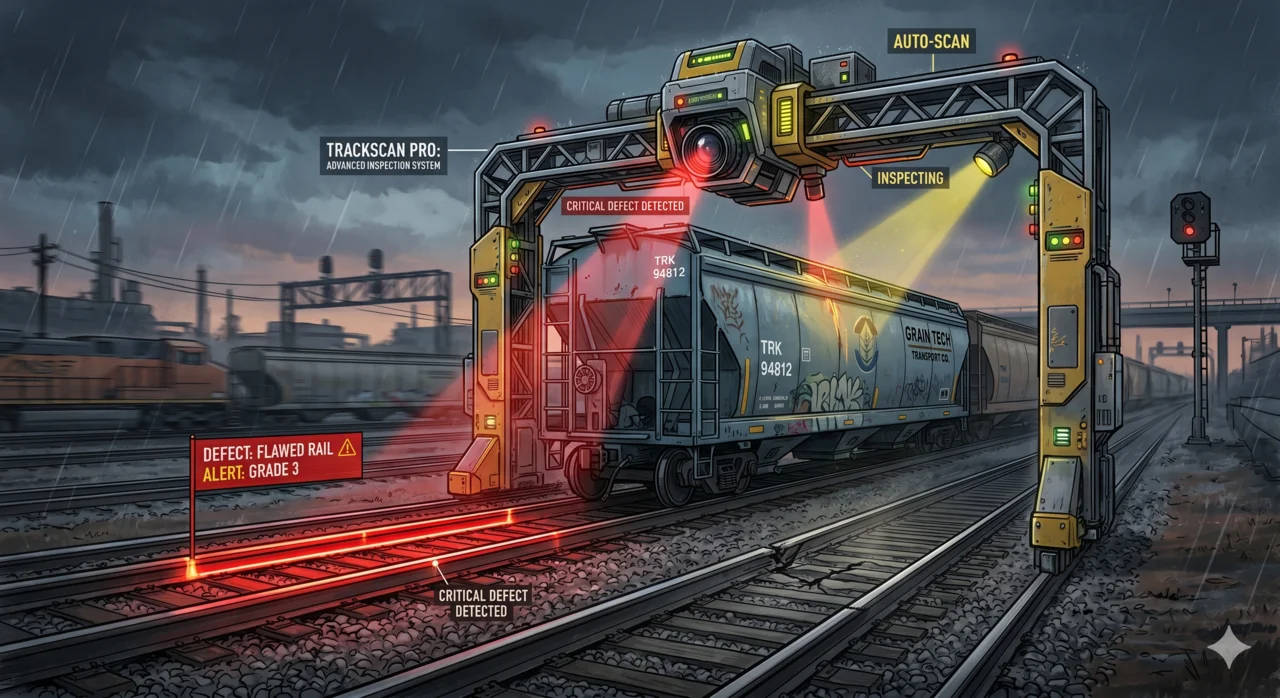
Here the constructive story acquires a shadow. On January 13, 2026, at a Transportation Research Board conference, BNSF's General Director of Rail, Matthew Keller, said something remarkable about THOR — the optical system the company markets as a safety triumph. BNSF, Keller acknowledged, is intentionally not training THOR to detect load-bearing defects, even though the technology could "very easily" be taught to find them.12
The reason was purely operational. Under FRA rules, a detected load-bearing defect triggers a mandatory 25 mph speed restriction until it is repaired. Find more of them and you slow more trains. "We are intentionally not going down the path of trying to find these," Keller said, "because we know the impact it's going to have on our network."12 In other words, the same machine-vision capability that BNSF celebrates for catching 1,900 defects has been deliberately blinded to a category of defect that would gum up throughput — the very throughput Abel's efficiency bet depends on.
The context sharpens the discomfort. A 2024 FRA investigation found load-bearing defects were widespread on BNSF track and frequently went unrecorded, noting a "reluctance for track inspectors to report conditions found during inspection runs." In fiscal 2024, BNSF paid more than $250,000 in track-safety violation fines — more than every other Class I railroad combined.12 Tony Cardwell, president of the track-workers' union, called BNSF's selective-detection approach "idiotic" and said it "should scare everyone." BNSF's own spokesperson then disputed Keller, calling his remarks personal views rather than company policy and claiming THOR would need "significant further development" to find such defects — a direct contradiction of the company director's own assessment.12
This is the tension that makes Abel's AI bet more than a feel-good modernization story. The promise of an AI railroad is two things at once: a more efficient railroad and a safer one. Most of the time those goals point the same direction — a sensor that catches a bad wheel before it fails saves both money and lives. But the THOR episode shows the seam where they part. When the efficiency objective ($230 million a point) and the safety objective (catch every defect) collide, BNSF has demonstrated which way it leans. An AI that sees everything is only as honest as the instructions it is given about what to report.
Labor, Waivers, and the Politics of Automation
The THOR fight is one front in a broader regulatory contest that will shape how far Abel can push automation. Rail labor has read the AI-and-inspection program for exactly what it is — a path toward fewer jobs — and has fought it accordingly. The Brotherhood of Locomotive Engineers and Trainmen and the maintenance-of-way union have formally opposed automated track inspection, staging public rallies in July 2025, while the AFL-CIO's transportation arm has urged regulators to deny waivers that would cut inspection levels in favor of "unproven technology."13
The regulatory winds, for now, blow Abel's way. In December 2025 the Trump administration's Transportation Department rolled out a temporary waiver program letting railroads with active automated inspection cut required visual track inspections from twice to once weekly — a direct tailwind for ODIN's expansion.14 BNSF had already gone to federal court to win the right to grow the ODIN program over FRA objections, and prevailed.15 But "temporary" and "won in court" are not "settled." The waiver can be reversed by the next administration; the unions are challenging it; and the two-person-crew rule that automation ultimately threatens still stands, defended even by the current FRA's nominee.13 Abel is building on contested ground.
There is one more competitive cloud worth noting. The pending Union Pacific–Norfolk Southern merger — if the Surface Transportation Board ultimately clears it — would weld together the railroad with the best operating ratio and one of the most aggressive inspection-AI programs, and UP has said it would extend its technology platform across the combined network. A BNSF that is already a step behind on automation would find the bar raised again, by a rival roughly its own size spanning the continent. The clock on Abel's "next few years" is not running in a vacuum.
What This Means for Shareholders
For a Berkshire shareholder, the honest read is that the AI bet is real, early, and unproven as a margin lever. The Q1 2026 numbers — 260 fewer locomotives, a 2.3-point operating-ratio improvement — are encouraging, but they cannot yet be cleanly attributed to algorithms rather than to ordinary cyclical recovery and disciplined asset management. The industry's own analysts are cautious here: a 2024 Oliver Wyman study of fifty rail participants found the sector still in the early innings of AI adoption, with data quality the binding constraint, and — crucially — no demonstrated operating-ratio gains from technology comparable to what PSR delivered.16 Nobody has published a credible estimate of how many basis points of margin AI alone can buy a railroad. Abel is wagering that BNSF can be the proof of concept.
The subtler thing to watch is governance. Berkshire's prized subsidiary autonomy means Omaha sets the target — close the Union Pacific gap — and lets BNSF's operators choose the means. The THOR episode is a reminder of what that autonomy can produce when an operator optimizes hard for the number the parent is watching. A shareholder can simultaneously cheer the $230-million-a-point math and worry that the surest way to hit it is to teach the railroad's expensive new eyes to look past the defects that slow the trains down. The operating ratio is the metric Abel watches. Track safety is the metric the FRA watches. Abel's real test is not whether BNSF adopts AI — it plainly has — but whether it lets that AI tell the whole truth even when the truth carries a 25 mph price tag.
Conclusion
Buffett bought BNSF as "an all-in wager on the economic future of the United States" and ran it on patience, content to let an unfashionable operating ratio compound slowly behind an unbeatable network. Abel has inherited the network and changed the wager. His is a bet on code — that machine vision, predictive maintenance, and digital twins can deliver the margin that patience alone left on the table, and do it without the labor wars that PSR touched off everywhere else. The scoreboard says he is starting from behind, a step back from the Union Pacific platform he means to catch. The first-quarter numbers say the gap is beginning to close. And the THOR story says the closing will come with choices that are not purely technical.
That is the genuinely new thing about the Abel era at BNSF. The old debate was philosophical and slow: service quality versus margin, patience versus discipline. The new one is concrete and quietly urgent: a railroad teaching itself to see, and a management team deciding, defect by defect, how much it wants to know. Berkshire shareholders have spent sixteen years trusting that the people running the railroad would do the patient, expensive, right thing. The AI era is about to test whether that trust survives contact with a number worth $230 million a point.
References
-
Berkshire Hathaway 2026 Annual Meeting — Live Updates - cnbc.com ↩↩
-
Berkshire Hathaway 2025 Annual Letter - berkshirehathaway.com ↩
-
Berkshire Hathaway 2025 Annual Report (BNSF segment); peer Q4 2025 earnings releases - berkshirehathaway.com ↩
-
Greg Abel on Berkshire's "Narrow AI" Approach - finance.yahoo.com ↩
-
BNSF RailTalk — ODIN and THOR Track Inspection - bnsf.com ↩↩
-
BNSF RailTalk — How BNSF Uses Artificial Intelligence - bnsf.com ↩
-
BNSF Targets Efficiency Gains to Boost Profitability - trains.com ↩↩
-
BNSF Logs Revenue, Income Growth in Q1 2026 - progressiverailroading.com ↩↩
-
CSX Train Inspection Portal technology - csx.com. FY2025 operating ratio not directly compared here. ↩
-
Norfolk Southern Launches AI Train Inspection Technology - prnewswire.com ↩
-
BNSF Exec: Railroad Intentionally Not Training Tech to Find Some Defects - cnsmaryland.org ↩↩↩↩
-
Labor and Industry Clash Over Rail Automation - freightwaves.com ↩↩
-
DOT Announces New Temporary Automated Track Inspection Waiver Program - transportation.gov ↩
-
BNSF–FRA Automated Track Inspection Dispute in Federal Court - rtands.com ↩
-
Oliver Wyman — Reshaping Rail Through AI - oliverwyman.com ↩