Tags: PCC / Warren Buffett / Innovation
This fanpage is not officially affiliated with Berkshire Hathaway: Disclaimer
In the 2020 annual letter, Warren Buffett did something he almost never does in print: he named a number, attached his own name to it, and called it a mistake. The number was an "ugly $11 billion write-down," and the mistake was Precision Castparts Corp. Six years later, the foundry he overpaid for is quietly printing the best revenue and profit figures in its history — and the more interesting question is no longer whether Buffett was wrong, but whether he was merely early.
Introduction
There is a particular kind of confession that only the very secure can make. When Buffett wrote in early 2021 that he had "paid too much" for Precision Castparts (PCC), he was not being forced to — the accounting charge had already been booked, the headlines already written. He volunteered the autopsy anyway, because the alternative, silence, would have been worse for a man who has spent seventy years lecturing shareholders on the discipline of price.
For Berkshire holders, PCC has therefore occupied an awkward shelf in the portfolio: the trophy that turned into the cautionary tale. It was the largest acquisition Berkshire had ever made, a bet on the unglamorous metals at the heart of every jet engine — and then a pandemic grounded the world's aircraft and the whole thesis looked like vanity.
This piece is about what happened next, which almost nobody has bothered to write up, because redemption arcs are slower and less clickable than mistakes. The short version: PCC's 2025 results, buried as usual inside Berkshire's manufacturing segment, are records. The longer version is more useful to a shareholder — because the reason the records will keep coming has flipped. For most of the last decade the question for PCC was whether the orders would come. That question is now settled for years. The open question is whether PCC can build fast enough to fill them.
The mistake, in Buffett's own words
The deal closed on January 29, 2016. Berkshire paid $235 a share in cash — about $32.7 billion in equity value, and roughly $37 billion once you fold in the debt it assumed, making PCC the biggest check Berkshire had ever written.12 At the time even Buffett conceded the price was full: the press reported a 21% premium and nearly 19 times expected earnings, a multiple he described as "right there at the top."3
Then 2020 arrived. Commercial air travel collapsed, Boeing's 737 MAX was already grounded, and airlines cancelled or deferred the very aircraft whose engines and airframes PCC feeds. Revenue fell from $10.3 billion in 2019 to $7.3 billion in 2020, and PCC cut roughly 40% of its global workforce.1 The accounting caught up in the form of a goodwill and intangible-asset write-down of about $10.6 billion — which Buffett rounded up and dramatized as that "ugly $11 billion" figure.1
His language in the letter is worth quoting at length, because it is unusually naked for a CEO:
"No one misled me in any way — I was simply too optimistic about PCC's normalized profit potential… I believe I was right in concluding that PCC would, over time, earn good returns on the net tangible assets deployed in its operations. I was wrong, however, in judging the average amount of future earnings… PCC is far from my first error of that sort. But it's a big one."1
Two things in that passage matter for the rest of this story. First, Buffett separated the business from the price — he kept insisting PCC was "the best in its business" and went out of his way to praise its long-time CEO, Mark Donegan, as "a passionate manager."1 Second, his specific error was about the level of normalized earnings, not the durability of the franchise. Hold that distinction; the 2025 numbers test it directly.
The comeback the letters never headlined
Here is the recovery Berkshire never put on a billboard, drawn straight from the annual reports.
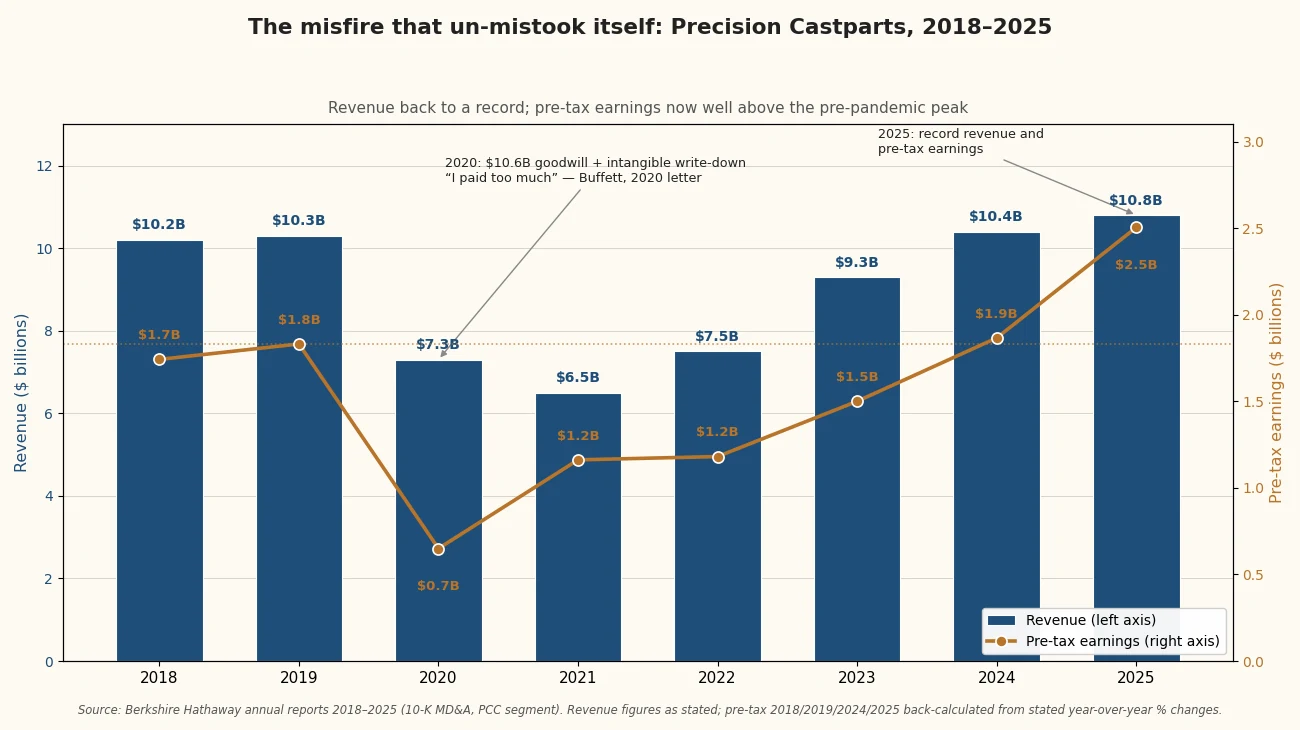
The trough was real and the climb was patient. But by 2024 revenue had already retaken the pre-pandemic peak, and 2025 turned it into a record: $10.8 billion in revenue, up 4.6% on the year.4 More striking is what happened below the top line. Pre-tax earnings rose 24.4% in 2024 and a further 34.2% in 2025, to roughly $2.5 billion — comfortably above the ~$1.8 billion PCC earned pre-tax in its last healthy pre-COVID year.45 The business is not merely back; it is more profitable than the version Buffett thought he was buying.
| Year | Revenue ($B) | Pre-tax earnings ($B) | Note |
|---|---|---|---|
| 2019 | 10.3 | ~1.8 | Pre-pandemic peak |
| 2020 | 7.3 | 0.65 | COVID trough; $10.6B write-down1 |
| 2021 | 6.5 | ~1.2 | Aerospace still grounded |
| 2022 | 7.5 | ~1.2 | MAX recertified; ramp resumes |
| 2023 | 9.3 | 1.5 | +22.7% revenue |
| 2024 | 10.4 | ~1.9 | Back above 2019 |
| 2025 | 10.8 | ~2.5 | Record revenue and pre-tax4 |
Revenue figures as stated in Berkshire's annual reports; pre-tax figures for 2019/2024/2025 derived from the stated year-over-year percentage changes.45
The cash tells the same story even more bluntly. In 2025 PCC generated $2.4 billion of operating cash flow, against an average of $0.9 billion across 2021–2022 and $1.7 billion in 2015 — the last full year before Berkshire owned it.4 On the one metric Buffett cares about most, the business is now throwing off more cash than it did when he "paid too much" for it.
The order book says the next decade is spoken for
A skeptic could fairly ask whether 2025 is just another cyclical peak waiting to roll over, the way 2019 did. This is where PCC differs from almost any other industrial business Berkshire owns, and where shareholders can do something better than guess: they can read PCC's future demand off other companies' published order books.
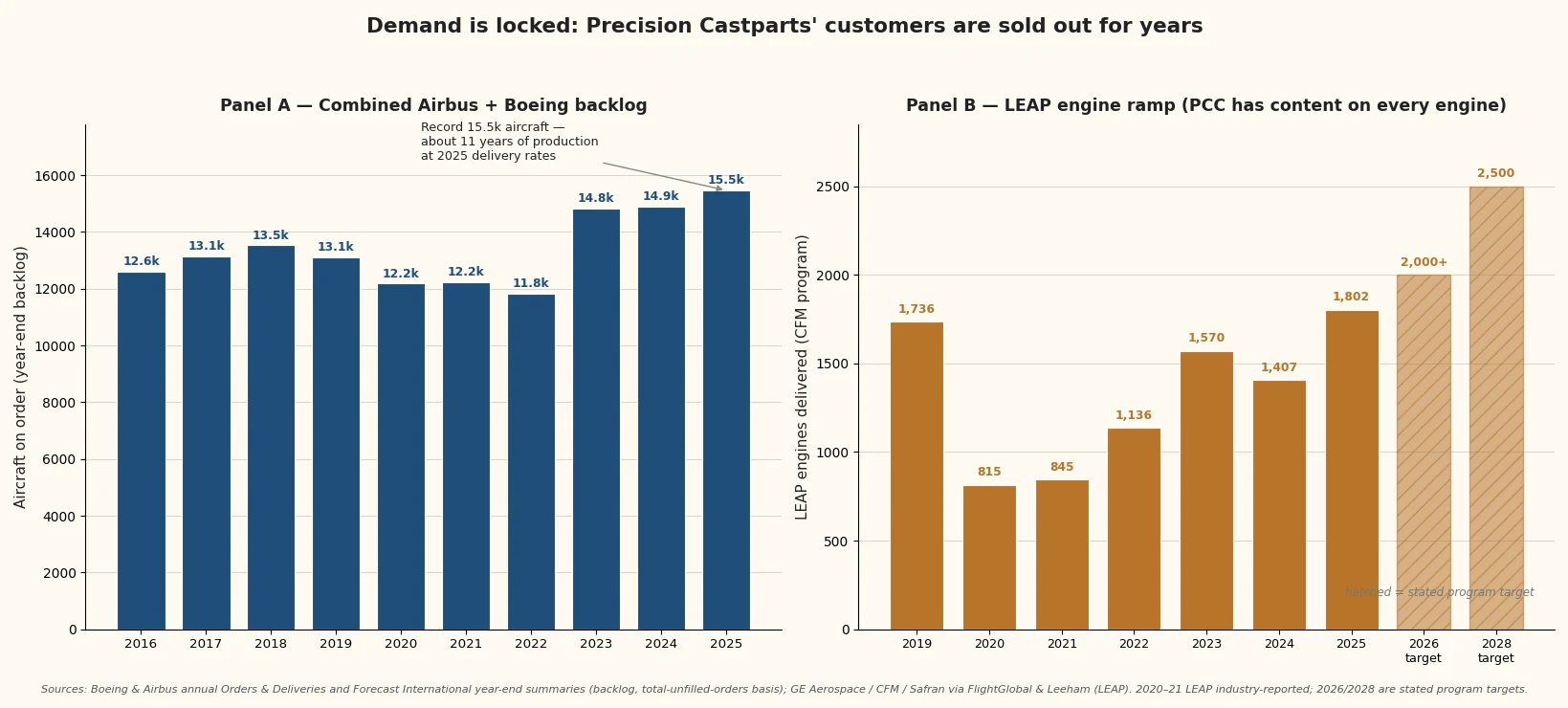
PCC does not sell to the flying public; it sells to a short list of giants whose backlogs are public record. At the end of 2025, Airbus and Boeing together carried more than 15,000 aircraft in unfilled orders — a record, and roughly eleven years of production at 2025 delivery rates.7 On the engine side, CFM (the GE Aerospace–Safran venture) delivered 1,802 LEAP engines in 2025 and has stated targets of more than 2,000 in 2026 and around 2,500 by 2028.89 Rolls-Royce closed 2025 with a large-engine backlog of 2,207, and Pratt & Whitney's geared-turbofan order-and-commitment book runs past 12,000 engines.1011 PCC has content — castings, forgings, fasteners, or some combination — on essentially all of it.
That last point deserves a correction of our own. In a 2024 piece on Boeing's troubles, we estimated, loosely, that "half to two-thirds" of PCC's revenue came from Boeing ↗. PCC's last public 10-K, filed before Berkshire took it private, tells a less alarming story: General Electric was the only customer above 15% of sales, and Boeing the only other above 10%.6 The customer base is broad, and the engine makers — who buy regardless of which airframe wins — matter at least as much as the planemakers. A Boeing stumble hurts; it does not define the company.
| Customer | What they buy from PCC | Published order book (latest) |
|---|---|---|
| Airbus + Boeing | Airframe structurals, fasteners | >15,000 aircraft backlog (2025)7 |
| GE Aerospace / CFM | Cast & forged hot-section parts | ~$190B backlog; 1,802 LEAP in 20258 |
| Rolls-Royce | Turbine castings, forgings | 2,207 large engines on order10 |
| Pratt & Whitney (RTX) | GTF & F135 components | >12,000 GTF orders & commitments11 |
This is the analytical heart of the piece: PCC is one of the few Berkshire businesses whose revenue you can forecast years out by triangulating its customers' delivery schedules. The order book is not a hope; it is a contract.
Three tailwinds, one foundry
Even that understates it, because commercial aerospace is only one of three demand waves now hitting the same set of furnaces.
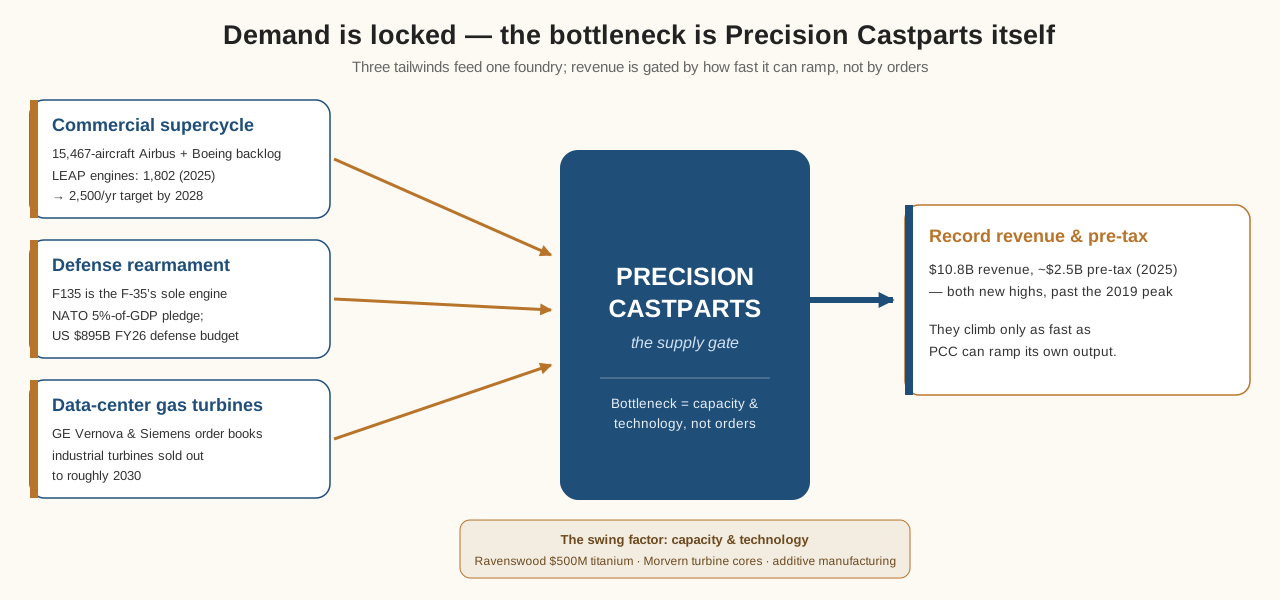
The second wave is defense. PCC casts and forges parts for the F135 — the sole engine of the F-35 — and across the major military engine programs.6 The geopolitics of 2025–26 turned a steady business into a structural one: NATO members agreed at the June 2025 Hague summit to lift defense spending toward 5% of GDP by 2035, and the U.S. FY2026 defense bill ran to roughly $895 billion, the largest in nominal peacetime terms.1415 Rearmament is a multi-decade order, not a quarter.
The third wave is the one that connects this article to an unlikely cousin in the portfolio. The same superalloy skills that make jet-engine blades also make the hot sections of industrial gas turbines — and those turbines have become the default way to power AI data centers. GE Vernova's gas-turbine backlog swelled toward 100 GW and is effectively sold out to around 2030; roughly 60% of Siemens Energy's gas-turbine orders are tied to data centers, with four-year lead times.1213 We argued in our piece on Berkshire Hathaway Energy that the data-center boom is best played as a regulated "toll road" ↗. PCC is the same bet from the supplier's side of the meter — and tellingly, in March 2026 it bought the UK's Morvern Group specifically for "industrial and aero turbine" casting capacity.16
Why the bottleneck moved inside
Put the three waves together and you get the single most important shift in the PCC story: the constraint is no longer demand. It is PCC itself.
The evidence is in the 2025 split. Revenue rose 4.6%, but pre-tax earnings rose 34.2% — a business that is adding profit far faster than units is a business running near the top of its capacity, choosing the richest work and pricing it accordingly.4 That is what a supply-gated business looks like. The shovelmaker can sell every shovel it makes; the only question is how many it can make.
Which is why the least glamorous parts of PCC's recent news are the most important. Berkshire is pouring capital into the gate: a $500 million greenfield titanium-melt facility at Ravenswood, West Virginia — powered by its own Berkshire-built renewable microgrid — to secure domestic supply of the metal aerospace cannot do without.17 PCC is investing in digital-twin process simulation and in additive manufacturing of superalloy parts, the kind of capability that turns a legacy foundry into something harder to copy. For a business whose ceiling is now set by throughput, capacity and technology are the growth strategy.
That same concentration of capability is also the risk. In February 2025 a five-alarm fire destroyed most of PCC's SPS Technologies plant near Philadelphia — a sole source for superalloy fasteners on the 787 and A350. The reassuring part is that PCC rerouted production across its network with no customer line stoppages; the sobering part is that a single fire could threaten 700-plus sole-sourced parts at all.18 A franchise this deep is also, by construction, a franchise with concentrated points of failure. Shareholders should file that next to the order book, not behind it.
Was Buffett wrong, or early?
So back to the question the 2020 letter forced open. Buffett's confessed error was precise: he misjudged normalized earnings. On that narrow charge, 2025 is a quiet acquittal — pre-tax earnings of roughly $2.5 billion and $2.4 billion of operating cash flow are not the numbers of a business whose "normal" he over-imagined; they are higher.4 He was wrong about the timing and the trough, and a global pandemic he could not have priced made the wrong look catastrophic on the GAAP page. He was not wrong about the franchise.

There is a neat internal benchmark for this. We have argued that Berkshire's well-priced industrial buys — OxyChem at trough multiples ↗, and the discipline that the Lubrizol retrospective found wanting ↗ — show what buying an industrial at the right price looks like. PCC was the opposite: a great business at a top-of-cycle price. The lesson is not that the business was bad, but that even Buffett can pay a multiple that takes a decade and a demand supercycle to grow back into. The write-down was the price of impatience; the recovery is the franchise reasserting itself.
None of this erases the caveats. Aerospace is cyclical, and an eleven-year backlog is a forecast, not a guarantee — deferrals happen, as 2020 proved. The single-source fragility is real. And because PCC sits inside Berkshire's manufacturing segment, none of this re-rating will ever show on a stock screen; holders have to do the arithmetic themselves. But that is precisely the edge of owning the conglomerate: the market cannot mark what it cannot see.
Conclusion
The most expensive sentence Warren Buffett ever wrote about a subsidiary was "I paid too much." It was honest, and at the time it was true. What the last five years have added is a footnote he could not write in 2021: the business was worth owning anyway. Precision Castparts is back to records, its order book is full into the 2030s across commercial, defense, and power, and the only thing standing between it and more growth is how fast Berkshire can expand the foundry — a problem any shareholder would rather have than its opposite. The misfire, it turns out, un-mistook itself. Buffett was early, not wrong — and on a long enough timeline, for a patient owner, those are nearly the same thing.
References
-
Berkshire Hathaway 2020 Annual Report (Chairman's Letter & PCC impairment) - berkshirehathaway.com ↩↩↩↩↩
-
Berkshire Hathaway Completes Acquisition of Precision Castparts (Jan 29, 2016) - berkshirehathaway.com ↩
-
Warren Buffett Bucks Trends With Precision Castparts Acquisition - nytimes.com ↩
-
Berkshire Hathaway 2025 Annual Report (PCC revenue, pre-tax change, operating cash flow) - berkshirehathaway.com ↩↩↩↩↩
-
Berkshire Hathaway 2024 Annual Report (PCC revenue +12%, pre-tax +24.4%) - berkshirehathaway.com ↩
-
Precision Castparts Corp. Form 10-K, FY2015 (customer concentration) - sec.gov ↩↩
-
Airbus and Boeing Full-Year 2025 Orders, Deliveries and Backlog - forecastinternational.com ↩
-
GE Aerospace Fourth-Quarter 2025 Results (LEAP deliveries; ~$190B backlog) - geaerospace.com ↩
-
GE Sees 2,500 LEAP Engine Deliveries by 2028 - leehamnews.com ↩
-
Rolls-Royce 2025 Full-Year Results (large-engine backlog 2,207) - rolls-royce.com ↩
-
RTX / Pratt & Whitney GTF orders and commitments - rtx.com ↩
-
GE Vernova gas-turbine backlog and capacity expansion - utilitydive.com ↩
-
Siemens Energy FY2025 results (gas-turbine backlog; data-center demand) - siemens-energy.com ↩
-
The Hague Summit Declaration (5%-of-GDP defense commitment, June 2025) - nato.int ↩
-
Analyzing the Final FY2026 U.S. Defense Appropriations Bill - forecastinternational.com ↩
-
Precision Castparts Acquires UK's Morvern Group (turbine casting capacity) - mainsights.io ↩
-
$500 Million Titanium-Melt Investment at Ravenswood, West Virginia - capito.senate.gov ↩
-
Fire at Aircraft-Fastener Maker SPS Technologies (sole-source 787/A350 parts) - cnbc.com ↩